
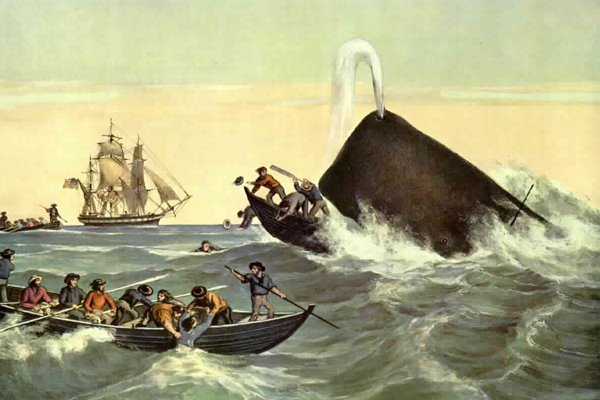

An idea’s been floating around for some time that whales more than chewed people — that they swallowed them, and people might have survived in the stomach. Jonah’s story came first, and then there were rumors from the 19th century Yankee Whale Fishery — whaling ships leaving New York and New England ports for years on the open ocean. I’d like to believe in swallowings, but it’s tough. There is no air in the stomach, for one. There are acids. And if we are talking about sperm whales, which we are most of the time, there is the deadly passage through the 30-foot jaws lined with 8-inch teeth.
Still, you’d like to think it’s possible. You want to believe in an animal that can fit you inside them — that you might be consumed not piece-by-piece, mouthful-by-mouthful as sharks and bears would eat you, but wholly; to be encased as your full self, womb-like. You want to believe in big animals like you did when you were a kid. You want to be powerless as you are leaning into hurricane winds or with your eyes closed or looking into the ocean.
– – – – – – – – – –
In 1947, Natural History magazine published a newly discovered letter from 1891 penned by a man aboard the ship Star of the East that told of a fellow crew member surviving 24 hours in a whale’s stomach. Here is the story in brief:
The Star of the East was sailing around the Falkland Islands. The crew spotted a bull sperm whale and lowered the boats to give chase. As they approached, the whale turned on the boats and attacked. It stove the boat, scattering the crew in the water. All were accounted for except for one, a young whaleman by the name of James Bartley. All assumed Bartley drowned.
The next day the crew spotted the same whale, gave chase again, and this time killed it. They dragged it back to the ship and began flensing it of its blubber. As they peeled the blubber away, someone noticed something moving under the stomach lining. They cut the stomach open, and out rolled Bartley, unconscious but breathing, his face and arms bleached entirely white by the stomach acids. After waking days later, he said he remembered nothing but sliding through the whale’s throat, and that the throat quivered when he touched it on his way down.
It didn’t take much research – follow-up articles appeared in the years following 1947 – to find that Bartley’s story was fiction, a letter written by mischievous sailors to excite landlubbers. But the letter was enough to pique my interest. Was there ever an actual swallowing, some evidence embedded deep in an antiquated logbook or diary that I might uncover?
– – – – – – – – – –
Sperm whales would rather eat squid, which require little chewing, and not the hairy, bony things we are. That’s not to say sperm whales haven’t swallowed more than squid. In the 1960s, biologist Malcolm Clarke and his colleagues examined the remains from 2,403 stomachs of sperm whales caught by whalers off the South American coast. Aside from the hundreds of squid remains, he found seabirds, lobsters, seals, driftwood, coconuts, stones, rays, swordfish and sharks. While finding a tiny coconut in a whale’s stomach is enchanting, there’s nothing so striking as the image of a sperm whale eating a shark. It disturbs me the way turducken does, like as a close cousin to cannibalism. More terrifying, with sharks in the diet, Americans who might have been swallowed by sperm whales would have had another thing to worry about: sharing the stomach of your predator with yet another predator. To be eaten after being eaten. To be the –en of the turducken.
– – – – – – – – – – –
In my initial foray into books about the dangers of the Yankee Whale Fishery, I found a pretty standard account of whalemen entering a whale’s mouth and then quickly being spit out. The whalemen either fell in the mouth from their perches in the whaleboats, or the whale, after smashing the boat with its flukes and snapping randomly at the debris floating in the water, chomped down on an unlucky swimmer. In 1771, for instance, a female sperm whale dragged Marshal Jenkins underwater when he fell from his boat, but she quickly resurfaced to spit him out. Job Sherman fell into a sperm whale’s mouth in 1860, Peleg Nye in 1863, Albert Wood in 1847. A November 1880 issue of New Bedford’s Shipping News tells of Wood, at the bow of a whaleboat floating over an angry whale, losing his balance and tumbling headfirst into the mouth. He landed straddling the lower jaw. The whale clamped down, dragged him underwater while smashing the boat with his fluke — immediately killing the boat steerer — then freed Wood, who bled heavily from his groin into the frothy water.
The famous Quaker captain Edmund Gardner’s entanglement with a whale paints the clearest picture of what might happen — he was photographed post-attack, his left hand, fingerless and gnarled, centered in the shot. Gardner and his crew were off the coast of Peru in 1839. They lowered for a sperm whale. Gardner, as captain, was the boat header. After the whale was harpooned, he switched places with the boat steerer to kill the whale with a lance. The whale turned on the boat, and bit the bow. An article in Our Flag – a mid-19th-century publication out of New Bedford — lightly describes the whale biting the bow as it might “the best part of an apple-tart in the munch of a hungry school-boy.” His crew retrieved him, put him in the bottom of the boat, and thought he was dead. But he croaked out that he wanted to go to a doctor in Peru, where he convalesced.
The secondary sources ended with Gardner’s story. If I wanted to find any evidence of full swallowings, I’d have to go to the heart of the Yankee Whale Fishery, where Ishmael goes in the second chapter of “Moby-Dick,” the once-richest city in America, the city that “lit the world” with its barrels of oil, the port from where thousands of men every year left to hunt the world’s biggest animals: New Bedford, Mass.
– – – – – – – – – –
The New Bedford Whaling Museum Research Library isn’t really open to the public like a regular library. You have to set up an appointment, and when you get there, you hit the metal handicap button that is the secret buzzer for a librarian a few levels up. You wait in the street, seagulls shrieking above you, for the librarian to come to the door. He opens it a crack and asks you, “Yes?” like gatekeepers do. You explain you have an appointment. You sign the guestbook.
The inside of the library is full of polished wood. Antique oars line a wall; there’s scrimshaw in a chest, wooden boat models in display cases, books behind glass-paneled bookshelves. The spines of the books are webbed in faded gold designs looping around gothic font titles. Four paintings of moments in the whaling industry hang on the cream-colored walls: one whale ship pictured at dawn, one with a ship’s trypots burning at night, one with men stripping a whale of its blubber, and one of a French whaleboat getting smacked by a whale’s flukes.
After the librarian let me in, he pointed to the back, and called, “Michael!” I heard a disembodied voice rise from deep in the stacks, “Send him back.”
Michael Dyer is the maritime curator at the Research Library. He works at the end of a nook hidden behind bookshelves lined with whaling logbooks. He spends his days going through logbooks, the now brittle and ink-smudged paper trail that whaling captains and crew left behind centuries ago. For this I told him as I shook his hand and settled down in a chair across his desk that he had the best job in the world, and that I envied him.
I asked him if it was true, if there was a whale out there that could swallow us. He shook his head and waved dismissively. “Sperm whales’ throats are small. They can’t swallow people.”
“The Bartley story?” I said.
“Apocryphal.”
His voice was soft and low, tacked with a Southern accent. He has blue-green eyes, scraggly eyebrows bristling behind a pair of glasses. It looked as though frost had settled over his head, turning only the tips of eyebrows and hair white. He certainly fit his role. Later that day I saw him walking New Bedford’s cobblestoned streets sucking on a pale wood pipe.
“And the Gardner story?”
“That one’s very true. He was bitten, not swallowed. Edmund Gardner’s great granddaughter – she’s still alive, she’s in her late 90s – told me personally, that her mother remembered putting her hand in the dent in Edmund Gardner’s head when he was a very, very old man.”
“So no swallowings?”
“There’s a picture I want to show you,” he said, turning to his computer and opening files. “Come around here and I’ll show you. It’s an old pencil drawing of men getting chewed up.”
In his search he found a different drawing of a sperm whale with a whaleboat in its mouth. The whale had attacked the boat from the bottom instead of the more common attack called “jawing over,” where the whale torpedoed upside-down and open-jawed along the surface. I thought of looking over a gunwale to see a 15-ton animal materialize in the water beneath me. I imagined the water might be still, the boat rocking under a gray sky, my fellow crew members hunched over their heavy oars. Someone might whisper, “Where is he?” and a few moments later the water would boil and a 30-foot jaw would appear on the side of the boat. We’d be thrown upward, the sky and sea blurring in the sound of snapping wood and bones. I can’t think of anything scarier than a predator underwater. I still get scared when eelgrass brushes my toes in shallow water. A few years ago, as I paddled around a tropical beach, a curious sea turtle bumped into me and I screamed so loud through my snorkel that my mother came running down the beach, thinking shark.
Michael couldn’t find the pencil drawing he was looking for.
“Well, there are thousands of stories of men getting chewed by whales. If you want true stories, they’re here. You can ferret them out of the logbooks. It might take a while.”
He stood, and we went to front of the library, where a file cabinet full of index card references for the logbook collection. The cabinet was big as three refrigerators side-by-side, divided by tens of 6-inch-square drawers packed with hundreds of index cards, references for the mammoth collection of whaling logbooks held at the Research Library. This is where I would start my ferreting, my search for a swallowing.
– – – – – – – – – –
If, I’ll pretend for a moment, you were swallowed, it would happen like this: You would first be chewed. Sperm whales’ teeth are 8 inches long – longer than most blades in your knife drawer. Then you would be gulped to the fauces, the back of the mouth, and forced down. Here is where Bartley apparently touched the quivering sides of the throat. You would also touch the throat, perhaps claw at the sides of the throat like you would sliding down an icy slope. There would be no air, and you’d suffocate in acid and water, but, we’re saying, you somehow survive. Imagine a black and mucous-smothered tube sock slipping over you.
You would then enter the first stomach, coined by 19thcentury naturalist Thomas Beale as the holding bag. It’s lined with thick, soft and white cuticle. At 7 feet long by 3 feet wide and shaped like a big egg, the first stomach would easily fit you. If you were kept in the holding bag for over 24 hours, you would likely be joined by squid, but a coconut or shark might come, too. Most squid that sperm whales swallow are bioluminescent — the neon flying squid is a favorite. So in no time at all you’d be bathing in a pool of phosphorescence, a slew of green-yellow light winking around you like you were standing in a field in Maine come July when all the fireflies are sparking up. The rest would be black, very black.
As the stomach acids broke you down, you would continue through three smaller stomachs — a chain of membranous, acid-filled cavities. The second stomach is S–shaped, and the third is more like the first, only smaller. Then, liquidated, you would ooze into the intestine, and eventually leave the whale as excrement, floating out of the anus and into the cold deep ocean, dissolving still further until you had become so small as debris that you were indistinguishable from the ocean itself. You would lap against whaling ships looking for whales.
The only part of you that might not be digested would be your bones. Squid beaks, equally, aren’t digested — they pass through the sperm whale’s intestines wholly. Along the way, the beaks scrape the intestinal lining, creating scar tissue, which is then passed in its new form, ambergris — the intoxicating, aromatic substance used in the most potent perfumes that was worth, in 1869, $97.50 per pound. That’s $1,600 per pound today. The Egyptians burned it as incense. Your sharp fingerbones or splintery skull would rub on the whale’s intestinal lining, and your remains would scrape up the most beautiful smell on earth.
– – – – – – – – – –
Michael left me with the file cabinet. Each drawer was labeled alphabetically. In front of me was the B’s to D’s: Bone (scraping) – Deaths. Within each drawer was a line of labeled dividers. In the Bone (scraping) – Deaths were the subject Buggery and Thievery, Bounty, and Burials. I thumbed through the cards. The Bounty section included cards reading fiddle and one dollar for seeing a whale, gold watch for most whales sighted in 18 months voyage, cook cooked doughnuts for all, in the trypots, Raisins given by captain, and one very familiar one that Melville might have come across: Captain nailed one dollar to the mizzen mast for the man that raises the first whale that we get.
I went to the Illness drawer and scanned the divider labels: Asthma, Bowels. Cold virus, Colic, Consumption, Convulsions / Fits, Distemper, Dropsy, Faintings, Food Poisoning, Homesickness, Depressed, Kidney, Lips, Measles, Pleurisy, Pox, Prickly Heat, Scurvy, Seasick, Smallpox, Typhoid, Venereal.
Venereal was the thickest category. Eighty-seven notecards referencing 87 mentions in close to 87 logbooks – that’s one-third more than the Scurvy category and a magnitude thicker than the Homesickness category. I thumbed through Venereal and found, slid between endless Syphilis cards, an archaic Lady’s Fever, the whimsical Blue boar in groin, and the enigmatic doby itch. Of all the Illnesses, it appeared the stops on shore hit the whalemen the most, the damage done in the arms of a woman. One 19th-century writer calculated that during whaling season in the port of Lahaini, Hawaii, there were “upwards of 400 instances of intercourse daily.”
Crammed between Depressed and Kidney, at only 10 notecards thick, was the file I was looking for: Injury by Whale.
– – – – – – – – – –
Other people have looked for swallowings before me. In 1903 the director of the Smithsonian sent a naturalist named F.A. Lucas up to Newfoundland to take a mold of a beached 90-foot “finback” whale with instruction that stomach and throat measurements be made. If Jonah had been swallowed by a big fish, perhaps the big fish was a whale, and that whale could have been something like a 90-foot finback. (This was probably a blue whale.) If the finback swallowed Jonah, its throat should be big enough to fit him. Lucas brought 20 barrels of plaster-of-Paris in St. John’s and got to work. The throat passage, needing only to fit mouthfuls of plankton, was measured no larger than the thickness of a man’s arm. The whale, he reported, was not the species that swallowed Jonah.
– – – – – – – – – –
Sitting in front of the file cabinet and looking at all the notecards, I thought of Russian dolls. Each step of my search for a swallowing encapsulated an equally interesting step. Inside the Research Library is a room with a giant metal file cabinet; inside the file cabinet are tens of tiny drawers; one of the drawers is labeled Illness; inside the Illness drawer are card dividers reading Blindness, Spleen. Sores. Seasick. Sick. Frostbite. Gunshot wounds. Fighting, etc; behind each card divider are dozens of cards; each card is marked with an accompanying logbook number and page number; inside that referenced logbook, which Michael would retrieve from somewhere deep in the stacks, were hundreds of entries, each one detailing the wind and storms and idle hours from a century and a half ago. I was splitting bodies to find the tiniest one, the only one not hollow, the kernel of solid truth hidden deep inside the bellies of a dozen other references.
I felt slowly dissolved, digested, in the trail of information, leading to more and more peculiar, archaic, scraps of information.
I picked out the 10 notecards from Injury by Whale, presented them to Michael, and a few minutes later the logbooks were set down on a big wooden table before me.
– – – – – – – – – –
Sperm whales’ jaws aren’t only for chewing and swallowing. In fact, with so much squid in the diet, they probably do very little chewing at all. A teacher once told me that the jaw of a sperm whale might be used as a tuning fork to aid their singing, like the metal kind you knock against your guitar and hold to its wooden body. Their mouths, when they weren’t chewing Americans’ limbs, were musical, judging pitch in the cold and dark depths from where they sang.
– – – – – – – – – –
Whaling logbooks are lovely. One from 1857 had powder-blue paper. Most are creamy brown. The writing is slanted far to the right, and difficult to read, sometimes impossible. Most of the ink is dark brown. Some is light brown. Some is black. You open them up on green foam wedges as to not over extend the binding.
The logbooks are part-business documents, part-journal, and sometime get personal. In Daniel Kimball Ritchee’s logbook from the ship Israel, there is the imprint of a pressed flower on the first page. The image is brown, but you can see the veins of the petals, and the little black dots of snuffed pistils. Behind that is a pencil drawing of a whale. And over that, a little poem:
Oh where are the Friends that to me were so dear
Long Long ago, Long Long ago
Where are the voices I delighted to hear
Long Long ago Long ago.
– – – – – – – – – –
Some single entries are stories in and of themselves. Scanning the pages of the 1860 logbook from the bark Triton, I found this: “Wednesday the 13th of March In 1860. Light north wind. One watch on liberty. Employed getting potatoes on board. Discharged William Popess, who proved to be a hermaphrodite.”
I went through each of the 10 logbooks referenced by the notecards. None mentioned a full swallowing.
* In the Indian Ocean. The whale struck the third mate with his tail and thinks a rib broken in the right side.
* On a Saturday in May, 1848 a man was struck and killed by a whale. Struck and then killed him t…..”
* On December 8, 1836 the Larboard boat got stove and the cook’s leg was broken and another man was crippled.
* Thursday, June 23rd 1869. Larboard boat struck and got stove. Joe Williams got hurt.
* July 23rd, 1843 The mate got fast to a large whale – a regular hard customer – the Capt. and 2nd Mate soon after fastened. The whale came near killing the Captain. He hit the Boatsteerer on the head with his flukes and knocked him overboard. Did not hurt him much, got the whale dead by 10 at night.
– – – – – – – – – –
Frustrated with no references to swallowings in the Injury section, I spent the rest of the afternoon looking through the file cabinet for any category that might point me in any and all entries involving whale-whalemen mishaps. I stopped when I got distracted reading references in logbooks to Unknown Islands.
– – – – – – – – – –
If I’m not sure whales ate Americans, I am certain that Americans ate whales. Some still do. I had whale meat stew above the Arctic Circle in a small, candlelit restaurant on Norway’s Lofoten Islands. It tastes, I described to my parents in an embarrassing and gushy email about “swooping fjords” and “stunning seascapes,” like beef soaked in shrimp-water.
Most would not eat whale meat. “Sailors were a persnickety bunch,” Michael told me as I chatted with him in the afternoon, “and they wanted their salt pork. They wanted their meat. And if they didn’t get their meat there would be big trouble. There were mutinies that happened because sailors didn’t get their meat.”
The best-known scene of an American eating a whale comes from “Moby Dick.” Stubb, the second mate of the Pequod, orders a harpooner to cut him tender, muscly ridgeline just before the tail, the tapering extremity of the whale. When Stubb is given his whale steak, he eats it by the light of lanterns filled sperm whale oil. This is a frightening thought, to have meat illuminated by light fed by the animal’s fat, the calm yellow flame at a dinner table flickering over the muscle.
The meat, after going down Stubb’s throat and into his stomach, would be digested by his stomach acids and pass through his villi and out to his blood, which flowed to his muscle. It would have fueled him the next day to hunt the whale, it would have been in the heat of his stiffening muscles as he tossed the lance, in his twitching leg muscles pressed against the loggerhead, and the tightening of his vocal chords as he screamed at his crew to ‘heave’ towards their prey, another sperm whale.
People don’t produce ambergris. The whale would have ended as foul-smelling excrement leaving Stubb, hunched over the precarious head at the bow of the Pequod.
– – – – – – – – – –
Having exhausted the index cards in the file cabinets, I took another approach. I went the Holy Grail of whaling logbooks, “History of the American Whale Fishery,” which the Research Library keeps handy on the tables.
The “History” includes 492 pages of tables of “Returns of Whaling Vessels, Sailing from American Ports, Since the Year 1715.” At an average of 52 entries per page, that makes for about 25,000 logbooks accounted for. The tables include name of the vessel, its class, tonnage, captain, managing owner, whaling ground, date of sailing and arrival, sperm oil / whale oil / whalebone barrels and pounds. At the end of the table is a column titled Remarks, where any odd occurrences – a particularly profitable voyage, a mutiny, or a whale killing a sailor, among others – are noted.
After compiling all references in “Remarks” to whalemen “killed by whale,” I took steps to discover if the killing was by swallowing. (I excluded “drowned by whale,” as third mate G. Thing was on Christmas day 1846 aboard the ship Florida.)
If I found in the “History of the American Whale Fishery” that the ship Milton, sailing out of New Bedford, was carrying a certain Mr. Porter, second mate who, on 5 October 1872, was “killed by a whale,” I would then go to Judith Navas Lund’s “Whaling Masters and Whaling Voyages Sailing from American Ports: A Compilation of Sources.” Lund’s book is big and maroon, longer than it is tall, and lists every logbook in the Yankee Whale Fishery and where it is located. I would then find the ship Milton listed under Vessel; I would then mark down the logbook number, ask the librarian if he had that logbook in the Library; he would say “yes,” and retrieve the 140-year old book from somewhere deep in the stacks; I would put that book on the green foam wedges, find the entry for 5 October 1872, and read the following:
Fine weather and light breeze. Mr. Porter, second officer, struck a whale he stove the boat and killed Mr. Porter. He was only seen in a seconds and appeared to be lifeless. Mr. —, 3rd Officer is off duty from injuries received from a humpback.
If I weren’t so lucky, if the librarian didn’t have that logbook – it could be Nantucket, or Martha’s Vineyard, or Peabody or lost altogether – I would take another tack. For example, after finding that in June 1843 second mate William Lacky of the Candace was “killed by a whale,” I’d go to Lund’s book and see, sadly, that the Candace’s logbook for those years is not present in the Library’s collection; I would then go to a short maroon volume of Dennis Wood’s “Abstracts,” Volume 6, Index, which is an index of logbook summaries from each vessel. “Abstracts” is around 250 pages of tables reading Ship Name, Rig (Ship or Bark) Tonnage, Dates and Volume – Page. After finding the ship Candace, I would then go to Dennis Wood’s stack of larger, elephant folio and equally maroon “Abstracts” – listed by Volume, Part, Pages; the Candace is mentioned in Wood’s 1832 – 1847, VOL. 1 PT. 1, pp 1-300 book. At the end of this, I would read the abstract, where there would be, I found, no usable information, no mention of William Lacky, and certainly no mentioned of a swallowing.
After I would fail again and again at finding any proof of a swallowing, I would settle back into my chair, defeated. My back would burn from leaning over logbooks and indexes of logbooks and indexes of indexes of logbooks, my eyes strained from trying to read illegible photocopies of century-old chicken scratch penned out on the rolling sea; I would feel thinned, liquidated, oozing onto the desks of the Research Library, dissolving still further, lapping against whaling logbooks that had been touched whalemen from so long ago.
– – – – – – – – – –
Michael came over to my table late in the afternoon, just before closing hours, with a printout of the drawing he had been trying to find.
“Here it is,” he said, “Look here.” He pointed to the top register of the drawing. “The whale’s splitting the boat clean in half. And here,” he pointed to the bottom, “a man driving the harpoon into the whale’s mouth.”
The whale was turned upside-down, jawing over. It had two harpoons stuck in its back with thread-thin coils of lines tangled in the water. Maybe it’s because of the big forehead of a sperm whale that elicits in me some connection to a baby, or the little, teardrop flippers the artist had drawn, or just because the whale was supine under the saw-toothed lines of sea, but it looked relaxed. If it weren’t for the man driving a harpoon into its mouth, I’d say this was a whale at play.
The other end of the whale, the flukes, were drawn and redrawn, telling me the artist wanted to get this part of the whale just right. Unlike the little flipper, drawn in one hasty loop, the flukes were an important body part. This was the real danger, thin and flat, a metal-hard piece of flesh swooping around, rising from underwater and smacking you dead. This was what would break your ribs and crush your head. This is what would most likely end you. In your death you would not witness a stomach glowing with phosphorescence; your skin would not turn white; you would not find a coconut; you would not be encased and warm, womb-like. The whale didn’t care for you enough to consume you because you were not its sustenance. It didn’t need you. Death didn’t need you.
