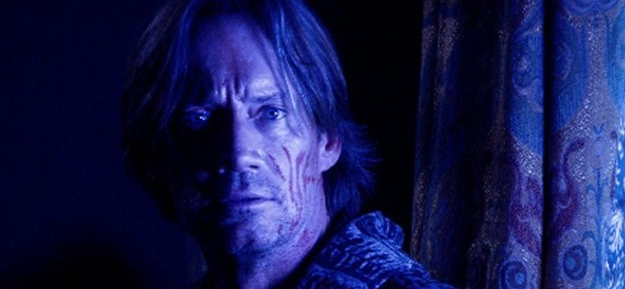

Movie reviewers will often say that a film is “painful to watch.” It’s an expression that gets thrown around quite liberally, but it’s actually very rare that a film is so incompetent that it might set off intracranial bleeding. “Tales of an Ancient Empire” is just such a film, and much of its ability to do irreparable damage comes from its near total lack of medium shots and wide angle shots.
And what’s even more of a bummer is that I’ve been looking forward to this thing since I first saw “The Sword and the Sorcerer” when I was 13 years old. “Sword and the Sorcerer” had just about everything an adolescent nerd could want from R-rated fantasy flicks: disgusting demons that made peoples’ heads explode, lots of bare breasts, a wicked sword that launched its blades like a hazardous toy, and a barbarian mercenary named Talon (Lee Horsley of TV’s “Matt Huston”) leading an army of swashbuckling johns recruited from a brothel to save a kingdom. In short, it was the best awful sword and sorcery film ever, and it even displayed generally competent filmmaking. But its end credits also promised that Talon would return in “Tales of Ancient Empire.” He never did. My teenage years were ruined.
Talon still hasn’t quite returned but director Albert Pyun has finally delivered something called “Tales of an Ancient Empire” after 30 whole years, during which he seems to have forgotten everything he had once known about filmmaking. White-haired Lee Horsley makes a cameo, but he’s billed as “The Stranger” instead of Talon, for some reason. Kevin Sorbo plays the lead ne’er do well swordsman this time around, which really makes me worry about him. Why is he in this thing? Does he need the money that badly? Can’t Starz give him a recurring role on “Spartacus: Shameful Amounts of Bloodletting” or at least that awful “Camelot” show? Sure, he’s got some crow’s feet around the eyes, but he still looks like the guy who flexed his way through six seasons of “Hercules: the Legendary Journeys.” Please, somebody show Sorbo some love.
Making one even more depressed about the sorry state of recognizable actors’ careers, Michael Paré (“Eddie and the Cruisers,” “Streets of Fire”) plays a warrior named Oda during a 15-minute credit sequence that takes up a staggering 20 percent of the film’s total runtime and looks like it was rendered using Microsoft PowerPoint. In between title cards and pen and ink comic-book art, the film’s mythic lore is dispensed as Paré runs around in a second-hand karate suit and kills wizards. He also says stuff like, “My sword is always poised for something different,” before making out with a vampire woman. After the vampire woman bears his child, Oda kills her in a display of more comic-book art. She later comes back to life and conquers a kingdom built entirely from old curtains and throw rugs.
Also along for the confusion are Ralf Moeller (the big German guy from “Gladiator”) and Gavin Newsom’s wife, Jennifer Siebel Newsom, who gets consumed by vampires in a clip that’ll be shown on “The Daily Show” over and over again if California’s Lt. Governor with immovable hair should ever run for president. The movie ends with Sorbo battling a drawing of a snake man to the death and promises of a sequel that will explain how vampires conquer the world. Hopefully, it’ll take Pyun another 30 years to make this follow-up and I’ll be long gone by the time its ready to be beamed into microchips in peoples’ brains or however crap like this will be distributed in the year 2042.
If you really need to see a straight-to-DVD sword and sorcery flick this month (and who doesn’t), there is “The Scorpion King 3: Battle for Redemption” with Ron Perlman in an amazing mullet wig and an increasingly campy Billy Zane. Zane starts out at the level of Tim Curry in “Muppets Treasure Island” (1996) and ends up in full-on Dr. Frank-N-Furter mode. MMA’s Kimbo Slice and former WWE champ Dave “The Animal” Batista are also brought in to make up for the lack of Dwayne “The Rock” Johnson from the original “Scorpion King” (2002).
Now “Scorpion King 3″ isn’t any good but director Roel Reiné (“Death Race 2″) at least adheres to the conventions of comprehensible filmmaking even though he mangles history by making Roman legions march into battle against ninjas. What I could make out of the film’s plot is just more hoohah about saving kingdoms, only this time the castles are hewed from stone instead of carpet scraps. The movie’s Thailand locations really helped with that one. I can only hope the film crew paid the national park admission fees.
Bob Calhoun is a California freelance writer who specializes in rock 'n' roll, martial arts and Hollywood stuntmen.
More Bob Calhoun.
“Nude Nuns with Big Guns” and its 90-minutes of blood-soaked blasphemy couldn’t have picked a better time to thunder onto Netflix. With Rick Santorum condemning nonbelievers like Torquemada in a sweater vest, the sight of a lesbian nun blowing away dope-pushing priests becomes downright comforting and sadly believable. The Catholic hierarchy seems willing to kick women to the curb over universal healthcare, so it’s not entirely inconceivable that it would go the extra mile and make nuns process piles of cocaine all day in the buff (except for their habits of course) like something out of a cross between “New Jack City” and “The Flying Nun.” It’s not like the church hasn’t covered up worse things recently.
This isn’t the first time that “Nude Nuns with Big Guns” has been endowed with a significance beyond the scope of its $85,000 budget. Last year, Camelot Films filed a mass lawsuit against the 5,865 Internet users who’d already managed to torrent the movie even though it hadn’t been released yet. The suit quickly came to resemble the kind of shakedown cooked up by the corrupt cardinals in “NNWBG” as the downloaders were offered the opportunity to settle out of court for $2,000-$5,000 or risk mounting legal costs and being exposed in open court as the kind of perv who freeloads naked nun flicks. After the Electronic Frontier Foundation got involved on behalf of the multiple defendants, Camelot dismissed the case in May 2011 rather than face escalating court costs of its own.
Now that we can watch “NNWBG” in the privacy of our own homes without fear of being sued for it, I can say that it does, in fact, deliver plenty of both nude nuns and big guns, all wrapped up in your standard revenge plot and taped together with a noodling wah-pedal guitar soundtrack. Sister Sarah (Asun Ortega) is caught trying to smuggle a package of product in her vestments during an exchange between drug trafficking priests and a biker gang called Los Muertos. As punishment, the priests pimp her out to the bikers who shoot her so full of heroin that she develops one hell of a Joan of Arc complex. When an aging heroin cooker named Mr. Foo (Maxie J. Santillan Jr.) cleans her up and gives her two shiny pistols, she thanks him by shooting him in the back.
“I have to show no mercy,” she explains, “even to those who show mercy on me.” As the film’s tagline says, “This sister is one bad mother.”
I know that many of you who’ve seen Robert Rodriguez’s “Machete” (2010) are saying that you’ve seen all this before, but you wouldn’t be quite right. Sure, Rodriguez may play with going to hell by dressing Lindsay Lohan up like a pistol-packing nun in his Mex-Tex grindhouse romp, but he still gives us Cheech Marin as a wisecracking warrior priest that probably even Mel Gibson can approve of (if not Rick Santorum). “NNWBG” director/co-writer Joseph Guzman displays a much bleaker view of our Mother the Church where the priests are more conniving than the bikers (who at least do their own dirty work) and the nuns are nothing more than sheepish slave labor. After so many priests, mother superiors and oppressed sisters are slaughtered during Sister Sarah’s mission for the Lord’s vengeance, “NNWBG” makes that scene where Danny Trejo makes his escape by sliding down a large intestine look like family-friendly entertainment.
“NNWB” takes the depravities hinted at by that sleazy motel scene in Orson Welles’ “Touch of Evil” (1958) and raps you across the knuckles with them like an overzealous Catholic school teacher in almost every frame. Guzman directs his bloody revenge flick with a style resembling a zero-budget “Kill Bill” digitally filtered through an episode of “Spartacus: Blood and Sand.” However, Guzman has learned the lessons of such ultra-gory 1970s revenge flicks such as the original “I Spit on Your Grave” (1978) or “Last House on the Left” (1972) perhaps a little too well; his use of misogyny only being balanced out by the camera lingering on the occasional severed penis.
As you might expect, I reached a point where I simply didn’t want to see any more nude nuns, naked strippers or papal carnage. But after just a few minutes of congressional birth control hearings or Rick Santorum campaign events on CSPAN, “NNWBG” started to make a sick sense all over again.
I was really dragging my feet on writing this review of Deepak Chopra’s new “Yoga Transformation: Weight Loss and Balance” DVD until the Vatican’s former chief exorcist, Father Gabriele Amorth, proclaimed that “practicing yoga is satanic” and ” leads to evil just like reading Harry Potter” before a screening of “The Rite” (2011) at an Italian film festival the other week. Now all of a sudden my kooky idea to put one of the fitness DVD screeners that get tossed onto my doorstep through the movie critic treatment packed as much occult fun as spinning Iron Maiden records backwards while conjuring spirits with a Ouija board. Thank you Father Amorth. You’ve inspired me to risk losing my immortal soul while burning calories and restoring my natural state of balance.
Actually doing the yoga exercises along with Tara Stiles, Chopra’s private yoga instructor, stopped short of enabling ancient Candarian demons to swallow my soul, but it did make my shoulders burn while all the blood rushed to my head. I stayed with Stiles for seven long minutes as the coffee brewed this morning, which is seven more minutes than Chopra spends on the mat in this video. Sure, Deepak looks all ready for action on the DVD cover with his $200 organic fiber sweatshirt, but he’s nowhere to be found once the bending and contorting starts — not even in voice-over. Come on Deepak! David Carradine was able to tough it out through entire box-sets of his Tai Chi workouts, and he was stoned out of his mind on lord only knows what the whole time. Chopra, on the other hand, can’t even be bothered to take off his bling encrusted shades when he’s on camera.
The DVD begins with Chopra hopping into a vast 1969 Cadillac Eldorado convertible and driving around the desert like he’s Hunter S. Thompson, only without the mescaline. Seeing Chopra there in the devil’s preferred ride made me think that maybe Father Amorth was right about the whole Satan-yoga connection. Except Chopra doesn’t actually come in contact with any yoga here. That’s all left up to Stiles, who’s forced to lead her yoga students while walking barefoot on hot desert sands. She actually grimaces a few times when she steps on some prickly brush. Chopra returns at the disc’s end for the meditation practice where he first informs us of “little buttons at the end of your chromosomes” and “self-repair mechanisms that have evolved over billions of years of time” before strolling through rocky terrain in a pair of bright red Pumas. Isn’t he the lucky one?
Now if you want a man who won’t ask you to do something he’s unwilling to do himself, look no further than Telly Savalas in the long-awaited Blu-ray release of “Horror Express” (1972). Telly not only puts on a veritable clinic in scenery chewing, but manages to steal this Spanish-made horror fest from both Peter Cushing and Christopher Lee in the process. It takes a lot of initiative to pull that one off. Set on a passenger train speeding through Siberia in the 1890s, “Horror Express” also boasts a crazed Rasputin-type monk, a thawed-out ape man possessed by an otherworldly intelligence AND Cossack zombies with blood streaming from their eyes. This film really does have everything, and I bet it even helps you burn calories too.
“Horror Express” holds its own against any horror film of the 1970s, which is saying a lot when you realize that this includes “The Exorcist,” reportedly Father Amorth’s favorite film. We don’t know how Amorth feels about “Horror Express,” even though he seems to be a fan of the genre. If the good father is reading this, I can strongly recommend it to him because he definitely agrees with the film’s hero, Professor Alexander Saxton (Christopher Lee). When asked about the mad monk’s apparent supernatural powers, Saxton blames it all on hypnosis and, yes, yoga. ”These mystics can be very convincing, ” Saxon retorts, “They can even hypnotize themselves.” Expect Father Amorth to host a screening of “Horror Express” any day now.
Long before “True Blood” made such things into a weekly television event, “The Howling” (1981) brought us werewolf-on-werewolf boffing in all of its drooling, hairy glory. The low-budget shocker also marked the first time that makeup artists pumped compressed air into masks for monster transformation sequences, beating John Landis’ bigger budgeted “An American Werewolf in London” to the screen by four whole months.
But “The Howling” offered far more than even its considerable cinematic werewolf innovations. Up-and-coming auteur John Sayles (“Matewan”) laced his screenplay about a pack of werewolves in a psychiatric retreat with biting satire of both the self-help movement and TV newscasts, while director Joe Dante (“Gremlins”) was able to strike that crucial balance between laughs and scares. As an added bonus, the movie also sports the only time that Slim Pickens sprouts a set of fangs on-screen. (Thankfully, good ol’ Slim didn’t take part in any lycanthrope lovemaking, because Slim Pickens werewolf sex may have been too much for even gore-addled, glue-huffing ’80s teens to take.)
While the other horror films of the time such as “Dawn of the Dead,” “Halloween” and “The Evil Dead” have spawned remakes, reboots and even musicals, “The Howling’s” legacy has been diminished by a litter of quickie sequels. The Czech–produced “Howling II: Your Sister Is a Werewolf” (1985) couldn’t even be saved by an appearance by Christopher Lee and repeated shots of Sybil Danning’s bare breasts, and the Australians behind “Howling III” decided to cram marsupial shape-shifters down our collective throats. Ooooo. Monsters that hop around and carry their young in pouches—very scary.
Despite the best efforts of an international coalition of inept filmmakers bent on filling this franchise with an entire arsenal of silver bullets (there were still four more “Howling” sequels after “The Marsupials”), you can argue that “The Howling” deserves one more night under a blood-red harvest moon. Unfortunately, “The Howling: Reborn,” arriving in your local redbox just in time for Halloween, only continues the downward slide by reimagining the series as a straight-to-DVD “Twilight” knockoff that’s all Team Jacob with no Team Edward.
As if taking a bite out of “Twilight” wasn’t enough, Landon Liboiron (“Terra Nova”) in the part of Will, the lead conflicted teen, strives so hard to look like Daniel Radcliffe from the last couple of “Harry Potter” movies that it’s actually distracting. Will’s mom was killed by a werewolf, so his dad has made the boy into a soy bacon-eating milquetoast who gets roughed up by Glok-toting Eastern European teens, and glared at by a multi-ethnic clique of werewolf kids who walk around in slow motion. It would normally be pretty easy to find Will sympathetic in a Peter Parker sort of way, but he also spouts just the right amount of overwritten narration to make you really hate him. “Only 2 percent of our DNA separates us from the animals,” he muses in a persistent voice over, before asking, “Where exactly is our free will?”
When he’s not pondering life’s bigger questions, Will fills an entire notebook with sketches of Eliana (Lindsey Shaw), the film’s prerequisite love interest. Eliana rewards this stalkerish behavior by inviting Will to a sparsely attended underground rave he where gets bitten by a werewolf, sparking off his internal tug-of-war between the soy-bacon-eating human world and the beast inside of him. Unfortunately, this struggle mostly manifests itself through drawn-out bouts of texting instead of beastly action, making me wish that Blade would just show up with his silver samurai swords and put everyone out of their misery. But to be fair, I spend most of my viewings of “True Blood” or the “Underworld” movies also longing for the sight of Wesley Snipes with shades and a fade.
Sadly, Blade never shows up, and “The Howling: Reborn” ends with a pair of rat-like werewolves fighting among themselves followed by a montage of flashbacks because if there’s one thing we need, it’s to see parts of this movie over again. Now I can’t say that this is the worst straight-to-DVD werewolf movie I’ve reviewed (that distinction goes to “Neowolf”), but that’s not exactly faint praise here. “Howling: Reborn” really tries to be the crappiest werewolf movie ever to hit Netflix, but it can’t even get that right.
The world of film distribution can be as cruel as a gang of bored silver miners who throw a longhorn bull into a deep pit with a grizzly bear just to see which will survive — and just as senseless. That explains why this year’s “Conan the Barbarian” was allowed to stink up 4,500 screens, while 2009′s far superior “Solomon Kane” hasn’t even been afforded the scant dignity of a U.S. DVD release. However, you can already save “Solomon Kane” to your Netflix queue, and it’s readily available in all shades of legality through those DVD sellers at book conventions (where I got my copy along with “The Star Wars Holiday Special”). Despite its lack of official US release, this movie is finding its audience like note in a bottle tossed adrift by the ghostly hand of author Robert E. Howard, the suicidal Texan who created both Conan and Kane during the pulp fiction heyday of the 1920s and 30s.
Solomon Kane, a grim demon-slaying pilgrim in a slouch hat, is one of Howard’s more inspired creations, but the character hasn’t exactly launched the careers of any Republican governors, so it’s easy to see why the studio bean-counters backed “Conan” over “Kane.” This isn’t to say that “Solomon Kane” writer/director Michael J. Bassett (“Deathwatch”) has delivered a completely faithful adaptation of any of the original Kane stories, but he has crafted a solid sword and sorcery movie built mostly on James Purefoy’s (Mark Antony in HBO’s “Rome”) ability to be totally badassed in the title role while looking like a refugee from a Thanksgiving parade float. Joining Purefoy are the late Pete Postlethwaite (“The Town,” “Inception”) and Max von Sydow, who would’ve made an awesome Solomon Kane himself if Ken Russell or Dario Argento had directed this thing in the 1970s.
The film begins in 1600 with Kane snarling to “kill the putrid heathens” as he leads his band of pirates in a raid on a North African minaret. At the top of one of those stone staircases, demons pop out of mirrors to snatch Kane’s men into some dreaded abyss, and Kane barely escapes from a dark entity with a voice like Darth Vader who informs him that his “soul is damned.” Once back in a grim England, Kane renounces violence as he walks through a landscape of corpse burnings and hanged men being picked at by crows.
Thankfully, the obligatory origin material is kept to a minimum, and it’s not long before an evil necromancer called Malachi (Jason Flemyng of “X-Men: First Class”) starts rounding up villagers for no apparent reason. When Malachi’s goons butcher the puritan family that gave Kane his buckled hat, Kane finally reconsiders the nonviolence thing. “If I kill you, I am bound for hell,” Kane muses before adding that it’s a price he “shall gladly pay,” as he guts several attackers.
Once the evildoers kidnap the surviving Puritan girl (Rachel Hurd-Wood), Kane sets off on a horse-drawn carnage spree, cleaving Malachi’s followers to the bone in true Howardian fashion. En route to his final confrontation with the forces of Satan, Kane confronts a creepy witch girl, fights his way out of a tomb filled with hissing zombies, and is crucified for added oomph, recalling both the Tree of Woe scene in the first Schwarzenegger “Conan” movie and the finale of “The Sword and the Sorcerer,” the best bad fantasy film of all time.
Unlike the films that license his creations, Howard rarely let himself get bogged down with the genealogy of his heroes, usually going straight to the violence that pulp readers demanded. From the moment that Kane, Conan or King Kull show up in a Howard story, “moving like panthers” with their “thews of steel,” we know who they are with only a few lines of florid prose to characterize them. While Bassett is as unwilling as the makers of other superhero movies to let his archetypes speak for themselves, he maintains Howard’s vision of Kane as an unstoppable force of piety who will pursue the girl and her abductors to the ends of the Earth. “Solomon Kane” also dispenses horror and action in the right measurements, and surprises with some atmospheric shots of the English (and Czech) countryside and above-average special effects.
As a fan of Robert E. Howard (and you can probably tell I am one), I can only look on with envy at how much Hollywood is cowed by the legions of Tolkien and J.K. Rowling admirers who will launch a blistering campaign of Tumblrs and tweets if their beloved fantasy figures are mishandled by the movie industry. Because of their numbers and veracity, those other fantasy fans are rewarded with Jackson’s “Lord of the Rings” trilogy and a well-crafted “Harry Potter” franchise, while Howard’s more ragtag following gets a series of studio tax write-offs.
But in “Solomon Kane” we have a glimpse of the Howard franchise made with some respect for the source material — at least if you can get your hands on it. “This movie has not been released on DVD,” Netflix warns in fine print. “Future availability is not guaranteed.”
When you review straight-to-DVD movies, you see a lot trailers built around Kimbo Slice fighting Rampage Jackson in a cage intercut with shaky cam footage of strippers working the pole. But every so often I run across one full of nothing but sheer, unadulterated WTF. If trailers like these are the precious metals of the video world, then the one for “Norwegian Ninja” is pure gold valued at nearly $1,900 an ounce.
In a little under two minutes, the “Norwegian Ninja” trailer combines the Scandinavian martial arts madness that the title suggests and footage of miniatures set ablaze with flames that look like they’re coming out of a Zippo lighter. And there are crazy-looking amphibious assault vehicles and sheep — lots and lots of sheep — and a synth score that resembles the repetitive triumphalist theme to the Chuck Norris epic “Delta Force,” only more somber and European. “Be one of us,” a stern blond man wearing glasses and a black karate uniform urges, “Be a Ninja.” I am so there.
With “Norwegian Ninja,” first-time writer-director Thomas Cappelen Malling somehow, against all odds, delivers a film that’s even stranger than its boffo trailer suggests. Malling bases his hallucinatory mishmash on the biggest case of espionage and treason in his country’s history. Arne Treholt was a Norwegian diplomat who was busted for passing secrets to the Soviets in 1984, but here he is reimagined as the patriotic commander of a crack team of ninjas dedicated to guarding “the Norwegian way of life.”
“No one will occupy us,” the heroic Treholt vows through subtitles, “neither Russians nor Americans.”
As it turns out, protecting Norway’s “sovereignty and self-sufficiency” seems to involve lots of philosophical discussions held around campfire barbecues, all in an island compound that looks like a petting zoo and is protected by Feng Shui. “System disharmony halts the flow of energy, slowing down intruders with illness and bad luck,” Treholt explains. When the ninjas do go out on missions to find marauding Russian subs or stop oil derricks from blowing up, they always seem to come up short. Mads Ousdal of Norway’s National Theater holds the lunacy together by playing Treholt with utter seriousness — even when he’s appearing and disappearing in puffs of smoke like a low-rent magician or flicking cigarettes into his mouth with action hero aplomb.
Squaring off against Treholt is Hans Otto Meyer (Jon Øigarden), another shadowy figure lifted from the annals of Norwegian conspiracy theories. Here, as well as certain corners of Wikipedia, Meyer works for Stay Behind, a CIA-backed covert op that stages train station bombings in Italy and other acts of terror all around Europe, and then blames it all on Soviet partisans to get these countries to allow U.S. bases on their soil. “Would you kill one person to save a thousand?” the Stay Behind field manual reads during a sequence of visual exposition. “Then you’d kill 4,500 to save all of Norway,” is the grim answer. Meyer even resembles G. Gordon Liddy and has a framed 8×10 of Ronald Reagan on his desk as he plots plane crashes and sabotage to “scare voters into the lap of the powers that be” and demands “war against an innocent scapegoat.”
The influence of Wes Anderson’s kooky visual and storytelling style is undeniable here (especially “The Life Aquatic with Steve Zissou”), but the seriousness of “Norwegian Ninja’s” source material has it sharing common, albeit less bloodstained, ground with Tarantino’s “Inglorious Basterds” (2009). While Tarantino clings to the “Dirty Dozen” paradigm of a band of gun-toting sociopaths shooting their way to freedom, Malling shows its absurdity by infusing the mundane and somber world of espionage with ridiculous amounts of hyper-macho super spy mythos. The real Treholt was just a bureaucrat attempting to pass some folders pulled from a ubiquitous gray file cabinet to other bureaucrats over a brunch of sausages. In the end, he was apprehended by airport police.
To illustrate his point, Malling intersperses scenes of ninja ass-kicking with old television news reports on the real Treholt and Meyer. And while this may be a silly movie, this disregard for nationalistic masculine fantasy goes at least a short way towards explaining Norway’s sober response to the recent massacre. After the attacks, Norwegian Prime Minister Jens Stoltenberg called for “more democracy, more openness and greater political participation” — a stark contrast to American politicians’ response to 9/11.
“A real ninja wins without fighting,” the fictional Treholt tells us in between explosions that look like sparklers. Now there’s a piece of chop-socky zen to think about.