
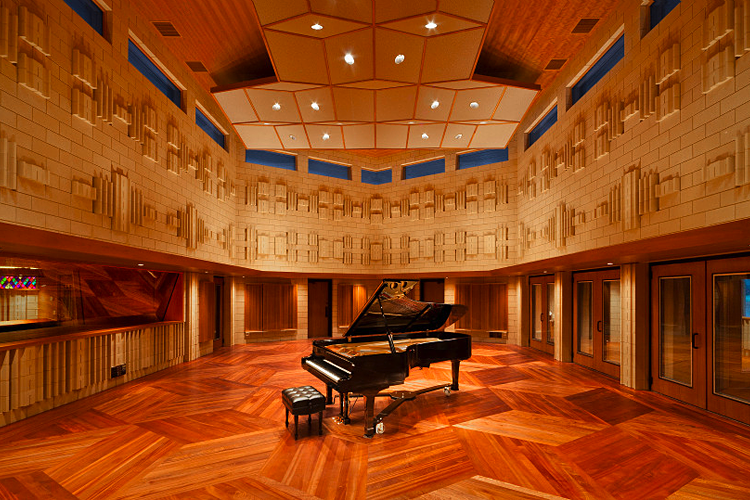

This past summer, Zenph Sound Innovations had a problem. Zenph is a North Carolina-based company specializing in computer-generated “re-performances” of classic recordings with astounding results. But Zenph’s latest project — “The Spanish Masters,” featuring renowned cellist Zuill Bailey and soprano Isabel Bayrakdarian accompanying recreations of century-old piano-playing — was coming in over budget.
That’s when Zenph’s management took a cue from the project’s setting, Manifold Recording Studio, which was designed with both old-school live performance and new-school open-source philosophy in mind. Manifold co-owner Michael Tiemann suggested that Zenph go the crowd-funding route to raise the money needed.
“I proposed that we offset the costs by holding a recording salon,” Tiemann says. “So we invited a select group of people to come in and experience the music live in the studio as it was being created.”
Six people came in to watch, and each paid $250 for the privilege. Presto, budget gap closed. If Tiemann has his way, that will be a regular happening at Manifold, a wildly ambitious high-end studio that opened over the summer in the rural splendor of Chatham County, North Carolina (near Raleigh).
Thanks to his deep pockets from his position at the software company Red Hat, Tiemann had the means to turn his “passionate obsession” of a dream into reality. He spared no expense on Manifold, which is a remarkable facility with lavish attention to detail. Most of the building’s dimensions are based on the Fibonacci sequence and/or the golden ratio, with all the grids of the floors, walls and ceilings lined up to interlock and intersect with perfect symmetry. The wooden floor of the main studio is composed of a diamond pattern, and each diamond has 12 slats in honor of the 12-note scale of Western music.
The studio’s technical gear is all state-of-the art, of course. Manifold is the sort of destination studio where you could imagine U2, Adele or some other chart-topping act setting up shop for a month or three to wax their latest opus. But if anything seems less practical than starting a record company right now, it’s building a high-end recording studio that rents for $2,000 a day. Having built it, Tiemann is convinced they will come — although the “they” he has in mind is less top-of-the-pops and more grassroots.
Even though Manifold is very much a high-tech facility, Tiemann’s vision of it is steeped in the vibes of past glory days from the era before Pro Tools rendered studios obsolete. Speaking of models for Manifold, Tiemann cites the Beatles’ old stomping grounds of Abbey Road, where they pioneered the technique of using the studio as another instrument; Peter Gabriel’s Real World, a studio he says was “built to support creativity”; and most of all the old CBS 30th Street Studio, favored back-in-the-day recording venue of everyone from Miles Davis to Leonard Bernstein.
“When Miles Davis would record at 30th Street, he’d bring three or four dozen people into the studio and they’d do a live recording session,” Tiemann says. “This was a lot like a musical version of the salon model, people gathering in a room small enough to support conversation and large enough to hold a diverse group of people. Glenn Gould, who recorded ‘The Goldberg Variations’ there, said that recording would completely replace live performance within 50 years. That was in 1966 and it has not quite come true, not yet. What we’ve got in mind is to bring together those two experiences, recording and performance.”
To that end, Manifold is set up to do broadcasting or webcasting, just in case anyone is of a mind to make a recording/performance available to a wider real-time audience. Even without that, it’s a very comfortable space for a live audience of several-score fans. And with the right act and setup — an unplugged rock band, say; or James Taylor, who grew up right down the road in Chapel Hill and still has ties to the area — you could imagine Manifold being the perfect setting for the right kind of live-recording project.
“Everybody still wants to make great-sounding records in great studios,” says Souvik Dutta, a producer scheduled for two Manifold projects in 2012 including one with Widespread Panic guitarist Jimmy Herring. “It’s like taking your kid to a baseball game to see his favorite player.”
Still, are there enough projects like that out there to support a studio that cost millions to build? Tiemann is convinced there is, citing parallels with the slow-food movement.
“Just as the slow-food movement encourages eaters to think more holistically about how food is grown, prepared and brought to the table, this co-producer model gives people much more access to the creative process of music,” Tiemann says. “They’re not just financially involved, but also participants in a stronger way than the traditional music industry has really encouraged. There is a new economy waiting to be discovered, new markets waiting to be engaged. We’re very early in addressing this brave new market, and doing so at a time when the record industry’s rhetoric is so wildly against anything new that it makes us look like the crazy ones.”
Trying to sell an idea like Manifold is actually familiar territory for Tiemann, a guru of the open-source-software movement whose career began just as the Internet was coming together in the 1980s. Early in the game, Tiemann was doing a lot of work with open-source software, which is free and set up so that users can easily modify it.
But open-source software seemed like a commercial dead end until Tiemann figured out how to monetize software that you give away: Sell support services, the software equivalent of giving away cell phones and charging monthly user fees. Red Hat, a company specializing in Linux software, acquired Tiemann’s company in the late 1990s, and he moved from Silicon Valley to Red Hat’s home base of North Carolina.
Tiemann started out as Red Hat’s chief technical officer, eventually settling into his current role as the company’s vice president of open-source affairs. That involves a fair amount of punditry and acting the gadfly. Couple that open-source mindset with his lifelong love of music (he first recorded as a 10-year-old member of the Saint Thomas Choir while growing up in New York City), and Tiemann might be just the guy to drag the record and studio industries kicking and screaming into the 21st century.
“People said the idea of giving away software and selling services to new markets would never work,” Tiemann says. “That worked out fine and this can, too. What would it be worth to provide a path to sustainable success in the music industry? I think that’s worth a lot. Strip-mining the low end, selling less and less quality to more and more people — there are limits to that model, and the music industry has done about as much of that as can be done. It’s time to try something new.”
