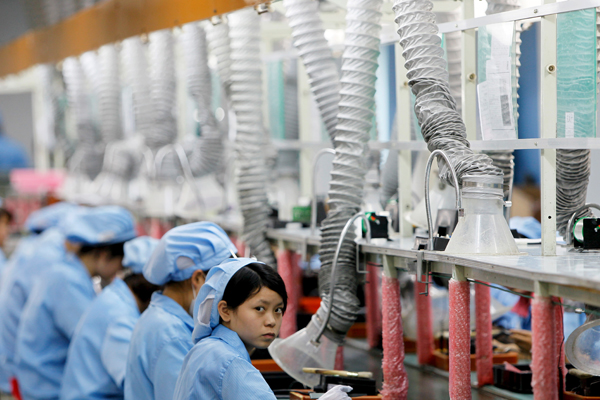

Has the term “education” become a code word? And if so, a code word for what?
These are the major unasked — but resoundingly answered — questions to emerge from two much-discussed articles about the future of American manufacturing. One is a cover story in the Atlantic Monthly about why jobs are being shipped overseas. It concludes that “to solve all the problems that keep people from acquiring skills would require tackling the toughest issues our country faces” — the first of those being “a broken educational system.” The second and even more talked about article comes from the New York Times. It looked at why Apple Computer has moved its production facilities overseas, concluding in sensationalistic fashion that “it isn’t just that workers are cheaper abroad” but that America “has stopped training enough people in the mid-level skills that factories need.”
These pieces were clearly written with a very specific objective in mind: to draw media attention to the supposed “education crisis” in America — a favorite topic of these publications’ elite readers, who have a vested interest in blaming the recession on the poor rather than on the economic policies that enrich the already rich. No doubt, both the Times and the Atlantic achieved their goal, with various NPR shows, cable gabfests and elite magazines spending the last week frothing over the articles’ central thesis.
The tragedy in all of this is that in both the articles and in most of the discussions that followed, few bothered to question the fundamental assumptions about education in America — and fewer still bothered to ask if “education” in the modern parlance has now become a synonym for “acquiescence.”
To see how this linguistic shift is occurring, reread the Times article with a critical eye. Specifically, notice that after the reporters structure their piece around Apple executives’ (unchallenged) claim that “the U.S. has stopped producing people with the skills we need,” there’s not a single shred of proof — empirical or otherwise — offered in support of that assertion. On the contrary, after a sweeping declaration at the top of the piece that wage and human rights differences between Chinese and American workers have little to do with offshoring, the article inadvertently goes on to prove those differentials — not skill levels and education — are the driving force behind the domestic job losses in America.
In one section of the piece, for example, the Times notes that Apple’s big Chinese factory, Foxconn, attracts American investment because “over a quarter of (the) work force lives in company barracks and many workers earn less than $17 a day” — and “many work six days a week, often spending up to 12 hours a day at the plant.” In another section of the piece, the Times notes that the cost of “building a $1,500 computer in (California) was $22 a machine … In Singapore, it was $6 … In Taiwan, $4.85.” While the Times unquestioningly forwards Apple’s impossible-to-believe explanation for these figures (“wages weren’t the major reason for the disparities”), the statistics are yet more proof that wage differences, not education, are the real offshoring motive.
The Times also quotes an Apple executive saying the company must outsource because “the entire supply chain is in China now” — and though the article doesn’t bother to mention it, that is true precisely because other factories in that supply chain have moved to China for the cheap wages and lax human rights/labor regulations. The Times later talks to Eric Saragoza, an American worker laid off by Apple, who says that Apple told him to keep his job he didn’t need to acquire more skills, but instead “to do 12-hour days, and come in on Saturdays.” And in another part of the piece, the Times quotes a former Apple executive who insists Apple was forced to move to China because there’s no “U.S. plant (that) can find 3,000 people overnight and convince them to live in dorms” — an admission, again, that Apple’s move to offshore isn’t about skills, but about a desire to employ a “flexible” (read: exploitable) workforce.*
In light of all this, the absurdity of the Times’ “education crisis” conclusion is obvious. Somehow, Dickensian realities are meticulously recounted, but Apple is permitted to plead helplessness without so much as a contradictory fact being mentioned — as if the company isn’t making calculated choices that are generating record profits off sweatshop conditions. China’s super-low wages and nonexistent labor, environmental and human rights protections are shown over and over again to be the driving force behind American corporate offshoring, and yet the conclusion is nonetheless that the problem for America is our education system. And somehow, that conclusion is made without the Times, the Atlantic Monthly or any part of the media echoing their stories measuring it against actual data from the American education system.
And what, pray tell, does that data say? It says that far from a drought of skilled high-tech workers forcing supposedly helpless victims like Apple to move to China, America is actually producing more of such workers than Apple and other high-tech companies are willing to employ. As I noted in a previous newspaper column (looking at yet another New York Times piece making the same education argument):
No doubt, you’ve heard (the) fairy tale from prominent politicians and business leaders who incessantly insist that our economic troubles do not emanate from neoliberals’ corporate-coddling trade, tax and deregulatory policies, but instead from an education system that is supposedly no longer graduating enough science, technology, engineering and math (STEM) experts. Indeed, this was the message of this week’s New York Times story about corporate leaders saying America isn’t producing “enough workers with the cutting-edge skills coveted by tech firms.”
As usual, it sounds vaguely logical. Except, the lore relies on the assumptions that American schools aren’t generating enough STEM supply to meet employer demand…
To know (that) supposition is preposterous is to consider a recent study by Rutgers and Georgetown University that found colleges “in the United States actually graduate many more STEM students than are hired each year.”
These facts were most recently corroborated in mind-boggling detail by the Senate testimony of Rochester Institute of Technology’s Ron Hira. But, of course, they are nowhere to be found in the Times. That’s not altogether shocking (even if it is offensive) — the Times is a newspaper whose ombudsman recently challenged the very idea that the paper’s journalists should actually fact-check statements made by its sources. It is also a newspaper that has helped construct a larger political and media consensus around what I’ve called both “The Great Education Myth” and the “Neoliberal Bait-and-Switch.”
These sleights of hand simply stipulate as unchallenged, unquestioned fact that all of our economic problems can be solved with better STEM education and more STEM graduates. The idea is that this educational improvement would fix the alleged problem of high-tech companies like Apple not being able to find enough STEM workers. This myth endures even though the data indisputably proves that there is no such dearth of STEM worker supply — indeed, we are already producing more STEM graduates than the domestic economy can employ, meaning the only worker shortage that exists in America is a shortage of workers willing to toil at slave wages with no labor or human rights. But, alas, those facts don’t matter because the Great Education Myth isn’t about economic reality — it is an instrument of propaganda designed to distract attention from the tax and trade policies that allow companies like Apple to make so much money off the current system of exploitation.
So that gets us back to the key question of whether the term “education” is effectively being redefined? In all of the elite media’s stories about offshoring and the STEM “education crisis,” does the term “education” no longer mean “learning a set of skills”? Does it in practice now mean American workers learning not new technological crafts, but learning to quietly accept the wage, labor and human rights standards of China — the standards we thankfully improved after our own crushing Industrial Age a century ago? In short, does “education” now mean “teaching American workers to be subservient”?
The answer, almost certainly, is yes, because that’s the only way that the media and political establishment’s entire “education crisis” meme makes any logical sense.
The fact is, while our cash-starved schools would obviously benefit from more resources, and while better schools clearly couldn’t hurt our society, there’s no empirical, data-based reason to believe that improving our schools would reverse the trend of America losing high-tech jobs to slave-labor nations like China. Without a change in tax and tariff-free trade policies that economically incentivize companies like Apple to keep moving production to cheap labor havens overseas, the only “education” that will bring those jobs back is the kind that indoctrinates high-tech American workers to compete with Chinese workers by accepting the horrific labor conditions those Chinese workers experience. Based on the New York Times’ own reporting on Apple, that means an education system in America that teaches our workers to simply accept being paid $17 a day, to work six days a week in 12-hour shifts and to live in crowded dormitories so that they can be stampeded into the factory at any hour of the day. It means, in short, an education system that tells Eric Saragoza to shut up and accept the employer’s draconian demands.
Not surprisingly, the curriculum for this new education system is already being championed by the very political and media realms that originally constructed the Great Education Myth. In Congress, a group of senators is proposing to eliminate overtime protections for vast swaths of the America’s high-tech workforce in the name of competing with China. In state legislatures, lawmakers are looking to weaken child labor statutes, also in the name of competition. And on the New York Times Op-Ed page, Thomas Friedman implies that Americans are lazy and declares that “average is over” and that “everyone needs to find their extra” — elite-speak for the notion that Americans, who already log some of the longest workdays in the world and who are already among the planet’s most productive laborers, must work even harder than they already do.
In beginning to construct this kind of pedagogy, our mandarins are not coincidentally promoting a key part of the educational ideology of their Chinese counterparts. No, not the part of that ideology that is focused on training high-tech workers — the part that prioritizes obedience. Indeed, as my friend Michael Levy recounts in his terrific book “Kosher Chinese,” that educational method teaches Chinese workers never to question their station, demand basic rights or ask for better conditions.
That same ethos is now being proudly promoted here at home. Should we accept it — and the redefinition of “education” that comes with it — we may end up bringing a few jobs back, but we will have reversed the very labor, wage and environmental progress that once defined our basic concept of human rights — and America itself.
*It’s important to note that the Times did eventually publish this follow-up piece to its original article about Apple and offshoring. The follow-up piece looks more closely at how Apple mistreats its workers in China, and that kind of scrutiny is certainly necessary and laudable. However, the fact that the Times made the decision to separate the later piece on labor rights from the earlier article on Apple’s employment decisions implies that the two issues — worker exploitation and offshoring — are separate, when in fact they are inextricably intertwined. That kind of distinction is a real problem. Indeed, pretending that these two issues are wholly different topics (as Apple and other high-tech executives so often do) perpetuates the deceptive notion that exploitation is just a “liberal” feel-goody concern while business practices are more serious, dispassionate, non-ideological decisions. But only when these issues are looked at in aggregate will we be able to start having an honest debate about how globalization really works.
The apocalyptic story line was once reserved for truly apocalyptic events. Nuclear war. The return of Christ. Environmental or economic collapse. But it’s 2012, and the apocalypse has become the basis for everything from Super Bowl commercials to summer romantic comedies – and no media story is too small to have an apocalyptic moniker attached to it. (Remember Snowmageddon?) If you want to get the world’s attention, simply proclaim that the world will soon end — or the Internet. Just read coverage of the so-called Internet Doomsday virus, which will supposedly strike and shut down the Web on July 9.
Here’s how the story got started. Back in October, the FBI announced that it had broken up an international crime ring when it arrested six Estonians in what was then heralded as “the biggest cyber criminal takedown in history.” The Estonians had, over the course of four years, hijacked more than 4 million computers in 100 countries through the use of malware known as DNSChanger. By redirecting the infected browsers of unwitting users, DNSChanger was able to send high volumes of traffic to the criminal ring’s rogue websites and servers, collecting more than $14 million in fraudulent advertising revenue and exposing their victims to information theft in the process.
“Operation Ghost Click” (as the FBI dubbed its sting operation) put an end to the Estonian scheme, but a problem remained. If the feds simply shut down the Estonian servers, the 4 million infected machines — nearly 1 million of which were in the United States — would be unable to reach the Internet. To give the cyber-crime victims time to clean up their machines, the FBI contracted the Internet Systems Consortium (ISC) to maintain valid servers in place of the criminal servers. The new servers would remain online until March 8, 2012.
And so it came to pass that the FBI tried to warn the people, but the people were not listening. The people were too busy swatting the pop-up ads that buzzed like flies around TMZ.
As things turned out, a cabal of Estonian thieves in an international crime ring wasn’t enough to get the public’s attention. By early February, nearly half of all Fortune 500 companies and half of all major federal agencies still had computers infected with the virus — along with 400,000 other computers around the world. If the government shut down its proxy servers on March 8, as was planned, all of these computers would be unable to access the Internet. (The FBI, frankly, hadn’t done the best job in getting the word out about DNSChanger: It slapped up a PDF on the Web and assumed people would find it.)
And then it happened. Somebody put two and two together. There was a larger, more familiar narrative at work here. The tale of Operation Ghost Click and DNSChanger held all the elements of a familiar story. A set date. The need for the wayward computer users to repent before the date came. The smug satisfaction that when the date finally came, the non-believers would be cast into a disconnected hell, with nary a Google Map to lead them out of it. Have you not accepted Norton AntiVirus as your savior? IT nerds across the nation waved their MacBooks in contemptuous indignation.
This wasn’t just any old computer virus. For those who did not repent — or at least scan their computers for the virus — March 8 would be INTERNET DOOMSDAY.
Let’s back up for a moment: “Doomsday?” one might ask. Really? Some accountant at Hormel might not be able to access the Internet one day because of slovenly security habits, and that becomes doomsday? Has the apocalyptic bar really been set that low?
In fact, it has — and there are three reasons for this.
Understanding the first reason requires a quick trip back to the last time apocalyptic rhetoric was as mainstream as it is today — the 1970s, when the country was buffeted by oil shocks, stagflation, Watergate, spiraling crime, inner-city decay, and defeat in Vietnam. A paranoid and pun-filled tome soon emerged to explain the chaos as signs of the end of the world — Hal Lindsey’s “The Late Great Planet Earth,” the “No. 1 nonfiction seller of the decade” (as the New York Times put it), which found its way onto the bookshelves of more than 15 million Americans. And now the teens and 20-somethings who had clutched copies of “The Late Great Planet Earth” in the 1970s are editors, writers and producers, and they bring to the media landscape the narrative of their youth, in much the same way that indie music from the 1980s and ’90s, which never sold very well at the time, has reached a wider audience in the 2000s as Gen Xers find themselves program directors at radio stations or music supervisors at ad agencies and television networks.
The second reason came at the dawn of the next decade, with the launch of CNN in 1980. The rise of cable news (and, in the late ’90s and early 2000s, the rise of the Internet) didn’t merely transform the media landscape; it exponentially expanded it. Prior to 1980, the “Big 3” networks — ABC, CBS and NBC — programmed little more than three hours of news per day. Nowadays, even the “24-hour news cycle” seems like an antiquated idea; Twitter has brought us the 24-minute news cycle, with reporters on their Tweetdecks chasing headlines like little kids playing soccer. In this new media landscape, where speed and hyperbole trump investigation and accuracy, apocalyptic headlines draw the all-important consumer eyeball, regardless of the story that runs beneath.
The third reason that we so readily embrace the apocalyptic story line — not merely as producers of news, but as consumers — can be found in the decade behind us. As we’ve written before, the first decade of the 21st century was a decade punctuated by historic events that seemed (or were treated as) nearly apocalyptic in scope. From preparations for Y2K to the attacks of Sept. 11, from rising evidence that climate change has arrived to the economic collapse of 2008 in which we still find ourselves entangled, the belief that the world is coming undone — that the final straw is just moments away from being lowered onto the camel’s back — has surged from the edges of conspiracy and into the center of our public discourse.
The problem with this arms race toward the ever more apocalyptic is that it depletes our reservoirs of concern. If everything is an apocalyptic threat, then nothing is. And when each overhyped threat passes with nothing happening — where are you now, Ebola virus? — we find ourselves more capable of dismissing real concerns like climate change as overhyped as well.
We called the FBI Press Office to ask them why they were trying to frighten people with their overheated rhetoric about “doomsday.” Didn’t they know that small children also used the Internet, and might be haunted by nightmares of never feeding their Moshi Monsters again? “I don’t think we’ve ever used that word,” the press officer who answered at FBI headquarters assured us. “We’ve never called it ‘Internet doomsday.’”
Ever since Y2K, the media has mastered the technique of combining any potential threat — no matter how remote the probability and no matter how localized or contained its likely impact — with the apocalyptic story line. The result has been an increasing hyperbole in the news, and an endless parade of stories that imagine the “end of the world” in the most unlikely of scenarios, from solar flares to polar shifts to … well, some get-rich-quick scheme cooked up by some hoodlums in Estonia.
Take, as another example, the headlines in March that warned us that an impending solar flare could knock out most of our satellite communications, GPS and utilities, plunging the world into unplugged chaos. Beneath the headlines, usually in the final paragraph, was a little-noticed caveat: Such flares occurred with regularity a decade ago, with virtually zero impact.
But it’s the headlines that matter, not the details or the subsequent paragraphs, and “Internet Doomsday” was a great headline. The blogs lit up with stories about the horrors that might befall us if we couldn’t access Gawker. And like all good apocalyptic narratives, the Internet Doomsday quickly took a turn toward the conspiratorial: The FBI itself was going to pull the plug on the Internet on March 8, it was said. Government efforts to protect computer users had become a government plot to unplug computer users. There was much logging on, and rumors of not logging on.
But this was not yet the end. A judge, apparently consulting with Harold Camping (who knew much about the flexibility of having a backup date for the apocalypse), ordered the FBI to keep its goodly proxy servers going for another 120 days, until July 9, to give the unrepentant more time to download Kaspersky. And the FBI became more Internet savvy: A few weeks ago, it unveiled a new website where computer users could check to see if their computers were infected with DNSChanger.
The press dutifully reported on the FBI’s valiant effort to help the remaining victims of the scam — perhaps 200,000 out of 2.3 billion Internet users in the world — repair their computers. The most common headline? You guessed it: “Internet Doomsday Coming July 9.”
Continue Reading
Close
Last year, The New Yorker ran a long, flattering profile of the director Andrew Stanton, the Pixar veteran who was engaged at the time in reshoots for the troubled “John Carter.” The article, by Tad Friend, noted some of the studio’s concerns about the initial cut of the film, which was Stanton’s debut in live action, but for the most part, its tone was highly positive, portraying Stanton as nothing less than Pixar’s resident storyteller: “Among all the top talent here,” an executive is quoted as saying, “Andrew is the one with a genius for story structure.”
Six months later, “John Carter” became one of the costliest flops in Hollywood history, and while the film may have its redeeming qualities, story structure isn’t among them. Read in retrospect, the Stanton profile now seems laden with irony, and it isn’t alone: A striking number of recent New Yorker features on movie directors and actors have been followed by embarrassing setbacks for the artists in question, usually involving the very projects that the articles are extolling.
In other words, whenever a New Yorker profile shows a director hard at work in the editing room, the studio should start to worry. Since the beginning of 2010, the magazine has published eight features on artists best known for their work in film. Two are profiles of Clint Eastwood and Jane Fonda that are basically career retrospectives. Of the remaining six, five of their subjects — Steve Carell, Guillermo del Toro, Anna Faris, John Lasseter and Andrew Stanton — experienced significant professional reversals soon after the articles appeared. And while I’ll discuss the one exception in a moment, such a dire track record might well give pause to Armando Iannucci, the British director of “In the Loop,” who was profiled by the magazine in March.
To put it mildly, there’s something of a New Yorker feature curse going around Hollywood these days. It doesn’t always hold true — Dana Goodyear’s profile of James Cameron certainly didn’t hurt “Avatar” — but when it does, the results can be startling, especially when you set the articles alongside the films they so effusively describe. Tad Friend’s profile of Steve Carell, for instance, portrays its subject as “a brilliant piece of software, a 2.0 fix for the problem of unfunny comedy,” whose approach to collaboration is nothing less than “a painstaking set of procedures aimed at maximum creativity.” The result? “Dinner for Schmucks,” a critical and commercial nonevent that few would hold up as a model of “the golden age of improvisation.”
Other profiles read even more strangely in hindsight. Last May, the film “Bridesmaids” had everyone talking about the role of women in modern comedy, a topic that Friend addressed in a lengthy feature published the month before. “What’s at stake is not merely a tenable marketplace for ‘hard’ female comedies,” he writes, “but a fresh vantage on romance and, perhaps, a fresh way of seeing men and women.” Unfortunately, he isn’t talking about “Bridesmaids,” but about Anna Faris in “What’s Your Number?,” which came out in September and promptly sank like a stone.
I don’t mean to pick on Tad Friend, a fine and perceptive writer, because he certainly isn’t alone. I first noticed the phenomenon in an article on Tony Gilroy by D.T. Max, who glowingly describes the creative process behind the underwhelming “Duplicity.” More recently, Guillermo del Toro had the curse hit him twice, first during the writing of a profile by features editor Daniel Zalewski, which coincided with del Toro’s departure from “The Hobbit,” and shortly after the piece appeared, when Universal passed on “At the Mountains of Madness.” These articles are invariably graceful, smart,and insightful — and their subjects are all talented. Yet there’s no shaking the sense that such a feature rarely bodes well for the future.
Sports fans have talked for decades about a Sports Illustrated jinx, in which a player’s cover appearance seems to lead to a string of unusual bad luck. The reason for the jinx, if it exists, isn’t hard to understand: Athletes generally make the cover after an exceptional performance, which is right when they often regress to the mean. The New Yorker doesn’t put stars on the cover, but its features are valuable real estate, so it tends to favor subjects with a big success already behind them. There’s room in the magazine for emerging artists, but it’s in the Brooklyn of the back pages, not the Manhattan of the features section, which prefers seemingly sure things. Much as in Hollywood itself, you can’t get fired for going with last year’s star.
In finance, this is called performance chasing. It means investing in today’s interview subject based on yesterday’s hit movie, which, as an outlier, is often followed by a slump. This is how we get a look behind the scenes of “Duplicity,” not “Michael Clayton,” and it sometimes results in reportage that has a troubling tendency to ignore obvious warning signs. Anthony Lane’s feature on John Lasseter and “Cars 2,” for instance, is written in his characteristically prickly style, but for all his evident cynicism, he never raises a crucial point that many other observers had noted at the time, which was that Pixar was making a sequel to one of its weakest films. In the end, Lane’s skepticism is only skin deep, and it’s ultimately sacrificed to the needs of the narrative, in which the critic is grudgingly won over by the studio’s charms.
Occasionally, of course, the feature section does devote space to an emerging talent, as Rebecca Mead did last year with the director Lena Dunham, before the release of “Tiny Furniture.” (Iannucci can take some comfort from Dunham’s example: Their shows “Veep” and “Girls” were both renewed last week by HBO, one of the few forces around that can reliably beat the curse.) In this article, the exception mentioned above, several elements combine to push it into feature territory — social media, the New York art scene, “the cinema of unexamined privilege” — and the result is a rare instance of a profile catching an artist on the way up. Dunham jumps the queue because her story feeds into fashionable issues, a fact she lightly mocks: “There’s always an article coming out, saying ‘The new thing is funny women.’”
And this gets close to the heart of the problem. Many feature articles — including this one — strive to tie a bow on the story, to tether themselves to some larger theme, a tendency visibly pronounced at the New Yorker, thanks both to its reputation and to the relatively small number of movie features it publishes. At four or so profiles per year, an article can’t just be about Steve Carell or Tony Gilroy or Anna Faris: To justify the use of such premium space, it has to be about the future of comedy, or adult drama, or funny women, which leads to grand claims that can ultimately seem peculiar when we finally see “Dinner for Schmucks.”
“Nobody knows anything,” the writer William Goldman famously said of Hollywood, and if that’s true of filmmakers, it’s doubly true of the journalists who try to draw conclusions about so unpredictable an industry. If journalism is the first draft of history, it’s no surprise that the draft occasionally contains 10 finely reported pages on “What’s Your Number?” But that shouldn’t stop reporters from trying. We desperately need thoughtful articles that go deeper than the average star profile, like Ian Parker’s New Yorker feature from a few years back on George Clooney, which remains one of my favorite pieces ever published in the magazine. It came out the same month, naturally, as “Leatherheads.”
Continue Reading
Close
In the single, whipped-up day since Time magazine unleashed that cover story about crazed MILFs “driven” to “extremes” by attachment parenting, there’s been plenty of debate over its provocative image of blogger Jamie Lynne Grumet breast-feeding her almost 4-year-old son. And, as so often happens when adults see an image that unnerves them, that anxiety is projected onto kids. In this case, one kid in particular. Grumet’s.
Unshockingly, the National Review Online was quickest to leap into pearl-clutching position. After deeming the image “as bad as it will ever get,” Glenn T. Stanton pronounced that “This poor boy may be diggin’ life now, but will soon be forever teased as the Got Milk? boy that Time magazine and his indulgent mom made infamous.” And in the Contra Costra Times, Tony Hicks decided that all the mothers who appeared in the story’s photos did so “simply to have something really embarrassing to use against their kids when they become teenagers.”
Most of us who live in some degree in the public space – whether it’s our Facebook photo albums or the cover of Time magazine – grapple with how much of our children’s lives we share. The little babies whose adorable smiles are posted swiftly turn into teens who’d like you to cut it out already, Mom. The contract that we have with our children to protect them and respect them is one that has to be constantly renewed as they grow and change. But it’s not the same for any two families, and the boundaries are incredibly varied.
The complicated reality is that our experiences are entangled with those of our loved ones. A woman should have every right to write and talk and present herself to the world. But if we’re going to talk about our lives, there’s no way we won’t be bringing our families along for the ride. That’s not automatically a traumatic thing. If a child, like Grumet’s, grows up in a family that’s very open about itself, and the child’s own nature is of that bent, he may well think nothing of it. The hang-up isn’t his; it’s the journalists transferring their own discomfort onto him. To assume he’ll be mocked about that Time cover is to assume that the image of him breast-feeding is something to be embarrassed about, that there’s something inherently wrong about it.
That’s not to say that profound sensitivity isn’t required. Our children aren’t props for us to use to boost our careers – or even, for that matter, our Facebook statuses. They’re human beings, and when they can’t give consent, it’s our duty to make reasonable choices on their behalfs. Would I appear on the cover of Time, breast-feeding one of my kids? I’m not sure I’d appear on the cover of Time with my kids, period. But that’s my choice and my family’s. Frankly, I’m way more unnerved when I see a soon-to-be ex-Facebook friend post a photo of his toddler’s first poop in the big boy toilet or announce her daughter’s first period than I could ever be by a woman nursing her preschooler. We’ve all got different boundaries.
Last evening I was at an event on motherhood and writing, and the novelist Martha Southgate spoke about how she’d written a very personal essay about her son when he was in elementary school. Now that he’s 18, she wonders if she should have done things differently. And in Tablet last winter, columnist Marjorie Ingall declared that after years of chronicling her life with her family, she was giving her two daughters “the greatest gift of all: I’m not going to write about them anymore.” In my own life I’ve moved, with each passing year, from simply writing abut my children to collaborating with them on what they do and don’t want revealed about their personal lives. I’m grateful when they’re generous and open with their experiences, even though I know they may second-guess that openness later.
On Facebook Thursday, Grumet wrote that “My mother posed for similar images (not as big as TIME obviously) and was a public advocate of breastfeeding. I am so proud of her and loved my upbringing.” So why would her son’s future mortification be a fait accompli?
None of us has a crystal ball. If we did, we’d probably still find ways of making choices that our children will be telling their future shrinks about for years. Life isn’t always about what your child is going to feel when he’s in college. More significantly, isn’t how the child is now a much more tangible and important issue? Was Grumet’s son comfortable when the Time photo was taken? Did he want to nurse then? Was he coerced? Or was he simply doing something that felt comfortable and acceptable? Was he content to pose for the photo? Because if we can allow for the possibility that he didn’t give a damn when the picture was shot, who’s to presume he will in 15 years?
Continue Reading
Close
It’s going to be a long Mom War, people.
In case you thought, nay, hoped, that the barrel-bottom had been fully scraped last week when the New York Times asked, in a query straight out of the Onion, “Has women’s obsession with being the perfect mother destroyed feminism?,” now Time magazine has upped the ante with a cover story brazenly challenging “Are You Mom Enough?”
It’s accompanied, by the way, by a picture of a hot blonde and her 3-year-old son standing on a chair to suckle her breast. Yo, take THAT, Room for Debate page! I guess Time felt it really had to bring it after uber-troll Katie Roiphe’s piece last month on why feminists just want a good spanking.
In a feature on the not-at-all-incendiary subject of “why attachment parenting drives some mothers to extremes,” writer Kate Pickert takes on motherhood and its “guru,” attachment parenting author William Sears. Sears’ work and the practice of attachment parenting have come under heavy scrutiny since Elisabeth Badinter’s button-pushing “The Conflict: How Modern Motherhood Undermines the Status of Women” became an international hit, and you get a sense where Pickert’s piece is going as soon as she fires the opening shot. “Joanne Beauregard is nothing so much as she is a mother.” Then there’s the story’s cover girl, 26-year-old Jamie Lynn Grumet, who admits she was breast-fed herself until she was 6.
On Time’s blog, photographer Martin Schoeller explains of the shot of Grumet, along with similar images of three other breast-feeding mothers, that “I liked the idea of having the kids standing up to underline the point that this was an uncommon situation.” Fair enough. And though my personal feelings on Barry Sears are ambivalent at best, I am all for promoting breast-feeding. I will be first in line to applaud images of mothers feeding their children, both in real life and advertising, and to cry foul when those images are suppressed. But I call massive, massive BS here.
First of all, why, when a breast-feeding mother makes the cover of a national magazine, is it a thin, young one in a tank top? Grumet’s image is so obviously sexualized it’s not even trying to pretend otherwise. But the real problem with the cover story is its obvious, dripping disdain. This is not just an attention-getting MILF shot. It’s a picture of a woman “driven” to an “extreme.”
Sure, extended breast-feeding is unusual – and reliably controversial. Two years ago, the Daily Mail pondered whether the practice was “horrifying.” It doesn’t, however, necessarily follow that a family that chooses long-term nursing is freakishly challenging anybody else to be “mom enough.” That’s what makes the whole thing gross. The entire Time cover story is framed in a way to make the viewer be simultaneously repulsed and aroused. Congratulations, editors. You’ve added to our already rampant cultural dismissal of motherhood as a kooky cult. And you’ve made a venerable news magazine one big hate bang.
Continue Reading
Close
As evidenced by the lack of stories about the May Day general strike last week, the mainstream media’s interest in Occupy Wall Street has waned. It’s a shame because, as a new report indicates, Occupy has been central to driving media stories about income inequality in America. Late last week, Radio Dispatch’s John Knefel compiled a report for media watchdog Fairness and Accuracy in Reporting (FAIR), which illustrates Occupy’s success: Media focus on the movement in the past half year, according to the report, has been almost directly proportional to the attention paid to income inequality and corporate greed by mainstream outlets. During peak media coverage of the movement last October, mentions of the term “income inequality” increased “fourfold.” Meanwhile:
As mentions of “Occupy Wall Street” or “Occupy movement” waned in early 2012, so too have mentions of “income inequality” and, to an even greater extent, “corporate greed.” The trend is true for four leading papers (New York Times, Washington Post, USA Today, Los Angeles Times), news programs on the major networks (ABC, CBS, NBC), cable (MSNBC, CNN, Fox News) and NPR, according to searches of the Nexis news media database. Google Trends data also indicates that from January to March, the phrases “income inequality” and “corporate greed” declined in volume of both news stories and searches.
Knefel notes that tokens of Occupy rhetoric — most notably the idea of a “99 percent” against a “1 percent” — has seeped into everyday cultural parlance. Since Occupy’s inception last fall, references to “the 1 percent” don’t elicit the response, “of what?”; these numbers are now understood far and wide to connote class disparity – even though many Occupy participants have at times felt the slogan too reductive to signify complicated socio-politico-economic issues. Knefel points out too “the danger, of course, is that ‘the 1 Percent’ simply becomes a buzzword and ceases to have any connection to the way American capitalism produces and reproduces economic and social inequality.”
FAIR’s findings prompt a number of critiques, both of the media’s attention span and of Occupy’s lasting power. It is a troubling state of affairs that in order to push conversations about rampant inequality in the press, it seems there needs to be continuous, headline-grabbing protests, occupations and public manifestations of anger (with newsworthy slogans, of course). But this should perhaps come as no surprise — after all, it was in recognition of our very troubling state of national and international affairs that Occupy participants took to the streets, parks and encampments in the first place.
Occupy supporters may well be saddened by FAIR’s news: that their important messages about corporate greed and class disparity have not permanently shifted the mainstream media’s coverage of these issues. Knefel’s report is at once a reminder of the long slog it takes to really shift a discourse. It’s a reminder too that mainstream media outlets are fickle creatures, ready to move on to the next shiny object with little focus on the issues underpinning stories.
It’s reasonable (although perhaps less so after the mass mobilizations in streets across the country on May 1) to debate Occupy’s current relevance. For me, the problem highlighted here might not be a radical movement’s failure to stay in the headlines, however; the fault is rather with a mainstream political and media machine that ignores economic and social inequality; hence the importance of radical movements. The question then becomes whether assemblages like Occupy should continue to work to hold the attention of such a machine, or work toward challenging its ability to determine political discourse.
Continue Reading
Close