
Wall Street
Wall Street’s gilded frat party
At an opulent annual blowout, bailed-out bankers haze newbies, mock OWS and show just how out of touch they are
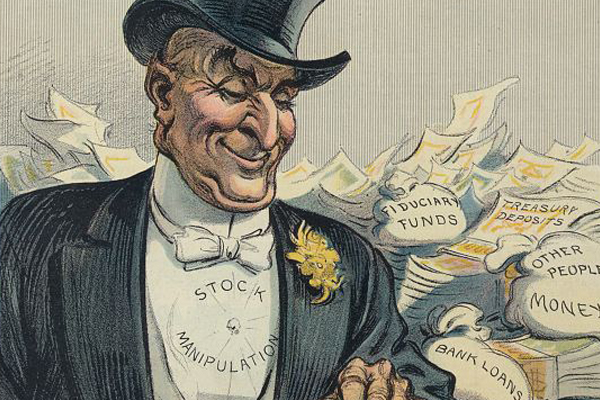
(Credit: Library of Congress) A week or so ago, we read in The New York Times about what in the Gilded Age of the Roman Empire was known as a bacchanal – a big blowout at which the imperial swells got together and whooped it up.
This one occurred here in Manhattan at the annual black-tie dinner and induction ceremony for Kappa Beta Phi. That’s the very exclusive Wall Street fraternity of billionaire bankers, and private equity and hedge fund predators. People like Wilbur Ross, the vulture capitalist; Robert Benmosche, the CEO of AIG, the insurance giant that received tens of billions in bailout money; and Alan “Ace” Greenberg, former chairman of Bear Stearns, the failed investment bank bought by JPMorgan Chase.
They got together at the St. Regis Hotel off Fifth Avenue to eat rack of lamb, drink and haze their newest members, who are made to dress in drag, sing and perform skits while braving the insults, wine-soaked napkins and petit fours – those fancy little frosted cakes — hurled at them by the old guard. In other words, a gilt-edged Animal House, food fight and all.
This year, the butt of many a joke were the protesters of Occupy Wall Street. In one of the sketches, the bond specialist James Lebenthal scolded a demonstrator with a face tattoo, “Go home, wash that off your face and get back to work.” And in another, a member — dressed like a protester – was told, “You’re pathetic, you liberal. You need a bath!”
Pretty hilarious stuff. The whole affair’s reminiscent of the wingdings the robber barons used to throw during America’s own Gilded Age a century and a half ago, when great wealth amassed at the top, far from the squalor and misery of working stiffs. Guests would arrive in the glittering mansions for costume balls that rivaled Versailles, reinforcing the sense of superiority and the virtue of a ruling class that depended on the toil and sweat of working people.
That’s consistent with the attitude expressed by several of these types after Occupy Wall Street sprung up; bankers told the Times on the record that they could understand the anger of the protesters camped on their doorstep; but privately, a hedge manager said, “Most… view [it] as ragtag group looking for sex, drugs, and rock ’n’ roll.”
So sayeth the winners in our winner-take all economy. The very guys who were celebrating at the St. Regis because they were too big to fail. Even when they fell flat on their faces, the government was there to dust them off, bail them out and send them back to fight the class war with nary a harsh word or punishment. Talk about a nanny welfare state.
None of this was by accident. The last three decades have witnessed a carefully calculated heist worthy of Robert Redford and Paul Newman in “The Sting” — but on a massive scale. It was an inside job, politically engineered by Wall Street and Washington working hand-in-hand, sticky fingers with sticky fingers, to turn the legend of Robin Hood on its head – giving to the rich and taking from everybody else. Don’t take our word for it – it’s all on the record.
The biggest of the big boys was Citigroup, at one time the world’s largest financial institution. When the meltdown hit in 2008, the bank cut more than 50,000 jobs and you and other taxpayers shelled out more than $45 billion to save it. And how are Citigroup executives doing? Nicely, thank you. Last year, its CEO, Vikram Pandit, took home $1.75 million in base salary, and was awarded $3.7 million in deferred stock.
According to the Times, “Citigroup is expected to disclose the rest of his pay, cash, be it upfront or deferred, in March. In addition, while not necessarily for work performed in 2011, Mr. Pandit last year was awarded a $16.7 million retention bonus, plus stock options that could add $6.5 million to the package’s overall value.” Makes you want to cry out, “Retain me! Retain me!”
To be fair, Vikram Pandit was at the World Economic Summit in Davos, Switzerland last week, where he told Bloomberg News, “It’s important for the financial system to acknowledge that there’s a great deal of anger directed at it… Trust has been broken. Banks have to serve clients, not serve themselves.” What’s more, he has said that the “sentiments” expressed by Occupy Wall Street demonstrators were “completely understandable.”
This, in contrast to the financial industry official who told a reporter that the protesters’ issues were “a lot of sound and fury, signifying nothing.” Or, as they used to say while partying down at the court of Louis XVI and Marie Antoinette, let them eat petits fours.
Bill Moyers is managing editor of the new weekly public affairs program, "Moyers & Company," airing on public television. Check local airtimes or comment at www.BillMoyers.com. More Bill Moyers.
Michael Winship is senior writing fellow at Demos and a senior writer of the new series, Moyers & Company, airing on public television. More Michael Winship.
Let’s put Jamie Dimon on trial
JPMorgan CEO Jamie Dimon should explain why a megabank that accidentally loses billions is good for the economy
Jamie Dimon (Credit: Reuters/Keith Bedford) Let’s put JPMorgan Chase chairman, president and CEO James “Jamie” Dimon on trial. Mr. Dimon has a reputation for being the sagest guy on Wall Street and an expert at managing risk. JPMorgan emerged from the financial crisis not just unscathed but secure enough to step in and rescue Bear Stearns when the government asked it to. (He gets very mad when you say that his bank got bailed out by the government, and he insists that the government made him take all that free money.) Then his bank somehow accidentally lost billions of dollars last week, whoops! And he is really embarrassed, but not embarrassed enough to fire himself. So, let’s put him on trial and force him to explain what good he and his bank are.
Continue Reading Close
Alex Pareene writes about politics for Salon and is the author of "The Rude Guide to Mitt." Email him at apareene@salon.com and follow him on Twitter @pareene More Alex Pareene.
Romney’s Jamie Dimon problem
JPMorgan's $2 billion blunder makes Mitt's pledge to repeal Obama's bank reform look dumb
Jamie Dimon (Credit: Reuters/Shannon Stapleton) Here is the most important sentence in Jamie Dimon’s Thursday afternoon conference call discussing JPMorgan’s colossal trading screw-up: “Just because we’re stupid doesn’t mean everybody else was.”
If you’re looking for the most easy-to-understand breakdown of how JPMorgan managed to lose $2 billion, read Marketplace reporter Heidi Moore’s fabulous explainer. Readers who fancy themselves financially sophisticated can ponder DealBreaker’s Matt Levine’s analysis. If all you want is a guide to the critics “flaying” Dimon’s hide, check out the New York Times’ DealBook.
Continue Reading Close
Andrew Leonard is a staff writer at Salon. On Twitter, @koxinga21. More Andrew Leonard.
Wall Street’s infrastructure racket
Mayor Rahm Emanual's new strategy for financing renovations isn't actually new -- and it rewards the greedy
Rahm Emanuel (Credit: AP/Jacquelyn Martin) When Mayor Rahm Emanuel introduced a “new and innovative” financing tool last month to help Chicago renovate failing infrastructure without precipitating another budget crisis, many in the city were understandably critical.
Chicagoans have already endured the notorious 75-year lease of their parking meters to a consortium headed by Morgan Stanley. That sale promulgated a system wherein the public is held hostage by private finance, due largely to the inclusion of arcane legal stipulations like “non-compete clauses” and “compensation events” in the language of the contract.
Continue Reading CloseNo one went to jail, so why is Wall Street so mad?
Not prosecuting any of the parties responsible for the recession has just served to embolden them
(Credit: Reuters/Joshua Roberts) In Newsweek, Peter Boyer and Peter Schweizer explore the question of President Obama’s Justice Department’s failure to press any major criminal charges against Wall Street. We learn, distressingly, that “finance-fraud prosecutions by the Department of Justice are at 20-year lows.” Ex-Countrywide whistle-blower Eileen Foster, to name one prominent critic of the Justice Department’s inaction, is still urging the Justice Department to do something about her former colleagues, but to no avail. What’s holding them back?
Continue Reading Close
Alex Pareene writes about politics for Salon and is the author of "The Rude Guide to Mitt." Email him at apareene@salon.com and follow him on Twitter @pareene More Alex Pareene.
A big day for the 1%
America's wealthiest made a killing on Wall Street today -- at the expense of the nation's under-employed workforce
Traders work on the floor of the New York Stock Exchange Tuesday, Feb. 28, 2012. World stock markets fell Thursday March 29, 2012 as signs of weakness in the world's two biggest economies kept investors at bay. (AP Photo/Richard Drew) (Credit: AP Photo/Richard Drew) The Dow Jones Industrial Average hit 13,338 Tuesday, it’s highest since December, 2007. The S&P 500 added 16 points. Wall Street will remember May 1 as a great day.
But most of these gains are going to the richest 10 percent of Americans who own 90 percent of the shares traded on Wall Street. And the lion’s share of the gains are going to the wealthiest 1 percent.
Shares are up because corporate profits are up, and profits are up largely because companies have figured out how to do more with less.
Continue Reading CloseRobert Reich, one of the nation’s leading experts on work and the economy, is Chancellor’s Professor of Public Policy at the Goldman School of Public Policy at the University of California at Berkeley. He has served in three national administrations, most recently as secretary of labor under President Bill Clinton. Time Magazine has named him one of the ten most effective cabinet secretaries of the last century. He has written 13 books, including his latest best-seller, “Aftershock: The Next Economy and America’s Future;” “The Work of Nations,” which has been translated into 22 languages; and his newest, an e-book, “Beyond Outrage.” His syndicated columns, television appearances, and public radio commentaries reach millions of people each week. He is also a founding editor of the American Prospect magazine, and Chairman of the citizen’s group Common Cause. His widely-read blog can be found at www.robertreich.org. More Robert Reich.
Page 1 of 85 in Wall Street
