
“Send me a bill that bans insider trading by members of Congress,” President Obama told the assembled members of the House and Senate in his State of the Union address last week, “and I will sign it tomorrow.”
If only it were that simple.
The Stop Trading on Congressional Knowledge (STOCK) Act, a bill that prohibits legislators and federal officials from knowingly profiting off of nonpublic information related to impending legislation and regulatory decisions, looks certain to pass the Senate this week. On Monday, senators overwhelmingly approved a motion to cloture on S.2038 preventing the bill from being filibustered. But on Wednesday in the House of Representatives Reps. Tim Walz, D-Minn., and Louise Slaughter, D-N.Y., demanded a straight up or down vote on a different bill, HR 1148, also known as the STOCK Act. The House bill already has 271 sponsors.
And therein lies a tale of Washington. No one in Washington favors allowing Capitol Hill insiders using non-public information to reap profits — at least not publicly. But privately, well, that’s a different story.
The Senate version of the STOCK Act differs from the House version in crucial ways. The House bill regulates the so-called political intelligence industry, which consists of lobbyists and private businesses who milk information from members of Congress and their staff and sell it to hedge funds and other investors. The House bill requires people in the political intelligence industry to register as lobbyists. The Senate bill merely calls for study of this obscure sector of the Washington economy, which is worth an estimated $100 million, according to the Wall Street Journal.
As the Journal explained last year:
Information about what’s happening in Washington is at a premium on Wall Street these days. Government regulatory changes and economic initiatives following the 2008 financial crisis have affected numerous industries, and even minor shifts in policy can be of interest to hedge-fund managers. When the health-care bill was snaking its way through Congress in 2009, for example, hedge funds wanted to know about every twist and turn. They followed the debt-ceiling showdown over the summer just as closely.
Keen for information about what’s happening behind the scenes, hedge funds have been drilling ever deeper into the government. Thousands of political insiders are being paid by hedge funds, private-equity firms and other big investors. Former Federal Reserve Chairman Alan Greenspan, for example, is an adviser to Paulson & Co., and former Treasury Secretary John Snow works for Cerberus Capital Management. SAC Capital Advisors and Eton Park Capital Management have hired former congressional staffers.
The move to limit the scope of the STOCK Act seems to have been led by the U.S. Chamber of Commerce and the less prominent but no less well connected Managed Funds Association. According to 2011 lobbying disclosure forms, lobbyists for both groups reached out to Congress with their clients’ concerns about the legislation.
According to Craig Holman, government affairs lobbyist for Public Citizen, a transparency advocacy group that lobbied for the House version of the STOCK Act, the two groups were especially concerned about the regulation of the political intelligence industry.
The U.S. Chamber of Commerce represents some of the most powerful corporations in America and spent almost $350 million lobbying Congress over the past three years, according to OpenSecrets.org. A spokesperson for the Chamber said that the group has not taken a position on the STOCK Act.
The Managed Funds Association lists influential investment firms and banks, such as Goldman Sachs, Bank of America, Citigroup, JP Morgan Chase, UBS and Barclay’s Capital as “strategic partners.” The group’s senior advisors include representatives from Eton Park Capital Management, which received an insider tip about Fannie Mae and Freddie Mac from former Treasury Secretary Hank Paulson in July 2008, as well as representatives from Paulson & Co., SAC Capital Advisors, and Soros Fund Management. A spokesperson for the Managed Funds Association declined to comment on the STOCK Act.
Whether or not these lobbying groups had a hand in the writing of the Senate bill, its provisions provide protections to the political intelligence industry that the House bill does not.
Walz’s version of the STOCK Act prohibits “any person from buying or selling any commodity for future delivery or swap while the person is in possession of material nonpublic information relating to any pending or prospective legislative action” or “material nonpublic information derived from Federal employment relating to the commodity.” It also requires political intelligence firms to register as lobbyists under the Lobbying Disclosure Act of 1995.
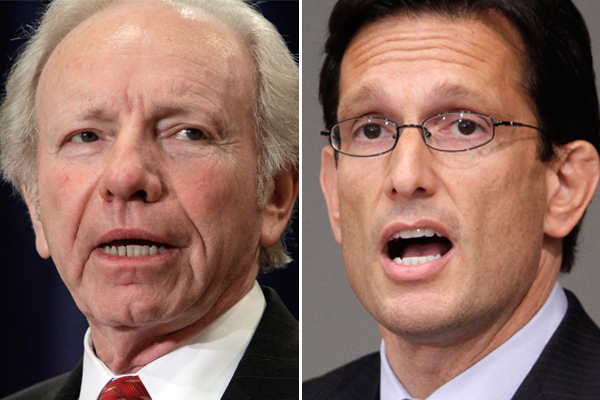
The Senate version of the STOCK Act, sponsored by Sen. Joe Lieberman, I-Conn., is less comprehensive. It merely prohibits any “Member of Congress and … employee of Congress” from using “any nonpublic information derived from the individual’s position as a Member of Congress or employee of Congress, or gained from performance of the individual’s duties, for personal benefit” (emphasis added). The actions of people in the political intelligence industry who use their congressional connections to sell information to the hedge funds would not be covered.
The Lieberman bill does not require political intelligence firms to register as lobbyists. It only mandates that the comptroller general and the Congressional Research Service submit studies on “the role of political intelligence in the financial markets” a year after the legislation is signed into law.
Rep. Slaughter, who has been championing the STOCK Act for five years, believes that curbing the power of the political intelligence industry is a crucial part of restoring the public’s trust in Congress.
“Our constituents didn’t send us here to line the pockets of hedge fund managers,” she has said. “If there was ever a case to show that Wall Street and Capitol Hill have become too cozy this is it, and the political intelligence industry is in desperate need of transparency, meaning they should register as lobbyists do.”
The House version of the STOCK Act got a boost from a “60 Minutes” feature on congressional insider trading last November that reported how members of Congress had used their insider’s knowledge to make profitable stock transactions. But when Republicans and Democrats rallied to support the House bill, House Majority Leader Eric Cantor, R-Va., suddenly balked. He canceled the mark-up by House Financial Services Chairman Spencer Bachus, R-Ala. – a major player in the “60 Minutes” feature and one of those eager to row back from the scandal. Cantor, who came under fire himself for having made a $15,000 bet on the dollar’s decline before last year’s summer debt ceiling fight, later told CBS News that he wanted to ensure that the legislation accounted for more than just deals based on the trading of financial instruments.
After Obama’s speech, Lieberman and Cantor scrambled to protect the Senate bill.
In a colorful floor speech on Monday, Lieberman resisted amendments to his bill by invoking Thidwick the Moose, the kindhearted creature in a Dr. Seuss book who allowed so many of his fellow animals to climb on his antlers that they eventually fell off. (“Dr. Seuss,” it should be noted, was the pen name of the late Theodor Seuss Geisel, a liberal Democrat, who would probably not be amused to learn that one of his fictional creations had been conscripted in the effort to protect the paid informants of Wall Street tycoons.)
For his part, Cantor told Politico yesterday that he wanted to “strengthen” the Senate bill without changing the language that calls for the study — not regulation — of the political intelligence industry.
It’s not hard to guess why Cantor and Lieberman want to leave the political intelligence industry unregulated. According to the Sunlight Foundation’s influenceexplorer.com, they are both major beneficiaries of securities and investment firms. The House majority leader and the senator have received just under $1.4 million and $3.8 million, respectively, in campaign contributions from securities and investment firms over the course of their political careers.
In a statement released after Monday’s cloture vote, Cantor said that he is “pleased” with the Senate bill, but reiterated that he wants to have the final legislation account for more than just financial transactions based on securities exchanges. He also wants the bill to more thoroughly cover the personal finances of members of the executive branch. He said the bill did not “go far enough.”
As for regulation of the political intelligence industry, he suggested that would be going too far.
“I think that the Senate bill … speaks to the potential misuse of that kind of information and untoward activity on the part of, not Members of Congress, but others that are in the business of monitoring Washington,” he said on Tuesday at a press conference. “I think that in advocating — in putting forth a directive to get underneath that kind of activity — to really begin to determine what it is — is something that is helpful.”
If you parse Cantor’s nervous language, he is saying more time is needed to assess whether or not Congress should prohibit private interests from cashing in on insider knowledge harvested on Capitol Hill. If Cantor and Lieberman have their way, the Stop Trading on Congressional Knowledge Act will ensure that some people can continue secretly trading on congressional knowledge.
Walz and Slaughter say they will file what is known as discharge petition to advance their bill this week. If a majority of the House signs the petition, the bill can immediately advance to the House floor for consideration. Whether their bill will reach President Obama’s desk is still in doubt. The hidden power of Wall Street and the hedge funds — “the political intelligence industry” — is not.
In March, a few weeks after the photo of an all-male hearing on contraception went viral, a USA Today story pointed out that on the most recent “Meet the Press” discussing that same policy change, Debbie Wasserman Schultz argued the Democrats’ case, while “the Republican counterpoint was given by a man” – Eric Cantor. The GOP, according to the headline, was in a “struggle to find a feminine voice.”
In Cathy McMorris Rodgers, a mild-mannered congresswoman from eastern Washington, an increasingly visible Romney surrogate and apparent aspirant to be his running mate, they seem to have found it. But it can be an awkward fit.
On April 29, McMorris Rodgers found herself representing elected Republicans on “Meet the Press” opposite Rachel Maddow, who told her, “The first law passed by this administration is the Fair Pay Act … The Mitt Romney campaign put you out as a surrogate to shore up people’s feelings about this issue after they could not say whether or not Mitt Romney would have signed that bill. You’re supposed to make us feel better about it. You voted against the Fair Pay Act.”
“It’s not about whether or not you have a female surrogate,” Maddow went on. “It’s about policy and whether or not you want to fix some of the structural discrimination that women really do face that Republicans don’t believe is happening.” McMorris Rodgers, though she tried to interject, didn’t get a response in.
But McMorris Rodgers (whose office did not respond to an interview request) and some of her colleagues seem to think having a female surrogate is, in fact, enough. The true split over charges of a “war on women” is that Democrats, while nakedly seizing on a political opportunity, are mostly talking about real restrictions on reproductive rights that Republicans in the House and statehouses have sought, and often passed, in unprecedented volume since 2010. But Republicans clearly prefer that these not be called “women’s issues” – that they be about “life,” or “babies,” or “religious liberty” or what have you – because otherwise, it starts to look a lot like excessive government regulation of women’s bodies.
Meanwhile, other legislation intended to improve the lives of women – which, like it or not, generally include different biological and social conditions than men – involve crossing key GOP constituencies (in the case of the Lilly Ledbetter Fair Pay Act, business interests; in the case of expanded Violence Against Women Act protections, anti-immigrant and anti-gay contingents).
What does that leave? It leaves simply being born female and being a Republican is considered enough to counter the charges, at least judging by a cheery but substance-free video from the new House Republicans’ “Women’s Policy Committee,” of which McMorris Rodgers is part. Even for those who want to see the paltry numbers of women in Congress increase, this isn’t much – and anyway, there are more than twice as many Democratic women in the House as Republican women, and 12 Democratic women to the five Republicans in the Senate, two of whom are retiring.
It’s not that McMorris Rodgers, the vice chairwoman of the House GOP conference, entirely lacks personal interest or experience in what’s still awkwardly known as “women’s issues,” though anti-tax and anti-environmental policies have most often been her focus. In 2010, she was responsible for recruiting Republican women to run for the House. She co-chairs the Afghan Women’s Task Force with a Democrat, Rep. Donna Edwards of Maryland.
And she happens to be the only woman to have given birth twice while in Congress. Her firstborn son, Cole, has Down syndrome, and McMorris Rodgers has agitated for funding and benefits for disabilities and Down in particular. In an article pegged to Sarah Palin’s run for vice president, McMorris Rodgers told the Times (in its partial paraphrase) that she feels “like many working mothers: caught between her job and ‘wanting to be the best mom and best wife you can possibly be … You’re torn.’” While she’s sponsored several bills aimed at helping military families – her husband is a retired Navy officer who she has said “has a new appreciation for stay-at-home parents” – and parents of children with disabilities, broader parental accommodations like paid family leave aren’t even on the table.
Despite those superficial resemblances to Palin, the vice-presidential speculation is highly unlikely to go anywhere. And there’s reason to believe that said speculation came mostly out of McMorris Rodgers’ office. In April, the Washington Post reported that an aide in McMorris Rodgers’ office was, embarrassingly enough, emailing reporters about Romney’s potential No. 2: ”One name to keep in mind would be my boss.” And the Fix blogger Chris Cilizza wrote, “This morning an email arrived in the Fix inbox from a ‘dcpress2012′ address, touting the fact that [McMorris Rodgers] was ranked as the seventh most likely VP pick by a website called race42012.com.” She acknowledged her interest to the National Review, though she claimed not to be “seeking” the nomination, and said she’d be happy to see Romney pick a woman.
Another difference is that McMorris Rodgers has never been a flamethrower like Palin — or Michele Bachmann and some of the “Mama Grizzlies” that didn’t make it past the 2010 general elections. But being the general in the war against the phrase “the war on women” can require some stepping up. Last week, she appeared on “Hardball” and was grilled by Chris Matthews about why the GOP version of the Violence Against Women Act she co-sponsored didn’t include protections for same-sex couples. “Those are side issues that have been attached to this bill,” she stammered.
“They’re not side issues if you’re being beat up by your partner,” Matthews blustered. “It’s not a side issue, it’s your life!”
When the topic of contraception coverage came up, McMorris Rodgers accused the president of having started the fight by changing the policy in the first place, and claimed, falsely, that he was making “the Catholic Church” cover birth control.
“If the president can take on an entire faith, an entire religion on this country, think what he can do to individuals,” said McMorris Rodgers. “It’s scary.” And suddenly, the transformation seemed complete.
Continue Reading
Close
Maryland congressman John Sarbanes, D-3rd, isn’t in a highly contested race this year — his opponent is Constitution Party candidate and bartender Eric Knowles. So he has decided to conduct an experiment. Could a congressional candidate in 2012 fund his campaign largely with contributions from small donors? And could he build a network of donors that could be mobilized at a moment’s notice, to pony up cash and fend off attacks by a super PAC?
In October, Sarbanes launched the Grassroots Donor project, a model of fundraising that mimics the Fair Elections Now Act, legislation proposed in 2011 that would give congressional candidates who assemble a large number of small donors access to a federally funded matching fund. The Fair Elections Now Act stands almost no chance of becoming law, and with the Bipartisan Campaign Reform Act made moot by the Supreme Court’s ruling in the Citizens United case, Sarbanes and his colleagues are increasingly frustrated.
Sarbanes’ Grassroots Donor effort is reminiscent of candidate Obama’s 2008 “army of small donors,” which accounted for more than $100 million in contributions. Sarbanes says, yes, “that financing approach Howard Dean pioneered and President Obama perfected serves as a model. But the success of that has only really been proven at the level of presidential campaigns or nationalized races. At the level of rank-and-file congressional races it’s still largely untested.” It’s also arguably most critical at the congressional level because that’s where candidates have the greatest vulnerability to super PAC and other big money attacks.
For example, late last month Karl Rove’s super PAC, Crossroads GPS, paid for television advertising targeting Nevada’s Democratic Senate candidate, Shelley Berkley. Crossroads spent $1.2 million on a package of ads airing in states with competitive races, including Montana, Missouri, Nevada, North Dakota and Virginia. In response, Berkley sent a flurry of emails to supporters asking them to donate $5 or $10 to fight back. (Berkley’s campaign didn’t answer requests from Salon for the amount raised from those small donors.)
After Sarbanes raised $500,000 from traditional donors (individuals giving more than $100, up to the federal limit of $2,500) he locked the money away where it will remain inaccessible until he gets 1,000 people to give between $5 and $100 to his campaign. At this stage it’s less about the money raised from 1,000 donors and more about the number of people involved. “The premise is that if you can get a thousand people to contribute at the grass-roots level, you would have learned enough techniques for reaching them that you can get the next thousand and the next thousand,” says Sarbanes. “The goal of the first thousand is to break into a new way of raising funds, and then you keep going back. Over time the number of donors is large enough to help you fight back.” The congressman is looking for a proof-of-concept, to show his colleagues in the House that it’s possible to build a network of small donors, most of them your constituents, and wean yourself off PAC and other special interest money.
“The collective effect of our dependency on that money is seen when we go to make public policy. The institution leans more in the direction of special interests than in the direction of the public,” he says. For example, even though the public wants the tax on earnings from hedge funds increased, Congress hasn’t been able to do it because the financial industry has so much influence, says Sarbanes. He hasn’t taken any corporate or labor PAC money this election cycle, but acknowledges that most of his colleagues don’t have that luxury.
“Other members are interested in this, but if they are in a competitive district, they have to deal with the system the way it is. I can’t pass judgment on that, a lot of my colleagues are in very difficult races,” he says. “I have some breathing room, so I have the opportunity to experiment, and I feel a responsibility to do this.”
But it’s proving tougher to do than he thought. Sarbanes has 400 small donors so far, three-quarters from Maryland. The average donation is $30. Yet it could work — even if members limit their grass-roots network to donors from their respective districts, that’s about 710,000 people according to the U.S. Census, thousands of them with the ability to give $5, $10 or $15.
Sarbanes’ Maryland district is largely white, with about 15 percent African-American, 8 percent Hispanic and 6 percent Asian. It’s considered a relatively affluent district, although incomes run the gamut. Sarbanes’ issues are the environment — specifically protecting the Chesapeake Bay — as well as environmental education. He’s also involved with public service and volunteerism, and sponsored the Public Service Loan Forgiveness Act, which allows college students with significant federal debt to have that debt forgiven if they perform 10 years of full-time public service work. He authored legislation that established VetCorps, a program within AmeriCorps that provides service opportunities to veterans and military families. And he’s worked to address shortages of healthcare professionals in the workplace.
If Sarbanes can’t reach his 1,000-donor goal, he’ll look into other ways to build a small donor network and tweak his model accordingly. His goal is to introduce campaign finance reform legislation that might include things like a tax credit for the first $50 of contributions to a congressional candidate. “Or a matching fund,” says Sarbanes, possibly funded by a tax on super PAC donations.
“I just want to see if this is possible, to raise money in a different way,” he says. Right now, says Sarbanes, a House member’s downtime is spent making calls to big donors or asking for money from PACs and industry groups. Instead, Sarbanes wants to figure out how to recruit grass-roots donors and what resonates with them. “The way money has to be raised now, it’s consuming us,” says Sarbanes. “It’s making it impossible for us to do the job we want to do.”
Continue Reading
Close
Paul Ryan is nothing if not indefatigable. On Wednesday, the Wisconsin Republican introduced yet another budget bill. The targets of his cuts — a long list of Democratic priorities — are painfully familiar. But this time around Ryan wrapped them up in a new package of urgency: preserving national security!
Ryan and his fellow Republicans (and a not inconsiderable number of Democrats) are desperate to find a way to avoid the dreaded ”sequester” — a package of around $600 billion in defense spending cuts that are scheduled to start kicking in at the end of this year. Never mind the holy grail of deficit reduction: When the beggar with his hand stuck out is the Pentagon, “entitlement” isn’t such a dirty word, after all.
As usual, the suffocating stench of Washington kabuki permeates the whole affair. The only reason defense cuts are on the table in the first place dates back to the failure of Republicans and Democrats to come to a real agreement on long-term deficit reduction at the end of last summer’s debt ceiling debacle. The threat of looming defense cuts that would automatically take effect in 2013 was supposed to force a bipartisan agreement before that dire day arrived. But the chances that Ryan’s newest salvo will get through the Democratic-controlled Senate during an election year are even more unlikely now than they were a year ago. The most realistic scenario? After the election, a lame-duck Congress will kick the can forward, again, to the new Congress and whoever inhabits the White House in 2013.
But a close look at the insidious nature of proposed cuts is still revealing, even in the midst of all the posturing. Ever since the midterm elections of 2010, House Republicans have been honing a new approach to government. Forget about old school “starve the beast” politics, the simple-minded belief that lowering taxes and depriving the government of revenue will ultimately topple the social welfare state. The new school tactic is sabotage. Break the government. Pour sugar into the gas tank. Steal the spark plugs.
Ryan’s new package of cuts takes aim at the heart of the two biggest pieces of legislation Democrats passed during the Obama administration, bank reform and healthcare reform. The details are wonky, but the goal is clear. By defunding crucial mechanisms designed to ensure that the laws actually work as intended, Republicans achieve two goals simultaneously: They avoid the anathema of cuts to defense spending, while rendering the legislation that they hate so much not just toothless, but incapacitated.
Machiavelli would applaud. Republicans may have lost the 2008 presidential election, but their insurgency-style guerrilla tactics ever since have ensured that the war is far from over. In 2012, the politics of sabotage rule Washington.
Ryan’s new bill, the Sequester Replacement Reconciliation Act of 2012, is constructed from recommendations formulated by six different House committees. The targeted cuts reflect familiar GOP priorities. One of the ways the Agriculture Committee, for example, proposes to save $33.2 billion over 10 years is by slashing food stamp assistance. The House Judiciary Committee put forward medical malpractice liability reforms that would theoretically cut federal reimbursements for spending on “defensive medicine” — such as medical tests ordered by doctors simply to protect against lawsuits. And so on.
But for our purposes the two most provocative proposed cuts are the House Financial Services Committee’s plan to defund the “orderly liquidation authority” mechanism in the Dodd-Frank bank reform act, and the House Energy and Commerce Committee’s effort to defund federal support for the construction of the health insurance exchanges at the heart of the Affordable Care Act.
Let’s break it down. The “orderly liquidation authority” — also known as the “resolution authority” — is the mechanism by which the Dodd-Frank Act aims to avoid the bailout chaos of the financial crisis of 2008. The Dodd-Frank Act includes a vast array of new rules for the financial sector, some of which are more far-reaching than others. But the resolution authority is crucial: it’s the law’s primary attempt at solving the Too Big To Fail problem — the frustrating reality that our biggest financial institutions are now so large that their failure routinely threatens to crash the entire U.S. economy. As was demonstrated by the collapse of Lehman Brothers, simply standing by and watching as a major Wall Street financial firm collapses into bankruptcy is an untenable solution. But mindlessly injecting billions of taxpayer dollars without accountability into the likes of Citigroup or the Bank of America or A.I.G. is equally irresponsible.
The Dodd-Frank Act set up a process for determining whether the collapse of a financial institution posed a systemic threat to the economy, putting that company into federal receivership, and guiding it through a government-managed liquidation process. The cost would be recouped by asset sales after the fact. A crucial point: The funding for the resolution authority can only be used to liquidate a financial firm, not to preserve it.
It’s probably worth noting here that the “savings” envisioned by getting rid of the resolution authority are entirely illusory. The Congressional Budget Office determined the cost of the resolution authority as around $30 billion over 10 years. But that’s contingent on whether there are financial firms that require liquidation. The $30 billion price tag is what the CBO thinks the government would have to pay if it was forced to liquidate “one or more” financial institutions sometime in the next decade.
So if Wall Street manages to avoid disaster over the next 10 years, there would be no government outlay. Win win! But the nasty little secret here is that, with or without the liquidation authority in place, the government will still be forced to take action if Citigroup or JP Morgan Chase is on the verge of collapse. Because there’s one thing we know for sure: No matter how much House Republicans claim to revere the autonomously acting free market, when push comes to shove, if the alternative is widespread economic collapse, Wall Street will get its bailout.
It’s also important to point out that the Dodd-Frank bill originally pre-funded the liquidation authority with $50 billion in assessments that would be levied on Wall Street’s biggest financial institutions. But after much screaming from financial sector lobbyists, that provision was dropped at the insistence of Senate Republicans. So what’s really going on here is that after first ensuring that Wall Street was not liable for paying the costs of its own government rescue ahead of time, now Republicans are intent on making sure that Wall Street won’t have to pay after it gets bailed out.
One can certainly question whether the Dodd-Frank resolution authority will work as planned in the heat of another crisis. But what’s the alternative? Republicans have put forth no other plan other than to simply watch as the economy crashes and burns. Instead, under the cover of budget cuts, they are taking aim at one of the core parts of the bank reform laws intended to prevent a repetition of the 2008 catastrophe. We shouldn’t label that fiscal restraint: We should call it vandalism.
The attack on health insurance exchanges is, in some ways, even more reprehensible. If Republicans are supposed to believe in anything, it’s the virtue of free-market competition. And that’s exactly what the health exchanges are supposed to provide. As set forth in the Affordable Care Act, starting in 2014, the health exchanges are where Americans who can’t get employer-provided insurance will go to compare and contrast the costs and benefits of different health insurance plans.
Way back in 2009, Ezra Klein called the exchanges “the most important, unnoticed part of health reform.”
And what happens when you introduce productive competition, efficiencies of scale, more innovation and increased consumer power into a market as dysfunctional as the current situation for health insurance? In theory, you get lower prices and higher quality. And if the Health Insurance Exchange has lower prices and higher quality, more individuals will use it and more companies will buy into it. And if that happens, then the efficiencies of scale should increase, and so should the pace of innovation (as the rewards will be greater with more customers), and so the Health Insurance Exchange should further outpace the other markets, thereby attracting yet more customers, thereby further accelerating the virtuous cycle. Eventually, it could become the country’s primary insurance market.
The Affordable Care Act includes federal funding to help set up the exchanges. The “Sequester Replacement Reconciliation Act” zeroes out that funding. How much will this save taxpayers? Hard to say — the language of Ryan’s bill simply orders the repeal of the provision in the ACA that allows the secretary of the Department of Health and Human Services to make financial aid grants to states at his or her discretion. As of February 2012, 33 states and the District of Columbia had received about $610 million in grants so far.
The attack on funding for exchanges is just one of half a dozen jabs at healthcare reform included in Ryan’s new bill. (Indeed, picking away at healthcare reform has become the GOP’s go-to move for funding any new government expense, as demonstrated, yet again, by last week’s House vote to fund an extension of low interest rates on government student loans by raiding so-called Obamacare slush funds.) And as a deficit-reduction measure, the exchange defunding doesn’t offer anything close to the largest savings. For example: The provision for repealing the Prevention and Public Health Fund, an effort to reduce healthcare costs in the long run by spending more on prevention, would save $16 billion over 10 years. In the big scheme of things, a billion here or a billion there for the exchanges won’t make that much progress toward $600 billion worth of defense cuts.
But as a targeted cut designed to cripple the long-term efficacy of the Affordable Care Act, Ryan could hardly be wielding his scalpel with more precision. It’s brilliant. The part of the ACA that one might imagine most Republicans would be ideologically predisposed to agree with — the use of free market competition to provide consumers with more choice and lower costs — is the part that Republicans want to go after.
But that’s what the politics of sabotage are all about. If Republicans really cared about the federal budget, they wouldn’t insist that tax cuts or wars did not need to be paid for. The point, now, of the budget showdown is not to ensure fiscal restraint, but to disembowel the legislation that a duly elected president and Democratic Congress passed. Starve the beast, so far, has failed. But making sure that government doesn’t work at all? That’s much more doable.
Continue Reading
Close
Liberals who admire the Democratic Party’s tradition of inclusiveness and civil rights should be troubled by what happened last week in Florida. Rep. Debbie Wasserman Schultz, who has served as the chairwoman of the Democratic National Committee since last April, was until then scheduled to speak Saturday at the annual dinner event of the nonprofit group Empowering Motivating Educating Resourceful Grassroots Entities, or EMERGE USA.
EMERGE is a grass-roots group that works primarily with South Asians, Arab Americans and Muslim Americans to empower young people to take part in community service projects, local government and other forms of civic leadership. “Our broad goals are to incorporate minorities generally, Muslim or non-Muslim, into the political system,” EMERGE board member Imran Siddiqui says. Whether it’s running a get-out-the-vote drive or petitioning a city council to stop the construction of an industrial waste dump site next to a mosque, the group’s activities are little different than those of any other classic grass-roots American organization – the only difference being that a large portion of EMERGE’s members are from Muslim communities. Last year, former governor and U.S. Sen. Bob Graham, D-Fla., keynoted their event.
Yet Wasserman Schultz decided to abruptly pull out of speaking at EMERGE’s annual dinner last week. “We never agreed to do a fundraiser, nor an event,” claimed Wasserman Schultz spokesman Jonathan Beeton. Yet EMERGE had previously widely advertised Wasserman Schultz’s participation at the fundraising dinner without apparent complaint from the congresswoman’s staff. “We were interfacing with congresswoman Wasserman Schultz’s people for about a year to try to get something together,” said Siddiqui. “So when she agreed to the banquet, we were elated.” There’s a much more likely explanation for her abrupt refusal to attend the event than a simple miscommunication. For months, Islamophobic websites and a far-right congressional candidate waged a smear campaign against EMERGE, pressuring Wasserman Schultz to back out of the event. With her withdrawal, it appears that they won.
The smears can be traced back to an article in right-wing McCarthyist David Horowitz’s Front Page Magazine. In a February article, Joe Kaufman – who is vying in a Republican primary to challenge Wasserman Schultz for her seat in Congress – teamed up with Militant Islam Monitor’s Beila Rabinowitz to claim that EMERGE was part of a “nefarious agenda of placing Islamists into positions of American power and influence.”
Based on that absurd premise that the community service volunteers and voter registration gurus of EMERGE were out to install an Islamist government in the United States, the bulk of the article’s allegations focused on Khurrum Wahid, one of the group’s founders. Kaufman and Rabinowitz note that Wahid, a civil rights lawyer, represented individuals accused by the U.S. government of terrorism-related crimes. This line of attack was similar to one waged in 2010 against Department of Justice lawyers who represented detainees at Guantanamo Bay. The group Keep America Safe referred to these lawyers as the “Al Qaeda 7,” a charge so incendiary that even a former Bush official rebuked it, noting that “there is a long-standing and very honorable tradition of lawyers representing unpopular or even uncontroversial clients.”
But it’s not surprising that Kaufman would engage in such outlandish smears. They help distract from his own past of espousing extreme ideas and outlandish rhetoric. Shortly after the Sept. 11 terrorist attacks, he endorsed using nuclear weapons against the Muslim world to retaliate, writing, “If the decimation of Hiroshima and Nagasaki was the right thing to do, in response to Pearl Harbor, then why the heck are we saving our nuclear weapons now?” He was even skewered by “The Daily Show” for his crusade to stop a Muslim Republican from getting the acceptance of the Broward County GOP. (Kaufman was at the time ironically leading a group called Americans Against Hate).
So how did a fringe congressional candidate, whose greatest feats have been getting mocked by “The Daily Show” and speaking out against Muslim Family Day at Six Flags on Fox News, cow one of the most powerful Democrats in the country? Unfortunately, he had some help running the smear campaign against EMERGE. His attacks were uncritically picked up by local news bloggers before making their way into larger right-wing publications. The Washington Free Beacon’s Adam Kredo sensationally wrote an article titled “Debbie’s Date With Radicalism,” playing a bizarre game of six degrees to claim that Wahid was associating himself with groups connected to the financing of al-Qaida because he once spoke at a conference of the mainstream Islamic Circle of North America. (Full disclosure: I attended one of its conferences as an elementary schooler, and so has one of Obama’s faith advisors, which may lead to claims that both Obama and I are secretly associated with al-Qaida.)
The article wondered aloud why a “proud Jewess” like Wasserman Schultz would appear with the Muslim-dominated EMERGE, clearly trying to stoke a racial and religious divide. It also quoted a “prominent Jewish Democrat,” who hid behind anomynity to claim that EMERGE’s leaders have a “soft spot for terrorism.” The Free Beacon topped off all of this reporting with a memo titled, “DNC BOSS TO RAISE MONEY FOR TERRORIST LAWYER.”
It’s easy to play this ridiculous guilt by association game with anyone, of course. Take the Washington Free Beacon, for example. It is run by Michael Goldfarb, a former McCain campaign flack who is also a senior vice president at Orion Strategies, a Washington, D.C., consulting firm. Orion Strategies has had as one of its clients none other than George Soros’ Open Society Policy Center. Goldfarb has also worked for the Emergency Committee for Israel, which has a board member who said Palestinians should be thrown into the sea to be “food for sharks” and whose executive director called on the Israeli Defense Forces to use protesters as “target practice.” By their own logic, the Free Beacon is on the payroll of George Soros and has troubling associations with would-be genocidal anti-Arab activists.
The smear campaign against EMERGE should be more comical than respectable – it was led by hysterical Islamophobes and third-rate bloggers – and it would have been, if not for the fact that Wasserman Schultz appeared to give in to it. “Unless the Muslim community has somebody stand up to this,” reflects Siddiqui on the smear campaign, “this is just going to keep happening. And it needs to stop.”
Continue Reading
Close
After a stopgap measure last year, Congress will once again debate whether the United States Postal Service as we know it can survive. The better question is: Will Congress let it?
The U.S. Postal Service is at risk of defaulting on healthcare obligations or exceeding its debt limit by the end of the year. Last month, USPS management unveiled a “Path to Profitability” that would eliminate over a hundred thousand jobs, end Saturday service and loosen overnight delivery guarantees. The Postal Service also proposes to shutter thousands of post offices. “Under the existing laws, the overall financial situation for the Postal Service is poor,” says CFO Joe Corbett. Republicans have been more dire, and none more so than Oversight Committee Chairman Darrell Issa, who warned of a “crisis that is bringing USPS to the brink of collapse.”
Listening to Issa, you’d never know that the post office’s immediate crisis is largely of Congress’s own making. Conservatives aren’t wrong to say that the shift toward electronic mail – what USPS calls “e-diversion” – poses a challenge for the Postal Service’s business model. (The recent drop-off in mail is also a consequence of the recession-induced drop in advertising.)
But even so, in the first quarter of this fiscal year, the post office would have made an operational profit, if not for a 75-year healthcare “pre-funding” mandate that applies to no other public or private institution in the United States.
Warren Gunnels, aide to Sen. Bernie Sanders, calls that mandate “the poison pill that has hammered the Postal Service … over 80 percent of the Postal Service deficit since that was enacted was entirely due to the pre-funding requirement.”
This death hug was part of the Postal Accountability and Enhancement Act, which was passed on a voice vote by a lame duck Republican Congress in 2006. As I’ve reported, the mandate required the Postal Service, over 10 years, to pre-fund healthcare benefits for the next 75. This unique burden costs USPS $5.5 billion a year. The new law also restricted the Postal Service’s ability to raise postage rates, or to provide “nonpostal services” that, in an e-diversion era, could be key to its future. American Postal Workers Union president Cliff Guffey says the bill was designed “by those people who hate government … to destroy the Postal Service. And that’s what they did.”
The Postal Service has long been required to provide “universal service”: delivering to all 151 million addresses in the United States. Conservatives promise that private companies could serve the Postal Service’s function more efficiently, but when it’s their money on the line, the private companies themselves aren’t always so sure. Some of the packages sent through UPS or FedEx are actually delivered by the Postal Service, because those companies save money by contracting with USPS to serve more remote customers.
The Postal Service fulfills its mandate without direct government funding. Faced with right-wing warnings about bailouts, the postal worker union this week is running a new round of TV ads reminding taxpayers that USPS is funded entirely by fees, not taxes. Guffey says the union — the largest of four representing post office workers — will likely hold rallies on next month’s Tax Day to drive home the same point.
Issa and other Republicans have been insisting for years that to stay solvent, USPS needs to make big cuts. In 2010, Issa told the postmaster general at a congressional hearing that the Postal Service has “more or less a third more people than you need. He warned in an Op-Ed that “Allowing USPS to postpone billions in obligations just makes a bailout easier.” In a December Op-Ed, Issa compared continuing Saturday mail service to “asking us to revive the Pony Express.”
Instead, Issa proposes creating a new board that, in the event of default on pre-funding or any other Postal Service obligation, would be empowered to override union contracts and managerial decisions for years.
Elijah Cummings, the Oversight Committee’s ranking Democrat, says for union members who just ratified a contract last year, that would be “a slap in their face … particularly when you have unions who have worked very hard and in a very cooperative manner to help to right-size the Postal Service employee force.”
Cummings also voices concern over USPS management’s proposed cuts to jobs and services. While agreeing reductions are necessary, he says, “I don’t think they would do it with the compassion that I would.” As for ending Saturday service and changing the overnight guarantee, Cummings warns, “We have to be careful that we don’t do things that push even more people away from using the postal service.” Corbett acknowledges that such changes will cost customers, but says that after factoring in such losses, USPS projections show it will still save billions of dollars. “It only makes sense,” says Corbett. “Any financial enterprise would do it.”
Twenty-six Senate Democrats, plus Sanders, have signed a letter raising similar concerns about service cuts and calling for an alternative approach: ending the pre-funding mandate, allowing the Postal Service a refund on billions in overpayments to pension funds, and allowing and encouraging USPS to diversify its services. In a TV interview last month, Sanders suggested that diversification could include shipping alcohol and providing notary and licensing services. (Last year, USPS commissioned a report from Accenture that examined diversification strategies in other countries and estimated that such an approach could have brought USPS $74 billion from 2003 to 2008.) By contrast, Sanders warned that the USPS management’s proposed cuts would mean “a death spiral” as customers are driven elsewhere.
Sanders is among the backers of the Postal Service Protection Act, whose recommendations are similar to the ones in the senators’ letter. Guffey says the most promising route to an acceptable compromise would be for these recommendations to be incorporated into a tri-partisan bill introduced by Sens. Joe Lieberman, Tom Carper, Susan Collins and Scott Brown.
Among USPS management’s proposed changes are a transformation of workers’ healthcare plans and the elimination of at least 155,000 jobs. USPS has already eliminated 130,00 full-time equivalent positions in the past three years. In a union contract signed in May 2011, APWU agreed to concessions in order to preserve its “no-layoff” clause; Guffey says that the Post Office’s projections, designed to make the case for further sacrifices from workers, fail to factor in savings from the concessions they’ve already agreed to. Union leaders expressed surprise last year when, within three months after signing the new contract with APWU, USPS issued white papers in support of congressional proposals to override those layoff protections. But Corbett says he believes the reduction can be accomplished through voluntary incentives.
Cutting those jobs would mean further reductions in public sector employment, including among veterans and African-Americans, who for decades have been over-represented in Postal Service ranks. “It just doesn’t seem like it’s the right time to go after veterans and their employment,” says Guffey. He wants Congress to maintain current delivery standards, which he says would save many post offices from closure.
Cuts have intangible costs as well. Interviewed for a Washington Post profile of the endangered post office in Star Tannery, Va., one resident said, “Closing the post office would be one step toward eradicating small-town life in America.”
True to form, President Obama falls between Sanders and Issa: He would scale back the pre-funding requirement and allow postage rates to rise, but would also back the elimination of Saturday service. In an emailed statement, White House spokesperson Matt Lehrich wrote, “The President proposed a balanced plan that would return USPS to financial viability while saving taxpayers money, and Congressional action that enacts this type of balanced plan is necessary.”
If you want a measure of the narrowness and conservatism of our politics, consider this: In a still-weak economy, with a recovery slowed by historic public sector layoffs, not even Bernie Sanders, the self-identified socialist senator, is proposing that the public good of universal delivery get a public subsidy. Instead, the range of debate is over how Congress should let the Postal Service fund itself: allowing it to raise rates, diversify services and cease funding benefits decades ahead of time; or letting it slash jobs and services. Since most of these proposals require legislative change, any deal will have to make it past filibuster-happy Senate Republicans and John Boehner’s House of Representatives. That political reality – more than technology or economics – is the greatest immediate threat facing the Post Office.
Continue Reading
Close