
War Room

Mitt Romney’s deal with the devil

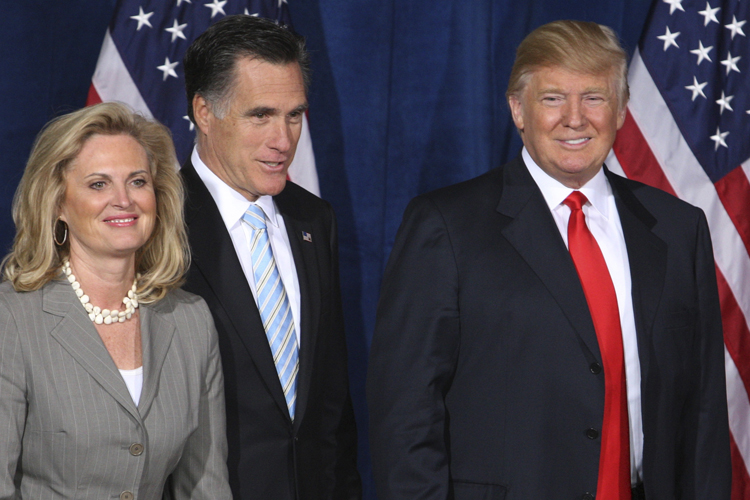
He accepts Donald Trump’s endorsement in a Las Vegas press conference that has the distinct feel of a hostage video

Republican presidential candidate and former Massachusetts Governor Mitt Romney (C) is endorsed by businessman and real estate developer Donald Trump at the Trump Hotel in Las Vegas, Nevada February 2, 2012. (Credit: Steve Marcus / Reuters)

(Updated)

Initial reports indicated that Donald Trump would be endorsing Newt Gingrich in Las Vegas this afternoon, but most major outlets are now saying that the celebrity millionaire will instead throw his support behind Mitt Romney.

As I wrote earlier, Gingrich may be a better match for Trump when it comes to expressing seething contempt for President Obama, but Trump’s public image depends on the appearance of clout, influence and general importance. This makes a Romney endorsement far more sensible; since Romney is far more likely than Gingrich to win the nomination (and in Nevada, where Trump is due to make his announcement), Trump will position himself to claim credit for pushing him over the top.

But is a Trump endorsement a good thing for Romney? That’s a more complicated matter, and it gets to the basic tension between Romney’s primary and general election imperatives.

From a general election standpoint, it’s potentially problematic. For one thing, Trump has always been a lightning rod, but in the past year he’s emerged as a particularly divisive figure, thanks to his birther crusade and degrading attacks on Obama. To the extent these antics have resonance, it’s on the right; among swing voters, they’re much more likely to be a turnoff. At the height of his political activity last year, Trump’s unfavorable score with all voters soared to new heights, and it remains at 48 percent today — eight points above his favorable number.

Plus, Trump’s own top 1 percent image could help reinforce Romney’s main vulnerability as a general election candidate. With his Bain Capital history and personal tax status dominating the news for the past month, Romney’s standing has plunged with blue-collar swing voters, a constituency that will be critical to the GOP’s hopes of ousting Obama. Nor has Romney helped himself with his often-clumsy efforts to inoculate himself against the charge that he’s an out-of-touch plutocrat. Does he really want to be associated with a celebrity business tycoon whose catchphrase is “You’re fired”? Already, Democrats are having some fun with this. “They both like firing people,” DNC chairwoman Debbie Wasserman  Schultz said on MSNBC. “They both make millions doing it.”

So you might think this would be a good moment for Romney to stage a Sister Souljah moment — to dramatically refuse Trump’s endorsement, bask in the resulting praise from the media, and reassure swing voters that he doesn’t embody all of the excesses of Tea Party-era Republicanism. But according to ABC News, Romney’s campaign has had “multiple discussions” with Trump in an effort to secure an endorsement.

From a primary season standpoint, this does make sense. Romney is likely to win the GOP nomination, but Gingrich (and Rick Santorum, for that matter) is still out there and the possibility of more embarrassing hiccups is very real. For instance, Gingrich could plausibly win a bunch of Southern states in early March, a result that would revive all of the talk about Romney’s weakness as a candidate and potentially extend the GOP race through the spring and into the summer. So Romney isn’t out of the woods yet, and it would be risky to make an enemy out of Trump right now. After all, Trump’s anti-Obama shtick resonates with many of the same hardcore Republicans who gravitate toward Sarah Palin, Rush Limbaugh, Herman Cain and the other prominent Tea Party voices who have been helpful to Gingrich recently.

In other words, Romney may well recognize Trump’s potential to hurt him with general election voters. But he wants to make sure he gets to the general election, and that means playing along

Update: And now it’s official. In a somewhat bizarre scene just before 1 p.m. PST, Romney stood next to Trump and formally received his endorsement. “Mitt is tough,” Trump said. “He’s sharp. Governor Romney, go out and get them — you can do it!” Romney seemed slightly uncomfortable, praising Trump for his supposed knowledge of economic issues and his anti-China rhetoric (and even calling him “Mr. Trump”), then veering into his customary talking points. “There are some things you can’t imagine happening in your life,” he remarked at one point. “This is one of them.” What he meant by this wasn’t exactly clear, but his tone suggested he didn’t mean it in the “Wow, this is the greatest thing that’s ever happened to me!” way. Romney didn’t take questions from the press.

Steve Kornacki

Steve Kornacki writes about politics for Salon. Reach him by email at SKornacki@salon.com and follow him on Twitter @SteveKornacki

Win-or-go-home for Pelosi?

She’s as confident as ever, but this could be the last time Nancy Pelosi leads House Democrats into an election

Nancy Pelosi (Credit: Reuters/Jonathan Ernst)

Talk to Democrats on Capitol Hill and one impression jumps out: This might be it for Nancy Pelosi.

The current House minority leader and former Speaker made one of her periodic Sunday show appearances yesterday, issuing a confident assessment of her party’s November prospects on ABC’s “This Week.” Noting that Speaker John Boehner recently said there’s a one-in-three chance Republicans will lose their House majority, Pelosi said, “I think it’s bigger than that. But what he did say that’s correct was that there are about 50 Republican seats in play. I would say 75. I feel pretty good about where we are.”

Take this with a grain of salt. It’s basically the same thing Pelosi says every election year around this time. That’s just her job. But while her public posture remains as steady and focused as ever, there’s reason to suspect that this year’s midterms could be a win-or-go-home proposition for the 72-year-old California Democrat.

Obviously, if Democrats somehow pick up the 25 seats they need for a majority, Pelosi will stick around for two more years, at least, becoming the first Speaker since Sam Rayburn in the 1950s to lose the gavel in one election and win it back in the next. But the takeover odds she quoted on “This Week” are awfully optimistic.

Because of the size of the Republican wave in 2010, there are plenty of pick-up opportunities for Democrats on this year’s map, even the occasional gimme.  But redistricting has imperiled several Democratic incumbents, while a few others who represent heavily Republican districts have opted to retire.

The situation calls to mind 1996, the last time a Democratic president sought reelection. Then as now, the party was coming off a midterm debacle and sought to channel popular anger toward a poisonously unpopular Republican Congress into a majority-making wave. The magic number back then was 19, and Democrats ended up knocking off 18 Republican incumbents (13 of them freshmen); but when retirements and open seats (particularly in the South) eroded the net gain to nine seats, thereby denying Dick Gephardt a chance to be Speaker.

That ’96 result came even as Bill Clinton cruised to a second term, beating Bob Dole by eight points in a race that was never really in doubt. It’s still theoretically possible that a jolt of good economic news will lift Barack Obama to a similarly commanding victory this fall, but it’s far more likely that his race with Mitt Romney will be decided by a point or two either way – probably not big enough, in other words, to produce the kind of down-ballot tide Pelosi is counting on.

This is where the Pelosi retirement talk kicks in. The best tool that one party can have in trying to gain seats in the House is for the other party to control the White House. So if Democrats fall short in the House this fall but Obama is reelected (the scenario considered most likely for now), it will be hard for Pelosi – or anyone – to lead the party to a better result in 2014, when the playing field will probably be tilted in the opposition party’s favor. Only once since James Monroe’s presidency has the White House’s party gained congressional seats in a “six-year itch” election (the one exception: 1998, when the GOP’s unpopular drive to impeach Clinton produced a backlash). And 2016, which would then feature an open seat presidential race after eight years of Democratic rule, probably wouldn’t be conducive to significant Democratic gains either.

Under this scenario, Pelosi might well conclude that her window of opportunity to win back the top job in the House has closed and opt for retirement. If this were to happen, the change for House Democrats would be dramatic. Pelosi hasn’t just been their public face for more than a decade; she’s also been an unusually powerful and canny leader, filling key caucus posts with loyal allies who have subordinated their ambition to hers and identifying and isolating those she views as potential threats. This means that there’s no clear heir apparent if Pelosi goes, at least not yet.

The No. 2 post is currently occupied by Steny Hoyer, but age could be an issue with him (he’ll turn 73 in a few weeks). So could his status as Pelosi’s longtime rival and nemesis. Through nearly four years of fits and starts, she and Hoyer waged an epic battle that culminated in her 23-vote victory in a 2001 race for party whip. That set Pelosi up to succeed Gephardt as minority leader the next year and to become Speaker after the 2006 midterms. She’s never stopped looking over her shoulder, though, taking sometimes dramatic steps to hold Hoyer’s influence (and whatever ambition remains) in check. It’s hard to imagine her leaving without first ensuring that Hoyer doesn’t succeed her.

The next highest-ranking House Democrats, 71-year-old James Clyburn and 63-year-old John Larson, aren’t widely seen as party leader material either. Larson, in fact, owes his post entirely to Pelosi’s distrust of Hoyer; in a famous behind-the-scenes maneuver, she used him as a last-minute vehicle in 2006 to prevent a Hoyer ally, New York’s Joe Crowley, from winning the party’s No. 4 leadership post.

If she does hang it up, Pelosi will presumably seek to play a role in anointing her successor, but it’s not clear whom she’d have in mind. A wide-open leadership fight seems possible.

Not that it’s necessarily wise to begin thinking about life after Nancy. After all, in the run-up to the 2010 midterms, it was commonly assumed that she’d stand down as leader – and retire from Congress – if her party lost the House, like Republican Dennis Hastert did after the ’06 midterms. Pelosi had no interest in walking away, though, and maybe she still doesn’t. Or maybe Mitt Romney will end up winning this year, putting in place just the right formula for a House Democratic revival in 2014…

Continue Reading Close
Steve Kornacki

Steve Kornacki writes about politics for Salon. Reach him by email at SKornacki@salon.com and follow him on Twitter @SteveKornacki

Cory Booker, surrogate from hell

What Cory Booker has to gain by calling President Obama’s attacks on Bain Capital “nauseating”

(Credit: AP)

If Cory Booker went on “Meet the Press” on Sunday with the intent of helping President Obama, then his appearance was an utter failure. But anyone who’s followed the enormously ambitious Newark mayor’s career closely knows he’s not one to pull a Joe Biden. He’s just too smart and too smooth to screw up so epically.

More likely, Booker went on the show to help himself and to advance his own long-term political prospects. And on that score, his appearance was a success.

You’ve probably seen or are now seeing the headlines Booker generated by calling the Obama campaign’s attacks on Mitt Romney’s private equity background “nauseating” and likening them to efforts by some on the right to inject Rev. Jeremiah Wright into the campaign.

“Enough is enough,” Booker said. “Stop attacking private equity. Stop attacking Jeremiah Wright.”

He added: “I have to just say from a very personal level, I’m not about to sit here and indict private equity. To me, it’s just we’re getting to a ridiculous point in America. Especially that I know I live in a state where pension funds, unions and other people invest in companies like Bain Capital. If you look at the totality of Bain Capital’s record, they’ve done a lot to support businesses, to grow businesses. And this, to me — I’m very uncomfortable with.”

Playing up Romney’s Bain record is, of course, central to Obama’s general election plan. Romney is running as a business-savvy “job creator” and relying on the public’s tendency to associate private sector success with economic competence. There is no overstating how vital it is for Obama and his campaign to break that link, and to establish that Romney’s real expertise is in making investors rich – not adding jobs and improving the quality of life for middle class workers.

In belittling this strategy, Booker isn’t just breaking with Obama, he’s breaking with just about everyone who’s ever run against Romney – including Ted Kennedy, who used criticisms of Bain’s treatment of workers to pull away from Romney in their 1994 Senate race. Essentially, Kennedy created the blueprint that Obama is now using. Booker is also providing Republicans with a dream talking point: A top Obama surrogate not only disapproves of Obama’s use of Bain, he finds it nauseating!

It wouldn’t be surprising if Booker has already heard from the White House, and surely he’s now in for a world of abuse from Obama supporters. But that hardly means he made a mistake, at least in terms of his own ambition. Financial support from Wall Street and, more broadly speaking, the investor class has been key to Booker’s rise, and remains key to his future dreams.

It’s easy to forget, but before the world met Barack Obama in 2004, many believed that the first black president would be Booker. Armed with Stanford, Yale and Oxford degrees and all of the invaluable personal connections he forged at those institutions, he set out in the mid-1990s to craft a uniquely appealing political biography, swearing off lucrative job offers to move to Newark’s Central Ward and take up residence in public housing. Within a few years, he won a seat on the City Council, where he showed an early and consistent knack for self-generated publicity, most notably with a ten-day hunger strike in the summer of 1999.

That set the stage for Booker’s 2002 race for mayor, an ugly contest against incumbent Sharpe James, an entrenched icon of the city’s civil rights generation of black politicians. James, as any self-respecting Newark mayor would do, leveraged his clout for campaign contributions from city workers, vendors and those who aspired to be city workers and vendors.

Booker, meanwhile, had hardly lost touch with his old classmates, keeping one foot in Newark and the other in Manhattan, where he built on the connections to elite donors that he already had. He called the millions of dollars he raised for the race “love money.” The press – and James’ campaign – took note that almost all of it was from outside Newark, nearly half of it was from outside New Jersey, and a quarter of it came directly from Wall Street.

This helped bolster James’ claim that Booker, who grew up in an affluent suburb, was not an authentic Newarker. That attack resonated just enough to save James, who won in a squeaker. It was a pyrrhic victory, though: Booker had captured national interest – there was a Time profile during the campaign, and an Academy Award-nominated documentary followed – and immediately started campaigning for the next race, while a federal investigation soon swallowed up James. In 2006, Booker was elected with ease, while James was on his way to jail.

Since then, the only question in New Jersey has been when – and not if – Booker will seek to run for statewide office. In 2009, the beleaguered Jon Corzine begged him to run for lieutenant governor on his ticket, an offer that Booker wisely refused. He’s often touted as a potential gubernatorial candidate for 2013, but those who know him say his eye is more on the Senate seat now held by 88-year-old Frank Lautenberg, which will be up in 2014.

This is why it’s not at all surprising to see Booker going to bat for private equity. The allies he’s cultivated on Wall Street and in the financial industry (think, for instance, of his chummy relationship with Michael Bloomberg) have made Booker a prolific fundraiser, and when he ventured into the ultra-expensive statewide game, he’ll need them more than ever. Many of them have turned fiercely against Obama over the past few years, convinced that he’s unfairly targeted them. Booker’s words on “Meet the Press” may have enraged the average Obama supporter, but to the Wall Street class they were probably close to heroic – finally, a big-name Democrat with the cojones to call out Obama on his class warfare!

The Booker calculation, in other words, is probably that the average Democratic voter’s memory of his outburst will fade long before 2014 – but that the average Wall Street donor’s won’t.

Continue Reading Close
Steve Kornacki

Steve Kornacki writes about politics for Salon. Reach him by email at SKornacki@salon.com and follow him on Twitter @SteveKornacki

Romney killed Americans Elect

The GOP candidate's boringness means there will be no Ross Perot-type wild card in this year’s race

Ross Perot in 1992. (Credit: Reuters/Sam Mircovich)

The much-ridiculed Americans Elect dream officially died last night, when the third way group released a statement saying that no candidate had qualified for its online convention and that the selection process is now over.

In a way, this isn’t at all surprising. The Americans Elect idea was a complicated one that relied on tens of thousands of Americans registering as delegates and participating in a multi-phase online process that would produce a bipartisan national ticket. It also required prospective candidates to go public with their interest and submit themselves to this process with no guarantee of success. In the end, not enough delegates signed up, and only one real candidate – former Louisiana Governor Buddy Roemer, who was treated as a non-entity during his bid for this year’s GOP nomination – stepped forward.

In a broader sense, though, it is somewhat surprising there won’t be a viable third party candidate in the 2012 presidential race. Toward the end of last year, it was starting to look like the basic ingredients for one would be in place: a wounded incumbent with a sub-50 percent approval rating, a sense that the opposition party’s candidate is an unacceptable alternative, and pervasive popular anxiety.

This was the formula that gave rise to the two third party presidential efforts that got the most mileage in the modern era: John Anderson’s in 1980 and Ross Perot’s in 1992.

Anderson, like Roemer, had originally sought the Republican nomination, although he gained more traction, carrying the mantle for moderate/liberal Republicanism and nearly winning a few primaries. When it became clear that Ronald Reagan would be the nominee, Anderson bolted the party and launched an independent bid. The logic was sound enough at the time: Reagan had the image of a dangerous, trigger-happy extremist, and just 16 years after the Goldwater debacle it was widely assumed that he was unelectable. At the same time, Jimmy Carter’s approval ratings were falling to the low-30s; the sentiment to get rid of him was widespread.

So there seemed to be a gigantic opening for a middle-of-the-road third choice, and sure enough, Anderson showed early polling strength, climbing to over 20 percent in the spring of ’80. He even made it into a one-on-one nationally televised debate with Reagan in September, with Carter boycotting (under the belief that it would further legitimize Anderson and cause him to pull even more votes from Carter). But by October, Anderson’s support was in decline. The sentiment to fire Carter remained strong, but as Reagan gained exposure, swing voters began to regard him as an acceptable alternative, and to see Anderson as a spoiler. Other Anderson supporters defected to Carter, simply to stop Reagan. In the end, Anderson secured 5.7 percent – a number that understates his prominence in the ’80 race.

Perot also capitalized on a deeply unpopular incumbent, George H.W. Bush, whose approval rating had fallen to the low 40s by early ’92. Perot first floated the idea of running on “Larry King Live” in February, and it quickly caught fire with an electorate that was sick of the incumbent but troubled by the scandals that seemed to continually jolt the presumptive Democratic nominee, Bill Clinton. By the late spring, Perot was consistently running in first place in national polls, with Clinton a distant and forgotten third.

But Perot didn’t hold up to scrutiny, while Clinton began repairing the damage to his image. In mid-July, after falling out of the lead, Perot abruptly withdrew, helping Clinton to emerge from the Democratic convention with a lead of well over 20 points over Bush. That lopsided advantage persisted through the summer and into the fall, when Perot reentered the race and qualified for the debates. The Texan’s performance was strong enough that he finished with 19 percent of the popular vote, the best national showing for a third party candidate since Theodore Roosevelt in 1912.

(Perot, of course, tried again in 1996, but while his performance that year – 8 percent of the vote – technically exceeded Anderson’s from 1980, he was locked out of the debates and had little impact on the campaign.)

There are some obvious parallels between today’s environment and the environments that created Anderson and Perot. And when it seemed possible last fall that the GOP would anoint Rick Perry (or another culturally polarizing ideologue) as its nominee, the idea that there’d be a viable third choice this year – whether through Americans Elect or some other vehicle — made sense.

But Mitt Romney’s emergence as the GOP’s presumptive nominee changed the equation a bit. It’s absolutely true, as Jamelle Bouie detailed in the American Prospect this week, that Romney as president would probably end up functioning as an instrument of the far-right forces that lead his party. But, thanks in no small part to all of the moderate and liberal positions he took to win office in Massachusetts years ago, Romney has the image of a moderate, and is often described as one in the press. Plus, his style is often mocked, but that’s because he can seem wooden and awkward, not because he’s unusually abrasive or inflammatory. It’s not surprising he’s been able to substantially improve his personal favorable rating since securing the GOP nomination. The third party formula calls for an opposition party nominee that arouses instant alarm among swing voters, but Romney is pretty close to being a generic Republican candidate.

So there’ll be no Ross Perot or John Anderson this year. But if you still want to have fun with third party mischief scenarios, you’re not entirely out of luck: former Virginia Rep. Virgil Goode is running as the Constitution Party’s candidate; what if he peels off a small but consequential share of the vote in his home state, aka the premier swing state?! There’s also Gary Johnson, who also got the Roemer treatment during the GOP primaries and is now running as a Libertarian. A new poll has him at 7 percent in the liberty-loving swing state of New Hampshire…

Continue Reading Close
Steve Kornacki

Steve Kornacki writes about politics for Salon. Reach him by email at SKornacki@salon.com and follow him on Twitter @SteveKornacki

About that “death march”…

Mitt Romney’s goal of becoming a perfectly average presidential candidate is suddenly within sight

Mitt Romney (Credit: AP/Mary Altaffer)

Remember earlier this spring, when Mitt Romney was emerging from the Republican primary “death march” with some of the worst personal popularity ratings for any presumptive nominee of the modern era?

Well, things have changed a bit since then. A new Gallup poll shows Romney’s favorable score recovering from its nadir and pulling roughly even with President Obama. Romney, according to Gallup, is now seen positively by 50 percent of voters, with 41 percent viewing him unfavorably. Obama’s favorable number is 52. Just a few months ago, Romney’s scores were stuck in the mid-30s. The one silver lining for Romney back then was that Bill Clinton had been in a similar spot when he emerged from the 1992 Democratic primaries only to bounce back and win easily in the fall.

If anything, the pace of Romney’s recovery is ahead of Clinton’s. It wasn’t until early July 1992 – three months after he won the New York primary and became the presumptive Democratic nominee – that Clinton’s favorable rating climbed ahead of his unfavorable score. There was a reason for this: The spring months of ’92 were dominated by the Ross Perot phenomenon, which relegated Clinton to afterthought status in media coverage. For months, the slick, scandalized image that Clinton had been saddled with during the primaries endured, but as Perot wilted under the campaign spotlight in June and early July, Clinton finally got a fresh look from the public.

With no third-party distraction, Romney has benefited from that fresh look much earlier. Gallup shows that a big chunk of his improved standing comes from shoring up his own party’s base, with a jump of 22 points in his favorable score among Republicans. Romney’s popularity is also up 11 points among independents, giving him a right-side-up 48-43 percent favorable score with them. Other recent polls have found similar results; Fox’s new survey, for instance, has Romney moving from a net-unfavorable margin of 10 points in March to a net favorable margin of 2 points now.

What this means is that Romney is close to becoming what he’s always aspired to be in this race: The generic opposition party candidate, with popularity neither significantly higher nor lower than it should be.

Mind you, this doesn’t mean that all the pieces are in place and Romney is now on course to win in November. For one thing, the Obama campaign will do everything in its power – and spend tens of millions of dollars — to drive down Romney’s popularity. It’s hard to imagine it dropping back to where it was in March, but a decline of even a few points from where it is now could be a serious problem for Romney. He could also stand to improve his score a few points; right now, it qualifies as adequate, but hardly great.

Ultimately, though, the generic candidate strategy depends on a majority of voters deciding that they want to throw the incumbent out. Romney’s goal is to offend as few voters as possible and to be positioned as an acceptable vehicle for these voters to act on their instincts. On this front, he’s nowhere near as well-positioned as Clinton was in ’92. Clinton was running against an incumbent, George H.W. Bush, whose job approval rating hovered in the high-30s and low-40s. Obama, by contrast, clocks in somewhere in the high-40s.

That’s a significant difference. We all remember Clinton as a master campaigner, but it was Bush’s profound unpopularity more than Clinton’s effortless charm that drove the ’92 result. A generic Democrat, in other words, would have won that race. Obama’s approval rating is low enough now that a generic Republican could win this year’s race, but it’s a much iffier proposition.

Continue Reading Close
Steve Kornacki

Steve Kornacki writes about politics for Salon. Reach him by email at SKornacki@salon.com and follow him on Twitter @SteveKornacki

When Mitt ridiculed Clinton

He’s either forgotten or just won’t admit how Bill Clinton actually balanced the budget

Mitt Romney in 1994 (Credit: AP/C.J. Gunther)

Mitt Romney’s “Bill Clinton strategy” is getting plenty of attention this week, and the idea is simple enough: Make it seem as if President Obama’s policies are so far to the left that they’re outside the mainstream of his own party’s tradition. In a way, it’s a response to Obama’s own use of Ronald Reagan – the conservative president who raised taxes 11 times and denounced debt ceiling brinkmanship — as a measuring stick for how far to the right this era’s GOP has moved.

But unlike Obama, who was a student and young community organizer during Reagan’s presidency, Romney was a public figure when Clinton was in office, running for the U.S. Senate in the 1994 midterm elections. Which means he actually took positions in real time on some of the key actions that formed the basis for Clinton’s presidential legacy – the legacy he’s now holding up as an example of responsible governance.

Nowhere is this more awkward than on the subject of taxes and deficit reduction. Romney this week wove Clinton into a speech that blasted Obama for kicking up “a prairie fire of debt,” claiming that the current president had “tucked away the Clinton doctrine in his large drawer of discarded ideas.” The problem is that Romney actually ridiculed the Clinton doctrine for reducing the deficit as it was implemented.

Romney and today’s GOP often cite the balanced budgets and surpluses that marked the late years of the 1990s, generally crediting them to what was then a Republican-controlled Congress. They’ll also give Clinton a measure of credit, if only as a backdoor means of slamming Obama, by citing welfare reform or some other compromise he struck with Republicans. But there’s really only one thing that Bill Clinton did to erase the deficit: He raised taxes on the rich – against the wishes of every single Republican in Congress.

Clinton’s 1993 budget, which was enacted as the country was emerging from a recession and confronting leftover deficits from the Reagan years, hiked rates on the top 1.2 percent of income-earners and created a new 39 percent tax bracket. Republicans branded it “the biggest tax increase in world history” and screamed that it would kill millions of jobs and plunge the country back into recession. (For a sense of the hysteria they stirred, just watch the video in this post of Newt Gingrich, John Kasich and other top congressional Republicans at the time.) Attacks on the Clinton tax increase became a major component of the GOP’s 1994 midterm campaign strategy – which is where Romney comes in.

Running against Ted Kennedy in Massachusetts, he embraced the ’93 budget as an issue, playing up the tax increases and claiming that it would do nothing to curb deficits because Democrats had refused to make real cuts in spending. When Clinton came to the state in late October to campaign with Kennedy, Romney held a rally of his own with Bill Weld, then the state’s Republican governor. As the Boston Globe reported it:

As Weld led the cheers of “Go, Mitt, Go,” Romney labeled Kennedy and Clinton “the guys who put together the biggest tax increase in the history of the nation” and said they were in Massachusetts “explaining why they need more of your money.”

“It’s fine for Bill and Ted to have their excellent adventure,” Romney said. “But I’d rather be here with Bill Weld showing the voters we care about taxes, about real jobs being created, about being tough on crime and being tough on welfare.”

Romney also bought 30 minutes of television time for an infomercial just days before the election. In it, he warned that if Kennedy were to be reelected “the national debt would be pushed even higher.”

But voters reelected Kennedy anyway, by 17 points, and the deficit was gone just a few years later. The Republican warnings about a second recession never materialized, and as the economy picked up strength, the new Clinton tax rates (on top of the hikes that President George H.W. Bush enacted over his own party’s objections in 1990) produced a revenue windfall and the resulting surpluses — which Romney and Republicans now hail as the work of a Democratic president who, unlike Barack Obama, just didn’t believe in class warfare.

Continue Reading Close
Steve Kornacki

Steve Kornacki writes about politics for Salon. Reach him by email at SKornacki@salon.com and follow him on Twitter @SteveKornacki

Page 1 of 2650 in War Room