
Planned Parenthood

Susan G. Komen’s priceless gift

A radical decision woke the country up to an alarming rightward drift, and gave new life to women’s health advocacy

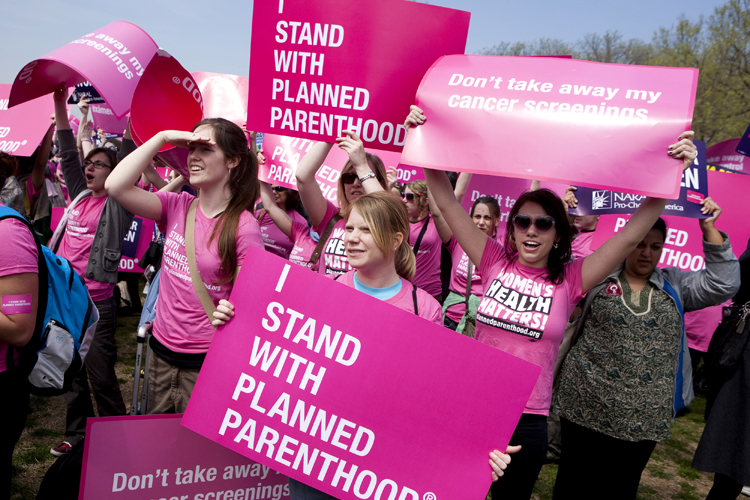
Members of Planned Parenthood, NARAL Pro-Choice America and more than 20 other organizations hold a "Stand Up for Women's Health" rally in Washington (Credit: Joshua Roberts / Reuters)

The startling intensity that we saw this week in response to Susan G. Komen for the Cure’s decision to pull its grants from Planned Parenthood — an intensity that prompted the Komen foundation to reverse its decision today — may be the best thing that’s happened to the conversation about reproductive rights in this country for decades. It certainly should be.

Practically since Roe v. Wade was decided in 1973, reproductive rights activists have been left to play stilted defense against ideological opponents who grabbed the language of morality, life, love and family as their own, always deploying it with reference to the fetus. The rhetoric around reproductive rights, which has more recently begun to creep into arguments over contraception, has become suffocating in its emotional self-righteousness, but too muscular, too ubiquitous to effectively combat.

But the overreach by the Komen foundation, while surely intended to strike yet another blow on the side of antiabortion activism, succeeded instead in waking a powerful constituency — armed with precisely the language and emotional heft they’ve been lacking for too long.

That this week’s blow against Planned Parenthood came not directly from John Boehner’s House of Representatives – which, ever since taking power a year ago promising to focus on jobs, has manfully focused on the single task of attacking women’s reproductive rights – but instead from a popular, officially nonpartisan organization dedicated wholly to women’s healthcare somehow brought this argument into the open.

The response to Komen was surely so tinderbox explosive because it had been building with every politically theatrical investigation launched by Cliff Stearns and every grisly abortion scene enacted on the House floor by U.S. Rep. Chris Smith. But it was not just Washington wonkery, and was not ginned up or amplified by professional political cranks. It was the reflexive kick of a shin hit just below the knee, and the visceral anger spilled everywhere, from a Planned Parenthood Saved Me tumblr and onto Facebook, where people posted images of Komen’s pink ribbon cut in half. It poured from bank accounts, including that of New York Mayor and former Republican Michael Bloomberg.

It came from often dispassionate media figures like Andrea Mitchell, was tweeted by novelists like Judy Blume, Terry McMillan and William Gibson, actors Ellen Barkin and Martha Plimpton, politicos like Donna Brazile, Reps. Gwen Moore and Jackie Speiers, former Speaker Nancy Pelosi and from 22 senators including Frank Lautenberg, Al Franken and Kirsten Gillibrand, who signed a letter urging Komen to reverse its decision. It came from callers to radio programs, announcing their intentions to drop out of Komen races, and from the American Association of University Women, which canceled a scheduled service event with Komen. In the three days after Komen’s announcement of its Planned Parenthood break, Planned Parenthood received more than $3 million in donations, said PPFA president Cecile Richards in a press call on Friday.

More than that, though: The starkly observable attack against something as crucial and basic as breast exams for poor women, as well as the fact that so many divergent voices were pulled into it, meant that the conversation was not about partisan politics; it was about women. For the first time in what feels like forever, passion and fury were being loudly, proudly given in a full-throated voice, on behalf of women – women as moral actors; women as citizens with rights, health, bodies, freedoms; women as people with families and economic concerns.

Taken together, these factors mark this as a watershed moment in the contemporary conversation about reproductive rights. This is a story in which we see the possibility of a turned tide, a new way to gauge how the public actually feels about women’s rights and health, and a new way to talk about it, as well. Because what we saw this week was big. It was mass. It was emotional. This was so different from the various polls activists on both sides of the abortion question are always throwing around, polls that depend so much on how a question is asked; polls that offer far less clarity than head-banging confusion about where America stands on the issue of reproductive heath. This was not a poll. This was America announcing that it cared about women’s health, and more specifically, that it cared about Planned Parenthood.

In many ways, the activism that forced Komen to backtrack was ignited by Boehner’s House Republicans a year ago, when they voted to cut off all funding to Planned Parenthood because it provides abortion services. This despite the fact that since 1976’s Hyde Amendment, no federal money has been able to be used to provide abortion services. The organization Republicans want to squash provides more than 800,000 women a year with breast exams, more than 4 million Americans with testing and treatment for sexually transmitted diseases, and 2.5 million people with contraception, which prevents unintended pregnancy and thus abortion. But playing to what they must imagine is overriding public sentiment, Republicans have worked tirelessly to lodge the image of Planned Parenthood as an abortion factory deep in the American imagination.

A year ago, some of the anger at this strategy began to bubble over. In response to Smith’s description of a second trimester abortion, read on the House floor, Democratic U.S. Rep. Jackie Speier went to the House well and described her own painful second trimester abortion. “For you to stand on this floor and suggest that somehow this is a procedure that is either welcomed or done cavalierly or done without any thought, is preposterous,” Speier said, directing her comments at Smith. “Planned Parenthood has a right to operate. Planned Parenthood has a right to provide services for family planning. Planned Parenthood has a right to offer abortions. The last time I checked, abortions were legal in this country … I would suggest to you that it would serve us all very well if we moved on with this process and started focusing on creating jobs for the Americans who desperately want them.”

It was around this time that a viral “Thank You Planned Parenthood” meme cropped up online. With participants noting the instances in which they had relied on PPFA for birth control, breast exams, gynelogical care, and yes, abortions. Twitter, Facebook and blogs began to be dotted with “I stand with Planned Parenthood” emblems. Comedian Lizz Winstead kicked off a tour called “Planned Parenthood, I am here for you.”

But this recent wave of defense of Planned Parenthood has remained broad, ambient. The politics of the congressional witch hunt have been so labyrinthine, so convoluted, that it has been difficult to know how to effectively harness an angry response. When, last fall, Rep. Cliff Stearns launched an investigation into PPFA’s bookkeeping, the move was so needless, such a trumped-up piece of political stagecraft (since PPFA does receive federal funds, it must scrupulously account for every dime it spends, no special investigation required) that it was hard to even know how to make sense of it, let alone respond. This week, a caller to WNYC’s “Brian Lehrer Show” professed her belief that the Stearns investigation centered on whether Planned Parenthood was performing late-term abortions.

The demonization of Planned Parenthood should have awakened the country to the radicalism of the right, and how far it has pushed the political conversation. It’s been hard to measure the degree of the radicalism, so slowly and unceasingly has it crept across our consciousness and the political discourse. But it’s important to remember how mainstream Planned Parenthood used to be. It was the respectable, even Republican, advocate for women’s health, including reproductive services; the leaders of the National Abortion Rights Action League were the activist agitators. Sen. Prescott Bush, the father of President George H.W. Bush, served as treasurer of Planned Parenthood’s first national fundraising campaign. Richard Nixon signed the family planning legislation in 1970 that authorized its federal funding.

As a congressman, George Bush and his wife, Barbara, were reliable friends of the organization. Barry Goldwater’s wife, Betty, was a founding member of Arizona Planned Parenthood; President Gerald Ford’s wife, Betty, was a high-profile supporter of the group. More recently, Ann Romney, wife of the 2012 GOP presidential front-runner, donated $150 to Planned Parenthood in 1994. And when a Romney relative died of a botched abortion in 1963, the family asked that memorial donations go to Planned Parenthood.

But what happened this week was a clarifying moment. Right-wing extremism, coming this time not from the partisan mill but from a mainstream women’s organization, was put in a direct and unflattering spotlight. Suddenly, so much was clear, and finally, the response was unified and thunderous. Right-wing overreach — and the backlash it inspired — feels a lot like the way other radical GOP power grabs in the last year have galvanized the public to fight back. Attacks on collective bargaining, public workers and unions by Republican governors in Wisconsin, Ohio and Indiana have produced mass mobilization in those states, the likes of which we haven’t seen in decades. Public workers – cops, firefighters, nurses, teachers, paramedics, sanitation workers – once were the proud backbone of the middle class. Now they find themselves derided by the GOP as the new welfare queens who are taking more than their fair share. Ohio voters repealed a law that abolished collective bargaining in November, and pro-union organizers in Wisconsin have forced a recall election for Gov. Scott Walker.

Efforts to restrict voting rights are likewise waking up the citizenry; Maine repealed a law that banned same-day voting and registration in November, and Ohio blocked a voter photo ID bill. Even on the issue of reproductive rights, a draconian “personhood” amendment to the state constitution failed to pass in Mississippi, one of the reddest of the red states. Overreach by the right has re-inspired movements – unions, voting rights, women’s rights — that have too long been dormant and too easily dismissed by their ideological opponents as outside the mainstream of American values, when in fact, they used to represent the most American of values.

For defenders of Planned Parenthood, and more broadly for reproductive rights activists, this moment of repositioning is a valuable one. Until now, it has proven very difficult for advocates to resuscitate their side with language anywhere near as powerful as that used by antiabortion forces. Instead they have relied too heavily on the fungible, limp, endlessly open-ended language of “choice.” (Even among “pro-choice” advocates, the “I choose my choice!” joke from “Sex and the City” has become a ubiquitous critique.)

But what happened this week was powerful. It was mass. It was direct. It was emotional. And it restores women as the moral center of this conversation — which is where they belong.

Rebecca Traister

Rebecca Traister writes for Salon. She is the author of "Big Girls Don't Cry: The Election that Changed Everything for American Women" (Free Press). Follow @rtraister on Twitter.

Joan Walsh

Joan Walsh is Salon's editor at large.

Jay-Z’s daughter will be the worst

Blue Ivy's dad admits that parents fail -- and offers a reality check for the rest of us

Beyonce and Jay-Z (Credit: AP/Bill Kostroun)

Jay-Z’s daughter is going to be insufferable. Just ask Jay-Z. In an episode of “Oprah’s Master Class” that aired on her OWN network Sunday, the Grammy winner, entrepreneur, ball and chain to Beyoncé and new dad to Blue Ivy Carter admitted, “I imagine I’ll take things I learned from my mom and things I’ve learned from raising my nephews and apply that — then at the end of the day, I just know I’ll probably have the worst, spoiled little kid ever.”

For a man who’s built a career on his swagger, there’s something very different – and adorably humble about Z’s acknowledgment that “Everyone imagines they’ll be a great dad — until their teenager’s saying, ‘Get away from me, Dad. You’re embarrassing me!’” And it’s a refreshingly clear-eyed view of the complicated reality of parenting.

Blue Ivy will not have a hard-knock life. She was born in a hospital suite bigger and nicer than your apartment.  She will know her way around red carpets before she can walk on them, and she will fall asleep to lullabies from Mary J. Blige.

But having a childhood that may include getting horsey rides from Kanye West is no assurance of happiness or fulfillment or future success. Z is, with his characteristic savvy, aware of that. He knows there’s a vast difference between the high-minded intentions of parenthood and the visceral, practical realities of it. You set out with goals for a perfect baby who will eat only organic vegetables and watch nothing but PBS episodes of “Live From Lincoln Center,” who will grow into the academic superstar/Oscar winner/beloved humanitarian who cures cancer.

And then they turn into people. People who are sometimes difficult and downright unlikable and who make mistakes, just like their parents. By being willing to laugh about that now, and acknowledge that sometimes your kids can be jerks, Jay-Z is sensibly keeping the hard work of parenting right-sized. He’s reminding us that you can give your kid everything and have her not turn out well. Sometimes, it’s because you give her everything she doesn’t turn out well. We all just do our best. And strange as it may sound, Blue Ivy’s dad is off to a fine start by saying she might be the worst. If someday he’s having girl problems, I’ll feel bad for him. But I have a feeling Z – and Ivy — will turn out just fine.

Continue Reading Close
Mary Elizabeth Williams

Mary Elizabeth Williams is a staff writer for Salon and the author of "Gimme Shelter: My Three Years Searching for the American Dream." Follow her on Twitter: @embeedub.

Why Planned Parenthood matters

The Tea Party tried to turn the group into the New Black Panther Party, and instead inspired an ongoing backlash

(Credit: Reuters)

On Thursday I’ll be speaking at Planned Parenthood of Illinois’ annual gala, and I’m honored. (Tickets are available here.) I’ve always supported Planned Parenthood, but I think the group has helped change the political debate in this country in tangible ways over the last year or so, and I’m excited to talk about where we go from here.

We also have to thank the Tea Party, of course. My MSNBC colleague Chris Hayes joked on Monday that Tea Party extremists “thought they could turn Planned Parenthood into the New Black Panthers” – that Fox News boogeyman – but they were wrong. When they pushed to defund Planned Parenthood, they touched off a grass-roots uprising to defend not only the organization, but women’s health and freedom. It flared up again when Susan G. Komen defunded Planned Parenthood, and Komen had to reverse itself.

I think the attacks on Planned Parenthood are part of what is widening the gender gap behind President Obama. Reading David Corn’s absorbing “Showdown: The Inside Story of How Obama Fought Back Against Boehner, Cantor and the Tea Party” (I’ll write more on it soon), I was bewildered all over again that House Speaker John Boehner tried to force President Obama to cut federal funding to Planned Parenthood in their negotiations to avert a government shutdown last April. Obama wisely refused.

I’m not going to be partisan in my talk, because there are still Republicans out there who support Planned Parenthood and what it stands for. As Rebecca Traister and I wrote after the Komen debacle, Planned Parenthood was traditionally the staid, bipartisan women’s health organization, supported by Republicans like Peggy Goldwater, Prescott Bush and his son George H.W. Bush, Barbara Bush, Betty Ford – and of course, at one time, Ann Romney, and Mitt Romney’s extended family. I think it would be good for the country, not just for Planned Parenthood, if believing that women (and men) should be able to plan their families went back to being a bipartisan point of view. Actually, it is still a bipartisan point of view, it’s just that Tea Party extremists are trying to hijack the Republican Party and impose a fringe view on the rest of us.

But the double-barrel assault on Planned Parenthood, first by the Tea Party, then by Komen, woke women up to that new radicalism, one that put even contraception access back on the table. (Thanks, Rick Santorum!) I think it also woke up the women’s movement to the importance of placing contraception and abortion services in a full spectrum of women’s healthcare – as well as in the larger context of the kind of society we want.  In the ’70s, the right grabbed the language of morality, love and family as its own. We’re taking it back. The assault on Planned Parenthood, and the spontaneous public backlash, reminded a lot of feminists that we’re the mainstream — the Tea Party radicals are not.

I’ll be talking about what we do with all that energy in my speech on Thursday. Hope to see some of you there.

Continue Reading Close
Joan Walsh

Joan Walsh is Salon's editor at large.

Tucker Max’s failed stunt

Planned Parenthood turns down the bad boy's $500,000. Here's why, and what he should really do

Tucker Max (Credit: tuckermax.com)

At first, I wasn’t sure what I thought of the news today that Planned Parenthood had turned down a half-million-dollar donation from Tucker Max. Sure, it was a transparent bid to burnish the reputation of a man who appears to have made millions on douchery, but hey, Michael Bloomberg did it too, and the money was going to a good cause — especially in Texas, which just punished low-income women by defunding Planned Parenthood.

But as Jill Filipovic persuasively pointed out at Feministe, Planned Parenthood made the right call in (eventually, and somewhat clumsily) turning down Max, who wanted a clinic named after him in exchange for the donation. “In order to accomplish their mission, Planned Parenthood needs to not open themselves up to further politicization and marginalization,” she wrote. “They’re already under attack from the GOP for doing nothing other than providing health care to women… [Taking] unnecessary risks can mean that the organization ceases to exist. That impedes their mission a hell of a lot more than not having an additional $500,000.” And that was before Max’s charming tweets about Planned Parenthood resurfaced: “Planned Parenthood would be cooler if it was a giant flight of stairs, w/someone pushing girls down, like a water park slide #FF @PPact” from last July, and just a month ago, “In South Florida. This place is awful. Shitty design, slutty whores & no culture, like a giant Planned Parenthood waiting room.” Today, after his media strategist Ryan Holiday blogged about the Planned Parenthood rejection at Forbes, Max hastily deleted the tweets. (Update: Max appears to have deleted the recent South Florida tweet, but not the one from last summer.)

When I tweeted a link to Filipovic’s piece and suggested Max donate anonymously, Holiday, whom I met recently at a party in Austin, emailed me in response, “You know they didn’t even suggest doing an anonymous donation instead. It was a complete rejection. Not to say that’s an option we would have gone with, donors often have conditions for their donations and naming rights is pretty standard. The money went elsewhere (Wounded Warrior foundation, etc).” He copied Max, whom I’d met at the same party.

I responded, “Hi guys! You already know I don’t think Tucker should be shunned and stoned. (Although that may because I haven’t read his books.) I just think you shouldn’t be surprised when what is transparently a publicity stunt in at-best-mixed-faith is met as such. As Jill point out, Planned Parenthood has enough to deal with — I would add that they already get tarred as enabling bad male behavior and even abuse (which I think is ridiculous for all sorts of reasons, but I don’t have to do their jobs). Of course donors have conditions for their donations, but I think this particular set of conditions would have benefited Tucker more than it would, in the long term, benefit women who need health care.” I was referring to the fact that one of the right’s favorite smears of Planned Parenthood is that it allegedly providing cover to boorish and/or abusive men who don’t have to suffer the “consequences” of their behavior — that was the entire point of the James O’Keefe fake pimp sting. ”Also,” I added, “What’s up with deleting Tucker’s PP tweet, while we’re chatting?”

Holiday replied, “That’s all well and good, but real clinics in Texas (3 I think) shut down between the time of this offer and the article. Does anyone really believe that a CLOSED clinic is better for women than one named after Tucker Max? Don’t know about Tucker’s tweet though. Is that true?” I sent him some links, and that was the last I heard. Max will presumably go back to his cozy life and Planned Parenthood will get back to fighting for its existence and ability to provide care for low-income women.

There is something nostalgic about rage at Max, to be honest. Misogyny is misogyny whether in pop culture or politics, and yet in this age of emboldened Republican attacks on women for just using birth control, so-called “fratire” seems like small fish to fry, and also like feeding the trolls. And even Max seems tired of his own shtick, according to a New Yorker article last month, suggesting that Max had reformed his ways and was no longer interested in living out the “dick lit” fantasies that made him rich. Meanwhile, feminist discussions about sex and “hookup culture,” which was the subject of my brief encounter with Max at a party in Austin a few weeks ago, are ever more complicated.

In the years Max’s books were prominent in the culture, I had no interest in reading them nor any professional obligation to do so. But I had read a blog post he wrote about Karen Owen, the Duke student and author of a PowerPoint presentation about the male athletes she’d slept with; while at Jezebel, I’d published her PowerPoint (names and faces blurred) along with an interview with her, shortly before she essentially went into hiding. Owen was swiftly called the female Tucker Max, and Max’s own agent eagerly wrote to me agreeing. Eventually, the actual Tucker Max weighed in — for some reason, the link to it on his site isn’t working, so I can’t revisit it, but I remember it being a curiously compassionate defense of her, if full of ungracious asides and stereotyping. (Update: Here it is.) I knew I was supposed to dislike what he stood for, but compared to Megyn Kelly’s mean-girl concern trolling, a more typical response, it was downright refreshing. And at least it was honest.

Everyone had claimed we’d set Owen up as a feminist hero, I told hm, and others saw her as a cautionary tale of girls trying to act like boys and getting bruised in the process. I’d thought she was neither; she was a young woman entitled to experiment and make her own mistakes on her terms, and she was only bruised by the publicity. (Unlike Max, who courted fame, she refused all further promotional offers.)

Not long afterward, “The Joy Behar Show” asked if someone at Jezebel would “debate” Max about this photo of college kids having sex on a roof in public view. Since they apparently wanted someone to righteously oppose “hookup culture” as being automatically bad for women and girls, which none of us believed, the request was declined. Probably a good thing, since it would have made very dull television if there’d been general agreement on this Max statement on the show: “Young men do stupid things and young women do stupid things. It’s part of how you learn.” When I brought this up to Max at the party, he lamented that we had missed the chance to gang up on the faux-concerned anchor, something I suddenly felt relieved to have missed.

After yet another round of hand-wringing, this time purportedly liberal, over whether young women are being fooled by feminism into giving away bad sex with feckless men in denial of their true nurturing natures, acknowledging that both men and women are human beings who have a range of feelings about sex and can fuck up (with sometimes painful, sometimes accidentally wonderful results) on their way to learning how to be better human beings also seemed pretty important. As it happens, Planned Parenthood’s basic philosophy is respecting the sexual choices made by its patients and giving them a range of care without judgment and coercion.

Maybe Max regrets his own mistakes, and has learned from them. It still doesn’t mean Planned Parenthood should name a clinic after him. Especially since it sounds like he still has a lot to learn.

Continue Reading Close
Irin Carmon

Irin Carmon is a staff writer for Salon. Follow her on Twitter at @irincarmon or email her at icarmon@salon.com.

Joan Walsh on “The Ed Show”

Joan Walsh talks to Ed Shultz about how GOP attacks on women's health are hurting the party's electoral chances VIDEO

On Monday, Salon editor-at-large Joan Walsh joined Ed Shultz to discuss the GOP’s continued denigration of Planned Parenthood. She argued that the organization “enjoys esteem and respect from most Americans… [ its employees and volunteers] have a health mission, and they carry it out well.”

Continue Reading Close

“I don’t think Mr. Issa has ever taken birth control”

Planned Parenthood’s president, Cecile Richards, talks about the new politics of contraception

Cecile Richards, president of Planned Parenthood (Credit: Carl Daniel Cox)

The assault on women’s healthcare in the effort to legally limit women’s reproductive rights is fast becoming the defining element of election 2012. Republican presidential candidates have been racing to see who can support the most regressive idea.  Congressional leaders like Darrell Issa are holding all-male hearings on contraception, and the state of Virginia just passed, then rescinded, a law forcing women seeking abortions to undergo invasive tests.

In the cross hairs: Planned Parenthood, the 91-year-old organization that provides birth control, cancer screening, STD testing and abortions to 3 million women a year, from 750 clinics in 49 states. In  the last month, Planned Parenthood was again in the headlines when the Susan G. Komen Foundation announced it wouldn’t fund Planned Parenthood anymore, then reversed itself.

Salon sat down with Planned Parenthood’s president, Cecile Richards, to talk about how American politics reached the point where access to not just abortion, but to birth control, suddenly became a priority in the national political debate.

Women’s reproductive health issues seem to be defining issues this election year. Did you see this coming?

No. Somehow the Republican primary has become this race to the bottom on women’s issues. They have been trying to outdo themselves. And they are going to wake up in November and realize that the majority of voters are women.

Why do you think this is happening?

After the 2010 elections we saw this total realignment of  Congress and legislatures, based on reproductive issues.  People had been elected on the basis of anger about this enormous economic dislocation. But what we saw was that the House of Representatives was then two-thirds anti-choice. This was not a topic at all in the election. Yet, as soon as they were sworn in, they didn’t focus on jobs, the economy or foreclosures, but the first legislation they introduced was about abortion and healthcare. One of the first bills the House passed was to completely eliminate Planned Parenthood funding.

As a former Democratic strategist, what do you make of this phenomenon?

I think the other issues really take some thought and energy to solve. And it’s a cheap shot to go after women. We are seeing this enormous overreach that the government should be in every part of women’s lives. And we are seeing people across the country saying, “OK, enough is enough. How do you put politics in front of breast cancer screening?”

Did the Komen funding controversy change the way you do business?

The great news for us is that millions of people now know we are a major provider of preventive care including breast and cervical cancer screenings for 700,000 women a year. We heard from men and women across the country, that they they couldn’t believe groups were putting politics ahead of healthcare. We were very pleased to get support from Lance Armstrong’s Livestrong, for example.

Do you expect to get more Komen funding going forward?

That happens at the local level. We are very pleased to be working with them again. Their money goes to our local doctors and screeners. I am quite encouraged. It opens some doors.

Since the 2010 elections lawmakers have introduced more than 1,000 reproductive health bills. Why? And what is Planned Parenthood doing?

I think there was a feeling that women would never object, that we would just take what was dished out. Unfortunately, women are not represented equally in these legislatures.

But, I think we are seeing a real backlash against these efforts against women’s health. We saw the U.S. Senate reject the House’s efforts to end funding for Planned Parenthood. And we gained more than a million new supporters during those months.

Then you see in Mississippi, the most conservative state in the country by practically any measure, that this Personhood measure, which every major Republican presidential candidate has endorsed, was overwhelmingly rejected. People in this country don’t want government intruding into personal and family decisions.

How many of the 1,000 anti-choice measures are becoming law? 

A lot of them. I was just in my home state of Texas. The Legislature had just ended family planning and basic preventive care for 300,000 women in Texas. And Gov. Perry was out bragging that he closed 11 Planned Parenthood centers. These were  all along the Rio Grande and they only provided preventive care, no abortions at all. Here he is out bragging and women in the state are paying the price.

Do you have Republicans on your board or supporting Planned Parenthood?

We have tons of  Republicans. The great irony is a lot of our Planned Parenthoods were started by Republicans. Mrs. Barry Goldwater in Arizona. Richard Nixon signed the first family planning law into effect: the one that Mr. Romney has pledged to eradicate, the one that serves 5 million American women a year. That was signed into law by Nixon. Among Republicans, there is a history of support for access to healthcare and rejection of the intrusive laws being passed by the more extreme members of the party now. The sad thing is, traditional Republicans are being threatened and bullied by the folks in their own party.

You just handed me a Planned Parenthood candidate questionnaire that Mitt Romney signed in 2002, answering “yes” to the questions of whether he supported Roe v. Wade and access for poor women to abortion. What has happened to him?

It’s very tough to be a moderate Republican and stay in office. Ten years ago Mitt Romney was trying to get the Planned Parenthood endorsement. Today, as a leading candidate for president, he has pledged to completely eliminate Planned Parenthood, to end the family planning program, and he has endorsed the Personhood amendment. He is unrecognizable from when he was governor. That is a very good example of how extreme the Republican primary system has gotten. The thought we would have a major candidate running for president in America that wants to end family planning is just extraordinary.

Romney is the moderate. Santorum leans a bit farther over the edge.  

It is extraordinary that someone wants to be president of the United States who has absolutely no regard for women and women’s ability to make any decisions about personal healthcare. What’s disheartening is every time he moves to the right, Mitt Romney moves with him. What’s really of concern for women is that these guys can’t be trusted.

What did you make of Darrell Issa’s all-male panel on contraceptives and the Affordable Care Act, saying the issue is about liberty, not women.   

Well, I don’t think Mr. Issa has ever taken birth control. Where they are totally missing the boat is that women in America don’t see birth control as a social issue. It’s a health care issue.  The average American woman spends five years getting pregnant and having kids and then she spends an average of 30 years trying not to get pregnant. So trying to prevent an unintended pregnancy is a lifelong pursuit for women. Birth control is a basic healthcare issue and it’s an economic issue. Many women will save $600 a year from this [Affordable Care] benefit alone. I can’t say it enough: 99 percent of women in America, if they have ever been sexually active, use birth control. And 98 percent of Catholic women use birth control. This is  just not a controversial topic!

Did you predict that they would go after this benefit?

We worked for the passage because we knew it would be good for women. But I have been stunned to see that the Republican Party has taken up as the issue they want to be working on in Congress:  ending birth control. I look around me and see all the things this country needs. And the thought that they make that their priority is astounding,. This is why people have so little regard for Congress now. People ask: What are they doing to help me in my daily life? And for women who don’t have time for politics, who are raising their kids, trying to put dinner on the table, working two jobs, that’s money I can use for groceries? And now, men are talking to other men about how they can get rid of this benefit for women.

Are we living in regressive times for women in the U.S. right now?

I do think in the last 12 months it is literally a tale of two cities. On one hand, there are enormous opportunities for women, getting preventive care covered. On the other hand, there are political forces trying to take us back to the 1950s.

 When you arrived in 2006 , you said, “I feel like we need to go into the 21st century. Clearly, we are going to get there kicking and screaming.” Still, 87 percent of U.S. counties have no abortion provider.  That’s not progress, is it?

We’ve made a lot of progress. We are really seeing change in the coming generation. I hear from a lot of people saying, oh we fought so hard in the 1960s and young people don’t appreciate how far we have come. But I think in the last year we have seen young people engage in a way they never have before. When the House voted to end our funding,  we saw young people, including young men, all across the country on college campuses, get involved. We signed up more than a million new activists and supporters. During the Komen thing, we had literally 1.3 million tweets — an explosion!  These are young people.  And we are seeing young men take these issues on, they are not just women’s issues. They can’t imagine going back to a time when birth control was an issue.

But PP will always be a target for the pro-lifers.

Yes. They want to end all access to safe and legal abortion. Planned Parenthood does more to prevent unintended pregnancy than any organization. It’s unconscionable that the U.S. has the highest rate of unintended and teen pregnancy in the industrial world. There is so much we can do in this country to prevent that. I have been so disturbed to read the things that Mr Romney is saying, because I feel surely he must know better, this is a country where there is a lot we can do to improve people’s lives, instead of making women’s healthcare a political issue.

Do you foresee a time when women won’t be fighting to protect basic reproductive rights?

I think there is always going to be a part of society that is trying to keep women back, but I think we are making progress. Ninety-five years ago Margaret Sanger was arrested for handing out not birth control, but information about birth control. Last year we saw 30 million people online looking for information about birth control. We are making progress.

Continue Reading Close

Nina Burleigh (www.ninaburleigh.com) is author of “The Fatal Gift of Beauty: The Trials of Amanda Knox.”

Page 1 of 3 in Planned Parenthood