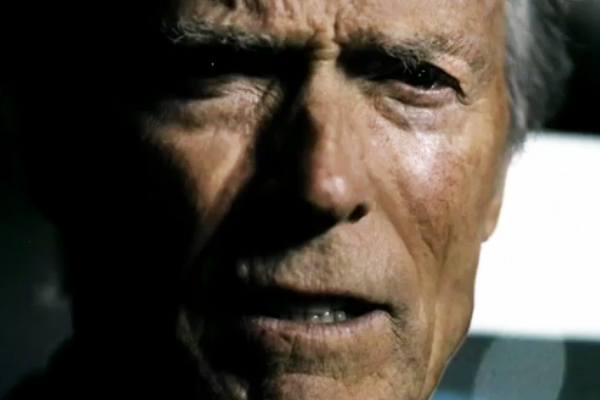

Clint Eastwood
Clint Eastwood’s Super Bowl Obama endorsement
His "Halftime in America" commercial cites Detroit's comeback as an example of Americans coming together VIDEO
This much we know for certain. During halftime at the Super Bowl, Clint Eastwood touted the resurgence of Detroit while narrating a striking two-minute-long commercial for Chrysler, “Halftime in America.”
But what did it mean? In a presidential election year, it is impossible to mention Detroit without political repercussions richocheting everywhere like shrapnel from an improvised explosive device. The fallout was instant: Clint Eastwood just picked sides!
For the conservative bomb-throwing blogger Michelle Malkin, Eastwood’s stance was an affront to free market principles:
“WTH? Did I just see Clint Eastwood fronting an auto bailout ad???”
For liberal Michael Moore, it was an endorsement of President Obama.
“Your sermon seemed 2 b a call 2 give O his ‘second half.’”
Charges of hypocrisy poured in like Giants defensive linemen collapsing on Tom Brady. Clint Eastwood has long been regarded as a solidly libertarian conservative, and he is on record as having opposed the auto bailout. Yet here he was, cashing in, indirectly, on the auto bailout: taking what must surely have been a hefty paycheck to tout Detroit’s comeback!
Of course, Eastwood is also a smart man, and by the evidence of his long career, he is not crazy. So maybe he changed his mind. Maybe he saw what’s happened since the auto bailout and decided that in this case, government intervention was good policy. And maybe he’s been looking at what passes for conservativism in the United States over the past few years, and he’s disgusted. Because whatever you might think about the hypocrisy issue, there’s absolutely no question that “Halftime in America” has a clear political subtext.
The commercial analogizes Detroit’s comeback from hard times to the still unrealized recovery of the United States from the Great Recession. And it bemoans not just the hardship, but the hard feelings and disunity that currently define our political landscape. Here’s one key section:
I’ve seen a lot of tough eras, a lot of downturns in my life. And, times when we didn’t understand each other. It seems like we’ve lost our heart at times. When the fog of division, discord, and blame made it hard to see what lies ahead.
Not only is that passage clearly a reference to the political fighting and harsh rhetoric of the past three years, but during that section, the commercial shows images of demonstrators in Wisconsin, protesting the effort by Gov. Scott Walker to break public sector unions! You can’t get more political than that. Sure, as John Nichols at the Nation reports, the pro-union signs of the demonstrators were surgically removed from the shots, but even that revisionism doesn’t obscure the power of the reference.. As a country, we’re fighting each other, Eastwood is saying. Let’s come back together … and support government intervention in the economy!
Seriously, what else are we to make of this?
It’s halftime in America, too. People are out of work and they’re hurting. And they’re all wondering what they’re going to do to make a comeback. And we’re all scared, because this isn’t a game.
The people of Detroit know a little something about this. They almost lost everything. But we all pulled together, now Motor City is fighting again.
As commentator Greg Mitchell pointed out almost immediately at the Nation, mister straight-shooter Clint is not being factually accurate. We did not all pull together. Obama bailed out Detroit, and faced enormous criticism for it. It’s exhibit A in the case for Obama’s supposed campaign to create the United Socialist States of America!
The conclusion seems clear: If we’re all supposed to pull together to reach a full economic recovery, just like we pulled together to rescue Detroit, then clearly we should be pulling together to reelect Obama. It certainly wouldn’t make sense to all pull together to elect the guy who wanted us to let Detroit go bankrupt, would it?
Andrew Leonard is a staff writer at Salon. On Twitter, @koxinga21. More Andrew Leonard.
Karl Rove’s hissy fit: “Offended” by Chrysler ad
If Clint Eastwood sounded like Obama, it's because the GOP has ceded optimism to the Democrats
Karl Rove (Credit: Reuters/Fred Prouser) I admit it: Chrysler’s “Halftime in America” Super Bowl ad reminded me of President Obama’s best recent speeches. Actor Clint Eastwood, the face of rugged American individualism, talked about “tough eras” and “downturns” and “times when we didn’t understand each other,” but then declared:
Continue Reading CloseBut after those trials, we all rallied around what was right, and acted as one. Because that’s what we do. We find a way through tough times, and if we can’t find a way, then we’ll make one…
This country can’t be knocked out with one punch. We get right back up again and when we do the world is going to hear the roar of our engines. Yeah, it’s halftime America. And, our second half is about to begin.
Joan Walsh is Salon's editor at large. More Joan Walsh.
“J. Edgar”: Clint Eastwood’s lame and insulting Hoover biopic
Leonardo DiCaprio mumbles through this tepid, soft-focus saga of America's closeted secret policeman
Leonardo DiCaprio as J. Edgar Hoover in "J. Edgar" We gather today to pay tribute to two genuine American icons, but without saying anything nice about either of them. Clint Eastwood has made a movie — or at least I think that’s what it is; the lighting is often so dim it’s difficult to make out — about longtime FBI director J. Edgar Hoover, who acted as the wacko third rail of American law enforcement for almost half a century. “J. Edgar” is one of those prestige Hollywood pictures that sounds, at first, as if it might be a good idea: a name director, a supposedly big star playing a major historical figure, and a script by young screenwriter Dustin Lance Black, who since “Milk” has become the go-to scribe for what is no doubt described in story meetings as “gay material.” But instead of a good idea, “J. Edgar” turns out to be one of the worst ideas anybody’s ever had, a mendacious, muddled, sub-mediocre mess that turns some of the most explosive episodes of the 20th century into bad domestic melodrama and refuses to take any clear position on one of American history’s most controversial figures.
Continue Reading ClosePick of the week: Can Matt Damon outrun God?
Pick of the week: The "Bourne" star and Emily Blunt challenge fate in a Philip K. Dick-inspired "Adjustment Bureau"
Matt Damon and Emily Blunt in "The Adjustment Bureau" Here’s the thing about “The Adjustment Bureau,” which is a science-fiction romance featuring Matt Damon and English actress Emily Blunt as a couple on the run from mysterious men with hats. It’s a somewhat awkward blend of ingredients, but not in the usual Hollywood fashion, where it often appears that nobody involved really gave a crap, or even bothered to watch the whole thing all the way through. Instead, “The Adjustment Bureau” is distinctly the work of one guy, and not a guy with Spielbergian or Scorsesean clout, either: Writer-director-producer George Nolfi is known in the industry as the writer of “The Bourne Ultimatum” and “Ocean’s Twelve,” but has never made a movie on his own before.
Continue Reading CloseEarly Oscar odds: “Inception” vs. “Social Network”
Who will win this year's Academy Awards? An early look at some of the frontrunners -- and wild cards
Jeff Bridges in "True Grit," Jesse Eisenberg in "The Social Network" and Annette Bening in "The Kids Are All Right" Question: Is it too unbearably early to begin thinking about the annual winter circus that is Oscar season? Answer: Never! Or at least not after the Gotham Independent Film Awards nominations, the unofficial starting gun of award-mania, have gotten us started.
Let me save your comment-typin’ fingers a workout and stipulate the following: No, the Oscars are no indication of quality, historically speaking; yes, the best films of the year (whether by my standards or yours) are often overlooked; and yes, covering movies by focusing overmuch on the Oscar race resembles the horse-race coverage of American politics and signifies the downfall of journalism in particular and civilization in general. But you want to know about it anyway, so let’s move on. (Check out my Movie List for an utterly subjective and totally non-market-driven ranking of the year’s best and worst movies.)
Continue Reading Close“Hereafter”: Clint sees dead people
Matt Damon plays a depresso psychic in "Hereafter," the director's lumbering, "Crash"-like supernatural fable
Matt Damon in "Hereafter" Clint Eastwood has now directed a kazillion movies — OK, I count 31 feature films, the bulk of them made since 1990 — and while some are good, some are bad and a whole bunch are in between, let’s say this: They’re all watchable. He knows where to put the camera and appreciates elegant, restrained cinematography. Actors like to work with him because he doesn’t waste their time or try to get inside their heads, and he prefers understated, even dry performances, whether he’s making a hard-boiled crime flick or a sentimental weeper.
Continue Reading ClosePage 1 of 2 in Clint Eastwood