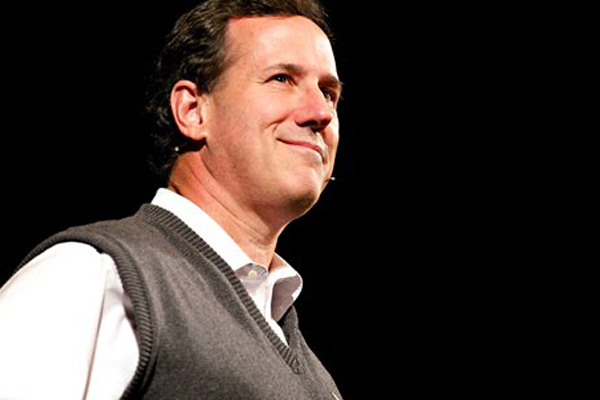

Rick Santorum

Santorum surges as culture wars heat up

Is the far-right Catholic candidate benefiting from a conservative fixation on gay marriage and contraception?

  • more
    • All Share Services

Santorum surges as culture wars heat upRick Santorum (Credit: AP)

Thrilling news, Americans! After today, we all have an excuse to pretend that Rick Santorum might win the Republican presidential nomination. And we will get to pretend this for weeks, or as long as he can pretend to have some sort of vaguely defined “momentum.”

After weeks of Mitt Romney and Newt Gingrich angrily hurling wads of third-party cash at one another, Republican voters have realized (for the second or third time) that Romney is an aloof job-destroying multimillionaire rentier and Newt Gingrich is an erratic narcissist scam artist. Being mostly ignored turned out pretty well for Rick Santorum, whose repellant bigoted sanctimony reads as righteous piety to the die-hard evangelicals and old cranks actually showing up to vote in these increasingly depressing Republican contests. And so, as Steve Kornacki writes, he’s the new not-Romney, and he’s poised to win Missouri or Minnesota or Colorado or some combination of the three today.

Santorum was also the recent beneficiary of one of those slightly fishy Rasmussen polls showing him besting the president nationally 45% to 44%.

Some pundits are already preemptively deflating the hype they haven’t even bothered to fully build up surrounding the not-yet-transpired Santorum victory. The Washington Examiner’s Byron York predicts a good day for Santorum, but notes that both the Gingrich and Santorum campaigns are praying for the other one to just give up already so they can consolidate the anti-Romney vote. It ends, sadly: “it’s entirely possible that neither Santorum nor Gingrich will pull ahead in the race to challenge Romney.”

But if there’s one factor (besides the political press’ institutional bias in favor of long, drawn-out races) that could actually give Santorum a real advantage in the near future, it’s the surprising number and variety of “culture war” issues that have suddenly become very prominent.

There is today’s Ninth Circuit ruling affirming the striking down of California’s gay marriage ban (Newt Gingrich, having already promised to have the entire Ninth Circuit tarred and feathered, is predictably excited). There is the Susan G. Komen for the Cure meltdown over grants to Planned Parenthood, which culminated in the minting of a brand new conservative martyr as Karen Handel resigned to take stock of the think tank and cable news opportunities available (possible VP pick?). And there is the most obviously manufactured of the current outrages, over the Obama administration’s decision to require that employers cover contraception and birth control in health insurance plans, even if those employers are people who subscribe to the Catholic Church’s morally repugnant and indefensible anti-contraception policy. (Which most American Catholics don’t.)

All of these, most of all the last one, are perfect stories for a candidate like Rick Santorum, so long as this remains a contest to win over outraged elderly ultra-conservatives. And indeed, Santorum has launched an unfair-ish attack on Romney, accusing him of forcing Catholic hospitals to provide emergency contraception. Santorum wants the voters to know that he’s always been the candidate most dedicated to protecting women from the responsibility of having any agency whatsoever over their role in the reproductive process!

(Would it be conspiratorial to note that these divisive cultural issues began attracting a great deal of right-wing attention very soon after the release of a positive jobs report? A little bit, probably.) (Also: Remember when the Tea Party meant the GOP was going all libertarian and abandoning social issues? Ha, ha.)

Not that you should take any of this to mean that Santorum’s good day (which has not yet happened and still may not actually happen) is indicative of anything other than a fickle minority of conservative voters drifting toward whomever was least recently savaged in the press and in attack ads. But if you note your favorite anti-Romney conservative pundits and bloggers rather suddenly talking a lot more about contraception and the gay agenda, don’t be too surprised. Santorum’s positions on these issues horrifies most Americans (“I will force rape victims to carry their pregnancies to term!” is not a general election winner), but most Americans don’t vote in Missouri Republican primary elections.

Alex Pareene

Alex Pareene writes about politics for Salon and is the author of "The Rude Guide to Mitt." Email him at apareene@salon.com and follow him on Twitter @pareene

SPIN METER: Rivals airbrush anti-Romney words

After the nastiness of the Republican primary race, former candidates have collective amnesia about Romney disses

  • more
    • All Share Services

SPIN METER: Rivals airbrush anti-Romney wordsFILE - In this Jan. 26, 2012 file photo, Republican presidential candidates, former House Speaker Newt Gingrich and former Massachusetts Gov. Mitt Romney talk during a commercial break at the Republican presidential candidates debate in Jacksonville, Fla. Remember Gingrich calling Romney a liar? Michele Bachmann saying Romney's unelectable? Rick Santorum calling Romney "the worst Republican in the country" to run against Obama? They're hoping you don't. And acting like it never happened _ even though most of their words are just clicks away online. (AP Photo/Matt Rourke, File)(Credit: AP)

WASHINGTON (AP) — Remember Newt Gingrich calling Mitt Romney a liar? Michele Bachmann saying Romney’s unelectable? Rick Santorum calling Romney “the worst Republican in the country” to run against President Barack Obama?

They’re hoping you don’t. And acting like it never happened (even though most of their words are just clicks away online.)

One by one — with the exception of holdout Ron Paul — the GOP also-rans have coughed up endorsements of their onetime rival. And as they do, they’re pulling rhetorical backflips to distance themselves from their former harsh assessments of Romney.

Don’t try this at home, folks. It takes a professional politician to pull it off with a straight face.

A sampling of the also-rans’ anti-Romney rhetoric when they were candidates and their obligatory niceness after endorsing Romney.

___

RICK SANTORUM

The former Pennsylvania senator still doesn’t have trouble curbing his enthusiasm for Romney. He waited a month after dropping out of the race to endorse Romney, then emailed his tepid endorsement in the dead of night. He finally got out the E-word in the 13th paragraph of his 16-paragraph statement.

THEN:

—”He is the worst Republican in the country to put up against Barack Obama.” Santorum later said he was referring to Romney’s standing on health care reform.

—”If Mitt Romney’s an economic heavyweight, we’re in trouble, because he was 47th out of 50 in job creation in the state of Massachusetts when he was governor. He may have had some success at making money for himself and his partners at Bain Capital, and I give him a lot of credit for doing so, but that’s a very different thing than going out and creating an atmosphere for people to create — that create jobs.”

NOW:

—”There are many significant areas in which we agree: the need for lower taxes, smaller government and a reduction in out-of-control spending. We certainly agree that abortion is wrong and marriage should be between one man and one woman. I am also comfortable with Gov. Romney on foreign policy matters, and we share the belief that we can never allow Iran to possess nuclear weapons. And while I had concerns about Gov. Romney making a case as a candidate about fighting against Obamacare, I have no doubt if elected he will work with a Republican Congress to repeal it and replace it.” — Endorsement emailed to Santorum supporters.

___

NEWT GINGRICH

Gingrich didn’t formally endorse Romney when he dropped out of the race but spoke well of him and later said that was close enough. The guy who promised not to run down his GOP opponents at the start of the race had some withering things to say about Romney during the heat of the campaign. Gingrich, a former House speaker, would rather you forget that now, though: His anti-Romney videos on YouTube, once public, are now private. The man who repeatedly branded Romney a “Massachusetts moderate” now calls him a “solid conservative.”

THEN:

—”Someone who will lie to you to get to be president will lie to you when he is president.”

—Are you calling Mitt Romney a liar? “Yes.” Questioned about his previous comment.

—”Can we drop a little bit of the pious baloney?” To Romney during a debate.

—”Why would you want to nominate the guy who lost to the guy who lost to Obama?”

—”We are not going to beat Barack Obama with some guy who has Swiss bank accounts, Cayman Island accounts, owns shares of Goldman Sachs while it forecloses on Florida and is himself a stockholder in Fannie Mae and Freddie Mac while he tries to think the rest of us are too stupid to put the dots together and understand what this is all about.”

—”I think that a bold Reagan conservative with a very strong economic plan is a lot more likely to succeed in that campaign than a relatively timid Massachusetts moderate who even The Wall Street Journal said had an economic plan so timid it resembled Obama.”

NOW:

—”I’m going to campaign for him, I favor him over Obama. I went through, like, seven different issues where I favor him. I’ll do everything I can to help elect Romney. … As far as I’m concerned, I’ve endorsed him.”

—”Compared to Barack Obama, Mitt Romney is a solid conservative. And I think you have to come down to, what’s the choice this November? And the choice is the most radical president in American history and a failed president at the economy and somebody who has a solid record on jobs and who, in fact, on basic principles, is conservative. And I think you can get into arguments about who’s how conservative, but compared to Obama, Mitt Romney is a solid conservative.”

___

MICHELE BACHMANN

Bachmann waited four months after dropping out before she endorsed Romney. The congresswoman from Minnesota campaigned with him in Virginia earlier this month but didn’t bring up health care in their joint appearance.

THEN:

—”He can’t beat Obama because his policy is the basis of Obamacare. The signature issue of Obama is Obamacare. You can’t have a candidate who has given the blueprint for Obamacare. It’s too identical. It’s not going to happen.”

—”He’s been very inconsistent on his positions. He’s been on both sides of the abortion issue, on both sides of the issue with same-sex marriage … he was for the TARP bill, the $700 billion bailout and the global warming initiatives.”

NOW:

—”I am endorsing Gov. Mitt Romney for president of the United States, a man who will preserve the American dream of prosperity and liberty.”

—”This is what victory looks like.” Campaigning with Romney in Portsmouth, Va., on the day she endorsed him.

—”He’s very smart. He has a very optimistic message. Women trust him because they see, this is a man who started a business from scratch, for heaven’s sake.”

—”One thing that Mitt Romney has demonstrated, he will repeal Obamacare. That’s a big compare and contrast between Barack Obama. We will never get rid of socialized medicine, which is Obamacare, under Barack Obama. Mitt Romney has committed himself to repealing Obamacare. … A lot of people know Mitt Romney’s positive agenda.”

___

RICK PERRY

If he couldn’t have the GOP nomination himself, Perry still wasn’t about to back Romney. As he dropped out of the race, the Texas governor endorsed Gingrich. He didn’t come around to endorsing Romney until Gingrich announced last month that he was planning to drop out.

THEN:

—”While you were the governor of Massachusetts in that period of time, you were 47th in the nation in job creation. … You failed as the governor of Massachusetts.”

—”If you are a victim of Bain Capital’s downsizing, it’s the ultimate insult for Mitt Romney to come to South Carolina to tell you he feels your pain. Because he caused it.”

—”I have no doubt that Mitt Romney was worried about pink slips — whether he’d have enough of them to hand out.”

NOW:

—”Mitt Romney has earned the Republican presidential nomination through hard work, a strong organization and a disciplined message of restoring America after nearly four years of failed, job-killing policies from President Obama and his administration.”

___

JON HUNTSMAN

The former Utah governor endorsed Romney at the same time he dropped out of the race in January, but there was no joint appearance.

THEN:

—”You can’t be a perfectly lubricated weather vane on the important issues of the day.”

—”Gov. Romney enjoys firing people. I enjoy creating jobs.”

—”When you combine a record of uncertainty — running first as a senator, as a liberal; governor as a moderate; then as a conservative for the presidency, people wonder where your core is.”

—”He’s been on three sides of every major issue of the day. And because of that it’s going to be very tough in the end to be able to make that trust argument to the American people.”

NOW:

—”It is now time for our party to unite around the candidate best equipped to defeat Barack Obama. Despite our differences and the space between us on some of the issues, I believe that candidate is Gov. Mitt Romney.”

—”I think he’s the best equipped by far to deal with the economic issues and challenges that confront us. … He’s grown a lot, he’s learned a lot. He’s probably better prepared to lead.”

___

RON PAUL

The scrappy Texas congressman was the last man standing among Romney’s GOP opponents, and he’s not ready to make nice yet. Paul announced this week that he won’t campaign anymore, but he’s still collecting delegates at state party conventions and could give Romney grief at the national nominating convention in Tampa, Fla., come August. Paul ran some scorching ads against Romney earlier this year but shied away from going after Romney in person.

THEN:

—Narrator in Ron Paul radio ad: “Mitt Romney can’t fight against Obamacare because he supported the same mandates and government takeovers as governor of Massachusetts. Romney can’t stand up against more bailouts because he supported them. He can’t lead the charge to shrink the government because he has grown it. Romney’s record is liberal and putting him up against Obama is a recipe for defeat.”

NOW:

—”Not soon.” Paul’s answer when he asked Tuesday when he’ll endorse Romney.

___

Associated Press writer Jack Gillum contributed to this report.

Continue Reading Close

Kornacki on “Now”

In a late-night email, Rick Santorum endorses Mitt Romney for president. But do endorsements even matter?

  • more
    • All Share Services

Kornacki on

Tuesday afternoon, senior political writer Steve Kornacki joined a panel to discuss Rick Santorum’s begrudged “endorsement” of Mitt Romney for president in 2012, arguing that as time goes on, it’s “less and less an issue of Romney unifying the right,” and more an issue of cultural supremacy.

Continue Reading Close

Romney vs. Santorum: What their words reveal

As Santorum exits the race, a look at what his and Romney's speech patterns say about their candidacies

  • more
    • All Share Services

Romney vs. Santorum: What their words reveal (Credit: Reuters/AP/Salon)

Now that the Romney campaign is officially shaking its Etch-A-Sketch, the name “Rick Santorum” will begin to fade from our collective memory. As he exits the national stage, I find myself wondering what kept him from capitalizing on the “anything-but-Romney” attitude that seemed to define many Republican voters’ attitudes. Money, certainly, was a significant and well-documented driver of the outcome. But what if we sought to understand the primary through a data-driven lens?

An interesting question, for sure, but, as anyone who works with data knows, the first challenge is to get your hands on the numbers. Fortunately, there’s one source of data that politicians are eager to provide in limitless quantities: their words.

In order to make sense of a mountain of words, I created a tool that analyzes the frequency of word and phrase usage in a body of text. The texts in this case were the transcripts of candidates’ speeches and interviews culled from Project Vote Smart between January and early April, creating a corpus of over 80,000 words (roughly the number of words in a 320-page novel). The tool then identifies phrases of one to six words in length that have been used with a non-trivial frequency. So what does it tell us?

On the Primary and the General Election

The popular understanding of the Republican primary was that Romney was more focused on Obama, while Santorum was busy battling Romney. The data bears this out: While both candidates mentioned Obama with high frequency — 2.2 mentions per thousand (MPT) for Romney, 2.0 MPT for Santorum — Santorum discussed other Republican candidates (3.8 MPT for his Republican peers) about three and a half times as often as Romney (1.1 MPT).

On a related and somewhat humorous note, one of Santorum’s favorite eight-word phrases was “Romney is the worst Republican in the country.” Digging into the actual text turned up a second, related phrase commonly used by Santorum: “make Barack Obama the issue in this [election].” Santorum generally used that phrase to compare “Romneycare” (a word with a relatively high 0.4 MPT for Santorum) with “Obamacare.” By contrast, one of Romney’s favorite six-word phrases was: “I’m going to become the nominee.”

On Job Creation and the Economy

One of the main memes of this election cycle has been “jobs” and “job creation.” (Admittedly, it’s at least a minor meme in every presidential election.) But who talked about jobs more often? Romney did — more than twice as often, in fact. Romney had a “job creation”-related MPT of 1.7, compared to 0.8 for Santorum.

A related, significant component of the broader discussion on the economy was the subprime mortgage crisis. When it comes to terms that are a part of this discussion such as “Fannie,” “Freddie” and “homes,” Romney was once again the dominant voice, with an MPT of 1.0, well above Santorum’s MPT of 0.2

While Romney addressed specific aspects of the economy more often, both candidates discussed the “economy” with a relatively close (and fairly high) frequency. Santorum’s MPT for economic terms was 1.9, only about 13 percent lower than Romney’s MPT of 2.2.

Faith and Conservatism

Santorum used faith-related terms about three times as frequently as Romney did, based on the occurrence of words like “God,” “faith,” “church,” “Christian” and “religion.” Romney had about 0.5 MPT, as compared to Santorum’s 1.4 MPT.

Both candidates had good reason to discuss their conservative credentials: Voters and the media constantly questioned Romney’s conservatism, and Santorum’s steadfast conservatism was a competitive differentiator. And yet, it was Santorum who mentioned “conservative” and “conservatism” about 40 percent more frequently than Romney, with an MPT of 1.4 against Romney’s 1.0. In the end, one of Santorum’s clearest advantages — one that he spoke about with regularity — did not pay dividends.

Speech Patterns: Vocabulary and Verbal Tics

As it turns out, both candidates had nearly an identical-size vocabulary across the body of text analyzed. Santorum used 4,088 unique words, while Romney used 4,090. By another measure, however, Romney spoke with more diversity: Santorum repeated 247 two-word phrases more than 15 times each, representing over 20.3 percent of his speech. Romney had just 233 such phrases, representing only 18.5 percent of his speech.

But when it comes to common verbal tics like “uh,” “um” and “you know,” Santorum was the undisputed leader. While transcripts generally don’t include “um” and “uh,” they capture in spades “you know,” “well” and the repetition of common words, such as “the … the.” Romney demonstrated a “verbal tic” MPT of only 6.0, compared to Santorum’s 9.8. In fact, roughly one out of every 200 two-word phrases uttered by Santorum was “you know.”

Bringing It All Together

The above analysis allows us to roll up all of these topics into a fascinating side-by-side comparison. It’s important to note that these figures are very meaningful when comparing candidates. When it comes to topic-to-topic comparisons, the results may be deceiving. It’s easy to count mentions of President Obama’s name, for example; it’s much harder to calculate mentions of specific topics — like jobs or the economy — that have many different synonyms. Nevertheless, these figures provide a directional, data-driven picture of how much time each candidate spent discussing any particular issue.

While the ultimate reason for Santorum’s loss might have more to do with money and momentum, these results point to two possible conclusions. The first (and more likely) is that these differences are exactly what enabled Santorum to stay competitive as long as he did, and that an apples-to-apples choice on economic issues would have sealed Romney’s candidacy earlier. But might Santorum have done better by dedicating more time to jobs and housing? Did he spend too much time attacking Romney instead of focusing on his own positions? Did Santorum’s propensity for verbal tics shake voters’ confidence?

As Romney now rejiggers his message for the general election, he’s likely to emphasize even more the subjects that have been his main talking points throughout the primary: the economy and President Obama. Whether his faith becomes more or less of an issue as Election Day nears remains to be seen. And his discussion of “other candidates” will disappear completely — unless, that is, you’re counting on another comeback from Newt Gingrich.

Continue Reading Close

Dan Kozikowski writes about the intersection of data and everyday life at dfkoz.tumblr.com.

The GOP candidate who actually hates the media

Mitt Romney hates the press more than Santorum does, he just doesn't have a potty mouth VIDEO

  • more
    • All Share Services

The GOP candidate who actually hates the media Rick Santorum and Mitt Romney (Credit: AP/Reuters)

This weekend, Rick Santorum blew up at New York Times reporter Jeff Zeleny (whose questions for politicians have themselves become national issues of pointless debate before). The whole angry rant, which Zeleny says was largely for the benefit of the cameras, peaked with Santorum saying, “Quit distorting my words. If I see it, it’s bullshit.” The Santorum campaign more or less immediately capitalized on the pseudo-spontaneous outburst with an email blast fundraising off the video. (“A subscription to the New York Times cost approximately $30,” it reads. That’s not really remotely true.) Santorum then went on Fox and Friends to deliver the campaign’s well-crafted line: “If you haven’t cursed out a New York Times reporter during the course of a campaign, you’re not really a real Republican.”

Left unsaid is that a certain candidate would never “curse out” a New York Times reporter, because a certain candidate simply doesn’t curse. Mitt Romney can’t bring himself to say “hell” in public. When, during the 2002 Salt Lake City Olympics, Romney was accused of publicly berating a volunteer security officer, he denied only that he swore while doing so: “I would not, have not, and never would use the f-word,” he told the press. He admitted only to saying “H-E double hockey sticks.” The irony is that Romney actually has a horrible relationship with the press, he just doesn’t make a big show of it.

Romney fundamentally distrusts journalists. He freezes them out. When he was in the private sector, he could happily ignore them. In politics, he prefers to manage them with as much distance as possible. His campaign was notorious for essentially ignoring journalists entirely, until they belatedly realized that, you know, journalists could be induced to write nice things about the candidate if they are treated humanely. Hence: baked Lays for the press corps and an Ann Romney charm offensive.

When your candidate’s media strategy is total avoidance, you don’t really get conservative movement “cred” for hating the liberal media. Meanwhile, Newt Gingrich lives for the attention of the press, and his ostentatious displays of media hatred are basically what Santorum was trying to emulate this weekend.

In 2007, Romney lost his cool with AP reporter Glen Johnson. Here’s Romney, unfiltered and pissed off!

“Excuse me, excuse me, Glen!” You accuse Mitt Romney of lying, you get a stern but polite response.

You attack Mitt Romney’s religion, and then accuse him of “running away” from his church, as Iowa conservative talk show host Jan Mickelson did in 2007, and you get … firm, polite debate!

This gets raw 10 minutes in, when they go off the air. “You’re wrong!” is about as salty as it gets.

Unhappily for Romney, he gets the same treatment from Fox News that it typically saves for liberals — there’s no “safe” media outlet to shill for him, as Fox does for most other Republican candidates. Romney’s entire media base is perhaps a few newspaper columnists.

Romney-hating conservatives are ignoring the candidate who hates the mainstream media most of all. If he could find some way to get that message across, keeping in mind the challenge of avoiding profanity, he might have an easier time in this endless primary.

Continue Reading Close
Alex Pareene

Alex Pareene writes about politics for Salon and is the author of "The Rude Guide to Mitt." Email him at apareene@salon.com and follow him on Twitter @pareene

Rick Santorum’s V.P. leverage

The last GOP nominee to face such deep and lingering intraparty resistance was – believe it or not – Ronald Reagan

  • more
    • All Share Services

Rick Santorum’s V.P. leverage Ronald Reagan and George H.W. Bush in 1980

If Rick Santorum is a little frustrated these days, it’s hard to blame him. On Saturday, he scored a resounding primary victory, demolishing Mitt Romney in Louisiana, the 11th state to side with the former Pennsylvania senator so far. The prospects for similarly lopsided Santorum wins throughout the spring are good, but his own party’s leaders and the political world in general just don’t seem to care.

“Unless something unusual happens, unless Romney steps on a land mine, he looks like he’s going to be the nominee,” Haley Barbour, the former Mississippi governor and RNC chairman, said on Sunday. That pronouncement came a few days after Jeb Bush came out for Romney and Jim DeMint essentially did the same, and it was followed today by endorsements of Romney from Kevin McCarthy, the No. 3 Republican in the House, and Utah Sen. Mike Lee, a Tea Party icon. According to Politico’s Jonathan Martin, the endorsement floodgates may really open if Romney prevails in next week’s Wisconsin primary.

In a way, the growing consensus that the GOP race is over and that Santorum has been reduced to an irritant’s role makes sense. Basic voting patterns that are apparently immune to momentum have seemingly taken over, guaranteeing Romney a floor of support that is very, very likely to push him past the magic 1,144-delegate number by the end of the primary season. And, obviously, it’s in the interest of Republican Party leaders to unite their party around a nominee as soon as possible.

But Santorum is an odd sort of doomed candidate because — as he demonstrated over the weekend — he’s still capable of winning primaries, often by big margins. A significant chunk of the Republican base is still eager to vote for someone, anyone other than Romney, and it’s entirely possible that Santorum will end up winning more than 20 states. There’s also still a theoretical possibility that Romney will fall short of 1,144 during the primary season, which would create a theoretical opportunity for Santorum to use the pre-convention months this summer to win the nomination. This makes him different than previous candidates who were accused of hanging around too long. Pat Buchanan in 1996, Jerry Brown in 1992, and Jesse Jackson and Pat Robertson in 1988 were being drubbed in primary after primary when the political world decided to ignore their campaigns and treat the process as finished. They weren’t still racking up victories.

If there’s a parallel for what Santorum is now facing, it can be found in George H.W. Bush’s 1980 campaign. At roughly this same point in the process, Bush had around 200 delegates, far behind Ronald Reagan, who had nearly 600 – with 998 needed to win the nomination. Except for John Anderson, who left the race to run as an independent, all of the Republican candidates who’d dropped out – Bob Dole, Howard Baker, Phil Crane and John Connally – had thrown support to Reagan, and key party leaders were jumping on board too. There were loud calls for Bush to quit, and warnings that his lingering presence would damage Reagan’s chances of knocking off Jimmy Carter in the fall. The Reagan campaign itself adopted a strategy of ignoring its last remaining rival.

But Bush, who came to the race with scant name recognition and support only to break through with a surprise Iowa victory, remained viable in key state primaries. On April 22, he beat Reagan in Pennsylvania by 8 points. Ten days later, he nearly won in Texas, which had been one of Reagan’s strongest states in 1976. And on May  20, he scored an absolute landslide in Michigan, annihilating Reagan by 25 points.

Bush, who campaigned as a supporter of abortion rights and the Equal Rights Amendment and a critic of Reagan’s supply-side economic agenda, was running from the left, but he was playing the same basic role that Santorum now is – the vehicle for the unusually large number of Republicans who really, really didn’t want to support the front-runner.

Today, the holdouts that Santorum is appealing to are mainly religious conservatives in the South and in rural areas across the country. Those voters were part of Reagan’s base in ’80. But the GOP back then still had a Rockefeller wing and was still a major force in the Northeast and industrial states, and among these Republicans Reagan was seen as an extreme ideologue who would have trouble winning in the fall.

Like Santorum, it took Bush a long time to get the one-on-one race he’d always wanted; if Baker and Anderson had dropped out sooner, he probably would have won more states. But even as his inevitability built, Reagan continued to encounter stiff resistance from moderate and liberal Republicans. As late as May, a national poll of Republican voters put Reagan only 8 points ahead of Bush.

Two factors ultimately pushed Bush out of the race. One was practical: On the night of his big Michigan victory, several news organizations announced that Reagan had nonetheless cleared the 998-delegate mark. This was a matter of dispute; then as now, there was no uniform delegate tally and serious disagreement over how to account for them. Plus, Bush’s campaign was insisting that hundreds of delegates who’d been pledged to Reagan during the primaries were actually free agents. The Bush strategy was to demonstrate strength in the late primaries, then to pressure these delegates into backing him. But the loud declarations from major news outlets that the race was over rained on Bush’s Michigan parade and dried up his fundraising overnight. Within days, he was out of the race.

Of course, Bush had another incentive not to press on any further. The depths of intraparty Reagan resistance that his campaign had revealed increased the pressure on Reagan to choose a moderate as his running mate. And Bush, by virtue of his surprisingly strong primary season showing, would be a logical choice for the role. In the days before dropping out, Bush had called himself “unequivocally opposed” to serving as Reagan’s No. 2. But after bowing out, he stopped issuing denials, and when Reagan’s effort to entice the preeminent GOP moderate, former President Gerald Ford, onto his ticket failed, Bush became the choice.

Santorum’s candidacy has highlighted similar intraparty resistance to Romney, so the same basic logic that landed Bush on the ticket 32 years ago could apply to him. It’s true that the Republicans who’ve been lining up behind Santorum seem mainly motivated not by affection for him but by opposition to Romney, but this was also the case for Bush in his race against Reagan. It’s also true that Santorum is stridently attacking Romney right now, but, again, Bush did the same thing to Reagan well into the spring of 1980 (when, for instance, he accused Reagan of trying to turn the clock back to the 18th century).

Santorum’s odds of winning the nomination are not entirely nonexistent right now, but they are slim. His chances of procuring the vice presidency are probably much better. As the calls for his exit grow louder in the weeks ahead, he may do well to consider what listening to them did for the last GOP candidate in his situation.

Continue Reading Close
Steve Kornacki

Steve Kornacki writes about politics for Salon. Reach him by email at SKornacki@salon.com and follow him on Twitter @SteveKornacki

Page 1 of 22 in Rick Santorum