
F**ked
When my job stopped paying
After a year of unemployment, I landed a contract gig. Then the paychecks stopped coming -- but the work didn't
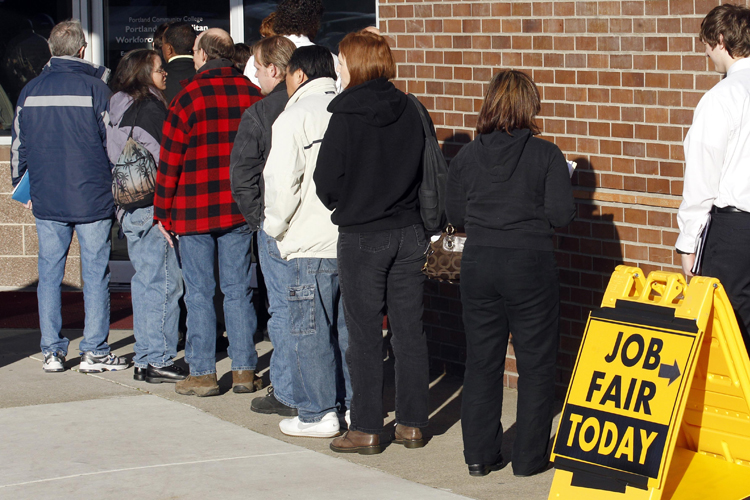
People waiting in line at a job fair in Portland, Ore. (Credit: AP/Rick Bowmer) It comes up all the time in conversation. Most recently, I heard it from a stranger at the dentist’s office, talking back to the television news and those of us fortunate enough to be stuck in the waiting room with her. “High unemployment, my ass. Just a bunch of lazy people looking to sit on their sofa and watch TV while we pay their bills.”
Sorry, lady. You’ve mistaken me as a responsible, upright citizen. Allow me to introduce myself: I am a former sofa-lounger, and now I qualify as something even lower than that.
My last full-time job ended in January 2009. Everyone at our small pharmaceutical marketing agency received an email invitation to a mandatory staff meeting. And, much like a bad reality show, it was only moments before the scheduled time that we began to realize we weren’t all invited to the same room.
Along with more than 30 colleagues, I got voted off the island.
Those lucky enough to receive invitations to the other room were told to take a long lunch while we poor saps cleared our desks.
I spent the first several weeks in a daze. There is not a lot of room for pride when you’re a single mom, so I filed for unemployment benefits. And in the height of irony, I was told I wasn’t eligible for food assistance because my income was too high.
That’s right. My unemployment benefits pushed me over the income bracket.
I spent that first year sending out resumes and supplementing my unemployment checks by buying designer clothes at thrift stores and reselling them for cash.
After 51 jobless weeks, I finally landed a contract position. Income! No benefits, but income!
It started out great. I worked; I got paid. Not the life-fulfilling work I’d hoped to be doing in my late 30s, but it was money. No complaints.
For a while, life was good. I married the wonderful man I’d been dating for several years. We bought a house. Saved money. My kids got to take after-school classes. All we needed was the golden retriever, and we would be living the American dream.
But all good things must come to an end. By law, once you’ve used a contractor for 18 months, if the need for a position is still there, you don’t need a contractor. You need an employee. So you have to let the contractor go and create an actual job.
But creating jobs is expensive, so there are a few loopholes that corporations can exploit to avoid those costs. The company can boot the old contractor and bring in a new one to do that very same job. Or the company can change the contractor’s employment status, which means the clock can run indefinitely. I got Door No. 2. Lucky me.
For my first year and a half, I’d been paid as a W-2 employee by the staffing agency who hired me. But if I became a 1099 contractor, we could continue business as usual. The company didn’t have to train a new person; I didn’t have to find another position in a terrible economy.
My new status meant I billed the company directly, and I paid my own payroll taxes. The company managed to dodge the expenses of creating a job, and got to pocket the placement fee the agency previously added to my hourly rate.
But I still had a job. And, like many contractors, I was so glad to have work, I was willing to put up with almost anything.
Like five months without a paycheck.
Because large international companies don’t live by the same rules as the rest of us. When your annual revenue is north of $20 billion, a piddly little $30K debt to an insignificant editor is so inconsequential … well, I’ve already used more words than it warrants.
I reminded. And cajoled. And begged.
Nothing. Except a steady flow of work assignments that needed to be completed.
A few days before Thanksgiving, it dawned on me: If I’m not getting paid, it’s not a job. It’s volunteer work. And that’s not what I signed up for.
And yet, I still naively believed that, given the opportunity, people would do the right thing. So I told my employers that I was not available for work until they paid me.
To say they laughed in my face would suggest that I was more than an insignificant speck of dust.
So here I sit.
Several weeks ago, I had to create a new folder in my hard drive: JOB HUNT 2012. It sits next to JOB HUNT 2009, JOB HUNT 2010 and JOB HUNT 2011.
I can’t remember what it’s like to weigh a potential job in terms of whether I’d enjoy it. And I’m actually a pretty good catch. I have a college education. And skills. I’ve even won some awards. It’s all right here on my resume. I can forward it to you, if you’d like.
Can Occupy Wall Street work with the jobless?
The long-term unemployed go to a General Assembly hoping for support for their job demands. They got something else VIDEO
Unemployed Connie meets the occupiers (Credit: Immy Humes) In the sixth installment of F**ked, the long-term unemployed meet the occupiers at a General Assembly in New York City, never expecting the generational and culture clash that ensues.
Immy Humes, a NYC documentary filmmaker, has produced stories for PBS, NBC News, and Michael Moore. Her short film, "A Little Vicious," was nominated for an Oscar. Her latest feature, "Doc," is a saga of the post-war generation of New York writers and of madness. Her web site is http://www.thedoctank.com/ More Immy Humes.
The 99ers’ unemployment fix
In the latest episode of our video series, jobless Americans fall in love with Occupy -- and bring their own agenda VIDEO
The 99ers to Occupy: this way to full employment For our 99ers, an informal group of jobless New Yorkers who have exhausted their 99 weeks of unemployment benefits, the Occupy Wall Street movement came as a dream fulfilled.
As the protests took root in Zuccotti Park, the 99ers found a mass of people who care about the plight of the jobless and want to do something about it. As seen in last week’s episode of our video series, “Occupy Meets MacArthur’s Tanks,” Occupy Wall Street is just the latest in a long line of American protest movements demanding economic justice. The emergence of the Occupy movement, one 99er said, felt “like the early stages of a revolution.”
And then the question arose: What do America’s jobless want? As the video shows, the 99ers have some answers.
Immy Humes, a NYC documentary filmmaker, has produced stories for PBS, NBC News, and Michael Moore. Her short film, "A Little Vicious," was nominated for an Oscar. Her latest feature, "Doc," is a saga of the post-war generation of New York writers and of madness. Her web site is http://www.thedoctank.com/ More Immy Humes.
Occupy meet MacArthur’s tanks
Episode 4 of our video series recalls when “unemployed armies” roamed America -- and the U.S. Army evicted them VIDEO
When Occupy Wall Street burst on the scene last September, the movement seemed unique and unprecedented. The latest installment of “F**ked: The United States of Unemployment,” however, traces the long history of occupation as a strategy of the unemployed. The impact these earlier movements had is rarely acknowledged, but those uprisings inspired everything from films like “The Wizard of Oz” to transformative government programs such as Social Security.
Another similarity between the “unemployed armies” of yesteryear and the Occupy movement is the brutal response by law enforcement. Witnesses expressed shock when the Oakland police sprayed tear gas at protesters and complained about the liberal use of billy clubs by cops in New York, but imagine Gen. Douglas MacArthur unleashing a deadly offensive of tanks, bayonets and torches on military veterans camping out in Washington, D.C. It’s all captured in the chilling video below.
Continue Reading CloseImmy Humes, a NYC documentary filmmaker, has produced stories for PBS, NBC News, and Michael Moore. Her short film, "A Little Vicious," was nominated for an Oscar. Her latest feature, "Doc," is a saga of the post-war generation of New York writers and of madness. Her web site is http://www.thedoctank.com/ More Immy Humes.
Is work worth it?
Unemployment brings soul-searching. In a new episode of our video series, the jobless share surprising priorities VIDEO
Certain experiences will always force a reevaluation of life’s priorities. The birth of a child, a near-death experience — or getting fired. The latest episode of Salon’s video series on unemployment in America begins with Theresa Iacovo, a laid-off truck dispatcher, reminiscing on all of the Christmases she missed during her 20-year career. “Why did I give up that time with my family that I can never give back?” she asks.
Several recent submissions to Open Salon on the topic of unemployment also question the relationship between personal fulfillment and work. Homeless Scribe aptly sums up the source of much frustration: “Fresh out of college, I expected job security in exchange for hard work. I expected fairness in exchange for loyalty. And I expected respect in exchange for respect. I lived up to my side of the bargain. It’s the other side that failed.”
Continue Reading CloseImmy Humes, a NYC documentary filmmaker, has produced stories for PBS, NBC News, and Michael Moore. Her short film, "A Little Vicious," was nominated for an Oscar. Her latest feature, "Doc," is a saga of the post-war generation of New York writers and of madness. Her web site is http://www.thedoctank.com/ More Immy Humes.
When I learned to scrape by
Hungry, jobless and pinching pennies to print resumes, I started to lose hope of ever finding a job
The author outside a gas station Three dollars in the gas tank, 49-cent burrito, a paper cup of water from the bathroom sink; I sit on the curb, eating my breakfast and listening to Javier sing. Every so often a car pulls up; Javier dips his brush in a bucket of suds and then scrubs gluey insects off the windshield before directing the driver’s tires onto the tracks of the auto-wash.
“You should try out for one of those singing shows,” I tell him, swaying to his melodic crooning.
Without looking up, Javier shakes his head, and snorts, “Who’d vote for an ol’ man, eh?” He yanks a hand-towel from his back pocket and coughs hard into it. His somber brown eyes meet mine for a moment.
Continue Reading ClosePage 1 of 2 in F**ked


