
Internet Culture

The Internet makes magic disappear

YouTube has killed the magician's art, and threatens the stores where tricks have been passed down for generations

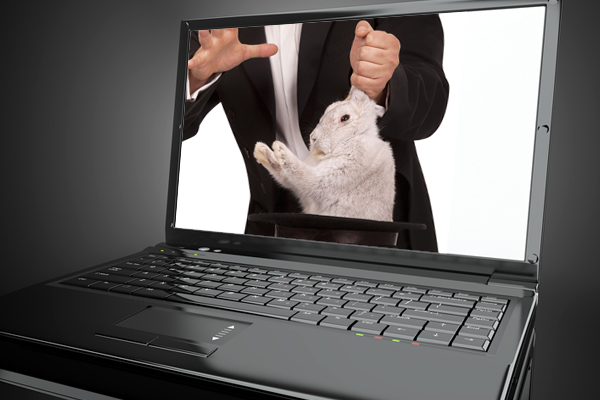
(Credit: Wallenrock and Maxx-Studio via Shutterstock/Salon)

In 1998, my father riffled a red deck of playing cards while we attended a family reunion on the outskirts of Bogota, Colombia. He asked me to pick one, and I told him to stop when his fingers reached the middle of the pack. As he closed his eyes, I pulled out the ace of hearts and placed it near the end. He ordered me to think hard about my random selection, and then pretended to write something on the inside of his left arm.

“Concentrate,” he said while I watched him roll up his sleeves. “This won’t work unless you focus on your card.”

He pretended to be lost. He looked around, shook his head and grabbed a newspaper by a fireplace. After selecting a faded page, he set it on fire, gathered the gray-white ashes and gently spread them over his slightly tanned arm. Two dark figures slowly appeared on his grayish skin: “A♥.”

I was fascinated. It wasn’t the first trick my dad had performed for me — since I was 8, coins had frequently come out of my “dirty ears” and ropes had disentangled themselves from impossible knots — but this was certainly the first one that captivated me. I begged him to tell me how he had done it. Like a parrot, he repeated over and over again a conversation-ending mantra that I would soon adopt. “A magician never reveals his secrets,” he stated sternly. Of course, that argument lacked prescriptive force for a 10-year-old, and several days of relentless questioning later, he finally caved in. He made me quite aware, however, that he wasn’t going to teach how me to do it.

Soon after, my father drove me to the School of Magical Arts of Bogota, an old, spacious edifice that housed a magic school, a theater and a remarkable shop crammed with variegated paper flowers, disappearing wands, jumbo decks, vintage posters and rabbit-size contraptions. There, he said, I would finally learn the secret.

- – - – - -

Since the late 19th century, when two German brothers named Francis and Antonio Martinka opened a conjuring store in New York, brick-and-mortar magic shops have played a central role in America’s magical culture. For more than a hundred years, these often small, dark chambers have been a gathering place where traveling illusionists and celebrated performers like Houdini, Thurston and Kellar discussed their latest creations, shielded from the pestering presence of hobbyists and the general public. More important, up until a decade ago, they were the only places where magicians could teach eager teenagers like myself the right methods to produce ashen apparitions and the more complicated tricks that inevitably follow.

But then the Internet broke that monopoly. Today, any 10-year-old kid can type “magic tricks” into Google and gain access either via YouTube or other websites to the biggest trade secrets in a matter of minutes. He can watch a video or buy an expensive apparatus without leaving his house, seeing a live demonstration or talking to another human being.

As a result, magic stores are slowly vanishing across America. With their gradual disappearance, as Jamy Ian Swiss — a leading card-expert and magic historian recognized for his brilliant technique and for his outspoken column in Genii, a conjuring magazine — has argued, one of the foundations of this ancient art form is disappearing.

“Magic has always depended on the control of information,” Swiss told me in an interview. “When I was young, you had to hang around a magic shop, and learn to ask, and ask politely. You would approach a guy and he would tell you, ‘Well, show me what you are working on, kid,’ and you’d show him. And then he might say, ‘Let me help you out with that,’ or ‘Let me show you something different than what you asked.’

“The biggest problem with DVD and YouTube exposure is that it has damaged the skill of learning through asking, and it has created the mistaken assumption, perhaps, that all knowledge and all wisdom is available to buy,” he said. “And there’s so much difference between those two acts, because asking involves a human experience, while buying is just sitting in your coach and passively absorbing countless secrets that you think constitute magic.”

In New York, the Yellow Pages listed 16 magic shops in 1960 but just three by 2003. Now there are only two, Fantasma and Tannen’s Magic, says George Schindler, the dean of the Society of American Magicians.

Fantasma and Tannen’s are lingering throwbacks where young magicians can still learn secrets directly from their elders, sidestepping DVDs and videos from online sites. They are sanctuaries where awkward 10-, 14- and 20-year-olds can meet and talk to each other and to older magicians without fearing ridicule or censorship. They are the last place where kids who mask their timidity through magic can find someone to help them overcome the challenges of art and life.

- – - – - -

On a recent visit to Fantasma, “Magic Mo,” a laconic 14-year-old who wouldn’t part with his real name, fanned the cards while he waited for his mentor. As he opened and closed a red-backed deck, Mo watched David Roth, a world-renowned sleight-of-hand artist, perform for an English couple.

After divining several cards and correctly naming a random word a woman mentally chose from a book, Roth walked to the cashier and added up the cost of tricks the couple had bought for their magic-obsessed godson. The woman waved as she disappeared through the main door. Roth closed the register with a sigh and returned to check on Mo.

With a soft and at times faltering voice, the teenager showed him a card-control technique he was working on. Roth corrected him and urged him to do it again.

“Don’t practice in front of the mirror,” he told him. “You get used to blinking when you are doing a pass, which is not good. Video is better. But then again, you should do it in front of your friends here. The camera doesn’t think.”

Roth stood behind a display case filled with DVDs, multicolored decks of cards and several types of coins in a 3,500-square-foot exhibition room on the corner of 33rd Street and Seventh Avenue. (Fantasma serves as a store and display room for one of the world’s leading magic manufacturers, according to Roger Dreyer, one of the owners.) Directly in front of him, just behind a caged pet rabbit named Rambo, lies a collection of original Houdini memorabilia, which includes handcuffs, locks, books and black-and-white photographs. A couple of bookshelves line a part of two walls to the left of the exhibition, near a table with four seats that are occasionally occupied by amateur and professional magicians spreading blue-backed Bicycle decks over a blood-red cloth lined by black felt.

“Magic shops are disappearing because of the Internet,” Roth said during one of my visits while he extended his calloused hands toward the roof. “This place is an oddity.”

He works at Fanstasma twice a week, demonstrating tricks to potential customers and holding court over the enthusiasts who come by to talk to him or to show him something they’ve developed. Roth, 69, has short white hair that contrasts with his rosy face.

As most magicians will tell you, Roth is a legend within the guild. An expert coin manipulator, he was mentored by Dai Vernon, a man revered by close-up magicians throughout the 20th century. Vernon was a Canadian sleight-of-hand artist known as “The Professor” who revolutionized card magic by developing techniques he learned from gamblers all around the country. He eventually adopted Roth as a protégé from the 1970s to the 1990s — the final years of his life — in the Magic Castle in Los Angeles.

Within the walls of the Hollywood private club of the Academy of Magical Arts, Vernon advised Roth on the importance of practice and highlighted the beauty of a flawless technique in which all movements seemed natural.

“There are terrible magicians online that do tricks as if they had just learned them in the schoolyard,” Roth told me when I asked him about people who posted magic videos on YouTube. “They don’t practice. They see something and think they can do it immediately.”

Lack of practice is a constant complaint. You hear it even from amateur magicians like Uriel Nashofer, 20, a New Jersey native now studying in Missouri who likes to hang out at Fantasma whenever he comes home.

“Kids don’t read books anymore. They just watch DVDs or download effects from websites like Penguin and Theory11. The problem is they don’t think about the presentation,” he said after showing me a series of card tricks. “The effects I just did, for example, it took me nearly eight months of practice to master.”

- – - – - -

Unlike Fantasma, Tannen’s Magic doesn’t sell toys, only items used by professionals. The store is located in the sixth floor of an unremarkable building near Herald Square. Three black-and-white rabbit silhouettes decorate a blank wall in the corridor that leads to the shop. The dimly lit quarters house six glass counters and several floor-to-roof shelves covered with an assortment of colorful cylindrical gimmicks, colossal dice, papier-mâché flora and countless DVDs and special kinds of playing cards inside transparent plastic bags.

Tannen’s moved its catalog online a couple of years ago, and now sales are split evenly between the shadowy locale on West 34th Street and its own website, according to Adam Blumenthal, 27, the young Broadway light-designer and magician who owns the place. (Balay calculated that in Fantasma 70 percent of the sales still took place in the shop.) The store, nevertheless, still attracts a loyal throng of kids, especially over the weekend.

On a Saturday afternoon, four teenagers and a 25-year-old stand-up comedian were practicing flourishes, spreading fans, cutting the deck in three smooth movements and making cards fly from one hand to the other, and showing each other new tricks on a table in the center of the room. After watching them for a while, I joined them and asked how they thought the Internet was affecting magic.

“I started by learning from YouTube and it messed up all my future performance,” Vlad Verba, 14, said while he kept on cutting a deck in his hand. “I’m a righty, so I have to hold the deck in my left hand. I didn’t know that and I learned all the sleights using the wrong hand. I had to start all over after I came here.”

Harrison Greenbaum, a stand-up comedian, magician and counselor at Magic Camp — an event that Tannen’s organizes each year in which magicians from all around the country fly to Philadelphia to mentor and teach kids about performance and the psychology of the art — emphasized the social aspect of the store.

“In a brick-and-mortar magic shop there is a sense of community,” he said. “You get to know other people and you have somebody who’s an expert, who can help you with specifics that you don’t know about. You meet incredible magicians and you are able to walk up to them and show them what you can do, so that they’ll critique you and give you some tips.”

For Danny Braff, 15, visiting Tannen’s at least once a week offered a related advantage. “I met my best friend here,” he told me. “He’s a magician named Ruben Moreland and he’s helped me a lot with everything. I wouldn’t be nearly as good as I am if it wasn’t for him.”

The kids talked about Magic Camp and Harrison joked about how videos would inevitably fall short when answering important questions.

“What do you do if the bar mitzvah boy starts crying?” he asked, shrugging. “What do you do if your pants rip during a show? That happened to me once, you know.”

Everyone laughed and after a long silence, Joshua Kurzbam, 20, a sinewy teenager with receding black hair who sat next to Braff, looked at me, as if asking for permission to speak. “Magic allows us to be social,” he said. “It gives us an excuse to talk to people.”

Two of his companions lowered their eyes and nodded. They kept on talking until it was closing time, ceaselessly shuffling the packs of playing cards in their hands.

- – - – - -

The online videos often resemble movie trailers. They range from around 45 seconds to almost two minutes, featuring cyan- or red-saturated images and original short-lived soundtracks. Typically, they start with the logo of the website or a fading title over dark backgrounds, and then feature fast, short frames in which viewers can catch a glimpse of the effects being sold.

There are now dozens of Internet-based companies that sell products online. Two of the biggest, as kids in shops will tell you, are Penguin Magic and Theory11. Penguin strives to project a youthful image by using cartoons and a bright color interface, while Theory11 reinforces the aura of mystery cultivated in its videos by using black and gray tones.

Penguin started in 2002 and has grown ever since to become one of the most visited magic sites. One of the company’s main strengths is the sheer amount and variety of effects that it sells. The same is true of Theory11, a website founded in 2007 by 11 magic industry insiders, which last year launched “The Wire,” a global marketplace that allows magicians to directly publish their creations online.

The philosophy behind both ventures was to offer their clients an ever-increasing inventory capable of fulfilling any kind of style or concentration.

“The idea was to start a store where magicians could actually see a demo of every trick in the shop,” Acar Altinsel, a co-founder of Penguin, wrote me in an email. “Walk into most magic shops and the magician behind the counter can only perform a handful of what you see. This was constantly disappointing for me as a kid.”

Videos are supposed to solve that problem, according to Altinsel. “A ‘good’ magic DVD will get as much into presentation as an in-person lecture or book. Further, online video chat ‘sessioning’ has put magicians in an even better position to get mentoring and correction,” he wrote.

Most professional conjurers would disagree. The difference between a live performance or even a live chat and an online interaction is qualitative. As any music lover will testify, there are essential differences between watching a live video of a concert and actually attending the concert. The feeling and the power of the experience are heightened by the use of all the other senses, by the crowd’s feelings and the immediate surroundings. The statement is equally valid for couples who try to rekindle their passion via Skype or for any other art-form that thrives on human responsiveness.

Eric DeCamps, a magician from Forest Hills who was the second man in 107 years to receive the Gold Medal of Excellence for Close Up Magic of the Society of American Magicians, put it in somewhat similar terms in a recent conversation.

“Magic is a performing art,” he said, “and while it is interesting and fun to solve magic problems on your own, the problem doesn’t take full life until you perform in front of a live audience. I can’t explain the feeling I get when you are in front of that audience and you communicate and you almost become one consciousness; I mean, you almost know what they are thinking and there’s a level of communication that is indescribable.”

- – - – - -

As Jamy Swiss points out, magic is timeless, perhaps the spawn of a single moment of ingenious play. “It is likely that even in ancient times someone in a cave took a stone and pretended to put it in one hand while keeping it in the other, and magic was born,” he said.

Nevertheless, just one trick, as my father knew, was worthless. He was aware that even though the ash effect I coveted was relatively simple, to perform it properly I would first have to learn to perfection certain card techniques. He also knew I rarely spoke to other people. He knew I would rather hide behind a book than talk to a classmate or participate in a social event that involved more than two people. I presume that in part that was why he decided that a brick and mortar magic shop was the only place where I would be able to acquire the skills I craved.

The two-story house was a gathering place for Colombian magicians and for quiet, awkward kids like myself. While dozens of doves cooed from cages in the second floor, a group of five teenagers would sit around a green felt table and watch Richard Sarmiento, the stout, bearded magician who ran the school, execute basic sleight-of-hand techniques twice a week. With exacting detail, Sarmiento would explain under a weak yellow light the essential hand movements, and correct our own poor attempts to mirror him, much like Roth had done with Mo in Fantasma.

We would rarely ask questions or talk to each other. We stifled our wavering voices as we concentrated on how to palm a coin or divine a card. As we got better, Sarmiento taught us more complicated effects and pressed us to speak. We had to shed our shared shyness, he said. Our low voices would not do, for it was important to control the stage, to act naturally while performing passes or using misdirection in front of a live audience.

After a year of study, my colleagues and I staged an evening of magic in the theater. I closed my act by inviting a woman from the audience to choose a card. I joked with her and the audience laughed while I grabbed a lighter from a top hat. I asked her to concentrate on her selection and pretended to write something with an imaginary pen on a silver tray, which I held over the inside of my left arm.

I burned a newspaper over the tray and triumphantly showed the audience the blackened silver. A couple of people clapped even though the darkened metal had no particular shape. After feigning panic for a couple of seconds, I spread the black ashes over my left arm while Sarmiento and my father watched me. A “2♥” appeared in bold letters on my skin.

Internet doomsday, explained

According to media reports, July 9 will be our online apocalypse. The better story is how this crazy rumor started

The apocalyptic story line was once reserved for truly apocalyptic events. Nuclear war. The return of Christ. Environmental or economic collapse. But it’s 2012, and the apocalypse has become the basis for everything from Super Bowl commercials to summer romantic comedies – and no media story is too small to have an apocalyptic moniker attached to it. (Remember Snowmageddon?) If you want to get the world’s attention, simply proclaim that the world will soon end — or the Internet. Just read coverage of the so-called Internet Doomsday virus, which will supposedly strike and shut down the Web on July 9.

Here’s how the story got started. Back in October, the FBI announced that it had broken up an international crime ring when it arrested six Estonians in what was then heralded as “the biggest cyber criminal takedown in history.” The Estonians had, over the course of four years, hijacked more than 4 million computers in 100 countries through the use of malware known as DNSChanger. By redirecting the infected browsers of unwitting users, DNSChanger was able to send high volumes of traffic to the criminal ring’s rogue websites and servers, collecting more than $14 million in fraudulent advertising revenue and exposing their victims to information theft in the process.

“Operation Ghost Click” (as the FBI dubbed its sting operation) put an end to the Estonian scheme, but a problem remained. If the feds simply shut down the Estonian servers, the 4 million infected machines — nearly 1 million of which were in the United States — would be unable to reach the Internet. To give the cyber-crime victims time to clean up their machines, the FBI contracted the Internet Systems Consortium (ISC) to maintain valid servers in place of the criminal servers. The new servers would remain online until March 8, 2012.

And so it came to pass that the FBI tried to warn the people, but the people were not listening. The people were too busy swatting the pop-up ads that buzzed like flies around TMZ.

As things turned out, a cabal of Estonian thieves in an international crime ring wasn’t enough to get the public’s attention. By early February, nearly half of all Fortune 500 companies and half of all major federal agencies still had computers infected with the virus — along with 400,000 other computers around the world. If the government shut down its proxy servers on March 8, as was planned, all of these computers would be unable to access the Internet. (The FBI, frankly, hadn’t done the best job in getting the word out about DNSChanger: It slapped up a PDF on the Web and assumed people would find it.)

And then it happened. Somebody put two and two together. There was a larger, more familiar narrative at work here. The tale of Operation Ghost Click and DNSChanger held all the elements of a familiar story. A set date. The need for the wayward computer users to repent before the date came. The smug satisfaction that when the date finally came, the non-believers would be cast into a disconnected hell, with nary a Google Map to lead them out of it. Have you not accepted Norton AntiVirus as your savior? IT nerds across the nation waved their MacBooks in contemptuous indignation.

This wasn’t just any old computer virus. For those who did not repent — or at least scan their computers for the virus — March 8 would be INTERNET DOOMSDAY.

Let’s back up for a moment: “Doomsday?” one might ask. Really? Some accountant at Hormel might not be able to access the Internet one day because of slovenly security habits, and that becomes doomsday? Has the apocalyptic bar really been set that low?

In fact, it has — and there are three reasons for this.

Understanding the first reason requires a quick trip back to the last time apocalyptic rhetoric was as mainstream as it is today — the 1970s, when the country was buffeted by oil shocks, stagflation, Watergate, spiraling crime, inner-city decay, and defeat in Vietnam. A paranoid and pun-filled tome soon emerged to explain the chaos as signs of the end of the world — Hal Lindsey’s “The Late Great Planet Earth,” the “No. 1 nonfiction seller of the decade” (as the New York Times put it), which found its way onto the bookshelves of more than 15 million Americans. And now the teens and 20-somethings who had clutched copies of “The Late Great Planet Earth” in the 1970s are editors, writers and producers, and they bring to the media landscape the narrative of their youth, in much the same way that indie music from the 1980s and ’90s, which never sold very well at the time, has reached a wider audience in the 2000s as Gen Xers find themselves program directors at radio stations or music supervisors at ad agencies and television networks.

The second reason came at the dawn of the next decade, with the launch of CNN in 1980. The rise of cable news (and, in the late ’90s and early 2000s, the rise of the Internet) didn’t merely transform the media landscape; it exponentially expanded it. Prior to 1980, the “Big 3” networks — ABC, CBS and NBC — programmed little more than three hours of news per day. Nowadays, even the “24-hour news cycle” seems like an antiquated idea; Twitter has brought us the 24-minute news cycle, with reporters on their Tweetdecks chasing headlines like little kids playing soccer. In this new media landscape, where speed and hyperbole trump investigation and accuracy, apocalyptic headlines draw the all-important consumer eyeball, regardless of the story that runs beneath.

The third reason that we so readily embrace the apocalyptic story line — not merely as producers of news, but as consumers — can be found in the decade behind us. As we’ve written before, the first decade of the 21st century was a decade punctuated by historic events that seemed (or were treated as) nearly apocalyptic in scope. From preparations for Y2K to the attacks of Sept. 11, from rising evidence that climate change has arrived to the economic collapse of 2008 in which we still find ourselves entangled, the belief that the world is coming undone — that the final straw is just moments away from being lowered onto the camel’s back — has surged from the edges of conspiracy and into the center of our public discourse.

The problem with this arms race toward the ever more apocalyptic is that it depletes our reservoirs of concern. If everything is an apocalyptic threat, then nothing is. And when each overhyped threat passes with nothing happening — where are you now, Ebola virus? — we find ourselves more capable of dismissing real concerns like climate change as overhyped as well.

We called the FBI Press Office to ask them why they were trying to frighten people with their overheated rhetoric about “doomsday.” Didn’t they know that small children also used the Internet, and might be haunted by nightmares of never feeding their Moshi Monsters again? “I don’t think we’ve ever used that word,” the press officer who answered at FBI headquarters assured us. “We’ve never called it ‘Internet doomsday.’”

Ever since Y2K, the media has mastered the technique of combining any potential threat — no matter how remote the probability and no matter how localized or contained its likely impact — with the apocalyptic story line. The result has been an increasing hyperbole in the news, and an endless parade of stories that imagine the “end of the world” in the most unlikely of scenarios, from solar flares to polar shifts to … well, some get-rich-quick scheme cooked up by some hoodlums in Estonia.

Take, as another example, the headlines in March that warned us that an impending solar flare could knock out most of our satellite communications, GPS and utilities, plunging the world into unplugged chaos. Beneath the headlines, usually in the final paragraph, was a little-noticed caveat: Such flares occurred with regularity a decade ago, with virtually zero impact.

But it’s the headlines that matter, not the details or the subsequent paragraphs, and “Internet Doomsday” was a great headline. The blogs lit up with stories about the horrors that might befall us if we couldn’t access Gawker. And like all good apocalyptic narratives, the Internet Doomsday quickly took a turn toward the conspiratorial: The FBI itself was going to pull the plug on the Internet on March 8, it was said. Government efforts to protect computer users had become a government plot to unplug computer users. There was much logging on, and rumors of not logging on.

But this was not yet the end. A judge, apparently consulting with Harold Camping (who knew much about the flexibility of having a backup date for the apocalypse), ordered the FBI to keep its goodly proxy servers going for another 120 days, until July 9, to give the unrepentant more time to download Kaspersky. And the FBI became more Internet savvy: A few weeks ago, it unveiled a new website where computer users could check to see if their computers were infected with DNSChanger.

The press dutifully reported on the FBI’s valiant effort to help the remaining victims of the scam — perhaps 200,000 out of 2.3 billion Internet users in the world — repair their computers. The most common headline? You guessed it: “Internet Doomsday Coming July 9.”

Continue Reading Close

Mathew Gross is considered one of America's top new-media strategists. Together with Mel Gilles he is the author of "The Last Myth".

Mel Gilles is a writer and a former advocate for victims of domestic abuse. Her essay, "The Politics of Victimization," went viral in 2004, reaching more than 2 million readers.

Nobody ever calls me anymore

I feel like the last person who still likes talking on the phone. Why did we give it up, and should we reconsider?

(Credit: Anatema via Shutterstock)

As a teenager, my friend Jennifer used to sneak into her mother’s room after bedtime and steal the phone. She would call the boy she was dating, or “going with,” or whatever we called it back then, and they would talk all night, sometimes till 4 a.m.

But something shifted a few years ago. She became afraid of talking on the phone. Just hearing it ring could provoke panic. Maybe it was the suffocation of carrying her cellphone all day long. (“There are these tentacles in you all the time,” she said.) But she rarely answered the phone, preferring to text message, and the voice mail piled up like unopened bills dumped in a desk drawer – frightening and unknown and ever present — until she couldn’t bear it anymore, and in a rush of guilt she would delete dozens of messages that had been left for her without even listening to them.

Sometimes she would text the person to find out what they needed: “Sorry I missed your call,” she would type, although technically she wasn’t, and technically she hadn’t. Instead, like so many people I know, she had simply stopped using her phone for the one purpose Edison intended: to speak to another person.

Jennifer calls this “telephobia,” and whenever she mentions it, friends nod in vigorous empathy: I have that. Me too. But “telephobia” is not quite accurate, because the truth is that most of us, Jennifer included, covet and depend on our telephones in a way that was unfathomable to previous generations, burdened by such clunky accouterments as Samsung video recorders and leather Day Runners big as a phone book. (Dang, phone books: Remember those?)

Instead, our phones have become so powerful, and so enmeshed in our lives, that a whole genre of journalism has sprung up around our thorny relationship to them: People who can’t break away from their cellphones for a mere conversation; people who rediscover the joy of life only after chucking them. Our phones are a 24/7 carnival of distraction – Facebook, Twitter, texting, Words With Friends – and the temptation to lose yourself, to become overwhelmed by the demands of a portable fun factory is an American experience currently being hammered out in a thousand trend stories (this one included).

People talk about how tough earlier generations had it, and I for one have no clue how to plow a field. But challenges simply mutate according to the demands of the day. I may be worthless with crop rotation, but I’d like to see a pioneer woman take a left-hand turn at a busy intersection while reading a suggestive text from the guy who is currently making her heart pound. Or, because we all know that’s a terrible idea, I would like to see her take that left turn and not read that text message from the guy. The internal fortitude it requires not to cave in to these seductions on a minute-to-minute basis? Massive.

But this is a story about talking on the phone, and why so many of us stopped doing it. It’s not news that this happened. A December 2011 Nielsen study on mobile media usage shows that voice calls have dipped 12 percent since 2009, while text messaging has exploded in the same time period, even tripling in volume among teens. When I asked friends whether they felt anxiety about talking on the phone, the response was more of a confused look: Why would I talk on the phone? A great 2011 New York Times Styles story by Pamela Paul talked about this shift, how much easier it was to punt our daily communication over to text and email, where we could fiddle with the knobs at our convenience, leaving a trail of evidence as to what we agreed upon and when. Even Miss Manners declared that the old-fashioned phone call was, well, kind of rude.

What I wish I heard more in all these stories about how we communicate — whether it’s about the death of voice mail, or whether or not Facebook is destroying our humanity — is the fact that it’s just plain scary to talk to other people. We avoid it not because people don’t matter — but because they do. And each of us brings emotional baggage to these interactions. When my phone rings, and I don’t recognize that number – forget it. I’m too scarred by the years I spent dodging credit card companies to take that kind of dare. I also don’t jump off cliffs, or do cartwheels on the highway. In fact, it’s amazing to me that there was a time when the phone rang, and someone just answered it. Who could it be? Could it be the guy who was currently making your heart pound? Oooh, let’s pick it up and find out! Now, when I see an unfamiliar number, I feel nothing but outrage: How the hell did someone in the 405 area code get this number? What could they possibly want?

Our social expectations evolve. After all, there was a time when door-to-door salesmen made the rounds in every neighborhood, but if anyone rang the doorbell in my New York apartment, I would cower like I’d seen a masked man outside wielding a crowbar. That’s just the moment we’re living in. We make ourselves wildly available online – dangerously available, some would say – and in real life, we are way more defended. Celebrities pay publicists hefty salaries to control their image, and then jump on Twitter and tippy-type away. Surely it won’t always be like this.

But we have so many alternatives for communication that agreeing on one dominant form is simply not necessary. A lot of people I spoke with despise the phone, and have for a long time. Why would they use it if they didn’t have to? “I’m pretty much always better in written communication than spoken,” a male friend told me via Gchat, where our conversations can thread throughout an entire workday, flaring up for 10 minutes at noon only to pick up steam again at 5 p.m. He adores instant message. “You don’t have to worry about interrupting the other person. You don’t have to listen to the other person while also trying to think of what you want to say. If the other person is telling a long, boring story, you can just let them tell it.”

A voice call, on the other hand, demands too much attention from him while offering not enough in return. No visual stimulation. Even a casual silence “can feel like a thousand deaths.” Not to mention crappy reception. As phones all go digital, the warmth of a land line has been replaced by an irritating buzzmuffle that requires constant affirmation. Can you hear me? Are you there?

Still, I was taken aback by the vitriol some friends have for talking on the telephone. “I really, really hate it,” a friend said over email, which is how she and I often have deep conversations. “Maybe it’s that there are too many distractions (TV, folding laundry) and I am guilty of giving in to them OR it’s that I can hear the other person doing the same thing. There just never seems to be a good time to sit down and speak into the void.”

Another friend complained that chatting on her iPhone was like “cradling a brick to my ear.”

And don’t even get people started on voice mail. Everyone detests it. “I cannot handle how uncomfortable it makes me,” said a friend, who is the kind of extrovert who can join any conversation. “There is an intimacy that seems too great, like a song that was written just for me.”

At a time when devices keep us at arms’ length, phone calls rocket the voice straight into the ear. It’s a revealing way to communicate. “The telephone conversation is one that really exposes nuances of meaning,” says Edward Tenner, a visiting scholar in the Rutgers School of Communication and Information, who is also the author of “Our Own Devices.” “So much of language is not just the words as they might appear but the inflection or accent, the deciphering of sarcasm.” Tenner and I spoke by phone, naturally, where the land line he used was nearly decadent in its clarity. I felt, at times, like he was in the room with me. “People have become much more guarded about their public persona,” he continued. “They will manage it on social media and dating sites. They will present carefully tailored pictures. When they’re in an actual conversation, there’s more revelation than they’re comfortable with.”

But that’s different from not wanting to converse at all. In fact, what I heard in these conversations was not a retreat from connectedness but a desire to do it better, to play to one’s own strengths. I happen to love long conversations on the telephone, probably because I think I’m pretty great at it – I’m highly verbal, thrilled by the joust and parry of a good debate, and the pure audio allows me to stop worrying about stupid stuff like how I look in this dress, and what your eyes are staring at right now OMG there is something in my nose. Because my closest friends are scattered across the country, I make regular phone dates that I treat like actual dates. That’s not to say I play Barry White and sprinkle rose petals on the bed (though, sure, when the mood strikes), but I do commit to offering that person my full attention for an hour, or an evening, or until the batteries on our phones go dead. A phone call offers a connection you can’t get anywhere else — not from a text, or email, or Gchat. Not even from a face-to-face conversation.

Then again, I also understand my friend Jennifer’s irrational fears of the phone. How do you say no to someone on the other end? How do you untangle yourself from an awkward conversation? Avoiding those messy, human questions can be awful tempting. But Jennifer found her anxiety, or her “telephobia,” or whatever we’re calling it was getting in the way of her life. “I was not available for people,” she says, “and that bothered me a lot.”

So she made a resolution to call a friend every weekday for a month. They didn’t always have long conversations. Often they were quite short. She says it was nothing short of amazing, though. I don’t want to pretend that Jennifer made a few phone calls and, poof, her life changed. But I also don’t want to undersell how transformative it can be to stare down a real, live fear and slay that sucker. In her month of voice calls, Jennifer grew a little closer to people in her life, but she also grew a little closer to the person she wants to be, who is not someone ducking into the closet whenever the phone rings.

The tricky thing about technology is letting it work for you, but not letting it do all the work. Otherwise, you don’t grow. Personally, I hope in the future we have robots that can do difficult things, like standing in line at the DMV or waiting for a text message from the guy who is currently making your heart pound. Until then, I have my friends to help. I can call Jennifer – and I know she’ll pick up.

Continue Reading Close

Sarah Hepola is an editor at Salon.

Who owns the cloud?

Google claims users retain intellectual property rights, but the terms of service tell a more complex story

(Credit: winul via Shutterstock)

When you hear the phrase “property rights,” you probably think of farmers fighting environmental regulators and homeowners arguing with oil drillers. But in the Information Age, you should also be thinking about your computer – and asking, how much of you is really yours? It’s not a navel-gazing rumination from a college Intro to Existentialism class – it’s an increasingly pressing question in the brave new world of social networking and cloud computing.

Last week’s big technology announcement spotlighted the thorny issue. As the Los Angeles Times reported, Google’s announcement of its “Google Drive” came with the promise that users will “retain ownership of any intellectual property rights that you hold in that content.” But when you save files to Google’s new hard-drive folder in the cloud, the terms of service you are required to agree to gives Google “a worldwide license to use, host, store, reproduce, modify, create derivative works, communicate, publish, publicly perform, publicly display and distribute (your) content” as the company sees fit.

When asked about this, Google argued that its provisions merely “enable us to give you the services you want – so if you decide to share a document with someone, or open it on a different device, you can.”

As reassuring as that seems, though, it’s not that simple when considered in a larger context.

In the last few years, major technology companies have become integral to interpersonal communication and information management. At the same time, many of these firms have tweaked user agreements in exactly the way Google has, helping the industry legally position itself for a mass intellectual property grab. That means whether you are using a photo-sharing site or a Web-based email account, you may have signed off on letting one of these corporations do whatever it wants with your data. As evidence of that reality, Facebook in 2009 let advertisers employ users’ uploaded photos to market products without users’ explicit approval.

Such a use unto itself may not offend you, but remember – that’s only what you can see. Indeed, nobody has any comprehensive idea of how tech companies are using these provisions in their secret business-to-business dealings. If they are already using your photos, what else are they doing behind their firewall? Are they selling your data? Are they mining your cloud files looking to preemptively appropriate the next great innovations? Nobody knows … well, except the tech companies themselves.

It’s easy to ignore such concerns by believing that the scope of a mass data mining operation is prohibitively large. But that’s not true. With the government already mining data from millions of Americans’ phone records in the name of fighting terrorism, it’s perfectly reasonable to believe that multibillion-dollar corporations can do the same.

Of course, companies providing these services assert that intellectual property is a substitute currency for cash. As the logic goes, even though online services cost money to create and maintain, you the user don’t have to pay actual cash for them because you are already paying in information about yourself, which technology companies then monetize.

That may seem at first like a good deal. But amid companies’ ever-intensifying pursuit of profit, the monetization process opens up the possibility for serious shenanigans. And here’s the worst part: If a company ultimately pilfers inventions or trade secrets or anything else from users, it will already be too late. Because we so quickly hit “agree” when we originally opened our accounts, we will have signed away any claim to what we believed to be ours and ours alone.

Continue Reading Close
David Sirota

David Sirota is a best-selling author of the new book "Back to Our Future: How the 1980s Explain the World We Live In Now." He hosts the morning show on AM760 in Colorado. E-mail him at ds@davidsirota.com, follow him on Twitter @davidsirota or visit his website at www.davidsirota.com.

Lessons of a baby bucket list

Avery Lynn Canahuati accomplished a lot in her six months of life. Imagine what the rest of us can do in a lifetime

Avery Lynn Canahuati (Credit: http://averycan.blogspot.com/)

What have you accomplished since November? What dreams have you fulfilled? In that time, Avery Lynn Canahuati threw out the first pitch at a baseball game, got a letter from the president and dressed up like a troll doll. She experienced deep love, and changed the lives of her family and friends. And that’s just what Canahuati got done in the first six months of her life. They were also the last.

Canahuati was born in Texas on Nov. 11. This past Good Friday, she was diagnosed with spinal muscular atrophy (SMA), a group of rare neuromuscular diseases that, in her case, were terminal. “We asked our doctors specifically if there is anything. Is there trial drugs, anything out of the country?” her mother, Linda, told CNN this week. So after “sitting around for two days crying and being devastated, since there is no cure and there is nothing we can do,” her father, Mike, decided to make the most of what was left of his daughter’s cruelly brief expected lifespan. Writing in Avery’s voice, he created a blog — and set a few goals.

“Imagine you’ve been diagnosed with an incurable genetic disease and you are told you will not only lose your ability to walk and move your arms, but you will die between now and the next 18 months. What would you do?” Avery’s blog reads. “This has become my reality. But before I die, there’s a few things I’d like to accomplish … this is my bucket list and my story.”

During an adventure riddled with so much good humor, so many images of smiling, laughing people that it’s damn near impossible to read about it without dissolving into a sobbing, balled-up wreck, Avery and her family went about achieving the feat of simply “celebrating life.” Avery’s objectives were as seemingly mundane as to “stay up past midnight” and “keep smiling even after surgery” — and as grand as raising a million dollars to fight SMA. Along with good-natured jokes about man-purses, hospital cribs that look like “Lockup: Texas Children’s” and insanely cute pictures of a smiling baby with a chick fuzz hairdo, are the harrowing realities of life with a fatal disease. There were tubes and operations and weight loss and reflux issues that affected her breathing and swallowing.

For all the items Avery got to cross off her list in just a few brief weeks — “eat ice cream,” “meet someone else with SMA” — there are many she didn’t. She didn’t, as she’d written she’d hoped to do, graduate college. Or get married. She didn’t play in a softball game or ride a Ferris wheel or attend a birthday party. She died suddenly on Monday afternoon, when, as her father wrote later, “one of her lungs collapsed and she went into cardiac arrest.” And one last time in Avery’s voice, he wrote that her final dream was “spreading awareness and helping to fund a cure for my friends.”

We live in a mortality-denying culture. Just this month, an Aflac WorkForces Report announced that “sixty-two percent of U.S. employees say it’s not likely they or a family member will be diagnosed with a serious illness.” Yet disease comes for many of us, and death comes for everybody. That’s not an abstract concept. It’s the truth. I didn’t always get it, either. But I certainly understand that much better now than I used to, after watching a few of my loved ones die over the past year while my best friend and I faced our own life-threatening cancers. And I’ve got to say, death really clarifies the hell out of one’s to-do list.

Avery’s goals were not her own, of course. They were the ones her parents set to maximize her remaining time. But it’s easy to see in her photos what a cheery, friendly baby she was, and the ways in which her sunny nature inspired others. It’s easy to see a mother and father who could have become embittered by a devastating twist of fate, who instead chose to fight fear with love, pain with compassion, who are trying to use their loss as a means of raising awareness and doing service for others. They did it in a matter of weeks. Think of what the rest of us could do with a few decades.

You shouldn’t have to wait for a diagnosis to consider the possibility that you are going to die. You are. Maybe even in the next six months. The question is: What will you do with the time you have left? Will you eat a cupcake, get a kiss? Avery did. Will you reach out and connect? Will you love and be loved? Will the ones you leave behind be able to call your life a “celebration” too? As Avery and her parents tell us, “You can live life dying or you can die living life.” Imagine you’re on the clock. Start acting like it. Go.

Continue Reading Close
Mary Elizabeth Williams

Mary Elizabeth Williams is a staff writer for Salon and the author of "Gimme Shelter: My Three Years Searching for the American Dream." Follow her on Twitter: @embeedub.

Pinterest’s gender trouble

As a host of male-centered "pinning" sites arrive, can the female-centric phenomenon continue its success?

It’s one of the biggest online success stories of the decade, attracting a staggering 10 million monthly uniques faster than any site in history. But what makes the rise of the image-sharing Pinterest surprising isn’t its stampeding growth, or its sudden ubiquity on your friends’ Facebook walls. It’s the fact that it’s a raging success story with an unmistakably female bent.

Even a cursory glance at Pinterest makes it easy to see why so many of its critics have been dismissive about it – specifically about its girlishness. In Salon earlier this year, Jude Stewart called the site ”basically online scrapbooking.” Slate’s Farhad Manjoo summed it up in a feature called “Cupcakes, Boots, and Shirtless Jake Gyllenhaal,” wherein he admitted, “I just don’t get it.” And when I first looked at Pinterest, my initial impression was “social networking for cat ladies.”

Just last week, Buzzfeed came up with a much-forwarded list of “125 Reasons Why Guys Are Scared of Pinterest” – almost all of which involve scary declarations of man-averse female feelings, a testament to the ways in which Pinterest has not only become emblematic of the gender divide, but a repository for knee-jerk sexism. No wonder then that a host of new Pinterest-inspired, decidedly dudely sites like Dart It Up and Manteresting are springing up in reaction to Pinterest’s Girls Gone Gluegunning vibe. The results have been mixed, though — even with self-aware senses of humor and more cars, bikini girls and red meat than an entire Axe campaign, you can’t just butch up a “pinning” format that is inherently about as studly as a subscription to Real Simple.

This intensifying social media gender gap reveals a great deal both about how social media works and how conservative ideas about gender find themselves reproduced online. Facebook, Twitter, Flickr, Instagram, YouTube and MySpace (aw, remember MySpace?) all managed to evolve by hinging their successes on their anybody-can-join-the-party appeals. Sure, they’ve always attracted a variety of gender-specific subcultures, from soccer moms to frat dudes. But those communities grew up as their own neighborhoods within the larger entity, rather than the destinations themselves. The results have been a pretty equitable gender split among users — evidenced by the fact, for example, that women account for roughly 57 percent of Facebook and 59 percent of Twitter users. In contrast, Pinterest’s U.S. demographics shake out very differently — hovering between an impressive 68.2 percent and an overwhelming 83 percent female audience.

What is it about Pinterest that makes it so lady-friendly? Is it the way its curvy font seems so much more feminine than Facebook’s manly block? Is it that the words “pin board” themselves just sound kind of femme? Perhaps, although I’d wager five years ago you wouldn’t have thought there was anything too macho about the word “Twitter” either. Could it be that women just naturally prefer sorting stuff into tidy categories?

It’s likely all that and more, a brand identity that the company has both coyly cultivated and gently refuted. In its mission statement, Pinterest says its raison d’être is “to connect everyone in the world through the ‘things’ they find interesting.” But when you’re enticing “people all over the world” to “Redecorate your home!,” “Plan a wedding!,” “Find your style!” and “Save your recipes!,” you might as well announce, “Guys, it’s like when she takes you towel shopping at Bed Bath and Beyond.”

Other sites encourage you to root around a bit first, to tailor it to your own vision. When you first sign up for Instagram or Tumblr, for instance, they’re as aggressively plain as Google’s home page, circa 1999. Pinterest, meanwhile, deluges you with its cavalcade of ever-changing, disarmingly pretty content. That immediacy makes for a sensible gambit for a site based on visuals. But depending on your inclination, a bombardment of wedding gowns, fancily frosted desserts, maxims about what it means to be “a lady,” and multiple repinnings of the same litter of puppies represents either an instantly addictive rabbit hole of inspiration — or the kind of thing that makes a person want to run out for a cleansing Michael Bay marathon.

Pinterest’s sunny, sincere, straight out of a yogurt commercial personality has been a rousing hit so far, a style that’s clicked instantly with legions of devoted “pinners.” Though its growth has slowed down in the past few months, it still pulled in 20 million unique visitors in March alone. But the challenge the company faces moving forward is whether it can maintain its formidable presence with an identity that’s so heavily chick-centric. As professor of linguistics at Georgetown and author of “You Just Don’t Understand: Women and Men in Conversation” Deborah Tannen says, “I remember years ago people saying, ‘Online communication is going to be gender neutral. This is great!’ But the same patterns show up everywhere.” And, she explains the cold reality is that “Anything associated with women is thought to have less value.” In other words, even with all the uniques in the world, would anybody ever pay a billion bucks for something so feminine?

The question now for Pinterest is whether it will hang on to its ladylike charm,  thoroughly dominating in that domain but risking becoming a pink ghetto — or broaden its scope and potentially crowd out the folks who come to seek advice on how to do a smoky eye right there on the landing page. Stacy Horn, who created the pioneering online community Echo back in 1990, notes, “People like to gather in all sorts of ways around an idea, an interest, a TV show, a band, or a gender. It’s only a problem, I suppose, if places like Pinterest would prefer not to be so girly, or if they’re trying to attract [different kinds of] advertising dollars.” And she points out that “When you’re talking about places the size of Pinterest, even if it is mostly women, how insular can it get? ‘Women’ is a large, diverse group. I’m a woman, Michele Bachmann is a woman.”

Unsurprisingly, Pinterest itself wants to have it all. A company spokesperson told Salon Monday that although “People who initially discovered Pinterest were largely women who were pinning for hobbies or activities … The act of collecting is a universal behavior.” She adds, “We believe our demographics will shift over time as more people discover the many different ways in which Pinterest can be used … to evolve to a broader and more demographically diverse audience.” Pinterest’s U.K. audience is already more gender balanced, perhaps because while Americans use it primarily for “crafts” and “gifts,” British users view it for inspiration on “venture capital” and “blogging resources and services.” Eventually, American Pinterest may go down a similar path, once it figures out how to attract men to get past its current, scented candle store ambiance.

Gentlemint co-founder Brian McKinney says that despite the evocative name of the mustachioed, manlier “visual social bookmarking site,” “If, at the end of the day we’re just copying some other site, what’s the point? We never set out to be the ‘manly’ Pinterest; we just wanted to have a site centered around sharing the type of content that was interesting to us – and it happened to appeal to a lot of people.” What Pinterest and Gentlemint have in common isn’t so much about gender-specific orientation, he says, but the understanding that “the future of the Web is less about having these mammoth sites that are focused on everything under the sun and more about niche sites with really supportive, passionate users.” And, he says, the fact that “it’s supposed to be fun and very tongue-in-cheek.”

Whatever Pinterest’s future shape, there’s no denying female-oriented businesses can rock the world. The Martha and Oprah empires were not built on manpower, after all. But we live in a culture in which the triumph of anything that skews toward women is still considered revolutionary. Look at how “Bridesmaids” and “Girls,” entertainments whose femininity is conveyed right there in their names, became instant flash points — their success viewed simultaneously as flat-out flukes or compelling evidence of the awesome, heretofore untapped power of the female audience. That’s what likewise makes Pinterest’s current position unique — and no doubt precarious. Within a seemingly tame array of cute animals and wedding ideas, nearly 20 years into Web culture, we have nevertheless somehow managed to create something formidable — at long last, the Net’s first true woman-centric blockbuster.

Continue Reading Close
Mary Elizabeth Williams

Mary Elizabeth Williams is a staff writer for Salon and the author of "Gimme Shelter: My Three Years Searching for the American Dream." Follow her on Twitter: @embeedub.

Page 1 of 55 in Internet Culture

www.salon.com/topic/internet_culture/