
Television

“Walking Dead” creator: Get ready for breakneck pace

Robert Kirkman heard fans' howls about Season 2 being dull, and promises to bring the action starting Sunday

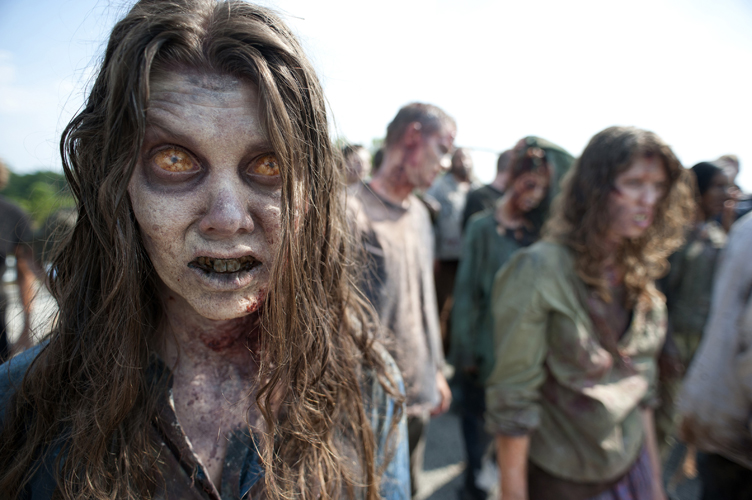
(Credit: AMC/Gene Page)

“The Walking Dead” returns Sunday to AMC to finish its second season, with sheriff Rick Grimes’ revolver still smoking from the first half’s shocking finale. While audience numbers have stayed high, the show has run into problems other than the packs of drooling undead. Showrunner Frank Darabont left for unspecified reasons, the pace of action noticeably dropped – to what creator Robert Kirkman admits now was “a little bit slower than it should” — and the zombies, when they did appear, seemed to be moving a lot faster than you’d expect from a group called walkers.

The affable Kirkman, 33, who also created the bestselling “The Walking Dead” comic book series, paused to address these issues as well as hint about new threats and locales to be encountered by the characters, and discuss the approach of new showrunner Glen Mazzara, who he says will bring a comparatively “breakneck pace” to the show as it resumes. (For those who haven’t finished the first half, there may be one spoiler included.)

What are you calling this point in the series, anyway, Part 2 of Season 2?

We call it all kinds of different things in the writers’ room: It’s Season 2.5; it’s the second half of the second season, which sometimes seems a little cumbersome, so I don’t know. It’s the last six episodes of Season 2.

I guess cutting it in half is now a common way for cable networks to present its seasons. How do you look at starting in the middle like this?

There’s a lot of different ways to look at it. I sort of enjoy the “mini-season finale” thing because I think season finales are really kind of cool and I’m a big fan of cliffhangers. Also, it’s nice to have a little break. It’s also nice to structurally make your season have some sort of punch in the first half and more punch in the second half. So structurally, it’s kind of cool. It helps writing-wise. But I don’t know, I could take it or leave it.

Consensus on the first half of the season is that it had a much different pace than the first season. Did you just want to slow the storytelling down?

It appears that the first half of second season moves a little bit slower than maybe it should. And I think that’s a byproduct of building to our midseason finale and knowing where we were going to end up, and putting all our pieces in place, and trying to tell the story in a somewhat cinematic kind of way, which may or may not work in episodic television.

I will say that’s one of the holdovers from Frank Darabont. He really wanted to take things slow and spend a lot of time dealing with different things. He was very much a big fan of the slow burn. Because he’s no longer on the show and Glen Mazzara took over as showrunner, he’s a big fan of much more fast-paced storytelling. So I think there will be somewhat of a shift when we come back with the season where we’re going to be a little more action-packed and are going to move at kind of a breakneck pace compared to the first few episodes.

And I think, looking at whole season together, when you see the first two parts, you’ll see that the first half of season kind of works, because we were building towards an event. And once that event happens  — when Sophia emerges from the barn — things just continue to escalate. So it will make sense and the whole season will be cool to watch as a whole. But there is going to be some drastically different pacing issues now that Glen Mazzara is running the show.

Do you regret that it went as slow as it did in the first half?

I don’t know that I regret anything. I think that despite the criticisms of it being slow, it was good to take the time to know the characters a little more and it was nice to see them interacting at that farm and I think that that sense of security and that tranquility, when it’s played against the chaos of coming episodes, will make chaos seem that much more intense. I think it will accentuate these episodes. So I liked it. But if I had to do it over again, I might have tried to cram some more stuff in.

From this side of the screen, it appeared that there were fewer zombies so far this season, and setting it at a farm seemed a little less expensive than clearing out part of the city. People assume it was a cost-saving measure.

No, it wasn’t a cost-saving measure at all. It was just adapting what we did in my comic book series. If you read the comics, you’ll see that eight years ago, when those stories were being told, there was a little bit of Atlanta action and then they moved into the more rural parts of Georgia and went there for safety. So it was just a decision to follow where the comics went. Filming out in the woods is not as cheap as you might think.

What has it been like for you to write for two different versions of your story,  first for the comic and then for TV? Do you consider them the same story or separate?

I kind of have to view it as separate. That’s really the only way to do it. I still write the comics month in and month out, putting new issues out. If I weren’t able to separate the two into two separate projects, it would be a little confusing.

But I’m having a lot of fun on the show. The collaborative medium of television is a really cool thing. I really do enjoy working in the writers’ room and getting to experience working in a group and forming a kind of a hive mind to try and tell stories. It’s a very different way of doing things for me.

Comic books are also kind of a collaborative medium in that you work with an artist and you tell that story together through words and pictures. But the artist on “The Walking Dead,” Charlie Adlard, he lives in the U.K, so I’m never in a room with him saying, “Wouldn’t it be cool if we did this.” It’s a very solitary working environment, where I’m in a room — I was in Kentucky and now I’m in Los Angeles — and then he’s in his room on the other side of the ocean, and we’re making a product together. But working in a room with guys and coming up with ideas and really having that exchange and pushing each other is a lot of fun for me. I really enjoy it.

We’re actually in our third or fourth week of working on Season 3 right now in the writers’ room. And one of the first things we did is we basically blocked out what happened in the comic book series in a chunk of time, from issue X to issue whatever, and said, “This is the story that we want to cover in our third season. What from this do we think is essential? What do we want to keep? Is there anything we want to add?”

It’s kind of cool to look at the comic book as a framework to improve upon; being able to have seven other talented writers look at your previous work and say, “Oh, you could have expanded this, I would have glossed over that, it would be cool if this had happened instead of that.” And for me to be involved in that process, it’s kind of a cool thing.

I guess it can be a little nerve-wracking to sit in a room with seven people and pick apart something you wrote seven years ago, but I don’t know, I think it’s a fun experience and I like being in the mix. And even I’m going, “Well, this led to this and it might be good to leave that out and it might be better if we did this instead and this really worked, people really liked this, I think we should definitely do this.”  Being able to do that, and have this give and take, is a lot of fun.

But at the same time you want to have surprises for fans of the comic book.

Absolutely. That’s why there are so many differences in the show. People who read “The Walking Dead” comic, I think one of the appealing things about it is when you sit down and read an issue, you have no idea what’s going to happen. So to lose that in the show, for people who have read the comic, I think, would be a horrible thing. So even when we adapt something in the show, we try to arrive upon an event in such a different way that it still holds a bit of surprise for people who are absolutely familiar with the comic. I like to change things up, and keep people guessing.

The comic is so similar in form to a storyboard. Does that explain why the series is so much more visual than most?

Yeah, well, it’s not really an action show. But there is definitely a lot more to be done with the visuals in this show than I think other shows. Because we’re adapting the comic, I think there are a lot of visuals to adapt from the comics. I think Charlie Adlard in particular is a fantastic artist who has been doing some real cool stuff. To leave that stuff on the cutting room floor would be a mistake. Also we have Greg Nicotero doing an amazing job bringing our zombie creatures to life. His team at KNB Efx are really essential to the show. So there’s definitely a wealth of visual storytelling for us to draw upon in order to make this series happen.

But there’s quite a lot visually happening, with those big wide establishing shots, or those subtle scenes, like the one Sunday where Daryl and Carol just sit there and don’t even speak a word. A lot of shows don’t do that.

Yeah, well, I think that’s good storytelling. When you’re making people talk just to make people talk, I think that’s when things start to be kind of fake.

So what is it about zombies in general that people are so interested in them these days?

First of all, they’re awesome. They look cool. They do cool things. There’s definitely a lot of reasons to love zombies. Culturally, the last time zombies were this popular was the height of the Cold War. So I think any time there’s a sense of unrest in society, it tends to drive people toward stories of the apocalypse and the end of the world. It makes it interesting to sit on your couch and think: OK, if society did collapse, would I be like Daryl Dixon? Would I be like Shane Walsh? Would I be like Rick Grimes? Which person would I be like? What decisions would I make? And analyzing that kind of stuff makes it easier to ignore the economic collapse or the crisis with oil prices, or whatever is going on in the world today. It’s much easier to sit in the safety of your living room and analyze it rather than to actually think about all the horrible things that are going on out in the world.

With the current cultural zombie takeover, is there a possibility of reaching overkill, as vampires seem to be doing?

Vampires cycle in and out every few years; they get really popular, then they go on the back burner for a while. I think that zombies reaching this level of popularity is a cool thing. In the history of entertainment, zombies have never got that kind of height of popularity where there is an overkill of people making zombie things and telling zombie stories. It’s kind of a cool thing for zombies to reach that level.

But I definitely feel the big budget World War Z movie with Brad Pitt and things like that that will carry it along, ‘The Walking Dead’ included. It will shoot back down eventually. But I think “The Walking Dead” hangs its hat on drama. And isn’t necessarily just a zombie adventure. It’s about human characters dealing with survival after the fall of civilization and I think that kind of story is always going to hold a vast appeal for audiences, whether it’s got zombies running around or unicorns or whatever.

While vampires (and unicorns, for that matter) seem to have their rules set in stone, things seem to be not quite nailed down yet for zombies.

One of the things I was trying to do with “The Walking Dead” was canonize zombie lore. Most people do try to reinvent the wheel when they do the zombie thing. Sometimes you have to dismember them completely, sometimes you have to shoot them in the head. Sometimes they eat brains, sometimes they eat flesh — people try to play around with it a little bit too much.

With “The Walking Dead,” I try to take the best part of the Romero model – George Romero by far did the best zombie movies in history — and his films are all consistent. Then I wanted to use most of those rules, because those are the best, and then add a few of my own — things that are logical; things that to me make sense. To just to try and say: Look, there should be some set rules on zombies. There are certain set things that make zombies cool, and we should try to maintain them.

That said, it seems like the zombies in “The Walking Dead” are a little speedier the second season than they were in the first. And why weren’t, say, the dead people in the highway pileup at the start of Season 2 not all turned into zombies as well?

There were definitely a few zombies trucking around in the first season as well. I don’t know if people didn’t notice them, or maybe they should just go back and watch it. One of the rules that we have in “The Walking Dead” is, depending on how fresh the corpse is, or how rotted it is, would logically make it fast or slow.

I don’t think we have any Olympic sprinters or anything like that. But a fairly recently formed zombie would be able to move somewhat like a human, but not quite. And we definitely have zombies that are much slower and mill about as they get more rotted. We’re trying to do things that are logical and make sense. And then every so often, you have an overzealous extra who is moving a little bit too quick, and we have to edit around that.

What about those bodies in the cars?

That’s the whole ting. That’s part of the fun of “The Walking Dead” is that you don’t really know all of the rules yet. What’s going on with those dead bodies? Why are they not zombies? Why are they just sitting in cars? That’s part of our specific set of rules that will be revealed over time.

So there are going to be mysteries like that: Why is that guy a zombie and the other guy isn’t? What happened with that guy, and various different things. I think by the end of Season 2, you’ll have a better understanding of what makes a zombie, and what goes into it and why those zombies in the car weren’t walking around.

So, in the short term, what can we expect?

We’re getting off the farm a little bit, and we’re introducing a lot of new characters and new threats. The very first episode that we come back on, on Sunday, we introduce new characters that represent a larger threat that is going to be coming after Rick and the rest of the group. And that’s really going to be a driving force that gets us right up to our finale. We’re going to be dealing with a lot of big problems.

There are a lot of questions as to whether or not Hershel knew that Sophia was in the barn, or how he and Rick are going to deal with that. And that’s not really what we’re going to be dealing with. We’re not going to have time to rest on our laurels and analyze the whole Sophia situation. There’s so much more happening and so many more threats coming into the forefront that we’re going to have to hit the ground running and deal with all these problems on our feet as we go.

“The Walking Dead” resumes its second season Sunday at 9 p.m. on AMC.

Risk-free Internet TV

Attention, Hulu and Netflix: It's not TV, it's the Internet. Original programming needs to take more chances

A still from "Battleground"

At the Fox Upfront on Monday afternoon, the head of programming “welcomed” Hulu and Netflix to the original programming game, with all the threatening good cheer of an amped-up high school senior getting ready to pound on an incoming freshman’s face. Sure, the more good original programming the better, Fox suggested, but making hit TV is hard and developing an audience is even harder — these online upstarts should expect to get demolished by their network rivals for a long time to come. Or as the head of programming put it, “Welcome to the NFL.”

But just mentioning Netflix and Hulu, two companies that have thus far rolled out exactly one original scripted program each to not much fanfare, is a compliment of the “It’s better to be talked about than not talked about at all” variety. Hulu and especially Netflix, which will begin airing new episodes of Fox’s former show “Arrested Development” sometime later this year, are on the playing field. Since one of the major distinctions between Hulu and Netflix and broadcast TV is that there’s no proper time to watch their shows, now seemed as good as any to catch up on the two existing series and see if Fox and its brethren have anything to worry about.

Hulu’s “Battleground” is a 13-episode comedy set behind the scenes of a Wisconsin Senate campaign and executed in the mockumentry style of “The Office.” Neflix’s seven-episode “Lilyhammer” is a comedic drama starring “The Sopranos’” Steven Van Zandt as a wise guy who ends up in Norway. Both series are professional, solid and unembarrassing. And even though I stayed up way past my bedtime one night finishing the enjoyable “Battleground,” both it and “Lilyhammer” are the TV equivalent of cautious toe-dipping, Netflix and Hulu’s proof that they can make polished products audiences will recognize as television.

“Battleground” is a well-constructed, low-key series that’s about 75 percent as good as something great. The dialogue is smart, the approach to politics is pleasantly non-histrionic, the characters are likable and so is the candidate. If the broad, idiotic Jordan — the son of the candidate’s husband — feels like a Dwight Schrute knockoff, the rest of the series counterbalances with an assiduous streak of Midwesternness, unshowily getting down to the business at hand, which happens to be putting together a competent, amusing television program. (One of the main characters, a nerdy, nice, newbie staffer who gets the girl by staying nerdy and nice, is a personality type that could only exist in the Illinois-Wisconsin-Minnesota tri-state area. More like him, please.) If you’ve run through episodes of “Veep” and “The West Wing” and “Tanner 88” and you still have an itch to scratch, “Battleground” will do it.

Netflix’s  “Lilyhammer” is not nearly as charming. Van Zandt plays a mobster who requests witness protection in Lilyhammer, because he liked the look of it in the 1992 Olympics. Once in Norway, a country full of snow and reindeer sweaters, electric cars and polite police chiefs, he figures out how to put his gangster skills to use in a new environment. In the first episode, a lone wolf — and that’s not a metaphor for a loner, but an actual sheep-eating wolf — gets a pair of cement shoes. The show feels like a really long indie movie that somehow got distribution, OK reviews and no audience, and now kicks around on your suggested Netflix streams for eternity.

But if the short, funny “Battleground” is both better and better suited to a computer screen than the longer, less funny “Lilyhammer,” Netflix’s strategy still makes more sense than Hulu’s. The great hurdle for both Netflix and Hulu is inserting their series into the conversation. There has to be a subset of people who feel about political comedies or displaced mobsters the way I do about British costume dramas — which is to say that they hunt down programs fitting this description, and watch the hell out of them — but that’s not most people. With thousands of TV shows available to audiences through legal means, and almost all the TV shows ever available through illegal ones, a brand-new series that’s not half bad isn’t going to jump to the top of anyone’s Netflix queue if people aren’t talking about it.

“Lilyhammer” isn’t great, but it is nominally ambitious (it is, in fact, another one of The Fauxpranos), and ambitious TV is the kind that gets people chatting and binge watching. Netflix’s next shows — “Arrested Development” and the David Fincher-Kevin Spacey collaboration “House of Cards” — should get lots of attention, and be a lot better than “Lilyhammer.” Meanwhile, Hulu’s model, to make something solid and small and premiere an episode of it every week, seems totally reasonable and not nearly flashy enough to get its shows to stand out in a very, very crowded field.

There is another way for Hulu to go, and it doesn’t involve spending heaps and heaps of money on famous people and canceled but beloved TV shows. And that’s to make something strange.  “Battleground” and “Lilyhammer” and all the shows that Hulu and Netflix have in the works are exceedingly normal, shows that would fit any TV executive’s idea of what a TV show should be. This seems sensible, as well as small-minded and skittish. Netflix and Hulu aren’t TV networks,  and they should revel in that. (It is not, if you hadn’t heard, such a good time to be a TV network.) Why aren’t they putting on the crazier, weirder shows, cheaper series with odd perspectives and strange time stamps, that are good enough to get people talking and that no network, or even cable channel, could ever put on? Hulu and Netflix want respect, when all they need is buzz, even the buzz of a small, dedicated audience. Netflix and Hulu aren’t just TV, they’re the Internet. They should stop being so boring.

Continue Reading Close
Willa Paskin

Willa Paskin is Salon's staff TV writer.

Can Britney pass the Paula Abdul test?

Wait, we're supposed to be the one judging the one-time pop princess. She'll try and turn the tables on "X-Factor"

Britney Spears (Credit: AP/Evan Agostini)

Rumors have been swirling for weeks that Britney Spears would join Fox’s “X-Factor” as a new judge, and yesterday it became official. At the Fox upfront, the annual presentations underway this week in which the major networks sell their new shows to advertisers, and then ply them with alcohol and vast buffets, Britney and Demi Lovato were introduced as the reality competition’s new judges, joining L.A. Reid and Simon Cowell, who appeared on the show last year. Lovato, the 19-year-old former tween star who has already had her own public difficulties with drugs and eating disorders, excitedly told the crowd she was “psyched” to be joining the show. Spears, in a smokier voice than the one she used to have, also expressed her excitement, capably delivering the line that had been written for her. Spears was onstage for all of two minutes, but it was enough to spark my imagination: What is an entire season of Britney Spears talking going to be like?

Thanks to Paula Abdul, the bar for speaking coherently as a judge has been set remarkably low. Paula was one of the original judges when “American Idol” began 10 years ago, and she made the jump with Cowell to “X Factor” last year, where she continued to vend her particular brand of addled kindness, never saying anything mean or insightful, and often saying it in spacey and strange ways. Spears is, of course, way more famous than Paula Abdul, and if she sits on the panel and says nice, meaningless things to the contestants each and every show, she will have earned her money. (It’s basically what the booted Nicole Scherzinger did all last season of “X Factor,” and just by virtue of being Britney Spears, Britney will be better at it.)

“X Factor” doesn’t need a hyper-articulate ballbuster to do this job and do it well. The time of sharp, critical insight on the singing shows — which initially seemed so crucial to “Idol’s” massive success — has passed. If viewers regularly lament how dull and plodding the judging rounds are now that even Cowell has tempered his honesty, “Idol” remains the biggest show on television with a judging panel that consists of Steven Tyler, Jennifer Lopez and Randy Jackson, a group as likely to insult a singer as call a newborn baby ugly.

But even if all that’s required of Spears is a season’s worth of banal compliments, that will add up to more sustained speaking than Spears has ever publicly done before. Rarely, if ever, has there been a person as famous as Britney Spears who talks so infrequently. Her most famous moments are all gestural — dancing in music videos, performing on the stage at some MTV awards show, shaving her head, bashing a window. Long before her breakdown, she displayed an uncanny tendency to speak in linguistic white noise, to say sentences that contained almost no content, just lots of y’alls and “you knows” and “oh my goshes” and a basic mood of sweetness, excitement, gratitude, eventually disconnect, and more recently, in her conservatorship years, anxiety and discomfort.

If this doesn’t make Spears a perfect judge for “X Factor” it should make her a perfect character for “X Factor.” The drama of Britney — how she will be, what she will say, and how she will hold up — is a story line at least as compelling as the one that will play out with the performers, if not far more so. We’ve been watching her for 13 years, not merely half a TV season. It’s possible “X Factor” will be as good for her career as “Idol” has been for Jennifer Lopez’s, but it’s more likely it will be uncomfortable and upsetting, a full season of watching a zonked-out Spears nervously navigate a live TV show. But we Americans owe Britney Spears a pension and worker’s comp for pain and suffering risked for our entertainment, and I’m happy a major corporation is paying it out (to the tune of $15 million). However “X-Factor” goes for Britney, I can’t wait to see what she says.

Continue Reading Close
Willa Paskin

Willa Paskin is Salon's staff TV writer.

Please don’t cancel my favorite show

"Parks and Rec," "30 Rock" and "Parenthood" sneak through for another year. Why do we get so anxious over TV shows?

Amy Poehler in "Parks and Recreation"

It’s that time of the TV year, when I find myself humming “Dayenu” all day.

“Dayenu,” the official anthem of Passover, is a song of gratitude, one thanking God for all that he did to free the Jews from slavery. The lyrics make a list: Each line enumerates something awesome and imperative that God did, before ending with “Dayenu,” which means “It would have been enough.” However, “paradoxically” (as my Haggadah puts it), the Jews really needed God to do many more awesome and imperative things, one example of which is then mentioned in the next line of the song. If God had gotten the Jews out of Egypt, “it would have been enough,” except, actually, he then had to part the Red Sea, which “would have been enough,” except, actually, he then had to provide food, “which would have been enough,” except, actually, and so and so forth until the Jews are safely tucked away in Israel with the 10 Commandments and a temple.

The Dayenu I’ve been humming this week has the same tune, but slightly different lyrics. They go like this: If NBC had aired just one season of “Community,” Dayenu. If NBC had aired the missing pen bottle episode, Dayenu. And the Christmas claymation episode, the my dinner with Abed episode, the Dungeons & Dragons episode, and the paintball sequel, Dayenu. If Inspector Spacetime, day-day-enu, day-day-enu, day-day-enu, dayenu dayenu.

The “Dayenu” sentiment, the knowledge that something really would have been enough while simultaneously not being enough at all, is all around this week as the major networks decide what series they’re keeping and canceling in preparation for next week’s upfronts, the yearly presentations they make to advertisers in which they unveil their new shows and schedules. To make room for all the new shows, the networks have to ax some old ones, decision-making that can be painless — as when, earlier this week, Fox decided not to renew “Alcatraz” or “The Finder” — or infuriating and nerve-wracking — as when NBC took its time picking up “Parenthood,” “30 Rock” “Parks and Recreation” and “Community.”

If it seems ridiculous to compare the parting of the Red Sea to getting a fourth season of “Community,” well, yes, it is ridiculous. As disappointing as it would be not to see new episodes of  “Parks” or “Community,” or ABC’s “Happy Endings” (which is still in limbo) ever again, these series have already aired more episodes than “Freaks & Geeks” or “Arrested Development” did, truncated TV series that are still perfectly satisfying, hugely influential, and really fun to watch, over and over again, on DVD. There has been enough.

But if there’s nothing logical or reasonable about the Dayenu mentality when it comes to TV, there is something emotionally intuitive about it and the “sure, there have already been enough episodes to make for a really sick DVD box set of this series, but there needs to be more” feeling. And it’s that you can have enough TV, but you can’t have enough of some people, even if they happen to be stuck in TV shows. Underlying all the gruff, screechy bluster about how idiotic NBC or ABC would be to cancel beloved series isn’t anger, but attachment. We audience members don’t know what next year’s episodes will be like, but we do know they’ll have certain characters in them, characters who have never, ever asked us how we’re doing, but who we have invested lots of time and caring into nonetheless.

On last night’s episode of “Parks and Recreation,” Leslie Knope achieved her lifelong dream of getting elected to public office. It would have been a great ending to the series, until one starts to imagine all the things Leslie would do with her new job. Then the ending, good as it was, didn’t seem like enough anymore.

Continue Reading Close
Willa Paskin

Willa Paskin is Salon's staff TV writer.

TV’s creepiest corpses

Ten network shows usually open with a murder. That's 200 deaths each season. Which one was the gnarliest?

A still from "Bones"

The network TV season ends this month, and with it a significant amount of carnage. There are currently 10 network shows — “Bones,” “Criminal Minds,” “The Mentalist,” “Castle,” “Body of Proof,” the three “CSIs,” and the two “NCISes” — that typically begin with a murder, the expected first beat in any crime procedural. This amounts to approximately 200 corpses a year, 200 dead bodies intended to entertain, to be prurient but not too prurient, disturbing, but not too disturbing. How do these shows make murder not only palatable, but a thing that millions of people want to watch after a long day’s work?  In contravention of common sense, avoiding the dead bodies altogether does not seem to be an option.

The 10 aforementioned murder series can be divided into two general categories, crime-solving shows and the corpse-studying shows. Both activities take place in both, but with a different emphasis. Programs in the first category, like “The Mentalist,” “Castle,” “NCIS” and “Criminal Minds,” have forensic scientists in the cast who can and do deliver helpful deductions about any cadaver, but the main characters mostly interview living people. On programs in the second category, like “Bones,” “Body of Proof” and the “CSIs,” the main characters mostly examine dead ones. The bodies in the crime-solving shows tend to be significantly less gruesome and graphic than the ones in the corpse-studying shows: The corpses may be a major plot point in both, but they’re only a major prop in the latter, where they have to look the part.

“The Mentalist” and “NCIS” begin with a corpse, but rather than some goopy, dripping horror show, it tends to resemble a not too mutilated human being. (“Bones,” as I’ll get into later, usually leads with a corpse more likely to resemble hamburger meat than a person.) These bodies serve a relatively staid Pavlovian function: You see one, and you know what’s coming next, 40 minutes of case cracking. Since the originality of the caper does not stem directly from the originality of the cadaver, standard murder — guns, stabbings and fights, as opposed to death by sky diving, motorboat or giant chocolate bar — tends to suffice. (This is not always the case: “NCIS” has done episodes about, for example, a murderer who cuts off and collects his victims’ feet, but it still tends to be more straightforward about cause of death than shows like “CSI” and “Bones.”)

This year “Castle” began to hew to this formula as well. In the past, “Castle,” which is a more jokey, lighthearted show than the “NCISes” and “The Mentalist,” had gone the over-the-top murder route — a burned-up guy found in a pizza oven; lumps of flesh stuck in the spin cycle. This year, episodes revolved around the death of a contestant on a show much like “Dancing With the Stars,” a victim who had teeth marks all over his body, and a third encased in concrete, but none of them looked particularly gnarly.

Dead bodies often look horrifying on “Criminal Minds,” which is about a group of law enforcement officials who track down serial killers. These serial killers, psychopaths and perverts with dark and creepy pathologies are a much more twisted bunch than the kind of kicky, oddball murderers who populate a series like “Castle,” and “Criminal Minds” is a much more twisted show. On it, a number of lifeguards show up dead … with their genitals cut off. Women show up murdered … with their lips removed. A man in a wheelchair murders prostitutes … with the help of his parents.

If all murder shows let the audience have its cake and eat it too, to identify with the good guy, but get the kicks of seeing the work of the bad one (or, to watch a group do-gooders help bring a victim, often young and attractive, to justice, but also to get to see her laid out half-naked in a morgue), “Criminal Minds” comes closest to tripping over this dichotomy. It regularly tangles with plots so creepy and horrible, it almost ruptures the real sanctity of the procedural watching experience: the feeling that, whatever is happening on-screen, you are safe at home.

This sensation is never a risk while watching the “CSIs,” shows so fizzy about murder they are, in their way, more disturbing than “Criminal Minds,” despite being much, much easier to watch. On the “CSIs” the murders are outlandish, zany and enjoyably gross: Three guys die in a car crash, and a fourth very pink brain is found with them; a woman drained of blood  is hung upside down in a haunted house; a guy gets run over by a motorboat, and the audience is treated to his ground-up throat; someone tosses body parts around Hell’s Kitchen. And those are just plots from this season. In recent years the “CSIs” have done episodes about patty sniffers, food orgies and death by alligator and dinosaur. One just has to compare “CSI” to the far less successful “Body of Proof” to see how effective its jocular attitude is. “Body of Proof” is much more serious, the plots are less crazy, it doesn’t revel in its victims’ wounds, and it is hardly any fun at all, and not nearly as successful.

But when it comes to taking the death out of murder, there is no show on TV as successful as “Bones.” The light, jokey “Bones” is about a forensic anthropologist, Dr. Brennan, who studies, yes, bones, and who is only brought in on a case when a body is in disgusting shape. This year Dr. Brennan has dealt with a head and melted body found in plastic wrap; a postal service-ready box of red goop, packing Styrofoam and a skull; an eyeball in a toilet; a body in a terrarium full of white rats; a guy pancaked so totally to the road, he had to be spatulaed off. “Bones” has an antic, enthusiastic approach to gore — more is always better — and seems to be crafted by a horror movie and Halloween enthusiast who treats each episode as an excuse to show off his or her impressive skills with awesome and icky make-believe. Of course, to have the intended good time effect, a key change has been made: None of the bodies on “Bones” much resemble people, making it much easier to forget the box of goop in the lab was ever a person. But, as all the murder shows ably demonstrate, that’s not such a hard trick to pull off.

Continue Reading Close
Willa Paskin

Willa Paskin is Salon's staff TV writer.

The “Daily Show” guide to my enemies

As a producer, I met people whose political views I detested. The hardest part was admitting they weren't so bad

(Credit: AP/Jason DeCrow)

For two years I was a field producer for “The Daily Show With Jon Stewart.” The field producer is the person who guides the creation of the pre-taped segments, the ones where the correspondent travels somewhere to interview and heartily agree with some person who holds, uh, fascinating ideas about the world. This meant I spent a lot of time with people whose causes or philosophies I found blecchy — the sort of folks who would fit nicely in the overlap of a Venn diagram whose circles included Bachmann supporters, fans of Rush Limbaugh, and people who wear tricorn hats and exercise their Second Amendment rights at Tea Party rallies.  You know – assholes.

Now, I like to loathe people. It just feels so good. I particularly like to loathe the sorts of people described above, and when I see them on TV or read their blogs I sigh contentedly and say, ahhh, it is now morally permissible for me to loathe this person. So imagine how irksome it was to have to deal with persons like that on a constant basis and discover that those persons, in person, generally weren’t loathsome persons after all. In fact, to my great consternation and disappointment, I often liked them.

I think it really hit home for me with Rapture Man. This was in 2005. Rapture Man had set up a service that would automatically send out an email in the event of the Event, an email explaining the sudden absence of the exalted Saved (e.g., him) to the despised Unsaved (e.g., New York Jewish media professionals). I feel morally superior to people who feel morally superior to me, especially when they’re certain their name is on the heavenly guest list and mine isn’t. Folks like him. What I expected was Angry Seething Evangelical Crackpot. What I got instead was a man who was devastatingly guileless and vulnerable and innocent, a man genuinely distressed by the pain and confusion the Rapture would instigate. He was the type you reflexively want to protect, to shield from the cruel realities of modern life.

In this case, the cruel realities of modern life included him and his delusions being ridiculed in a “Daily Show” piece. If I had somehow been eligible for the Rapture before producing that segment, I doubt I was afterward. I felt a bit dirty. One the other hand, it was a very funny piece. You should see it. There’s Samantha Bee disappearing in a flash of light, Ed Helms running through a post-apocalyptic landscape, Stephen Colbert wandering around with bleeding nipples and apparently snacking on parts of Rob Corddry – a veritable “Daily Show” all-star apocalypse. Great fun. Also, I don’t think Rapture Man owned a TV, so I figured I was good.

But he was just one of many others in this I-Should-Hate-These-People-But-Somehow-I-Don’t phenomenon. There was the state representative in Maine who introduced a gay marriage bill just so he could vote against it. He turned out to be just sort of sad and lonely. Wanted to hate him. Couldn’t. There was the Canadian lady who despised her homeland because it wasn’t conservative enough and too kind to immigrants and the poor. She was raucous and funny and pretty good company. I felt awful when it dawned on her mid-shoot that we weren’t actually her pals (really – there was a moment in the middle of the sit-down interview when you could see her finally catch on and sort of crumble. I wanted to leap forward and say, “Wait, it’s not you we find risible and absurd! Just your entire worldview!”). There was the Arizona state rep who introduced a bill to let people bring guns into bars. He had supported other daft legislation, was supremely confident that his background as a golf pro qualified him to interpret the Constitution, and had really, really awful Republican hair. Hated him. Until I met him. Imagine an amiable and none-too-bright Golden Retriever that breaks everything – a bit annoying, maybe, but hard to hate. Who else? There was the well-known conservative strategist, a man famed for his Orwellian genius at manipulating language. He is single-handedly responsible for several of the most insidious and effective locutions in modern political history, terms that make me want to hammer nails in my forehead. And of course he was friendly and funny and smart and could laugh at himself, and there was a strange integrity to his lack of integrity. Hate fail.

And it wasn’t just individuals who would confound me. I would often contact extremely right-wing organizations and ask if they might perhaps be interested in participating in a segment. The response was generally no – probably the wisest choice – but on more than one occasion the person on the other end would enthusiastically inform me that they all loved the show and they watch it every day and what is that wonderful Jon Stewart really like?

By the way, the converse also held true: I’d occasionally meet people who were on the right side (that is, my side) of the issues, and they’d turn out to be insufferable jerks. You know – assholes. (A quick word to the wise: If someone shows up with a time machine and offers you a chance to attend a vegan potluck fund-raiser for Dennis Kucinich, politely decline. [Just to clarify: the congressman himself, delightful. His supporters ... yeesh.])

I recently discussed the topic with another former “Daily Show” producer, and her experience matched mine. She described spending a long day with Shirley Phelps-Roper, the spokesperson for the Westboro Baptist Church – the ones who spread light and joy in the world by doing things like picketing military funerals because, you know, the gays. You’d be hard put to find a group of people with more hateful convictions. And what was it like dealing with Shirley? She was warm and affable and lovely. She lent my friend a wool cap because it was so chilly out.

OK, yes, that’s an extreme example. Being a friendly person doesn’t excuse heinous beliefs or deeds – I’m sure there were plenty of pleasant Klan members, and Hitler loved dogs and so on. But surely there’s a middle ground. We can disagree over the best way to provide healthcare, or what optimal tax rates are, without assuming that the person on the other side of the argument emerged steaming from Satan’s fundament. I might, for example, find Rick Santorum’s views and rhetoric repugnant, but I bet if I spent time with him or his supporters, they’d turn out to be honest citizens and good company.

I don’t think that the lesson is that we’re all basically the same and everyone is wonderful and let’s hug. I will admit that the lesson might be that I’m easily gulled or just morally promiscuous, willing to drop my analytical knickers at the hint of a smile or a charming Southern accent. What I’m hoping the lesson is: People are complex and can hold different views and still be moral actors — essentially the message that Jon Stewart talked about during his Rally for Sanity.

Maybe you already grasp that concept, because you have good friends or loving relatives with beliefs that are wildly divergent from your own. But I tend to think my experience is more typical: I lived in a little bubble surrounded by people who think more or less like me. And when I considered people with opposing viewpoints I would turn into a fabulist, concocting an entire narrative of who they were and what they were like — and what they were like was yucko. Because I was not really interacting with them. I just thought I was, because, hey, look, there they are on the TV, or there’s that guy’s post in the comments section. But that stuff doesn’t count. Meeting people counts. Talking counts.

So yes, I love to loathe people, but my “Daily Show” experience complicated all that and sort of spoiled my fun. When I’m exposed to views that I dislike, I try to remind myself of the human being behind those views and to cut that person some slack. I hope that they would do the same. I think we should all fight hard for what we believe in, but I’d like to put in a request for some general slack cutting – especially as we move deeper into what is sure to be a very heated campaign season.

No, of course I was kidding about Rick Santorum. I’m sure in person he’s an obnoxious cretin.

Continue Reading Close

Michael Rubens' first novel, “The Sheriff of Yrnameer,” was published in 2009. His second novel, “Sons of the 613,” is due out this fall.

Page 1 of 498 in Television

www.salon.com/topic/television/