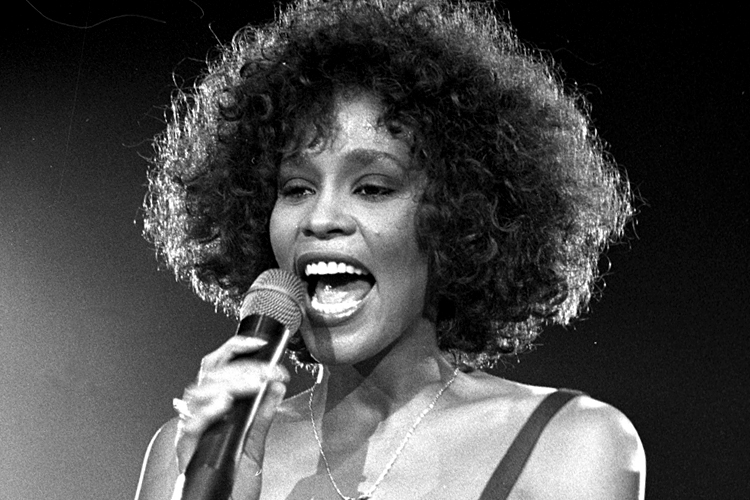

Whitney Houston

Didn’t she almost have it all?

Whitney Houston died Saturday at 48. As Salon wrote six years ago, it's a tragedy too many people saw coming

Singer Whitney Houston performs in concert at Wembley Stadium in London on May 5, 1988 (Credit: Reuters)
Editor's note: In 2006, Rebecca Traister tried to understand how one of the most popular and successful singers of all time fell into a tragic cycle of addiction. Houston died Saturday at 48, making this story even sadder. To remember Houston in happier times, check out our video tribute.

Two weeks ago, a story by Los Angeles celebrity journalist Nick Papps began, “It’s hard to believe that the drugged, dazed woman staring out from [an accompanying] picture was once one of the most popular singers in the world … But today that woman, Whitney Houston, 42, is just another crack head.”

The dim assessment came in response to tabloids that on March 29 printed photos of what is supposedly Houston’s Atlanta bathroom, littered with crack pipes, cocaine-coated spoons, cigarette butts, Budweiser cans and garbage. The photos were taken, and sold to the magazines, by Houston’s sister-in-law, who provided an accompanying tale of the singer’s cracked-out habits, from hallucinating violent demons, to biting and hitting herself, putting her hand through walls, and locking herself away to smoke rock cocaine and pleasure herself with an apparently prodigious collection of vibrators. Speaking about the mess on Fox’s “The O’Reilly Factor,” Billboard executive editor Tamara Conniff said, “I think that she was a really well-manicured diva star and she just turned a little ghetto.”

Whitney Houston has sold more than 120 million records. Her first album, “Whitney Houston,” sold 24 million copies in 1985, becoming the highest-selling debut for a female solo artist. She was the first American singer to have seven consecutive No. 1 hits. She won six Grammys and 21 American Music Awards; her 1992 cover of Dolly Parton’s “I Will Always Love You” was the highest-selling single by a woman in pop music history. But her impact went deeper than that: Houston’s was one of the only black faces that white girls like me who grew up in the 1980s ever saw in magazines in our dentist’s office or in video rotation on early Af-Am-light MTV. For many black girls, she was the only young female role model presented in lily-white teen bibles or mainstream entertainment who looked anything like them.

But 20 years after her record-breaking debut, and a decade-long dominance of the pop charts, Whitney Houston has been reduced to this: “just another crack head,” “a really well-manicured diva” who “just turned a little ghetto.”

Hearing someone who mattered to me as a child, who was famous in a daily, first-name-only kind of way, whose voice and face were so very beautiful, get tossed away so unceremoniously was jarring to me. Yes, jarring, even after a decade spent watching her career circle the drain. Listening to the ugly overtones of her dismissal — “crackhead” just half an epithet away from “crack whore” — I found myself wanting to blame everything that’s wrong with American culture. I wanted to point out that successful black women get punished, that women’s entertainment careers get manipulated to conform to standards they can’t maintain, that Houston’s thunderous slide was surely precipitated by racism and sexism and a celebrity machine that chews people up and leaves them for dead. Literally. In 2001, the New York Post reported that MTV has collected B-roll for a Houston obit, an honor normally reserved for geriatrics.

So I called the kinds of people who could shed light on these possibilities. And they did. But in talking and thinking about Houston’s story, walking past newsstands where her shiny, bloated face stared up from the tabloid covers, I realized that part of what’s so sad about this particular pop culture tragedy is that racism and sexism and celebrity culture only went so far in destroying this woman; the rest she seems to have done herself.

“She couldn’t have been a bigger or more beloved star, and she was really the first black America’s sweetheart,” said Janice Min, editor of Us Weekly, about Houston’s mid-’80s profile. “Now she’s not even worthy of ‘The Surreal Life.’ She’s fallen below the entertainment C-list level. It’s almost too tragic to deal with.” Perhaps the surest sign that Houston has essentially ceased to matter is that Min’s magazine, whose pages burble and hiss with every plodding plot point in every celebrity soap opera, did not run a story on the Enquirer’s “Inside Whitney’s Crackden!” scoop.

“We kind of ignored it,” Min explained, adding that she decided against covering it only at the last minute. First of all, the story was one hell of a celebrity bummer. “It’s a little tawdry for an Us audience, where celebrities have a nice shiny veneer on them. This is a little hardcore,” said Min. “You turn to celebrities for escape and voyeurism. When their problems are worse than yours, then you don’t want to read about them.” And there’s no worse buzz kill than a predictable one. “The interesting thing was that when you saw the pictures, you almost wanted to be more surprised than you were,” Min continued. “There are a few celebrity stories that filter into the white noise category: Paris Hilton breaking up with a boyfriend, Nicole Richie looking stick thin, and on a much more tragic level, Whitney Houston using drugs. This has been an ongoing plotline for a long time.”

It certainly has. Houston has been missing concerts for years. She was booted from the Oscars in 2000 for blowing off rehearsal. When she does perform, she often sings badly and looks consumptive. She’s been in and out of rehab, was arrested for marijuana possession in 2002, and admitted to Diane Sawyer that same year that she “partied.” Her husband of 14 years, Bobby Brown, has spent time in jail for drunk driving, failure to pay child support, and breaking parole by assaulting his wife in 2003. Houston hasn’t released an album since 2003; the most exposure she’s had in recent years has been “Being Bobby Brown,” the train wreck of a reality show she and her husband headlined last year.

But all that doesn’t change who she used to be. It doesn’t change the fact that many women in their 30s and late 20s can still remember the 17-year-old fashion model as one of the first women of color to grace the cover of Seventeen in 1980. It wasn’t hard to suss out the ways that America’s historical anxiety about black femininity and sexuality was manifesting itself during the ’80s: These were the years when Vanessa Williams, the first black Miss America, was dethroned for having been photographed naked, and when Lisa Bonet, aka Denise Huxtable, was savaged for costarring in the kinky movie “Angel Heart” with Mickey Rourke. If young black women were going to be in the public (white) eye, they had to be pure and unthreatening, especially sexually.

For a long time, Houston fit the bill. And while there’s lots to be said about the lengths she, or her P.R. people, may have gone to to make her a palatable crossover sensation, there was no question that her roots were deep in African-American musical tradition. Slick and overproduced though they may have been, Houston’s songs were soul and R&B ballads; her voice was huge, and straight out of her Newark, N.J., church choir. She was the product of music royalty, daughter of gospel star Cissy Houston, who sang backup for Aretha Franklin and Elvis Presley. Franklin is Whitney’s godmother; Dionne Warwick is her cousin.

Houston’s run is often described in shorthand now: She sang “the ‘Bodyguard’ song” (“I Will Always Love You”) and “The Greatest Love of All,” a tune popular at sixth-grade graduations everywhere. But those are the tip of the iceberg; between 1985 and 1997, she slammed out hit after hit after hit, from peppy dance tunes to ocean-liner-size ballads: “All at Once,” “How Will I Know,” “I Wanna Dance With Somebody,” “You Give Good Love,” “Saving All My Love,” “So Emotional,” “Where Do Broken Hearts Go,” “Didn’t We Almost Have It All,” “One Moment in Time,” “Run to You,” “I’m Every Woman.” Houston’s pipes could shake the stereo, make you shiver even when you knew the song was schmaltzy.

It’s hard to convey now, in a more diffuse media landscape, the intensity of radio and video play she got. I “grew out” of my Whitney fandom around puberty and haven’t sat down to listen to her in 15 years; while writing this, I downloaded some tunes and found that I still knew every word. That’s not just a mark of early devotion; it’s a sign of what was her inescapable ubiquity.

“Whitney Houston was probably the most important African-American singer between Aretha Franklin and Mary J. Blige. For a decade or so, she was probably the most important black female singer out there,” said Craig Werner, chairman of the University of Wisconsin-Madison’s African-American studies department and author of “A Change Is Gonna Come: Music, Race and the Soul of America.” Werner also pointed me to the work of music journalist Danny Alexander, who has argued that the untold story of black music in the past two decades — lost amid the attention showered on rap and hip-hop — was the emergence of the black female vocalist as the most powerful force on pop charts.

In an e-mail, Alexander explained that while it wasn’t “all about” Houston, there was “a sea change that follows her initial success. Black women, in particular, [including] extraordinary vocal groups such as En Vogue, TLC, SWV … Destiny’s Child, but also Mariah Carey, Toni Braxton, Mary J. Blige and others in line for Whitney’s undisputed throne, played the largest role in chart history as talent to be reckoned with … it’s unlike anything that happened before.” According to Alexander, Houston and her peers, including Madonna, Janet Jackson and Tina Turner, “carved out a space for women to come close to dominating pop radio in the early ’90s — as not simply producers’ pawns … but serious artists demanding artistic control and respect and, in Whitney’s case in particular, with a vocal talent to rival anyone else on the radio.”

But if Houston was helping to spearhead a music industry revolution, that revolution was concurrent with tectonic shifts of another kind. Houston was a product — literally — of MTV. And that meant that she was packaged within an inch of her life — pinched and prodded and tweaked to look a certain way. Check out the cover of her first album. Houston was 21; her face looks about 14. But she’s done up like a piece of Grecian statuary, her hair pulled into a severe bun, a string of pearls around her neck. She looks unrealistically pristine.

“She was like the black Princess Di — always in a gown; beyond gorgeous,” said Danyel Smith, former editor in chief of Vibe who has profiled and spent time with Houston over the years. Smith observed that in the mainstream press, many female stars are motivated to present themselves — or others choose to represent them — as rebel bad girls who defy prudish expectation and wholesome good looks by staying out late, drinking too much and sneaking off to bathroom stalls with Wilmer Valderrama. Back in the mid-’80s, Houston was defying a different set of cultural expectations — the ones applied to black girls — to a much different effect. She was presented to us as youthful feminine perfection: all sugar and spice and poofy dresses, a solid rearing in the church, a close family. Her unraveling “is not the same thing as a bad girl getting worse,” said Smith. “It’s a good girl seemingly tumbling to the bottom of a ravine. We have to watch, but it’s really not pretty, and not entertaining.”

Houston was famously guarded about her private life. If there was the sense that everything we saw about her as a young performer — her family, her faith, her clothes — was what we were meant to see, then at the least that publicity lockdown presented her (or someone) as in control. After her marriage and the birth of daughter Bobbi Kristina in 1993, the media began to get glimpses, with the missed performances and weight loss, that something was amiss. There were rumors that she was doing drugs with her husband, who often was assumed to be the catalyst behind her self-destruction.

This loosening of her grip on her public presentation seemed a sign that Houston’s private life was in free fall. In the now-infamous 2002 interview with Diane Sawyer, Brown arrived uninvited, an irritating presence whose desire to control his wife, or to keep her from emerging from whatever private universe they inhabited, seemed to emanate from his pores. But Houston didn’t appear to mind. She came off as defensive and vaguely unpleasant as she crowed to Sawyer that she made “too much money to ever smoke crack.” “Crack is cheap,” she said. “Crack is whack.”

Her raucous denials served not only to make her sound like someone who might well have done crack, but also like someone who was drawing invisible and unattractive class and race lines around herself. No matter how strung-out she was willing to look on television, this was a message she seemed determined to control: I’m not that kind of drug user, she was saying. Not the kind who’s poor. And while it was clear that whatever kind of person she was in 2002, it bore little resemblance to the young woman on the cover of Seventeen; it was hard to tell whether her new, unlikable presentation was any more authentic than the clean-scrubbed package. “I watched with hope that I would see something in her face that was real,” said Smith of the interview. “But I don’t know what her real is. And I’ve spent time with her a couple of times over the years. Like the best and biggest pop stars, she is a very veiled persona.”

The veil dropped more dramatically last year, when Houston appeared on her husband’s Bravo reality series “Being Bobby Brown.” The show dealt intimately with the action taking place (and not taking place) in Houston’s lower intestine, and was peppered with lines from the former “black Princess Di” like, “I’ve got to poop a poop!” It was disgusting — not because of the scatological humor, which actually seemed refreshingly real — but because of the context in which that humor played to the scads of viewers who made the show one of Bravo’s biggest hits. Houston and Brown didn’t look right; they didn’t appear to be well, or particularly sane. And so it seemed that the message was not, “Look at the successful celebrities who, like real people, talk about farting,” but rather, “Laugh at these strung-out has-beens who can’t help but degrade what’s left of their image by talking about their bowel movements on camera.”

Smith was clear that she doesn’t know what to make of the story behind the current set of drug-den photographs: “If it’s old, if it’s new, if it’s Bobby Brown, if it’s drugs, if it’s fatigue, if it’s depression, if it’s freedom; we don’t know what it is at all.” But she also said that she could bring herself to watch only one episode of the reality show. “It seemed so tragic and broken that I just couldn’t take it.”

Perhaps the most surprising twist of “Being Bobby Brown” was that it turned a lot of assumptions about just what had happened to Houston on their ears. There had been a pretty simple imaginative narrative about the singer’s decade-long decline: that as a victim of her own early success, she had been pushed into a public marriage to an abusive man, perhaps been badly treated and forced to live a lie, and fallen into drug addiction and depression at his hands. Who knows — maybe there’s truth in that story arc. But what “Being Bobby Brown” made clear was that however the Houston-Brown marriage has developed over the years, it is now, if not blissful, then at the very least functionally codependent. And more than that, that Brown is not the only bully in the family.

“That was a show where you probably saw more pathology than you needed to,” said Us Weekly’s Min. “I think a lot of people stopped feeling sorry for Whitney Houston after that show. It looked like she had the upper hand in that relationship. Where people had probably assumed Bobby was the thug, I think they began to consider that maybe Whitney was the thug.” Houston was pushy and mean and dismissive, and she looked physically wrecked: from her waxy skin to straw-dry hair to her oddly protruding belly. “And,” Min paused before pointing out, “she looked like probably not the best mother in the world. In America you can be forgiven for a lot of things. But not being a fully engaged mother is a sin.” Here, she recalled a “Being Bobby Brown” episode in which Houston locked young Bobbi Kristina out of her bedroom so that she and Brown could have sex. “People were shocked by that,” said Min. “Especially coming from America’s former pop princess.”

But isn’t part of the demonization of black female sexuality about our attitudes and assumptions more than it is about reality? Houston’s meteoric rise, after all, had occurred during what Wisconsin professor Werner described as “an extremely chaotic period in African-American culture” during which the class-carving effects of Reaganomics dissolved black communities, the church lost its role as a centralizing organizing structure, and drug wars ripped through black neighborhoods. “The cultural moorings that had held black life together during all kinds of turmoil and suffering in some way fell apart,” said Werner. If Houston had become unmoored by her early success, he hypothesized, she might not have found the communal support she once would have. “Celebrity culture replaced the culture of community that had nurtured soul music and early rock ‘n’ roll,” he said. “It was a perfect storm of how to screw up somebody’s life.”

The circumstances of Houston’s trajectory were in some ways reassuringly stereotypical. “The media particularly likes this kind of story because it plays into stereotypes of black degradation,” said Werner. “The specific squalor of the Whitney Houston crack story, that part of it is racialized. There’s the idea that crack is a black drug. Which is horseshit. But look at how we love the stories of black people doing it: Remember Marion Barry in Washington? We like this because it’s a ghetto story. And it shows no matter how high they rise, this is how they all fall.”

But while Houston may have steered her way into a perfect storm of unjust racial expectation, she was still at the wheel. And she has had ample offers of rescue, including, by her own admission, family interventions. While writing this piece, I spoke to a friend who strenuously argued that Houston’s present circumstances have little to do with race. If distant engagement with celebrity life can be compared to friendship, she said, then Houston is the friend on whom we have finally been forced to give up. We did gasp with horror over her skeletal appearance, were saddened by her no-show concert appearances, shaken by tales of spousal abuse and drugging. But she has sworn she’d get help and then failed to do so too many times, returned again and again to the abusive boyfriend, gotten clean only to relapse, stolen money from our wallets — if minutes spent poring over dismaying People photo spreads count as currency — until we eventually told her never to call us again. Moreover, mentioning Robert Downey Jr. by way of comparison, my friend said that if Houston had been able to smoke crack and still produce compelling product — hit songs — we would have forgiven her anything, regardless of color.

Downey is a fair example of down-and-out celebrity (at least temporarily) redeemed. One that’s even more apt would be Mariah Carey, who went all-out bonkers and still managed a glorious return. Or Courtney Love, an addled and unwell figure who has been pilloried even more brutally than Houston, but who has managed to retain a claim on some fuzzy corner of our hearts. Houston has no such fuzzy place. At least in the mainstream (white) press.

But, Danyel Smith reminded me, that doesn’t mean that everyone’s given up on her. “When you say, ‘How did we discard her so quickly?’ ‘We’ is too big a word,” said Smith. “I don’t think the African-American community has discarded her. There is equal parts sadness and on some levels disgust, and I hesitate to speak for every African-American like we’re all joined hand-in-hand. But I do think that however misguided, there is a huge hope for her recovery. And there is still a deep and abiding love for the Whitney we knew on those first three or four albums.”

So maybe that’s all I want: for the mainstream press to save Whitney from the tabloid and reality-TV haze that seems to have enveloped and obscured everything about who she was before. The tragedy here — in addition to the loss of a talent and the apparent illness of a once-healthy woman — is the way that loss and illness have sucked dry our well of respect for someone who made an artistic and social impact. Maybe in an extremely twisted way, MTV’s obituary B-roll is the right idea. What we need to be doing is not laughing, or looking away. What we need to be doing is mourning.

Rebecca Traister

Rebecca Traister writes for Salon. She is the author of "Big Girls Don't Cry: The Election that Changed Everything for American Women" (Free Press). Follow @rtraister on Twitter.

The Enquirer’s ghoulish Whitney cash-in

The tabloid publishes a photograph of her corpse -- and proves, again, just how low it will go

Whitney Houston (Credit: Reuters)

What would you call a photograph of a dead celebrity, peddled out to a bottom-feeding rag? How would you describe an image running with the exclamation-pointed words “The last photo!” and details of how much money the jewelry on her corpse was worth? Creepy? Morbid? Gross? Speaking to Fox.com news on Thursday, ghoulish Enquirer publisher Mary Beth Wright thought her “world exclusive” purported photo of Whitney Houston laid out in her coffin “was beautiful.”

(The Enquirer isn’t yet running the image on its website, but it does offer an “exclusive” from a woman who claims, “I did crack with Whitney!” Oh, National Enquirer, you’re so predictable.)

Death voyeurism is nothing new for the Enquirer. In 1977, the tabloid famously splashed the image of Elvis Presley in his coffin on the front page. In 1980, it managed to go even grislier, devoting the front page to a murdered John Lennon in the morgue. Four years ago, it ran a “chilling final image” of what appeared to be the corpse of Anna Nicole Smith in a body bag, whose authenticity it then refused to verify.

Public viewing of the dead, both in person and via photographs, is not an uncommon occurrence. It’s part of how we process loss — and it’s also a grim way of peering into the abyss we all eventually face. It’s why, after all, we have open caskets in the first place. Consider the body of Lenin, which has been reposing in state for all the world to see for the last eight decades. And when James Brown died, images of his fabulously decked out body, on view at the legendary Apollo Theater, were ubiquitous.

But there’s a pretty obvious line of taste to be drawn between public memorial or a family wake and plain old crass corpse-ogling. The National Enquirer was not disseminating an image that was ever intended to be shared. If it were, there might be a photo credit on it, or at least the Enquirer would own up to how it obtained it. Instead, it’s doing what the Enquirer does, loathsomely reveling in “all the details” of what the paper itself describes as her “private” viewing. A representative of the Newark funeral home where the photo was taken told E! Thursday that she was “very angry, very upset” about the image, adding, “We would not do that.” Someone, however, clearly did, and is no doubt right now waiting for a substantial check to clear. (Fox estimates the payout for the picture could have been as high as six figures.)

What’s almost as sickening as the tawdry exploitation of a woman’s untimely death is the weary acceptance of it. Writing in the LA Times Thursday afternoon, Rene Lynch pointed out that “This is the National Enquirer, people.” In a CBS poll, 28 percent of respondents said it was OK for the Enquirer to publish the image. You don’t go looking for class from the tabs. But being consistently horrible should never make you less accountable.

Whitney herself does indeed look “beautiful” in that picture. Bedecked in jewels, her hair and makeup flawless, she appears more elegant and peaceful than the sadly familiar gaunt, troubled figure of more recent years. But even for a woman who was endlessly scrutinized and photographed, who lived under the flashbulb lights most of her relatively short life, this “last photo!” is a violation. The dead can’t consent. And the living — even those who publish cheap supermarket tabloids — ought to respect that.

Continue Reading Close
Mary Elizabeth Williams

Mary Elizabeth Williams is a staff writer for Salon and the author of "Gimme Shelter: My Three Years Searching for the American Dream." Follow her on Twitter: @embeedub.

What Whitney’s death should have us talking about

Despite its obsession with the star's demise, the press ignores the real issues behind America's deadliest epidemic

(Credit: AP)
This article originally appeared on The Fix.

the fixJust minutes after Whitney Houston was found dead in a bathtub at the Beverly Hilton last Saturday at the age of 48, a caravan of network trucks began slowly encircling the plush hotel, morbidly eager to document her untimely demise. Since then, it’s been nearly impossible to turn on the TV or log on to the Web without witnessing a tribute to the singer, often including depressing video footage of her long, painful decline. Her memorial on Saturday had the pomp and pageantry of a state event—complete with dignitaries, crying onlookers and flags at half-mast.

But while speakers talked movingly about her battles, mention of the word “addiction” was curiously scrubbed from the event.

It’s no surprise that the singer’s death has struck such a chord in the country. Incredibly talented, beautiful and ambitious, Whitney Houston was a rare kind of legend who changed the face of American pop music. In her later life she also became an addict whose cruel struggle with the disease unfolded in full public view. That she lay dying for hours in a luxe bathroom suite while her bodyguards cooled their heels outside is a sad commentary on the state of modern celebrity. That it took less than 10 minutes for the press to begin broadcasting her death is an even more searing indictment of contemporary media culture.

Houston, of course, is not the only celebrity whose problems have received rapt press attention. Last month it was Demi Moore. The week before that it was Disney’s Demi Lavato. Meanwhile, the weekly travails of Charlie Sheen and Lindsay Lohan have been breathless fodder for fleets of paparazzi. And for over a year before her death last year, fans of Amy Winehouse received daily updates of her ups and downs. One British tabloid even went so far as to embed a pack of paparazzi at her favorite pubs.

As a longtime editor at several magazines over the past two decades, I’ve admittedly been an active participant in this game—keenly aware that for ordinary readers grappling with the mundanities of daily life, stars offer a few rare moments of transcendence. But their intoxicating effect on the American public also gives them outsize power to shape public perception. In the 1980s, Rock Hudson and Magic Johnson forced the media to finally pay attention to AIDS only after it had already killed an army of Americans. Michael J. Fox’s battle with Parkinson’s helped bring invaluable attention and funding to the disease, while prompting a debate on stem cell research that promises to have profound effects on the treatment of other illnesses.

But substantive stories about alcoholism and drug addiction remain largely outside the media purview—focused on the tribulations of A and C-list celebrities, they’re often ghettoized in gossip sites and channels like VH1. For all the daily hand wringing about celebrity overdoses and DUIs, there is precious little real reporting on the growing scientific understanding of the disease, the tragic lack of access to treatment or insurance coverage, or even the growing number of promising drugs that have begun to make real progress against this condition.

For a long time, I regarded this kind of journalism as business as usual. But my own perspective began to change as I was forced to confront the fact of my own addiction. For most of my early 30s I fancied myself a young version of the late Christopher Hitchens, a literary legend rarely spotted without a drink who once bragged that he couldn’t write without a hangover. Alas, I soon learned that I possessed neither his talent nor his hardy constitution. As a result, I spent two years in a series of rehabs and sober living facilities, witnessing firsthand the ravenous toll taken by addiction and the abject failure of our medical and political system.

My first roommate was a 23-year-old violinist from Iowa who had cycled through five detoxes and five rehabs in just 11 months. At the same rehab, I befriended an ad executive whose proclivity for Absolut eventually landed her in a homeless shelter. I met an investment banker whose weekend crystal meth binges led to a lifelong HIV infection. At one sober living facility I played poker with a rum-loving Catholic priest who led one of the largest congregations in Nigeria. I met countless others who maintain publicly productive lives while suffering through their own private hell. You can be certain that none of them will ever show up on CNN. But neither will the pernicious behavior of the insurance companies and Big Pharma, who have often illegally profited off the scourge while accumulating blockbuster profits.

As someone who’s seen the effects of alcoholism close-up, I’ve grown increasingly frustrated by the failure of my colleagues to get beyond the superficial details of addiction, or to empathize with the lives of people who aren’t regulars on Perez or Page Six. Much of the mainstream media has been lazy—even downright derelict—when it comes to addressing the nation’s most pressing health crisis.

When I ask my journalist friends about their failure to take on the larger issues behind these stories, they usually reply that reporting on struggling stars is a teachable moment for many Americans. But that’s not much of an answer. It’s not really breaking news that drugs can be harmful and sometimes deadly. The real questions are: What can we do about it? And how exactly did we get here?

Ultimately, the torrent of coverage of the Whitneys and Winehouses of the world is little more than a distraction, a game of mirrors that deflects attention from millions of farmers, bankers and college kids who are also suffering and dying of drug-related causes at a record rate. It’s easier not to have to confront the reality of our drug-slammed towns, or jails full of untreated addicts, or high-school kids who swallow up to 50 Oxys a day. Entire regions of middle America have been decimated by poverty and crystal meth. America’s seemingly ravenous appetite for drugs raises questions that demand deeper explanations.

The fact is, while most major causes of preventable death in the U.S. are in decline, drugs—especially pharmaceutical drugs—remain a dramatic exception. A 2010 national survey by the Department of Health and Human Services found that over 22 million Americans suffer from alcohol or drug dependency. Drug overdose rates have more than tripled since 1999, claiming a life every 14 minutes. In fact, it’s hard to imagine a single person in the whole country who hasn’t been directly or indirectly affected. Rehabs and sober livings around the country have become a vast $20 billion business, many of them operating under woefully inadequate oversight. Many Americans under the age of 30 have become hooked on opiate painkillers like OxyContin and Vicodin, buying them on the street for prices as high as $80 a pill. According to the Centers for Disease Control and Prevention, the abuse of these painkillers was responsible for close to half a million emergency room visits in 2009, a number that has nearly doubled in just the past five years.

Our nation’s seemingly ravenous appetite for drugs also raises problematic questions about the larger culture the media has helped create. Why is it that a nation that enjoys one of the highest standards of living in the world also suffers one of the highest rates of drug abuse? Why are so many of us driven to substances to obliterate reality? What does this continuing scourge say about the values and morals that underlie our society?

Given the expensive impact of drugs and alcohol on our medical and prison system and addiction’s massive impact on workplace productivity, the continued lack of serious discourse on the issue remains surprising. Certainly it’s not just reporters who are to blame. Though the Obama administration recently doled out extra funding for drug prevention programs, it still spends several billion more on a drug war than seems as unwinnable as Vietnam. To its credit, starting in 2014, Obama’s historic new health plan will mandate insurers for the first time ever to treat addicts the way they treat victims of other diseases, putting an end to decades in which desperately ill addicts were denied life-and-death treatment.

For their part, however, the Republicans have been uncharacteristically more restrained on the subject. Not long ago they could dismiss the drug epidemic as symptoms of urban permissiveness and decaying inner-city neighborhoods. But as drugs intrude deeper and deeper into the leafy middle-class suburbs and the wide-open ranges of America’s heartland, the law and order types at the GOP have become tongue-tied. During the season’s endless series of GOP debates, not a single candidate was quizzed about their policies on drugs or treatment. While Ron Paul has been an articulate advocate of drug legalization, Mitt Romney and Rick Santorum’s websites devote not a word to their drug policies, even though Bain Capital, once run by Mitt Romney, is one of the leading owners of the nation’s 20,000 rehabs and sober living facilities. Newt Gingrich, a one-time pot smoker who has lately taken to extolling the virtues of AA’s Big Book, has maintained a hard-line anti-drug stance, even though he’s backed down on his former pledge to put drug dealers to death. Last year, in Florida, newly elected Tea Party Gov. Rick Scott mounted a crazy and ultimately doomed campaign against an effort to regulate the state’s pill mills, which produce the vast majority of the country’s illegal prescription painkillers. Not to be outdone, the Tallahassee Republicans recently voted for a bill that would dramatically slash funding for drug prevention in a state that has one of the highest percentages of drug abusers in the country.

In short, there’s no lack of important, compelling stories out there that could benefit from a little media attention. And while some enterprising reporters and bloggers have risen to the challenge, they’re the exception rather than the rule. What’s responsible for their continued reluctance? The continuing stigma around addiction undoubtedly has something to do with it. Even though decades of research proves addiction is a condition with complicated genetic and chemical roots, far too many journalists continue to see it as a sort of moral weakness. Their failure to actively report on the issue represents both a lack of initiative and funding. After all, covering Whitney’s last moments is a lot easier (and less expensive) than going up against the wrath of formidable lawyers and lobbyists employed by corrupt pharmaceutical behemoths. It’s also a lot more comfortable than venturing into the ravaged small towns of Iowa and Montana to witness firsthand the devastation wrought by poverty and crystal meth.

The senseless death of one of America’s most outsize talents is undoubtedly a cause for mourning. But tragic as her death may be, Houston is just another person lost to an epidemic that has also killed thousands more in just the path month. It would be a fitting coda to her impressive legacy if her death ended up providing a genuine “teaching moment” for America: one that would encourage the media and public to look beyond the scandals and personalities to the complicated causes and consequences of this miserable disease. But that’s probably wishful thinking. More likely, in a couple of weeks the hysterical pundits and satellite trucks will roll on to the scene of the next tragedy. As Truman Capote famously noted, “The dogs bark and the caravan moves on.” Meanwhile, the 22 million people affected by this disease will stay exactly where they are.

Continue Reading Close

Maer Roshan is Founder and Editor of The Fix. Previously he served as Founder and Editor-in-Chief Radar Magazine and Radaronline.com, Editorial Director at Talk, Deputy Editor of New York, and Senior Editor of Interview. He is also Founding Editor of the forthcoming I-Pad publication, Punch!

The real problem with honoring Whitney

The uproar over Christie's order to fly the flags at half-staff was about race and gender, not drug addiction

(Credit: AP)

If any single political figure in America is a flesh-and-blood personification of a Rorschach test, it is Republican New Jersey Gov. Chris Christie. In almost every way, he raises vexing questions which ultimately say more about us than they do about him.

Is he, for instance, refreshingly authentic or just downright offensive? Is he regular-guy fat or too obese to be president? Is he a rare moderate Republican who is at least willing to discuss legalizing gay marriage or is he a standard GOP bigot who is deftly maneuvering to prevent such legalization?

How you answer all of these questions is a matter of political identity — your answers all but determine where you fall on the larger political map, and in the process, highlight your assumptions about a whole host of issues.

Now, in the wake of Whitney Houston’s tragic death, Christie’s done it again. By ordering his state government’s flags to half-staff to mourn the singer’s tragic death, he has ignited a heated national debate about who should — and who should not — be posthumously honored by the public. In the process, his move has provided a lesson in how dog-whistle politics works — and how the ugliest forms of bigotry still dictate so many Americans’ unconscious reflexes.

To summarize the details of this latest manufactured controversy, read the arch-conservative Washington Times’ writeup (emphasis added):

Twitter was abuzz Wednesday with reaction to the decision by Christie… In online postings, there were two main arguments against the honor for the Grammy Award winner who died over the weekend in California at age 48: One was that it should be reserved for members of the military, first responders and elected officials. The other was that it’s wrong to honor a drug addict.

Heather Clause, a Richmond, Va.-based blogger who writes about teen moms and was tweeting critical comments, said in a telephone interview that she was appalled by the planned flag-lowering.

“It’s just such a bad example for people,” said 23-year-old Clause. She said the decision was like saying if someone sings well, drug use doesn’t matter and “you can still be an idol.”

In upstate New York, Rebecca Eppelmann, a newspaper copy editor, also tweeted her disgust at the Houston honor, then discussed her views.

“It should be for major events,” she said. “It’s horrible that she passed away. It’s not something that should warrant this.”

Thankfully, Christie did the right thing and proudly stood by his decision, saying “I am disturbed by people who believe that… because of her history of substance abuse that somehow she’s forfeited the good things that she did in her life — I just reject that on a human level.” But that hasn’t stopped the backlash. In response to Christie’s alleged crime of honoring the dead, conservatives’ Fake Outrage MachineTM has rip-corded to life, generating the usual howls of heartland outrage — including a man who burnt a New Jersey flag in protest of Christie’s order.

Of course, when singer Frank Sinatra died and New Jersey’s flags were flown at half-staff, this kind of outrage was nowhere to be found — despite the fact that Sinatra himself was a drug abuser (the drug in question being alcohol). Likewise, the outrage was nowhere to be found when Elvis Presley died of a drug overdose in 1977 and flags all over America were flown at half-staff. Indeed, as the Rockford Register Star’s Chuck Sweeney notes, that event prompted an order for “all city flags in Memphis (to be) lowered to half staff”; compelled former President Richard Nixon to “ask Americans to fly their flags at half staff in honor of Elvis”; and got then-President Jimmy Carter to issue a statement saying, “With Elvis, a part of our country has died.”

What, then, explains the difference? Why would there be a hostile reaction to the way New Jersey memorialized the drug-abusing Houston, when there was no such hostile reaction to the way the drug-abusing Sinatra and Presley were memorialized?

The answer, of course, is rooted, in part, in racist and sexist double standards.

When famous white men engage in illicit activities, American culture allows them to nonetheless retain their street cred, their wholesome image and their public honor. In some instances, in fact, the illicit behavior contributes to their mystique and their legacy — it is seen as a cool part of who they are. This is exactly why one of the iconic images of Sinatra is him in a tux with a highball in his hand — because a white, male-dominated culture accepts — and even at times celebrates — the blemishes of fellow white men.

By contrast, when famous women — and particularly famous women of color — engage in the same behavior, the same swath of America that celebrates the Presleys and Sinatras often reacts with indignant disgust. Hence, the backlash to Christie daring to minimally honor Houston — a reaction that shows a white, male-dominated culture which accepts the imperfections of white males simultaneously refuses to accept the imperfections of “the other.”

Importantly, such a double-standard isn’t just amplified by men. In this case, some of those criticizing Christie’s decision are women. But that merely shows how pervasive the double standard really is — it’s so widespread and so accepted that it’s operating at a subconscious level across demographic divides.

To be sure, it’s fair to raise questions about whether any entertainer deserves the same form of state-sponsored memorial as soldiers, elected officials, first responders and other public servants. Such principled and necessary queries make us contemplate a culture that overly deifies famous people, regardless of why they are famous — and challenging that celebrity-worshiping theology is important.

However, if we are going to accept entertainers being recognized and memorialized by our civic institutions, then we ought to apply one standard. Either icons should be recognized regardless of their lifestyle choices, or they should not be recognized because of their lifestyle choices. Applying two standards to two sets of icons — and applying those standards selectively against women and minorities — converts solemn memorials of the dead into more ugly expressions of racism, sexism and other pathologies that still plague America.

Continue Reading Close
David Sirota

David Sirota is a best-selling author of the new book "Back to Our Future: How the 1980s Explain the World We Live In Now." He hosts the morning show on AM760 in Colorado. E-mail him at ds@davidsirota.com, follow him on Twitter @davidsirota or visit his website at www.davidsirota.com.

Nancy Grace is more terrible than ever

Wild and unfounded speculation about Whitney Houston's death is a new low for the HLN host VIDEO

Nancy Grace (Credit: AP/Chris Pizzello)

Cable news depends on colorful characters to draw eyeballs in between those reminders that there are “no new developments” in the real stories of the day. But even in a sea of distinctive jerkwads – your Erin Burnetts and Piers Morgans and Bill O’Reillys and Megyn Kellys –  HLN host Nancy Grace never fails to distinguish herself. And just when you think she can’t find new depths to plumb, along comes the Whitney Houston story.

Grace, the woman who has made an entire cottage industry out of her indignation over Casey Anthony, who paints herself nightly as the avenging angel of poor dead Caylee, has never been one to trade in subtlety — or, for that matter, facts. CNN had to settle a wrongful death suit after the mother of a missing child killed herself after being browbeaten on her show. (The parties agreed that Grace “engaged in no intentional wrongdoing.”) She fearlessly championed the prosecution’s side in the Duke lacrosse team rape case, blithely referring to “the victim,” and went ballistic over the very notion that the accused might be innocent. (She then conveniently remained quiet on the subject after the case was dismissed.) This, folks, is a woman who has guilt-tripped abduction victim Elizabeth Smart for not playing along with her interview tactics. And even after a jury found Casey Anthony not guilty last summer, she has held on to the story like a dog with a bone, insisting that “I told the truth,” luxuriating in descriptions of “the backdrop of 2-year-old Caylee’s decomposing body just a few houses down from where Tot Mom put her pillow every night,” and excoriating Anthony for – rich irony alert –“generating interest in herself.”

Yet apparently there just aren’t enough kidnapped babies and alleged gang rapes out there to keep Grace satisfied. She’s turning her attention now instead to the mysterious death of a diva. Grace, who famously said last summer that she knew more than the “kooky jury” on the Anthony case, now seems to know more than the L.A. coroner’s office. Despite word that foul play is “not suspected at this time” in Saturday’s death of Whitney Houston, Grace isn’t so sure. On Monday she appeared on CNN to ponder, “Who, if anyone, gave [Houston] drugs following alcohol and drugs.” That itself isn’t a crazy question, though it is a bit of a reach – a suggestion that the story of a superstar dying alone and surrounded by prescription bottles just isn’t sexy enough. Not when surely there’s a villain on the loose for Nancy Grace to bring to justice. Cue dramatic theme music!

Medical accountability is to be considered whenever someone dies who may have had drugs administered to him or her. Just ask physician Conrad Murray, who was convicted of involuntary manslaughter in the death of Michael Jackson. But where Grace, in her totally Nancy Grace-like way, went totally bananas was when she asked, “Who let her slip or pushed her underneath that water? … Who let Whitney Houston go under that water?” Uhhhhhmm… Whitney Houston?

The sad desperation of news networks, and their flailing competitiveness in a glut of information overload, is rarely pretty to watch. But Grace isn’t just some blowhard, saying provocative things to get a rise out of the viewership. She’s a full-on loose cannon, a disseminator of disinformation and an ego gone rogue. That CNN and its sister network HLN continue to permit her to spew her wild speculations, to proudly flaunt her flat-out contempt for the facts as they are known, and to engage in character assassination long after a not guilty verdict has been rendered in a court of law, is blatant and arrogant recklessness. Unchecked, how long before Grace decides she knows who “pushed” Houston under the water? How long before she’s on another crusade, deciding who is a victim and who is a perpetrator? How long before a real criminal investigation or trial is tainted because of her nightly yammering?

After her jaw-dropping segment Monday, CNN anchor Don Lemon had to leap into fire-dousing mode, issuing a hasty reminder that “This is not CNN’s reporting. We don’t know that to be true.” Here’s a crazy idea – you shouldn’t be talking about things you don’t know to be true on a network with the word “news” right there in the middle of it. And CNN shouldn’t continue to provide a platform to a woman whose self-interest makes a mockery of journalistic credibility.


Continue Reading Close
Mary Elizabeth Williams

Mary Elizabeth Williams is a staff writer for Salon and the author of "Gimme Shelter: My Three Years Searching for the American Dream." Follow her on Twitter: @embeedub.

Did the war on drugs kill Whitney Houston?

Tony Bennett blames drug laws for the deaths of Houston and Amy Winehouse -- but misunderstands addiction

Whitney Houston and Tony Bennett (Credit: AP)

It may be weeks before the exact circumstances of Whitney Houston’s death Saturday are determined, but Tony Bennett has some ideas on how it could have been prevented. Drug legalization.

Just hours after the news of the singer’s death, Bennett was at a Grammys event in the Beverly Hills Hilton – where Houston died just a few floors above – and said, “First it was Michael Jackson, then there was Amy Winehouse, and now the magnificent Whitney Houston. I’d like to have every gentleman and lady in this room commit themselves to get on government to legalize drugs … Let’s legalize drugs like they did in Amsterdam. No one’s hiding or sneaking around corners to get it. They go to a doctor to get it.”

Bennett knows plenty about drugs — and the ravages of addiction. He’s been upfront in the past about his own experience with drug abuse and his near fatal 1979 overdose on cocaine. In his 1998 memoir, “The Good Life,” he wrote of passing out in a bathtub, an eerie foreshadowing of the discovery of Houston’s body in her hotel tub. And on Sunday, he shared a Grammy win with the late Amy Winehouse for a duet on “Body and Soul.”

Back in September, Bennett said that Winehouse “knew that she was in a lot of trouble” and “that she wasn’t going to live.” After taking the stage with Winehouse’s parents Sunday night, the 85-year-old Bennett told Rolling Stone that drug legalization would “get rid of all the gangsters that make people hide. One thing I’ve learned about young people, when you say ‘Don’t do this,’ that’s the one thing they’re going to try and do. Once it’s legal and everybody can do it, there is no longer the desire to do something that nobody else can do … I witnessed that in Amsterdam. It’s legal, and as a result there’s no panic in the streets. There’s no deals, there’s no ‘Meet me at the corner and I’ll give you something.’ You’re always afraid you’re going to get arrested. You have to hide. Why do that?”

You don’t have to be Zach Galifianakis to know that America’s 40-year war on drugs is a joke. Or as the Global Commission on Drug Policy called it last year, a flat-out failure, one with “devastating consequences for individuals and societies around the world.” Arrests for nonviolent possession offenses continue to rise, disproportionately targeting minorities and creating a booming prison population. According to the Bureau of Justice Statistics, “Between 2000 and 2007, drug offenders represented 45 percent of the growth in the federal prison population.” Meanwhile, even the president of the United States can acknowledge, “I inhaled frequently. That was the point.”

But talking about drugs – and how we as individuals and a society handle them – can’t be managed with a simple “It’s all good.” To do so ignores not only the enormity and unmanageability of the international trade but the complexities of consumption. Smoking weed and running a meth lab out of your basement aren’t exactly the same things. We can’t just make blanket statements about “drugs” as if they’re all the same, not in a culture where we still expect limits on environmental toxins. And if you’ve ever wandered into a circle of thuggish, hooker-seeking British tourists in Amsterdam on a summer weekend, it’s worth asking – Hey, Tony Bennett, is this really the greatest argument we’ve got for how great legalization is?

Yet what really muddles the waters is the examples Bennett used, of Michael Jackson and his friend Amy Winehouse. The claim that “Once it’s legal and everybody can do it” problems go away is sadly untrue. Michael Jackson didn’t meet his maker shooting heroin into his veins; he died of “Acute Propofol Intoxication” — and his doctor, Conrad Murray, was subsequently convicted of involuntary manslaughter. Other drugs found in Jackson’s system at the time of his death were the FDA-approved Lorazepam, Lidocaine, Diazepam and Midazolam. Winehouse, meanwhile, died of alcohol poisoning.

Houston was no stranger to the illicit. In 2009, she admitted doing “heavy drugs, every day,” including cocaine, to Oprah Winfrey. But the investigation into her death so far has focused on prescription medications. A plea for a saner approach to our misguided, punitive drug war is a valid one to make. But accessibility doesn’t cure the problem of abuse. And as Dylan Thomas, Marilyn Monroe, Elvis Presley, Jackson, Winehouse — and quite possibly Whitney Houston — discovered, you can die just fine without breaking any drug laws.

Continue Reading Close
Mary Elizabeth Williams

Mary Elizabeth Williams is a staff writer for Salon and the author of "Gimme Shelter: My Three Years Searching for the American Dream." Follow her on Twitter: @embeedub.

Page 1 of 7 in Whitney Houston

www.salon.com/topic/whitney_houston/