
Abortion
Ruth Bader Ginsburg’s alternative abortion history
The Supreme Court justice reflects on her legacy -- and the little-known case she wishes had preceded Roe v. Wade
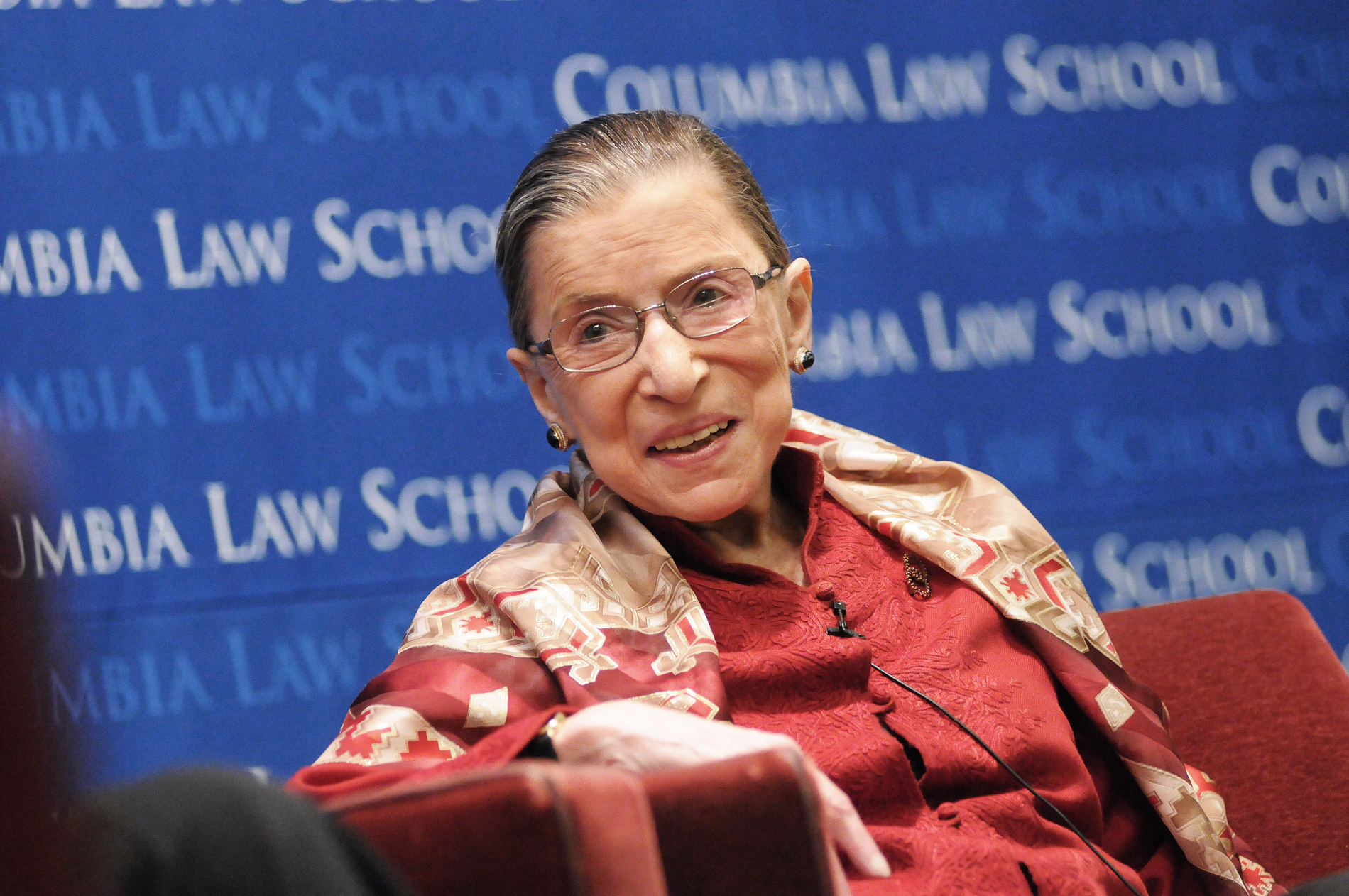
US Supreme Court Associate Justice Ruth Bader Ginsburg at Columbia Law School, February 10, 2012. (Credit: Eileen Barroso) Last Friday, some of the most distinguished scholars and litigants working on gender and the law gathered to honor a foremother and inspiration, Ruth Bader Ginsburg, as Columbia University Law School marked the 40th anniversary of Ginsburg becoming the first tenured female professor there.
But there was another 40th anniversary as well, one less-known, but very much on Ginsburg’s mind. It has been 40 years since she filed a brief before the Supreme Court for a case she wishes had established the abortion right instead of Roe v. Wade.
That was the case of Capt. Susan Struck, who had become pregnant in 1970. The Air Force demanded she either terminate the pregnancy — abortions were being conducted on bases back then — or leave her post. Struck, a Catholic, said she wouldn’t have an abortion but would put the child up to adoption without taking off any unusual amount of medical leave. Though she lost both at the district court and the circuit-court level, she appealed to the Supreme Court, which agreed to hear her case until Solicitor General Erwin Griswold persuaded the Air Force to simply waive her discharge and change the rule. Ginsburg was disappointed.
“I thought if Susan’s case came first,” she said — before Roe, which would be heard a year later — it would be preferable for the goals of women’s equality, because “her choice was birth. Solicitor General Griswold saw to it that we did not have that opportunity.” (This was the same Griswold who, as dean of Harvard Law School, asked the rare women in Ginsburg’s class how they justified taking spots that should have gone to men. Ginsburg later transferred to Columbia Law School.)
Instead, it would be Roe that would invalidate state abortion bans, an outcome Ginsburg said not only “moved too far too fast” but failed to make a women’s equality argument. ”If you read the decision [in Roe], it’s as much about the doctor’s right to recommend to his patient what he thinks his patient needs. It’s always about the woman in consultation with her physician and not the woman standing alone in that case,” she said.
Yale reproductive rights scholar Reva Siegel wrote in a recent essay celebrating Ginsburg’s brief in the Struck case — it was overlooked in part because she never got to argue it — that “Ginsburg and the women’s movement talked about pregnancy discrimination in a way that ties together pregnancy discrimination and women’s equality, and women’s equality and reproductive freedom, before the Court split them apart in cases such as Roe v. Wade, Frontiero v. Richardson and Geduldig v. Aiello. The Court made some fateful choices in those cases: to focus its sex equality jurisprudence on cases other than pregnancy, and so to develop its sex equality jurisprudence in isolation from its abortion jurisprudence.”
That was also true of many of the litigants at the time, Ginsburg said Friday, including the ACLU, which had been involved with Griswold vs. Connecticut, the case overturning a state contraceptive ban with a substantive due process argument that focused on privacy. Ginsburg preferred “women’s change to chart their own life course,” consistent with her idea that full citizenship meant the right to choose a life distinct from sex-role stereotypes.
But an abortion rights case involving a woman who wanted to choose to give birth would also have been consistent with the current reproductive justice framework, which is about bodily autonomy and a woman’s right to moral dignity and self-determination. And Ginsburg, who brought several sex-discrimination cases with male plaintiffs, clearly understood the power of framing these choices with potentially surprising reversals that showed how traditional gender roles limited everyone.
It wasn’t to be. Ginsburg called Struck to try and see if there was any way to press on with her case once the Air Force changed its policy. “‘My dream is to be a pilot,’ she said, but the Air Force doesn’t give flight training to women.’ We both laughed because in 1972 that was an impossible dream. That’s one sign of how much things have changed.”
During the question-and-answer portion, I asked Ginsburg about her comments last year that she likely couldn’t be confirmed today because of her women’s rights work. I asked if that made her concerned about the legacy on the bench of the issues she cared about.
“My dear husband once said that the symbol of the United States really isn’t the bald eagle,” she said. “It’s the pendulum.” She referred to contentious confirmations that preceded hers, and to the fact that despite being warned by the coaches for her confirmation hearings that she would have to answer for her ACLU work, it never came up. “The Senate was then determined to do it the way it should be done,” she said. “I think my biggest champion on the Senate Judiciary Committee was Orrin Hatch.” Justice Stephen Breyer, she pointed out, had a similarly uneventful confirmation hearing. “And then the divisiveness started up again.”
“I’m hoping that a saner view will prevail and we will get back to the process the way it should be,” she added. She didn’t address the part about the legacy.
Irin Carmon is a staff writer for Salon. Follow her on Twitter at @irincarmon or email her at icarmon@salon.com. More Irin Carmon.
Abortions made public
States want more data on abortion patients. Zealots want their hands on it. Shame is the new anti-choice strategy
(Credit: Cannaregio via Shutterstock/Salon/Benjamin Wheelock) It was an “anonymous informant,” Operation Rescue claimed last week, after someone slipped them the April records of 86 women who were treated at Central Family Medical. The clinic’s lawyer was blunter. “It certainly appears to me that a crime was committed,” Cheryl Pilate told the Kansas City Star. Though the clinic (which performs abortions) had already reported a break-in to a locked dumpster, Pilate said it wouldn’t have contained patient records, which are shredded. The “informant” must have gotten the documents – containing names, addresses and details of procedures – another way.
Continue Reading Close
Irin Carmon is a staff writer for Salon. Follow her on Twitter at @irincarmon or email her at icarmon@salon.com. More Irin Carmon.
Texas’ abortion enforcer
Fifth Circuit Court Judge Jerry Smith makes sure that the state's antiabortion legislation gets upheld
Jerry Smith Here is what the state of Texas considers “irreparable harm”: Continuing to provide Planned Parenthood with federal funds for the Texas Women’s Health program, which it has done for several years. Here is what it does not find harmful: immediately denying healthcare access to tens of thousands of women who have been going to Planned Parenthood affiliates for basic health services that aren’t abortions.
Continue Reading Close
Irin Carmon is a staff writer for Salon. Follow her on Twitter at @irincarmon or email her at icarmon@salon.com. More Irin Carmon.
The myth of the “morning-after abortion pill”
There's a reason why people mistake emergency contraception and abortion: The right intentionally confuses the two
(Credit: Shutterstock/Salon/Benjamin Wheelock) It started around February, when Republicans were still eager to talk about contraception. The Obama administration, or so Mitt Romney charged in Colorado, was forcing religious institutions to provide “morning-after pills –in other words abortive pills — and the like, at no cost.”
It was, of course, a lie. Romney was conflating two different pills: emergency contraception, known as the morning-after pill, which prevents a pregnancy; and chemical abortion, or mifepristone, which ends a pregnancy of up to seven weeks’ gestation and isn’t covered under the new guidelines. Since both pills were marketed in the U.S. around the same time, even some pro-choicers have gotten confused. But Colorado happens to be the epicenter of people confusing them on purpose. It’s the birthplace of the Personhood movement and home to Focus on the Family, both of which have strategically called emergency contraception “abortion” on the scientifically unproven basis that they could block a fertilized egg from implanting.
Continue Reading Close
Irin Carmon is a staff writer for Salon. Follow her on Twitter at @irincarmon or email her at icarmon@salon.com. More Irin Carmon.
Tuning out bad abortion laws
One woman's idea on how to counteract invasive ultrasound and sonogram rules: Hand out iPods at Planned Parenthood
(Credit: Kostia via Shutterstock) “I don’t know how you make anybody watch. You just have to close your eyes,” Pennsylvania Gov. Tom Corbett notoriously said of a now-shelved forced-ultrasound law in his state. Now one enterprising pro-choicer online has offered another option: Drowning it out with music.
Although it’s the transvaginal ultrasound laws that get all the attention, the true cutting edge of abortion restrictions is currently in place only in Texas, which not only mandates ultrasounds before abortion but also compels the woman to listen to a description of the sonogram and to a fetal heartbeat. (An attempt to get the law struck down on First Amendment grounds — both the woman’s and the doctor’s right not to be forced by the state to submit to ideological speech — has so far failed, and the law is currently being enforced.)
Continue Reading Close
Irin Carmon is a staff writer for Salon. Follow her on Twitter at @irincarmon or email her at icarmon@salon.com. More Irin Carmon.
Abortion options fade in South
Have antiabortion activists finally found a way to drive two women's clinics out of Mississippi and Alabama?
(Credit: iStockphoto/sjlocke) The New Woman All Women abortion clinic in Birmingham, Ala., survived a 1998 bombing, though Eric Rudolph’s terrorist attack took the life of a security guard and seriously injured a nurse. In Mississippi, Jackson Women’s Health is the last abortion clinic standing in the entire state. But both clinics, which share an owner, will likely soon close their doors – not by dint of violence, but by legislation, regulations and enforcement explicitly designed to shut them down.
Last week, Diane Derzis, who owns both clinics and several others, signed a consent order by the Alabama State Board of Health relinquishing New Woman All Women’s license to perform abortions by May 18. Any entity that might take on the license “must agree that it or he/she will not employ Diane Derzis” or another unnamed employee. Antiabortion activists celebrated, calling the clinic a “very dark and deadly place,” though the vast majority of the violations cited in the Board of Health’s report concerned record keeping and legibility of reports.
Continue Reading Close
Irin Carmon is a staff writer for Salon. Follow her on Twitter at @irincarmon or email her at icarmon@salon.com. More Irin Carmon.
Page 1 of 127 in Abortion