Iran
Iran’s Greens aim to rise again
A protest march Tuesday is a test of strength for a movement under siege
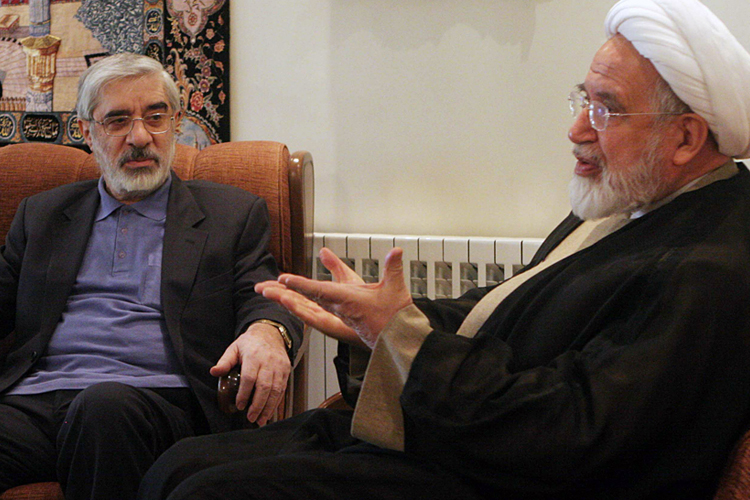
The now-confined leaders of Iranian opposition, Mahdi Karroubi, right, and Mir Hossein Mousavi, talk in freer days in Tehran. (Credit: AP) At 80 years of age, Ebrahim Yazdi has the distinction of being Iran’s oldest political prisoner. Yazdi was one of Ayatollah Ruhollah Khomeini’s closest confidants, accompanied him during his triumphant return to Tehran in February 1979, and briefly served as deputy prime minister and foreign minister. Authorities arrested him three times after the disputed 2009 presidential election for his membership in a political opposition group. Yazdi spent months in jail, then was released for medical treatment.
But on Dec. 28, 2011, a revolutionary court sentenced him to eight years in prison and a five-year ban from civic activities for “acting against the national security” and “publishing lies.” It is often said that “revolutions eat their children.” In the case of Iran, the Islamic Revolution of 1979 swallowed up some of its children whole, chewed and spit out the ones who strayed from the proper path, and mercilessly gnaws on those it cannot disown.
On Feb. 11, Iran’s rulers commemorated the 33rd anniversary of the day in 1979 that demonstrators and armed opposition groups, inspired and guided by Ayatollah Khomeini, seized control and the shah’s imperial regime ended. Back then, the revolution’s children rejoiced, and those who had taken the lead – the clergy, Islamist parties, secular leftists and workers’ groups, and members of the intelligentsia – began working toward establishing a new government. Many hoped it would represent the popular will and respect human rights.
Fast-forward 33 years. Today the Islamic Republic faces a crisis, with punishing economic sanctions and increasing isolation over its nuclear program. But Iran’s real crisis is within. It is a crisis of legitimacy, rooted in its systematic denial of basic human rights and dignity and the steadfast refusal of some of the revolution’s most faithful children to stay silent in the face of injustice.
Beginning in 1979, Ayatollah Khomeini, as supreme leader, initiated a methodical march to consolidate power and eliminate the opposition, especially secularists, leftists and reformers. Along the way, many, including some who had once been the revolution’s most ardent supporters, died in extrajudicial killings and from torture, withered away in prison following unfair trials, or were harassed and threatened out of politics. Ayatollah Ali Khamenei replaced Khomeini in 1989, but the revolution’s methodical march continued to roll back reforms made during the late ’90s and to target reformist politicians like former President Mohammad Khatami.
Since its founding, the Islamic Republic has amassed an appalling human rights record. In the past year alone, prison authorities executed more than 600 people, including children. Security forces killed, beat, arrested and detained thousands of demonstrators demanding government accountability, reform and an end to discrimination against ethnic minorities. As of December, 42 journalists and bloggers were in prisons and detention facilities, according to the Committee to Protect Journalists, making Iran the largest prison for reporters in the world.
And that’s just a small sample.
Iranian officials have dismissively rejected criticism from human rights groups and the U.N. Earlier this month, Ayatollah Sadegh Larijani, the head of Iran’s judiciary, said it was a mistake for Iran to have agreed to the principles embodied in the Universal Declaration of Human Rights.
Feb. 14 will be another anniversary, a year since the government put three of the revolution’s most faithful promoters under house arrest: former Prime Minister Mir Hossein Mousavi; a former speaker of Iran’s parliament, Mehdi Karroubi; and Zahra Rahnavard, a renowned academic, political advisor and Mousavi’s wife. Authorities initially placed Karroubi’s wife, Fatemeh, under house arrest but later released her. Their families face constant harassment and intimidation.
Their crime? In June 2010, Mousavi issued the Green Charter, a manifesto documenting the guiding ideals and principles of the Green Movement, formed after the June 2009 presidential election, and its bold rejection of the current path of the Islamic Republic. The charter identifies “respect for human dignity and human rights” as a primary demand, along with self-determination in the form of free and fair elections. Then in February 2011, Mousavi and Karroubi called for Iranians to fill the streets in support of the Arab Spring, and demand their basic rights.
Thousands filled the streets of Iran’s major cities. Armed police, intelligence agents and paramilitaries were waiting for them. Clashes left at least three protesters dead, and hundreds were injured or detained.
Yet despite their circumstances, the detained leaders have continued to speak out. On Dec. 26, Fatemeh Karroubi relayed a message from her husband calling the upcoming parliamentary elections, scheduled for March 2, “a sham.” Several days later, the Iranian judiciary announced that any calls for a boycott of the elections constituted “a crime.” Authorities retaliated by preventing Karroubi’s family from visiting him.
Karroubi and Mousavi responded with another call for Iranians to fill the streets on Feb. 14.
On Feb. 4, 2009, less than four months before his first arrest, Yazdi spoke to a host on National Public Radio about the 30th anniversary of the Islamic Revolution. He ended his interview by saying that it was “unavoidable” that the “future belongs to democracy in Iran.”
Indeed, the Islamic Republic is facing an existential crisis. But at its very core, the crisis is less about the international power politics than about the irrepressible power of the revolution’s children demanding what they regard as rightfully theirs.
Energy wars heat up
From Africa to South America, conflicts over waning resources are becoming more tense -- and dangerous
A member of the military stands guard near pump stations before a
ceremony in which oil operations at Heglig oilfield will resume in
Heglig, Sudan, May 2, 2012.
(Credit: Reuters/Mohamed Nureldin Abdallah) Conflict and intrigue over valuable energy supplies have been features of the international landscape for a long time. Major wars over oil have been fought every decade or so since World War I, and smaller engagements have erupted every few years; a flare-up or two in 2012, then, would be part of the normal scheme of things. Instead, what we are now seeing is a whole cluster of oil-related clashes stretching across the globe, involving a dozen or so countries, with more popping up all the time. Consider these flash-points as signals that we are entering an era of intensified conflict over energy.
Continue Reading CloseNYPD must spy on all Muslims to protect us from Iranian photographers
New York City's own constitutionally iffy intelligence agency justifies itself with fear-mongering
Ray Kelly (Credit: Reuters/Brendan McDermid) The NYPD is less a “police department” than a secretive and unaccountable international intelligence-gathering organization with a large minority-frisking division and the firepower of a mid-sized army. Lately they have been facing a bit of criticism for their style of intelligence-gathering, which seems to be done with more gusto than concern for civil liberties or… accuracy. Sometimes the NYPD’s muscular-but-stupid approach to spying gets them in trouble with the FBI. And when the organization that fights terror by recruiting shady weirdos to try to trick random Muslims into saying “jihad” into tape recorders says your practices are counterproductive and out of line, they are probably pretty counterproductive and out of line.
Continue Reading Close
Alex Pareene writes about politics for Salon and is the author of "The Rude Guide to Mitt." Email him at apareene@salon.com and follow him on Twitter @pareene More Alex Pareene.
Former Bush official warns against Iran attack
National Security Council advisor and Iraq hawk Stephen Hadley counsels diplomacy, not war
Stephen Hadley (Credit: AP/Alex Brandon) Another voice against war in Iran is heard and from perhaps an unexpected source. Former Bush administration National Security Advisor Stephen J. Hadley warned against an attack on the Islamic Republic yesterday. “If something needs to be done, it is not military action,” said Hadley. “There’s a wide spectrum between sheer diplomacy and military action.”
Hadley was an early and enthusiastic functionary in the war against Iraq. During the George H. W. Bush administration, he was a Pentagon aide to uber-hawk Paul Wolfowitz, and later served as a senior foreign policy advisor to George W. Bush’s presidential campaign. Hadley was instrumental in allowing the “Yellowcake Forgery” fabrication into Bush’s 2003 State of the Union address, a mistake for which he reportedly offered to resign. Taking over as national security advisor in 2005 from Condoleezza Rice, he was known for being on the relatively moderate spectrum of the Bush administration (well, at least when compared to Cheney and Rumsfeld). Upon leaving office, he formed a consulting shop with Rice, and he recently co-wrote a piece calling for negotiations with the Taliban.
Continue Reading CloseJordan Michael Smith writes about U.S. foreign policy for Salon. He has written for the New York Times, Boston Globe and Washington Post. More Jordan Michael Smith.
What Iran’s election results mean
The growing divide between the president and the Supreme Leader could be good news for the West
In front of a portrait of late Iranian leader Ayatollah Khomeini, former President Akbar Hashemi Rafsanjani casts his ballot for the parliamentary elections at a polling station in Tehran, Iran, Friday, March 2, 2012 (Credit: AP Photo/ISNA, Ruhollah Vahdati) BOSTON — It was no coincidence last week when Iran’s Supreme Religious leader, Ayatollah Ali Khamenei, praised a 64 percent turnout for parliamentary elections at home as well as President Barack Obama’s words that dampened talk of war against Iran. The elections gave him a commanding authority at home and a freer hand to deal with foreign threats.
Continue Reading CloseNazila Fathi reported out of Iran for nearly two decades, most recently for The New York Times. In 2009, following the elections, she was forced to leave the country because of government threats against her. She was a Nieman Fellow at Harvard in 2010 and is currently a fellow at the Shorenstein Center on Press, Politics and Public Policy at the Harvard Kennedy School. More Nazila Fathi.
A Hollywood party, with a nervous look to Iran
Behind the scenes at the Academy Awards with the star of "A Separation"
Payman Maadi (right) in "A Separation" The 405, Los Angeles’ leading freeway, is under construction. Lanes suddenly close and then merge haphazardly into the one nuzzled next to it. Center dividers inch closer and closer into carpool lanes. And drivers – which in a city of waitresses, actresses and waitresses longing to be actresses, might be the most infamous population of all — drive erratically as a result. The drivers are erratic because the road has become erratic; the road has become erratic because the city is erratic.
Continue Reading CloseRod Bastanmehr is a freelance writer, born in San Francisco, with a focus on film, culture and politics. His writing has appeared in Nerve, Thought Catalog, Not Coming to a Theatre Near You and more. More Rod Bastanmehr.
Page 1 of 91 in Iran
