
Valentine's Day Fiction

Whip-it

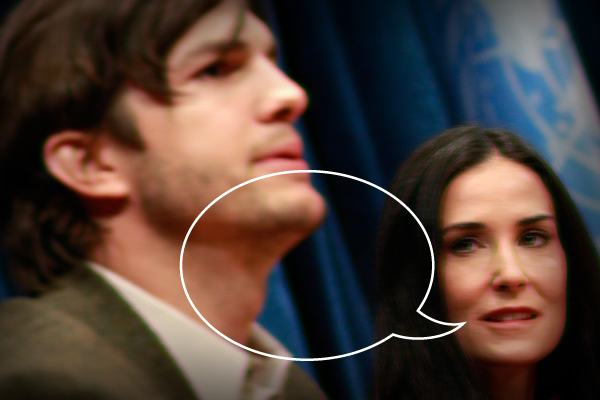
It's the final phone conversation of Demi and Ashton's marriage and, wait, is that Rupert Murdoch listening in?

(Credit: Reuters/Salon)

Kutcher-Moore Residence, Los Angeles, Jan. 26

Demi Moore sits, distraught, on her living room floor. The house is in upheaval, every flat surface covered with boxes halfway packed, then abandoned; it seems her husband will never be done with moving out. A large bottle of Zyrtec is at her side. A dozen thin, high-strung dogs wander in and out of the room. Her cellphone rings.

“It’s me,” he says. “Don’t hang up.”

“What do you want?”

“I want the truth.”

Demi grabs one of the dogs with her free hand — it hardly struggles — and holds it closely, rubbing its silky fur against her cheek. How she loves these dogs: their dark, smooth coats, their effortlessly thin flanks. No matter how much she feeds them, she can still feel their ribs through their skin. Wonderful!

The dog nuzzles at her cardigan pocket, where she has taken to keeping treats for them: sinewy pieces of bison jerky, tiny sausage links, sliced-up organic hot dogs. The maid, shaking her head over the grease stains on her sweaters, suggested dog biscuits instead, but Demi has a horror of carbs. Besides, there is something strangely appealing about cutting up hot dogs. She holds out a nub, and the dog takes the treat delicately between its teeth.

“They say you’re holed up with whippets again.”

“Don’t you have some strippers to …” She sneezes three times, violently. “Some cameras to sell?”

“How many this time?”

“I don’t know,” she says, looking around the roomful of dogs. “One or two. Maybe six.”

“Look, I know haven’t exactly been a model of responsible behavior …”

“It’s true,” she says. “You have not. You also have some packing up still to do. Your free weights … your grooming products … your glassware.”

Demi hates the word “bong.”

“… but I think you might have a problem.”

Demi sets the phone in her lap and extends two thin, tawny arms. The dogs run to her, tumbling over each other just to lick her greasy fingers. She feels a pang in her chest. “When it’s just me and the whippets,” she murmurs, “there’s no more pain.”

“This is front-page stuff!”

Demi picks up her phone again and holds it to her ear. “What did you say?”

“I didn’t say anything,” says Ashton.

“MENTAL LASS, DENTAL GAS,” the voice mutters again. “Bugger it, I’ve dropped my Mont Blanc in the loo.”

“Someone with an Australian accent,” Demi says. “Is Hugh Jackman there with you?”

“No,” says Ashton.

“Eric Bana?”

“Nope. Look, we may not be together anymore, but I care about you and your well-being.”

She hears this kind of talk every time he comes by to retrieve a stray video game or a favorite T-shirt; it never stops him from leaving just as quickly as he arrived. But the dogs, every one of them younger and more handsome than Ashton, never leave her side.

“I have something to tell you,” she says.

“Good. I’d like to hear it.” He sounds hopeful.

“If you want to take digital photos these days, you can just use your phone. Everyone knows that.”

She gathers another dog in her arms and rubs her face on its fur, inhaling. Her lungs constrict. With her free hand, she scrabbles for the Zyrtec bottle.

“You’re huffing one of those whippets right now!”

“I can handle it!” she wheezes. “I know my limits!”

“If you keep doing that, you’re going to wind up in the emergency room!”

“You have your tech start-ups and your hot-tub whores and your four-megapixel paperweights. These whippets are all I’ve got!”

The dogs gather around her, first one at a time, then in a pack, whining, wagging their wiry tails. She realizes there is frying-pan grease in her hair. The dogs begin to lick her head.

“Aaah!”

“What? What?”

“These whippets are messing with my head.”

“So you admit it!”

The speedy dogs dart back and forth, licking Demi’s hair, her face, her cellphone.

“The whippets are going to my head so fast!”

“What? You’re breaking up!”

On the business end of an illegal wiretap, Rupert Murdoch is scribbling frantically. “Wendi!” he hisses. “Are you getting this?”

“I need a dog … walk … er…” Demi moans.

“Hold on, baby! I’m calling the doctor right now!” cries Ashton.

“This could be the scoop that causes the Daily to stop hemorrhaging money!”

“Wait,” says Demi, sitting up. “Rupert Murdoch?”

“Wrong number!” Murdoch says, and hangs up.

Ashton is confused. “Is the Daily the same thing as the Daily Beast?”

The dogs close in again, yipping, licking, panting: an ecstasy of devotion. Soon the line goes silent.

“Oh man,” says Ashton. “Wow.” He pauses before dialing 911. “Dude.”

Belle Boggs is the author of the story collection "Mattaponi Queen," which won the Bakeless Prize and the Library of Virginia Award.

Richard D. Allen is a poet and humorist.

Demi’s last night out

When did Demi Moore know she and Ashton were done? Maybe when she tried and tried, but still couldn't rise from bed

(Credit: AP/Salon)

The party is in the Hollywood Hills, at someone’s house that looks familiar, or maybe all these houses look alike to me at this point. We’re outside by the pool and the air smells of citronella and night-blooming jasmine. I’m drinking a Red Bull and watching a couple of girls in sundresses leap into the shimmering water, the thin fabric revealing their underwear, both of them shrieking loudly to make sure everybody pays attention.

They are lovely, those girls.

The music is so loud it pulses inside my chest, as if it’s replacing my heart, which would be fine with me. Two guys come up and start dancing. They look exactly the same, androgynous and pretty, with floppy hair. It’s a look I like, feel strong against, and we all three sway together.

When the music pauses I order one of them to get me another Red Bull. He nods and bows; he likes being ordered around.

“Chivalry is not dead,” he says.

“Good to know,” I say.

The other one tells me I’m beautiful and I can see he means it. Then he gets that look in his eye — soft, sweet  — and asks if I’m OK. Every person I’ve talked to in the past two months has looked at me like that and asked if I’m OK. It is driving me insane.

“Never better,” I say, and I mean it to sound bright but it comes out sarcastic.

This good-looking boy, maybe 23, tells me not to give up on love. “Just … don’t stop believing.”

I laugh. “Like Journey.”

“Exactly,” he says earnestly. “We’re all on a journey.”

I could tell him that believing in love is not my problem. If anything, I believe in it more than ever. I understand its strangeness, its tender bloodthirstiness, how it’s large enough to contain hate and humiliation inside it and still exist. Love is every kind of emotion at the same time. It’s more complicated and terrible than I ever knew, and it has filled me, fractured me.

But seriously, why would I say that to him?

So instead I smile and nod without speaking. It seems fine with both of us. I’ve spent the last few weeks doing nothing but talking. I’ve negotiated and discussed and confessed and processed and prayed. None of it has made much difference. The next time I fall in love, I decide, I will do it all in silence.

Then somehow it’s a couple of hours later and I’ve lost track of my two handsome boys and even worse I’m out of Red Bull. There’s more dancing and a lot of people pressing up against me and in a moment when the crowd shifts I think I see you on the other side of the pool, your white shirt reflected in the turquoise water, and my chest lurches but it’s somebody else and I feel both empty and relieved.

The day I knew it was over, we were camping. It was my idea to go out into nature, into a place that felt simpler, where we’d talk and just be ourselves with nobody watching. We hiked up to a bluff where we could see the ocean, and the air smelled of spicy juniper and warm earth. We held hands and were gentle with each other, as if we might shatter, and looked at the view.

For a little while it was really nice, and I thought maybe we can do this. And then I felt everything around me sinking. I understood: It was the gentleness that told me it was over. We were wrung out. We’d reached the point where all we wanted was not to wake up each day and face the wreck of it.

Now it’s 2 in the morning and we’re in a private room at a club on Sunset and the music is muffled and electric and a beautiful girl with a squeaky voice tells me my hair looks great and I say thank you.

“The best thing about L.A.,” she adds, leaning in like she’s sharing a secret, “is that there’s no humidity. Everybody’s hair looks so perfect.”

I want to laugh at her but I can’t, because every woman wants to be perfect. She notices my lips twisting in this almost-laugh and says sweetly, softly, “Are you OK?”

I reach out to wring her neck. Mistaking this gesture for something else, she grabs my hands and holds them warmly and we sway together for a while. Then somebody offers her some ecstasy and she promises she’ll be right back. As she disappears into a churn of bodies my gaze follows her across the room and I know you’re not even in the country but I see you on a platform dancing with a blond girl in a silver skirt and gleaming skin.

If you were here, these are the things I would say to you:

You have the most beautiful smile I’ve ever seen.

That show you’re on is terrible.

I know we’re both to blame. Every day we devised new ways to rub each other raw, scraping the vulnerable spots we’d always known about but left untouched. We were experts at it, geniuses of punishment. And yet, if you offered me the choice, I wouldn’t go back, I wouldn’t give up any of it, because it made me something different, broken but bigger, than I had been before.

Which is another way of saying that I will love you forever, even if that love has no path forward in this world. No journey.

And somehow it’s dawn and we’re in the car with the windows rolled down and the air smells of car exhaust and fried food and my chest is burning in a way that’s not totally unpleasant and my breath is full of diamonds. The sky is beginning to lighten and I know the sun is on its way up even though I can’t see it yet. You’re in the seat next to me, holding my hand, and I’m not sure if this is now or then, a wish or a memory, and I don’t really care, because your smile is bright and there are splashes of neon across your cheek, pink then red, and I’m laughing at something you just said and the car’s going so fast it feels like flying and for a moment, everything is beautiful and so, so perfect.

Continue Reading Close

Alix Ohlin is the author of the novel "The Missing Person" and the collection "Babylon and Other Stories." A new novel, "Inside," and a story collection, "Signs and Wonders," are forthcoming from Knopf this spring.

One day you’re in

When Seal and Heidi Klum split, no one survives on the "Project Runway" set unless they get a little crazy

(Credit: AP/Salon)

The old crew was back to work for the first time since Season 9 ended, and the new hires were cracking the “Make it work” jokes that the rest of us had gotten sick of five years ago. Even Tim seemed a little apologetic when he said it these days. He’d gotten too much sun the day before and was pinker than usual. “Just … make it work, I guess,” he told the makeup artist.

The casting episodes were always awkward, no proper sets or dressing rooms in the hotels and a desperate mass of humanity clutching garment bags in the hallways. And now everyone tiptoeing around Heidi, looking to see if she’d changed since the news broke, peering for bags under her eyes, or deepened lines around her mouth. If she looked older, she must be unhappy. If she didn’t, maybe the entire thing was a stunt to sell more albums. Women in this business are never just sad, they’re one step closer to the grave.

Some new intern had memorized Seal’s entire song catalog, and lobbed titles like little grenades. “‘Love Don’t Live Here Anymore,’” Raoul hissed to me, when Heidi got into a disagreement with Nina about a swimsuit with epaulets. “‘Back Stabbers,’” he said, when a PA told him to get off his ass and do some work. “‘I’ll Be Around,’” he whispered as he left, which turned out to be a track off “Soul 2,” but I just thought he was telling me I could sneak out for a smoke break. I hadn’t listened to much Seal before I’d gotten this job. I hadn’t read Marie Claire, either. But I adapted.

Once Heidi was dressed, it was just hair and makeup that had to hover, who sleeked down her hair or redid eyeliner between takes. But today I didn’t want to leave. I stood around with my hands worrying the insides of my pockets, then invented a scuff on Tim’s left shoe, just to buff it away. He asked me what I’d been up to, during the hiatus. “You’re not wearing your necklace,” he said.

“Just time for a change. Besides, what kind of wardrobe stylist gets away with wearing the same necklace every day? I’m surprised Nina hasn’t had me fired, just for that.”

“I’d stand up for you,” he said. I straightened his tie. We both knew it was already straight.

“I’m fine,” I said.

That’s what Heidi had been saying, to the few people brave enough to ask. We didn’t want to embarrass ourselves by presuming any closeness. But if she wanted a shoulder to cry on, we all wanted it to be our shoulder. Women and men, gay and straight, we’d all watched her give kiss after kiss to the departing contestants and wondered if there were a way to make her notice us short of getting fired.

The overall feel of the room was as tense as the day Tim came back to work after announcing on his other makeover show that he hadn’t had sex in 29 years. I’d felt like I’d accidentally walked in on my parents, seen something that was natural enough but that you really didn’t want to think about. Something I didn’t feel I had any business knowing. It was a surprise and it wasn’t. A surprise, I guess, that he said it on television.

You don’t have to live this way, I wanted to tell them, but I guess some of them do. It wasn’t like Heidi could have taken off her ring and hoped no one noticed. I wondered if Tim ever missed his old life, writing curriculum proposals at Parsons. I wondered if Heidi ever imagined not entering that high school modeling competition in Germany. I wondered about how things would have been different if I’d never left Indiana.

Everyone has to decide. Models all decide early. They have to give it a go before anything else about themselves is formed, before their bodies are even settled. The ones who make it onto “Project Runway,” whatever else they do later, they’ve done this, been on national television in some muslin and macaroni or hot pants made of pet store moss. Their boyfriends will come and go and when they watch Lifetime with some other woman, years from now, they’ll say, “I used to date that girl. The one in the sexy mailman uniform.”

I thought of Sam watching TV with his new wife in West Lafayette and telling her that the girl he was once engaged to left for New York to try and make it big. She never got in front of the camera, but she ended up holding some decent jobs behind it. In West Lafayette, that would count for something. “Oh my god,” she’d say. “Someone chooses those ridiculous outfits?”

I returned the ring, when I called it off. We didn’t have wedding bands yet. Didn’t even have a date set or a venue. Sam should have guessed, and I’d kept wishing he would. He hadn’t even looked for a job in New York, still waiting for me to fail so totally I’d come back, feel settled and satisfied in Indiana. We each thought we could wait the other out, but even when I couldn’t book modeling jobs, I couldn’t imagine going back home.

A rejected contestant was kneeling on the table, crying with his hands clutched in supplication, like Heidi was a merciful god. Security was circling, but they didn’t want to get too close and ruin the shot. Finally the poor guy left on his own, and an AD called a break. Heidi just sat back, didn’t get up and stretch. I tried to remember which shoes she was wearing, whether they were extremely uncomfortable or just moderately uncomfortable.

Raoul came back with a stack of cookies wrapped in a napkin from craft services. He offered me one, humming the chorus of “Kiss From a Rose.” I shook my head, and walked over to Heidi. I pretended to find a thread on her shoulder, pretended to pick it off.

“Don’t tell me that’s been there all morning,” she said.

“Nothing showed up on camera.” I stared at the part in her hair. “I have this,” I said. “You left it on the makeup counter. I didn’t want to leave it sitting out.”

I took her wedding band from my pocket and held it on my opened palm. All the previous seasons, she’d worn it to work and kept it on all day, whatever her outfit. I’d known without explanation that it was my job to accessorize around the ring.

She shifted in her seat. “I forgot about it,” she said. “I’ve been wearing it but then … I was just sitting in the makeup chair and I thought I should take it off. And then I was late to the set.”

A PA was gesturing me away from the table. The next round of auditions was about to start.

“What do you want me to do with it?” I asked.

“I don’t have any pockets,” she said, looking down at her short aquamarine dress. She wasn’t accusatory, but of course I felt responsible. All the things I could not do for her, and I’d denied her even pockets. That, at least, I could have arranged. She had a broken heart and now no pockets even to stow it in.

“I’m so sorry,” I said.

“That’s OK.”

“But I’m sorry.”

“OK.”

“I have pockets.” I gestured down at my own outfit, plain jeans and flats.

Sam mailed the ring straight back. I want you to have it (and I can’t return it), he wrote. We were playing some game of hot potato, but I didn’t see any way to win. I put the ring on a gold necklace chain, and when people asked I said my fiancé had died. I didn’t get anything good this way. No jobs or dates or even free drinks — it just made people sad and uncomfortable. Tim had put his hands on my shoulders and pulled me close for a hug. But I’d kept saying it. It steeled my resolve. I’d told myself my life had to work out because I’d already given up so much. It just had to.

“I can hold onto it for you,” I said. “Would that help?”

“Or give it to my assistant. She’ll put it in my room. She has the key.”

“OK. I can do that.” I wondered how long Heidi and Seal had tried to make things work just because they felt things had to. Because everyone would be talking about how they’d failed, and leaving notes on her website about how she should just have tried a little harder.

“Thanks,” Heidi said.

“No problem.”

Michael Kors had to push past me to sit back down and he gave me the stink eye. I backed away as the cameras started taping. Raoul had finished the cookies and collected a handful of cheese cubes on toothpicks. He held them like a bouquet, offering me a blossom. “‘Let’s Stay Together,’” he sang.

I shook my head.

“‘Crazy,’” he whispered.

I rolled the ring between my fingers, slipping it on and off the tips of my fingers.

“‘Future Love Paradise.’”

I didn’t say anything. Heidi’s engagement ring had been a rock, but the wedding band was delicate, even thinner than it had looked on her long fingers.

“Debut album. Second single.”

“I know.”

“Which is weird. If it’s future, how are we ever supposed to get there? It’s a totally depressing song.”

During the hiatus I’d gone on vacation with one of the sound mixers. It was getting serious and I could tell the necklace creeped him out, so I’d left it at home. It was easier than I’d thought. I think I’d stopped wanting my life to be one specific thing. I wanted to write Sam to tell him this, that I was happy, that I hoped we both were, that I didn’t think we had anything to regret. I wished there was a way to share this with Heidi.

I figured I could at least say it to Raoul, give him some piece of wisdom he could take away from this job along with all the cheese he could fit in his maw. I tried to think of an appropriate Seal cover to sum up the situation, but “‘A Change Is Gonna Come’” was as close as I could get, and it just seemed obvious.

“What’s the ring?” he asked.

Auf wiedersehen,” I said. “I need to find Heidi’s assistant.”

“Don’t let her hear you say that. I’m sure she’s got it copyrighted or something.”

“You can’t copyright ‘goodbye,’” I told him, which really could have been a song title of its own.

Continue Reading Close

Caitlin Horrocks is the author of the story collection "This Is Not Your City" (Sarabande). Her fiction has been published by the New Yorker and in the 2011 edition of Best American Short Stories.

Pitch and catch

It must've been awkward for Tom Brady and Gisele Bundchen after she blamed his teammates for losing the Super Bowl

(Credit: AP/Salon)

“You shouldn’t have said it.”

“Yes.”

“I wish you wouldn’t have.”

“I did.”

“That’s what I’m saying.”

“I’m sorry.”

“I know. I’m not mad.”

“You shouldn’t be.”

“I’m not.”

“It’s just that the man wouldn’t stop.”

“You shouldn’t start with people who won’t stop.”

“I know. I’m mad at myself.”

“You shouldn’t be. Be mad at him.”

“I am mad at him, too.”

“Right. You should be.”

“He started talking about you and he wouldn’t stop.”

“That’s what they do.”

“He was saying horrible things.”

“Right. That’s also what they do.”

“If you had been there he would have stopped.”

“I couldn’t be there.”

“Or maybe he never would have started.”

“I couldn’t be there.”

“I’m just saying I wish you were there.”

“I couldn’t be.”

- – - – - -

“I have a question.”

“Yes.”

“How can you answer? You don’t even know what the question is.”

“I wasn’t answering. I was just saying yes.”

“OK.”

“What’s your question?”

“You said that he said horrible things.”

“Yes.”

“That’s not my question.”

“I know. Go on.”

“OK. What were they?”

“What were what?”

“The horrible things.”

“You heard them.”

“The things I heard weren’t so horrible.”

“They were.”

“They weren’t so nice but were they so horrible?”

“Yes. I saw his eyes.”

“You did?”

“You should have seen them. How they looked.”

“How did they look?”

“It’s not easy to say.”

“The things he said mean nothing.”

“They mean something. Something horrible.”

“What do they mean?”

“You know.”

“He said I was owned.”

“Yes.”

“Does he mean outplayed?”

“I don’t know.”

“Does it mean defeated?”

“I don’t know.”

“Those things aren’t great, it’s true.”

“They’re horrible.”

“But they’re true.”

“They’re not.”

“They happened.”

“Does that make them true?”

“Yes.”

“I agree with you. But I don’t agree with him.”

“I think we’re saying the same thing.”

“Me and you?”

“Me and him.”

“You’re not being horrible.”

“I don’t think he was, either, even if you saw his eyes.”

“What?”

“Isn’t he just saying what happened?”

“No.”

“What is he doing, then?”

“I have no answer.”

- – - – - -

“I’m asleep.”

“What?”

“I’m sleeping.”

“Wake up.”

“I’m awake.”

“I dreamed that I said something.”

“I have that dream all the time.”

“I dreamed that I said something to him.”

“To who?”

“To the man.”

“What man?”

“The man who said horrible things.”

“You’re still thinking about him?”

“No.”

“You’re dreaming about it.”

“Yes.”

“That seems worse.”

“It felt better.”

“What was the dream?”

“I told you.”

“I was sleeping.”

“I dreamed that I said something.”

“That’s not a dream.”

“What?”

“You did say something.”

“I did.”

“That’s how this all started.”

“I said that same thing I said in real life.”

“Is that a dream? It might just be a memory.”

“But when I said it in real life it felt wrong.”

“It was wrong.”

“In my dream it felt right.”

“What do you mean?”

“I don’t know.”

“Do you mean accurate?”

“I don’t know.”

“Do you mean justified?”

“I don’t know.”

“Well, both of those things are untrue.”

“Oh.”

“How is it accurate? How is it justified?”

“Because you can only do so much.”

“You shouldn’t say that.”

“In my dream? It felt right.”

“I mean in real life.”

“I feel better now that I said it.”

“I thought you felt worse.”

“I feel better that I said it in my dream.”

“I can’t sleep.”

“I’m wide awake.”

- – - – - -

“You can only do so much.”

“I thought we had stopped with this.”

“Others have to do the rest.”

“We need to not start with this.”

“I didn’t think before I said it.”

“I know.”

“But now that I have thought about it I know I was right.”

“What?”

“You can only do so much. Others have to do the rest.”

“Don’t say that.”

“I may never stop saying it.”

“You have to stop.”

“You don’t own me.”

“You should see yourself.”

“What do you mean?”

“You should see how you look.”

“How do I look?”

“Your eyes are really something.”

“Isn’t it great?”

“I don’t think we’re saying the same thing.”

“You should have been there.”

“I couldn’t be there.”

“I wish you would have.”

“You shouldn’t have said it.”

“No?”

Continue Reading Close

Ben Greenman is an editor at the New Yorker and the author of several acclaimed books of fiction, including "Superbad," "What He's Poised To Do" and "Celebrity Chekhov." His fiction, essays and journalism have appeared in numerous publications, including the New York Times, the Washington Post, the Paris Review, Zoetrope: All Story, McSweeney's and Opium.

www.salon.com/topic/valentines_day_fiction/