
Foreign policy

America’s apocalyptic imperial strategy

In Iran, China and elsewhere, U.S. attempts to cling to power threaten to destabilize the globe

  • more
    • All Share Services

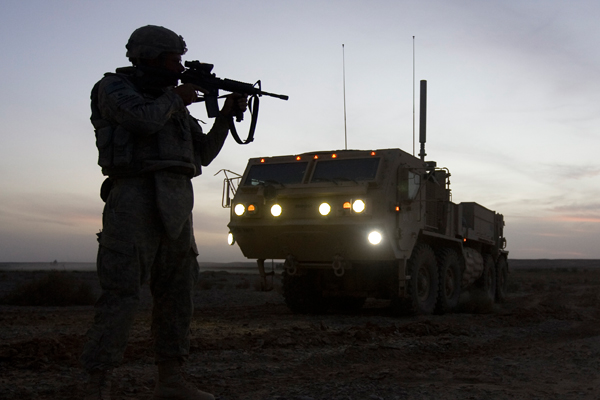
America's apocalyptic imperial strategy A U.S. Marine aims his rifle during a route clearance mission across a desert in Helmand province, southern Afghanistan (Credit: Reuters/Shamil Zhumatov)
This originally appeared on TomDispatch. It is the second installment of two-part series on America's decline. You can read part one here.

In the years of conscious, self-inflicted decline at home, “losses” continued to mount elsewhere. In the past decade, for the first time in 500 years, South America has taken successful steps to free itself from western domination, another serious loss. The region has moved towards integration, and has begun to address some of the terrible internal problems of societies ruled by mostly Europeanized elites, tiny islands of extreme wealth in a sea of misery. They have also rid themselves of all U.S. military bases and of IMF controls.  A newly formed organization, CELAC, includes all countries of the hemisphere apart from the U.S. and Canada. If it actually functions, that would be another step in American decline, in this case in what has always been regarded as “the backyard.”

Even more serious would be the loss of the MENA countries — Middle East/North Africa — which have been regarded by planners since the 1940s as “a stupendous source of strategic power, and one of the greatest material prizes in world history.” Control of MENA energy reserves would yield “substantial control of the world,” in the words of the influential Roosevelt advisor A.A. Berle.

To be sure, if the projections of a century of U.S. energy independence based on North American energy resources turn out to be realistic, the significance of controlling MENA would decline somewhat, though probably not by much: The main concern has always been control more than access.  However, the likely consequences to the planet’s equilibrium are so ominous that discussion may be largely an academic exercise.

The Arab Spring, another development of historic importance, might portend at least a partial “loss” of MENA. The U.S. and its allies have tried hard to prevent that outcome — so far, with considerable success.  Their policy towards the popular uprisings has kept closely to the standard guidelines: support the forces most amenable to U.S. influence and control.

Favored dictators are supported as long as they can maintain control (as in the major oil states). When that is no longer possible, then discard them and try to restore the old regime as fully as possible (as in Tunisia and Egypt). The general pattern is familiar: Somoza, Marcos, Duvalier, Mobutu, Suharto and many others. In one case, Libya, the three traditional imperial powers intervened by force to participate in a rebellion to overthrow a mercurial and unreliable dictator, opening the way, it is expected, to more efficient control over Libya’s rich resources (oil primarily, but also water, of particular interest to French corporations), to a possible base for the U.S. Africa Command (so far restricted to Germany), and to the reversal of growing Chinese penetration. As far as policy goes, there have been few surprises.

Crucially, it is important to reduce the threat of functioning democracy, in which popular opinion will significantly influence policy. That again is routine, and quite understandable. A look at the studies of public opinion undertaken by U.S. polling agencies in the MENA countries easily explains the western fear of authentic democracy, in which public opinion will significantly influence policy.

Israel and the Republican Party

Similar considerations carry over directly to the second major concern addressed in the issue of Foreign Affairs cited in part one of this piece: the Israel-Palestine conflict. Fear of democracy could hardly be more clearly exhibited than in this case. In January 2006, an election took place in Palestine, pronounced free and fair by international monitors. The instant reaction of the U.S. (and of course Israel), with Europe following along politely, was to impose harsh penalties on Palestinians for voting the wrong way.

That is no innovation. It is quite in accord with the general and unsurprising principle recognized by mainstream scholarship: The U.S. supports democracy if, and only if, the outcomes accord with its strategic and economic objectives, the rueful conclusion of neo-Reaganite Thomas Carothers, the most careful and respected scholarly analyst of “democracy promotion” initiatives.

More broadly, for 35 years the U.S. has led the rejectionist camp on Israel-Palestine, blocking an international consensus calling for a political settlement in terms too well known to require repetition.  The western mantra is that Israel seeks negotiations without preconditions, while the Palestinians refuse. The opposite is more accurate. The U.S. and Israel demand strict preconditions, which are, furthermore, designed to ensure that negotiations will lead either to Palestinian capitulation on crucial issues, or nowhere.

The first precondition is that the negotiations must be supervised by Washington, which makes about as much sense as demanding that Iran supervise the negotiation of Sunni-Shia conflicts in Iraq. Serious negotiations would have to be under the auspices of some neutral party, preferably one that commands some international respect, perhaps Brazil. The negotiations would seek to resolve the conflicts between the two antagonists: the U.S.-Israel on one side, most of the world on the other.

The second precondition is that Israel must be free to expand its illegal settlements in the West Bank. Theoretically, the U.S. opposes these actions, but with a very light tap on the wrist, while continuing to provide economic, diplomatic, and military support. When the U.S. does have some limited objections, it very easily bars the actions, as in the case of the E-1 project linking Greater Jerusalem to the town of Ma’aleh Adumim, virtually bisecting the West Bank, a very high priority for Israeli planners (across the spectrum), but raising some objections in Washington, so that Israel has had to resort to devious measures to chip away at the project.

The pretense of opposition reached the level of farce last February when Obama vetoed a Security Council resolution calling for implementation of official U.S. policy (also adding the uncontroversial observation that the settlements themselves are illegal, quite apart from expansion). Since that time there has been little talk about ending settlement expansion, which continues, with studied provocation.

Thus, as Israeli and Palestinian representatives prepared to meet in Jordan in January 2011, Israel announced new construction in Pisgat Ze’ev and Har Homa, West Bank areas that it has declared to be within the greatly expanded area of Jerusalem, annexed, settled, and constructed as Israel’s capital, all in violation of direct Security Council orders. Other moves carry forward the grander design of separating whatever West Bank enclaves will be left to Palestinian administration from the cultural, commercial, political center of Palestinian life in the former Jerusalem.

It is understandable that Palestinian rights should be marginalized in U.S. policy and discourse. Palestinians have no wealth or power. They offer virtually nothing to U.S. policy concerns; in fact, they have negative value, as a nuisance that stirs up “the Arab street.”

Israel, in contrast, is a valuable ally. It is a rich society with a sophisticated, largely militarized high-tech industry. For decades, it has been a highly valued military and strategic ally, particularly since 1967, when it performed a great service to the U.S. and its Saudi ally by destroying the Nasserite “virus,” establishing the “special relationship” with Washington in the form that has persisted since. It is also a growing center for U.S. high-tech investment. In fact, high tech and particularly military industries in the two countries are closely linked.

Apart from such elementary considerations of great power politics as these, there are cultural factors that should not be ignored. Christian Zionism in Britain and the U.S. long preceded Jewish Zionism, and has been a significant elite phenomenon with clear policy implications (including the Balfour Declaration, which drew from it). When General Allenby conquered Jerusalem during World War I, he was hailed in the American press as Richard the Lion-Hearted, who had at last won the Crusades and driven the pagans out of the Holy Land.

The next step was for the Chosen People to return to the land promised to them by the Lord. Articulating a common elite view, President Franklin Roosevelt’s Secretary of the Interior Harold Ickes described Jewish colonization of Palestine as an achievement “without comparison in the history of the human race.” Such attitudes find their place easily within the Providentialist doctrines that have been a strong element in popular and elite culture since the country’s origins: The belief that God has a plan for the world and the U.S. is carrying it forward under divine guidance, as articulated by a long list of leading figures.

Moreover, evangelical Christianity is a major popular force in the U.S. Further toward the extremes, End Times evangelical Christianity also has enormous popular outreach, invigorated by the establishment of Israel in 1948, revitalized even more by the conquest of the rest of Palestine in 1967 — all signs that End Times and the Second Coming are approaching.

These forces have become particularly significant since the Reagan years, as the Republicans have abandoned the pretense of being a political party in the traditional sense, while devoting themselves in virtual lockstep uniformity to servicing a tiny percentage of the super-rich and the corporate sector. However, the small constituency that is primarily served by the reconstructed party cannot provide votes, so they have to turn elsewhere.

The only choice is to mobilize tendencies that have always been present, though rarely as an organized political force: primarily nativists trembling in fear and hatred, and religious elements that are extremists by international standards but not in the U.S. One outcome is reverence for alleged Biblical prophecies, hence not only support for Israel and its conquests and expansion, but passionate love for Israel, another core part of the catechism that must be intoned by Republican candidates — with Democrats, again, not too far behind.

These factors aside, it should not be forgotten that the “Anglosphere” — Britain and its offshoots — consists of settler-colonial societies, which rose on the ashes of indigenous populations, suppressed or virtually exterminated. Past practices must have been basically correct, in the U.S. case even ordained by Divine Providence. Accordingly there is often an intuitive sympathy for the children of Israel when they follow a similar course. But primarily, geostrategic and economic interests prevail, and policy is not graven in stone.

The Iranian “Threat” and the Nuclear Issue

Let us turn finally to the third of the leading issues addressed in the establishment journals cited earlier, the “threat of Iran.” Among elites and the political class this is generally taken to be the primary threat to world order — though not among populations. In Europe, polls show that Israel is regarded as the leading threat to peace. In the MENA countries, that status is shared with the U.S., to the extent that in Egypt, on the eve of the Tahrir Square uprising, 80 percent felt that the region would be more secure if Iran had nuclear weapons.  The same polls found that only 10 percent regard Iran as a threat — unlike the ruling dictators, who have their own concerns.

In the United States, before the massive propaganda campaigns of the past few years, a majority of the population agreed with most of the world that, as a signatory of the Non-Proliferation Treaty, Iran has a right to carry out uranium enrichment. And even today, a large majority favors peaceful means for dealing with Iran. There is even strong opposition to military engagement if Iran and Israel are at war. Only a quarter regard Iran as an important concern for the U.S. altogether. But it is not unusual for there to be a gap, often a chasm, dividing public opinion and policy.

Why exactly is Iran regarded as such a colossal threat? The question is rarely discussed, but it is not hard to find a serious answer — though not, as usual, in the fevered pronouncements. The most authoritative answer is provided by the Pentagon and the intelligence services in their regular reports to Congress on global security.  They report that Iran does not pose a military threat. Its military spending is very low even by the standards of the region, minuscule of course in comparison with the U.S.

Iran has little capacity to deploy force. Its strategic doctrines are defensive, designed to deter invasion long enough for diplomacy to set it. If Iran is developing nuclear weapons capability, they report, that would be part of its deterrence strategy. No serious analyst believes that the ruling clerics are eager to see their country and possessions vaporized, the immediate consequence of their coming even close to initiating a nuclear war. And it is hardly necessary to spell out the reasons why any Iranian leadership would be concerned with deterrence, under existing circumstances.

The regime is doubtless a serious threat to much of its own population — and regrettably, is hardly unique on that score. But the primary threat to the U.S. and Israel is that Iran might deter their free exercise of violence. A further threat is that the Iranians clearly seek to extend their influence to neighboring Iraq and Afghanistan, and beyond as well. Those “illegitimate” acts are called “destabilizing” (or worse). In contrast, forceful imposition of U.S. influence halfway around the world contributes to “stability” and order, in accord with traditional doctrine about who owns the world.

It makes very good sense to try to prevent Iran from joining the nuclear weapons states, including the three that have refused to sign the Non-Proliferation Treaty — Israel, India and Pakistan, all of which have been assisted in developing nuclear weapons by the U.S., and are still being assisted by them. It is not impossible to approach that goal by peaceful diplomatic means. One approach, which enjoys overwhelming international support, is to undertake meaningful steps towards establishing a nuclear weapons-free zone in the Middle East, including Iran and Israel (and applying as well to U.S. forces deployed there), better still extending to South Asia.

Support for such efforts is so strong that the Obama administration has been compelled to formally agree, but with reservations: Crucially, that Israel’s nuclear program must not be placed under the auspices of the International Atomic Energy Association, and that no state (meaning the U.S.) should be required to release information about “Israeli nuclear facilities and activities, including information pertaining to previous nuclear transfers to Israel.” Obama also accepts Israel’s position that any such proposal must be conditional on a comprehensive peace settlement, which the U.S. and Israel can continue to delay indefinitely.

This survey comes nowhere near being exhaustive, needless to say. Among major topics not addressed is the shift of U.S. military policy towards the Asia-Pacific region, with new additions to the huge military base system underway right now, in Jeju Island off South Korea and Northwest Australia, all elements of the policy of “containment of China.” Closely related is the issue of U.S. bases in Okinawa, bitterly opposed by the population for many years, and a continual crisis in U.S.-Tokyo-Okinawa relations.

Revealing how little fundamental assumptions have changed, U.S. strategic analysts describe the result of China’s military programs as a “classic ‘security dilemma,’ whereby military programs and national strategies deemed defensive by their planners are viewed as threatening by the other side,” writes Paul Godwin of the Foreign Policy Research Institute.  The security dilemma arises over control of the seas off China’s coasts. The U.S. regards its policies of controlling these waters as “defensive,” while China regards them as threatening; correspondingly, China regards its actions in nearby areas as “defensive” while the U.S. regards them as threatening. No such debate is even imaginable concerning U.S. coastal waters. This “classic security dilemma” makes sense, again, on the assumption that the U.S. has a right to control most of the world, and that U.S. security requires something approaching absolute global control.

While the principles of imperial domination have undergone little change, the capacity to implement them has markedly declined as power has become more broadly distributed in a diversifying world. Consequences are many. It is, however, very important to bear in mind that — unfortunately — none lifts the two dark clouds that hover over all consideration of global order: nuclear war and environmental catastrophe, both literally threatening the decent survival of the species.

Quite the contrary. Both threats are ominous, and increasing.

To stay on top of important articles like these, sign up to receive the latest updates from TomDispatch.com here.

Noam Chomsky is Institute Professor (retired) at MIT. He is the author of many books and articles on international affairs and social-political issues, and a long-time participant in activist movements.

Neocons vs. Islamophobes

There's an ongoing war for the future of Republican foreign policy

  • more
    • All Share Services

Neocons vs. IslamophobesJohn McCain and Michele Bachmann (Credit: AP)

The Muslim Brotherhood, a group that was once thought virtually extinct in Syria, has surprised everyone by staging a comeback.  The Islamist group is, according to Reuters, a “dominant force” in the Syrian opposition. Similarly, in Egypt, the MB has become perhaps the most powerful group in the wake of the Revolution.

This doesn’t sit well with everyone in the American conservative movement, and two factions are vying to define the Republican response to the increased power of political Islam. Leading what might be called the ‘to-hell-with-democracy’ strain of thought is Andrew McCarthy, a national-security columnist for National Review and senior fellow at the Foundation for Defense of Democracies. McCarthy has been relentless in arguing that the MB poses a major threat to America, and that it must be opposed at all costs. McCarthy called Republican Sens. Lindsey Graham and John McCain “the useful-idiot brigade” for meeting with MB members in Egypt. He accused the senators of “helping install an Islamist government in Libya” that he says is composed of al-Qaida members.

McCarthy’s perspective opposes democracy in the Middle East because it could bring parties to power that are less friendly to the United States. It has echoes in the views of Walid Phares, an important advisor to Mitt Romney. Phares said in March that the “Islamist lobby directs U.S. policy in Egypt, Libya, Tunisia and the Middle East.” He told the far-right Newsmax that the Obama administration is creating an “Islamist state” in Egypt.

Other important individuals in the to-hell-with-democracy movement include John Bolton, who is rumored to be up for a top spot in a Romney administration, and who says that Egyptian democracy is bad news; Michele Bachmann, who criticized Obama for not standing by Egyptian dictator Hosni Mubarak; and Frank Gaffney, a former Reagan administration official and head of a right-wing think tank.

There is another faction among the right-wing that is equally powerful, however: the neoconservatives. For the most part, the neocons have embraced the upheaval in the Middle East. “The key is whether a government in Egypt or Tunisia respects the democratic process and doesn’t try to subvert the system,” says Jamie Fly, executive director of the Foreign Policy Initiative, a neocon think tank. “The jury is still out on that, and I think we have to let the process continue and see what comes of it.” Fly believes that there are differing views on Israel and the United States within the MB, and the democratic voices should be encouraged. The organization has urged military intervention in Syria to bolster democratic forces. FPI’s board of directors includes Robert Kagan, an advisor to both presidential candidates, and Dan Senor, an official in the Bush administration. “Paula Dobriansky, leading advocate of Bush’s ill-fated ‘freedom agenda’ as an official in the State Department, recently joined the Romney campaign full time,” the Nation’s Ari Berman reportedly recently. McCain and Graham are similarly bullish on Middle East democracy, rather admirably insisting that the Muslim Brotherhood be given a chance. Even former President George W. Bush has come down on the side of letting the revolutions run their course.

Both factions are vying for the ear of Mitt Romney, and control of the conversation. But the conservative split has its roots not in the era of Middle East upheaval but in the 1980s. During the Cold War, Ambassador to the U.N. Jeane Kirkpatrick famously made the distinction between right-wing dictatorships that could evolve into democracies and therefore should be supported, and left-wing ones that needed to be combated. In truth, Kirkpatrick’s thesis was merely a rationalization for opposing communist governments because they were thought to be inimical to U.S. interests. Ronald Reagan was so impressed with the analysis that he brought her into his Cabinet. And indeed, Reagan’s policy reflected the Kirkpatrick doctrine, as the administration supported brutal right-wing regimes across Central America. At the same time, Reagan provided crucial support for Solidarity in Poland, the movement that was instrumental in taking down the Soviet regime. Czech dissident Vaclav Havel similarly praised Reagan’s anti-Soviet policy.

Conservatives believe both approaches — supporting democratic and anti-democratic anti-Communist movements — were vital in defeating the Soviet Union. And so now they are divided between supporting pro-American dictators in the Middle East, and supporting democracy movements. Both worked against the Communists, they believe. But in, say, Egypt, one cannot support democracy while opposing the MB. Hence the split between the factions in the conservative movement. Which one triumphs in a prospective Romney administration may set the course of U.S. foreign policy for decades to come.

Continue Reading Close

Jordan Michael Smith writes about U.S. foreign policy for Salon. He has written for the New York Times, Boston Globe and Washington Post.

A farewell to superpowers

Our new multipolar world pits major emerging economies like the BRICS, Turkey and Iran against the U.S. and the EU

  • more
    • All Share Services

A farewell to superpowersIran's Chief Nuclear Negotiator Saeed Jalili, right, and EU Foreign Policy Chief Catherine Ashton leave after they posed for cameras before their meeting in Istanbul, Turkey, Saturday, April 14, 2012 (Credit: AP Photo/Tolga Adanali, Pool)
This originally appeared on TomDispatch.

Goldman Sachs — via economist Jim O’Neill — invented the concept of a rising new bloc on the planet: BRICS (Brazil, Russia, India, China, South Africa). Some cynics couldn’t help calling it the “Bloody Ridiculous Investment Concept.”

Not really. Goldman now expects the BRICS countries to account for almost 40 percent percent of global gross domestic product (GDP) by 2050, and to include four of the world’s top five economies.

Soon, in fact, that acronym may have to expand to include Turkey, Indonesia, South Korea and, yes, nuclear Iran: BRIIICTSS?  Despite its well-known problems as a nation under economic siege, Iran is also motoring along as part of the N-11, yet another distilled concept.  (“N-11″ stands for the next 11 emerging economies.)

The multitrillion-dollar global question remains: Is the emergence of BRICS a signal that we have truly entered a new multipolar world?

Yale’s canny historian Paul Kennedy (of “imperial overstretch” fame) is convinced that we either are about to cross or have already crossed a “historical watershed” taking us far beyond the post-Cold War unipolar world of “the sole superpower.” There are, argues Kennedy, four main reasons for that: the slow erosion of the U.S. dollar (formerly 85 percent of global reserves, now less than 60 percent), the “paralysis of the European project,” Asia rising (the end of 500 years of Western hegemony), and the decrepitude of the United Nations.

The Group of Eight (G-8) is already increasingly irrelevant. The G-20, which includes the BRICS, might, however, prove to be the real thing. But there’s much to be done to cross that watershed rather than simply be swept over it willy-nilly: the reform of the U.N. Security Council, and above all, the reform of the Bretton Woods system, especially those two crucial institutions, the International Monetary Fund (IMF) and the World Bank.

On the other hand, willy-nilly may prove the way of the world.  After all, as emerging superstars, the BRICS have a ton of problems.  True, in only the last seven years Brazil has added 40 million people as middle-class consumers; by 2016, it will have invested another $900 billion — more than a third of its GDP — in energy and infrastructure; and it’s not as exposed as some BRICS members to the imponderables of world trade, since its exports are only 11 percent of GDP, even less than the U.S. percentage.

Still, the key problem remains the same: lack of good management, not to mention a swamp of corruption. Brazil’s brazen new monied class is turning out to be no less corrupt than the old, arrogant, comprador elites that used to run the country.

In India, the choice seems to be between manageable and unmanageable chaos. The corruption of the country’s political elite would make Shiva proud. Abuse of state power, nepotistic control of contracts related to infrastructure, the looting of mineral resources, real estate property scandals — they’ve got it all, even if India is not a Hindu Pakistan. Not yet anyway.

Since 1991, “reform” in India has meant only one thing: unbridled commerce and getting the state out of the economy. Not surprisingly then, nothing is being done to reform public institutions, which are a scandal in themselves. Efficient public administration? Don’t even think about it. In a nutshell, India is a chaotic economic dynamo and yet, in some sense, not even an emerging power, not to speak of a superpower.

Russia, too, is still trying to find the magic mix, including a competent state policy to exploit the country’s bounteous natural resources, extraordinary space and impressive social talent.  It must modernize fast as, apart from Moscow and St. Petersburg, relative social backwardness prevails. Its leaders remain uneasy about neighboring China (aware that any Sino-Russian alliance would leave Russia a distinctly junior partner).  They are distrustful of Washington, anxious over the depopulation of their eastern territories, and worried about the cultural and religious alienation of their Muslim population.

Then again, the Putinator is back as president with his magic formula for modernization: a strategic German-Russian partnership that will benefit the power elite/business oligarchy, but not necessarily the majority of Russians.

Dead in the Woods

The post-World War II Bretton Woods system is now officially dead, totally illegitimate, but what are the BRICS planning to do about it?

At their summit in New Delhi in late March, they pushed for the creation of a BRICS development bank that could invest in infrastructure and provide them with back-up credit for whatever financial crises lie down the road. The BRICS know perfectly well that Washington and the European Union (EU) will never relinquish control of the IMF and the World Bank. Nonetheless, trade among these countries will reach an impressive $500 billion by 2015, mostly in their own currencies.

However, BRICS cohesion, to the extent it exists, centers mostly on shared frustration with the Masters of the Universe-style financial speculation that nearly sent the global economy off a cliff in 2008. True, the BRICS crew also has a notable convergence of policy and opinion when it comes to embattled Iran, an Arab Sprung Middle East and Northern Africa. Still, for the moment the key problem they face is this: They don’t have an ideological or institutional alternative to neo-liberalism and the lordship of global finance.

As Vijay Prashad has noted, the global North has done everything to prevent any serious discussion of how to reform the global financial casino. No wonder the head of the G-77 group of developing nations (now G-132, in fact), Thai ambassador Pisnau Chanvitan, has warned of “behavior that seems to indicate a desire for the dawn of a new neocolonialism.”

Meanwhile, things happen anyway, helter-skelter.  China, for instance, continues to informally advance the yuan as a globalizing, if not global, currency. It’s already trading in yuan with Russia and Australia, not to mention across Latin America and in the Middle East. Increasingly, the BRICS are betting on the yuan as their monetary alternative to a devalued U.S. dollar.

Japan is using both yen and yuan in its bilateral trade with its huge Asian neighbor. The fact is that there’s already an unacknowledged Asian free-trade zone in the making, with China, Japan and South Korea on board.

What’s ahead, even if it includes a BRICS-bright future, will undoubtedly be very messy.  Just about anything is possible (verging on likely), from another Great Recession in the U.S. to European stagnation or even the collapse of the eurozone, to a BRICS-wide slowdown, a tempest in the currency markets, the collapse of financial institutions and a global crash.

And talk about messy, who could forget what Dick Cheney said, while still Halliburton’s CEO, at the Institute of Petroleum in London in 1999: “The Middle East, with two-thirds of the world’s oil and the lowest cost, is still where the prize ultimately lies.” No wonder when, as vice president, he came to power in 2001, his first order of business was to “liberate” Iraq’s oil. Of course, who doesn’t remember how that ended?

Now (different administration but same line of work), it’s an oil-embargo-cum-economic-war on Iran. The leadership in Beijing sees Washington’s whole Iran psychodrama as a regime-change plot, pure and simple, having nothing to do with nuclear weapons. Then again, the winner so far in the Iran imbroglio is China. With Iran’s banking system in crisis, and the U.S. embargo playing havoc with that country’s economy, Beijing can essentially dictate its terms for buying Iranian oil.

The Chinese are expanding Iran’s fleet of oil tankers, a deal worth more than $1 billion, and that other BRICS giant, India, is now purchasing even more Iranian oil than China. Yet Washington won’t apply its sanctions to BRICS members because these days, economically speaking, the U.S. needs them more than they need the U.S.

The World Through Chinese Eyes

Which brings us to the dragon in the room: China.

What’s the ultimate Chinese obsession? Stability, stability, stability.

The usual self-description of the system there as “socialism with Chinese characteristics” is, of course, as mythical as a gorgon. In reality, think hardcore neoliberalism with Chinese characteristics led by men who have every intention of saving global capitalism.

At the moment, China is smack in the middle of a tectonic, structural shift from an export/investment model to a services/consumer-led model. In terms of its explosive economic growth, the last decades have been almost unimaginable to most Chinese (and the rest of the world), but according to the Financial Times, they have also left the country’s richest 1 percent controlling 40-60 percent of total household wealth. How to find a way to overcome such staggering collateral damage? How to make a system with tremendous inbuilt problems function for 1.3 billion people?

Enter “stability-mania.” Back in 2007, Prime Minister Wen Jiabao was warning that the Chinese economy could become “unstable, unbalanced, uncoordinated and unsustainable.” These were the famous “Four Uns.”

Today, the collective leadership, including the next prime minister, Li Leqiang, has gone a nervous step further, purging “unstable” from the party’s lexicon.  For all practical purposes, the next phase in the country’s development is already upon us.

It will be quite something to watch in the years to come.

How will the nominally “communist” princelings — the sons and daughters of top revolutionary party leaders, all immensely wealthy, thanks, in part, to their cozy arrangements with Western corporations, plus the bribes, the alliances with gangsters, all those “concessions” to the highest bidder and the whole Western-linked crony-capitalist oligarchy — lead China beyond the “Four Modernizations”? Especially with all that fabulous wealth to loot.

The Obama administration, expressing its own anxiety, has responded to the clear emergence of China as a power to be reckoned with via a “strategic pivot” — from its disastrous wars in the Greater Middle East to Asia.  The Pentagon likes to call this “rebalancing” (though things are anything but rebalanced or over for the U.S. in the Middle East).

Before 9/11, the Bush administration had been focused on China as its future global enemy No, 1.  Then 9/11 redirected it to what the Pentagon called “the arc of instability,” the oil heartlands of the planet extending from the Middle East through Central Asia.  Given Washington’s distraction, Beijing calculated that it might enjoy a window of roughly two decades in which the pressure would be largely off.  In those years, it could focus on a breakneck version of internal development, while the U.S. was squandering mountains of money on its nonsensical “global war on terror.”

Twelve years later, that window is being slammed shut as from India, Australia and the Philippines to South Korea and Japan, the U.S. declares itself back in the hegemony business in Asia. Doubts that this was the new American path were dispelled by Secretary of State Hillary Clinton’s November 2011 manifesto in Foreign Policy magazine, none too subtly labeled “America’s Pacific Century.” (And she was talking about this century, not the last one!)

The American mantra is always the same: “American security,” whose definition is “whatever happens on the planet.”  Whether in the oil-rich Persian Gulf, where Washington “helps” allies Israel and Saudi Arabia because they feel threatened by Iran, or Asia, where similar help is offered to a growing corps of countries that are said to feel threatened by China, it’s always in the name of U.S. security. In either case, in just about any case, that’s what trumps all else.

As a result, if there is a 33-year Wall of Mistrust between the U.S. and Iran, there is a new, growing Great Wall of Mistrust between the U.S. and China.  Recently, Wang Jisi, dean of the School of International Studies at Peking University and a top Chinese strategic analyst, offered the Beijing leadership’s perspective on that “Pacific Century” in an influential paper he coauthored.

China, he and his coauthor write, now expects to be treated as a first-class power.  After all, it “successfully weathered … the 1997-98 global financial crisis,” caused, in Beijing’s eyes, by “deep deficiencies in the U.S. economy and politics. China has surpassed Japan as the world’s second largest economy and seems to be the number two in world politics, as well … Chinese leaders do not credit these successes to the United States or to the U.S.-led world order.”

The U.S., Wang adds, “is seen in China generally as a declining power over the long run… It is now a question of how many years, rather than how many decades, before China replaces the United States as the largest economy in the world … part of an emerging new structure.”  (Think: BRICS.)

In sum, as Wang and his coauthor portray it, influential Chinese see their country’s development model providing “an alternative to Western democracy and experiences for other developing countries to learn from, while many developing countries that have introduced Western values and political systems are experiencing disorder and chaos.”

Put it all in a nutshell and you have a Chinese vision of the world in which a fading U.S. still yearns for global hegemony and remains powerful enough to block emerging powers — China and the other BRICS — from their 21st-century destiny.

Dr. Zbig’s Eurasian Wet Dream

Now, how does the U.S. political elite see that same world? Virtually no one is better qualified to handle that subject than former national security advisor, BTC pipeline facilitator and briefly Obama ghost advisor, Dr. Zbigniew (“Zbig”) Brzezinski.  And he doesn’t hesitate to do so in his latest book, “Strategic Vision: America and the Crisis of Global Power.”

If the Chinese have their strategic eyes on those other BRICS nations, Dr. Zbig remains stuck on the Old World, newly configured.  He is now arguing that, for the U.S. to maintain some form of global hegemony, it must bet on an “expanded West.”  That would mean strengthening the Europeans (especially in energy terms), while embracing Turkey, which he imagines as a template for new Arab democracies, and engaging Russia, politically and economically, in a “strategically sober and prudent fashion.”

Turkey, by the way, is no such template because, despite the Arab Spring, for the foreseeable future, there are no new Arab democracies. Still, Zbig believes that Turkey can help Europe, and so the U.S., in far more practical ways to solve certain global energy problems by facilitating its “unimpeded access across the Caspian Sea to Central Asia’s oil and gas.”

Under the present circumstances, however, this, too, remains something of a fantasy.  After all, Turkey can  become a key transit country in the great energy game on the Eurasian chessboard I’ve long labeled Pipelineistan only if the Europeans get their act together.  They would have to persuade the energy-rich, autocratic “republic” of Turkmenistan to ignore its powerful Russian neighbor and sell them all the natural gas they need.  And then there’s that other energy matter that looks unlikely at the moment: Washington and Brussels would have to ditch counterproductive sanctions and embargoes against Iran (and the war games that go with them) and start doing serious business with that country.

Dr. Zbig nonetheless proposes the notion of a two-speed Europe as the key to future American power on the planet.  Think of it as an upbeat version of a scenario in which the present Eurozone semi-collapses.  He would maintain the leading role of the inept bureaucratic fat cats in Brussels now running the EU, and support another “Europe” (mostly the southern “Club Med” countries) outside the euro, with a nominally free movement of people and goods between the two. His bet — and in this he reflects a key strand of Washington thinking — is that a two-speed Europe, a Eurasian Big Mac, still joined at the hip to America, could be a globally critical player for the rest of the 21st century.

And then, of course, Dr. Zbig displays all his Cold Warrior colors, extolling an American future “stability in the Far East” inspired by “the role Britain played in the 19th century as a stabilizer and balancer of Europe.”  We’re talking, in other words, about this century’s No. 1 gunboat diplomat.  He graciously concedes that a “comprehensive American-Chinese global partnership” would still be possible, but only if Washington retains a significant geopolitical presence in what he still calls the “Far East” — “whether China approves or not.”

The answer will be “not.”

In a way, all of this is familiar stuff, as is much of actual Washington policy today.  In his case, it’s really a remix of his 1997 magnum opus, “The Grand Chessboard,”  in which he once again certifies that “the huge Trans-Eurasian continent is the central arena of world affairs.” Only now reality has taught him that Eurasia can’t be conquered and America’s best shot is to try to bring Turkey and Russia into the fold.

Robocop Rules

Yet Brzezinski looks positively benign when you compare his ideas to Hillary Clinton’s recent pronouncements, including her address to the tongue-twistingly named World Affairs Council 2012 NATO Conference.  There, as the Obama administration regularly does, she highlighted “NATO’s enduring relationship with Afghanistan” and praised negotiations between the U.S. and Kabul over “a long-term strategic partnership between our two nations.”

Translation: Despite being outmaneuvered by a minority Pashtun insurgency for years, neither the Pentagon nor NATO have any intention of rebalancing out of their holdings in the Greater Middle East.  Already negotiating with President Hamid Karzai’s government in Kabul for staying rights through 2024, the U.S. has every intention of holding on to three major strategic Afghan bases: Bagram, Shindand (near the Iranian border) and Kandahar (near the Pakistani border). Only the terminally naïve would believe the Pentagon capable of voluntarily abandoning such sterling outposts for the monitoring of Central Asia and strategic competitors Russia and China.

NATO, Clinton added ominously, will “expand its defense capabilities for the 21st century,” including the missile defense system the alliance approved at its last meeting in Lisbon in 2010.

It will be fascinating to see what the possible election of socialist François Hollande as French president might mean.  Interested in a deeper strategic partnership with the BRICS, he is committed to the end of the U.S. dollar as the world’s reserve currency.  The question is: Would his victory throw a monkey wrench into NATO’s works, after these years under the Great Liberator of Libya, that neo-Napoleonic image-maker Nicolas Sarkozy (for whom France was just mustard in Washington’s steak tartare).

No matter what either Dr. Zbig or Hillary might think, most European countries, fed up with their black-hole adventures in Afghanistan and Libya, and with the way NATO now serves U.S. global interests, support Hollande on this. But it will still be an uphill battle. The destruction and overthrow of Moammar Gadhafi’s Libyan regime was the highpoint of the recent NATO agenda of regime change in MENA (the Middle East-Northern Africa). And NATO remains Washington’s plan B for the future, if the usual network of think tanks, endowments, funds, foundations, NGOs and even the U.N. fail to provoke what could be described as YouTube regime change.

In a nutshell: After going to war on three continents (in Yugoslavia, Afghanistan and Libya), turning the Mediterranean into a virtual NATO lake, and patrolling the Arabian Sea nonstop, NATO will be, according to Hillary, riding on “a bet on America’s leadership and strength, just as we did in the 20th century, for this century and beyond.” So 21 years after the end of the Soviet Union — NATO’s original raison d’etre — this could be the way the world ends; not with a bang, but with NATO, in whimpering mode, still fulfilling the role of perpetual global Robocop.

We’re back once again with Dr. Zbig and the idea of America as the “promoter and guarantor of unity” in the West, and as “balance and conciliator” in the East (for which it needs bases from the Persian Gulf to Japan, including those Afghan ones). And don’t forget that the Pentagon has never given up the idea of attaining Full Spectrum Dominance.

For all that military strength, however, it’s worth keeping in mind that this is distinctly a New World (and not in North America either).  Against the guns and the gunboats, the missiles and the drones, there is economic power.  Currency wars are now raging. BRICS members China and Russia have cordilleras of cash. South America is uniting fast. The Putinator has offered South Korea an oil pipeline. Iran is planning to sell all its oil and gas in a basket of currencies, none dollars. China is paying to expand its blue-water Navy and its anti-ship missile weaponry. One day, Tokyo may finally realize that, as long as it is occupied by Wall Street and the Pentagon, it will live in eternal recession. Even Australia may eventually refuse to be forced into a counterproductive trade war with China.

So this 21st-century world of ours is shaping up right now largely as a confrontation between the U.S./NATO and the BRICS, warts and all on every side. The danger: that somewhere down the line it turns into a Full Spectrum Confrontation. Because make no mistake, unlike Saddam Hussein or Moammar Gadhafi, the BRICS will actually be able to shoot back.

To stay on top of important articles like these, sign up to receive the latest updates from TomDispatch.com here.

Continue Reading Close

Pepe Escobar is the roving correspondent for Asia Times. His latest book is "Obama Does Globalistan".

Pakistan’s War on Terror con

The U.S. "ally" continues to receive billions in aid despite protecting dangerous Islamist jihadis. Here's why

  • more
    • All Share Services

Pakistan's War on Terror conHafiz Mohammad Saeed, right, chief of Jamaat-ud-Dawwa and founder of Lashkar-e-Taiba, addresses a news conference with anti-American cleric Sami ul Haq in Rawalpindi, Pakistan on Wednesday, April 4, 2012. (Credit: AP Photo/B.K. Bangash)
This piece originally appeared on TomDispatch.

The following ingredients should go a long way to produce a political thriller. Mr. M, a jihadist in an Asian state, has emerged as the mastermind of a terrorist attack in a neighboring country, which killed six Americans. After sifting through a vast cache of intelligence and obtaining a legal clearance, the State Department announces a $10 million bounty for information leading to his arrest and conviction. Mr. M promptly appears at a press conference and says, “I am here. America should give that reward money to me.”

A State Department spokesperson explains lamely that the reward is meant for incriminating evidence against Mr. M that would stand up in court. The prime minister of M’s home state condemns foreign interference in his country’s internal affairs. In the midst of this imbroglio, the United States decides to release $1.18 billion in aid to the cash-strapped government of the defiant prime minister to persuade him to reopen supply lines for U.S. and NATO forces bogged down in the hapless neighboring Islamic Republic of Afghanistan.

Alarmingly, this is anything but fiction or a plot for an upcoming international sitcom. It is a brief summary of the latest development in the fraught relations between the United States and Pakistan, two countries locked into an uneasy embrace since September 12, 2001.

Mr. M. is Hafiz Muhammad Saeed, a 62-year-old former academic with a tapering, hennaed beard, and the founder of the Lashkar-e-Taiba (the Army of the Pure, or LeT), widely linked to several outrageously audacious terrorist attacks in India. The LeT was formed in 1987 as the military wing of the Jammat-ud Dawa religious organization (Society of the Islamic Call, or JuD) at the instigation of the Pakistani army’s formidable intelligence agency, Inter-Services Intelligence (ISI). The JuD owes its existence to the efforts of Saeed, who founded it in 1985 following his return to his native Lahore after two years of advanced Islamic studies in Riyadh, Saudi Arabia, under the guidance of that country’s Grand Mufti, Shaikh Abdul Aziz bin Baz.

On its formation, the LeT joined the seven-year-old anti-Soviet jihad in Afghanistan, an armed insurgency directed and supervised by the ISI with funds and arms supplied by the CIA and the Saudis. Once the Soviets withdrew from Afghanistan in 1989, the Army of the Pure turned its attention to a recently launched anti-Indian jihad in Indian-administered Kashmir and beyond. The terrorist attacks attributed to it range from the devastating multiple assaults in Mumbai in November 2008, which resulted in 166 deaths, including those six Americans, to a foiled attack on the Indian Parliament in New Delhi in December 2001, and a successful January 2010 attack on the airport in Kashmir’s capital Srinagar.

In January 2002, in the wake of Washington’s launching of the Global War on Terror, Pakistan formally banned the LeT, but in reality did little to curb its violent cross-border activities. Saeed remains its final authority. In a confession, offered as part of a plea bargain after his arrest in October 2009 in Chicago, David Coleman Headley, a Pakistani-American operative of LeT involved in planning the Mumbai carnage, said: “Hafiz Saeed had full knowledge of the Mumbai attacks and they were launched only after his approval.”

In December 2008, the United Nations Security Council declared the JuD a front organization for the banned LeT. The provincial Punjab government then placed Saeed under house arrest using the Maintenance of Public Order law. But six months later, the Lahore High Court declared his confinement unconstitutional. In August 2009, Interpol issued a Red Corner Notice, essentially an international arrest warrant, against Saeed in response to Indian requests for his extradition. Saeed was again put under house arrest but in October the Lahore High Court quashed all charges against him due to lack of evidence.

It is common knowledge that Pakistani judges, fearing for their lives, generally refrain from convicting high-profile jihadists with political connections. When, in the face of compelling evidence, a judge has no option but to order the sentence enjoined by the law, he must either live under guard afterwards or leave the country. Such was the case with Judge Pervez Ali Shah who tried Mumtaz Qadri, the jihadist bodyguard who murdered Punjab’s governor Salman Taseer for backing an amendment to the indiscriminately applied blasphemy law. Soon after sentencing Qadri to capital punishment last October, Shah received several death threats and was forced into self-exile.

Aware of the failures of the Pakistani authorities to convict Saeed, U.S. agencies seemed to have checked and cross-checked the authenticity of the evidence they had collected on him before the State Department announced, on April 2nd, its reward for his arrest. This was nothing less than an implied declaration of Washington’s lack of confidence in the executive and judicial organs of Pakistan.

Little wonder that Pakistani Prime Minister Yousaf Raza Gilani took umbrage, describing the U.S. bounty as blatant interference in his country’s domestic affairs. Actually, this is nothing new. It is an open secret that, in the ongoing tussle between Pakistani President Asif Ali Zardari and his bête noire, army chief of staff General Ashfaq Parvez Kayani, the Obama administration has always backed the civilian head of state. That, in turn, has been a significant factor in Gilani’s stay in office since March 2008, longer than any other prime minister in Pakistan’s history.

How to Trump a Superpower

Given such strong cards, diplomatic and legal, why then did the Obama administration commit itself to releasing more than $1 billion to a government that has challenged its attempt to bring to justice an alleged mastermind of cross-border terrorism?

The answer lies in what happened at two Pakistani border posts 1.5 miles from the Afghan frontier in the early hours of November 26, 2011. NATO fighter aircraft and helicopters based in Afghanistan carried out a two-hour-long raid on these posts, killing 24 soldiers. Enraged, Pakistan’s government shut the two border crossings through which the U.S. and NATO had until then sent a significant portion of their war supplies into Afghanistan. Its officials also forced the U.S. to vacate Shamsi air base, which was being used by the CIA as a staging area for its drone air war in Pakistan’s tribal areas along the Afghan border.  The drone strikes are exceedingly unpopular – one poll found 97 percent of respondents viewed them negatively — and they are vehemently condemned by a large section of the Pakistani public and its politicians.

Furthermore, the government ordered a comprehensive review of all programs, activities, and cooperation arrangements with the U.S. and NATO. It also instructed the country’s two-tier parliament to conduct a thorough review of Islamabad’s relations with Washington. Having taken the moral high ground, the Pakistani government pressed its demands on the Obama administration.

An appointed Parliamentary Committee on National Security (PCNS) then deliberately moved at a snail’s pace to perform the task on hand, while the Pentagon explored alternative ways of ferrying goods into Afghanistan via other countries to sustain its war there. By contrast, a vociferous campaign against the reopening of the Pakistani supply lines led by the Difa-e Pakistan Council (Defense of Pakistan), representing 40 religious and political groups, headed by Hafiz Saeed, took off. Its leaders have addressed huge rallies in major Pakistani cities. It was quick to condemn Washington’s bounty on Saeed, describing it as “a nefarious attempt” to undermine the Council’s drive to protect the country’s sovereignty.

Meanwhile, the loss of the daily traffic of 500 trucks worth of food, fuel, and weapons from the Pakistani port of Karachi through the Torkham and Chaman border crossings into Afghanistan, though little publicized in U.S. media, has undermined the fighting capability of U.S. and NATO forces.

“If we can’t negotiate or successfully renegotiate the reopening of ground lines of communication with Pakistan, we have to default and rely on India and the Northern Distribution Network (NDN),” said a worried Lieutenant General Frank Panter to the Readiness Subcommittee of the Armed Services Committee of the U.S. House of Representatives on March 30th. “Both are expensive propositions and it increases the deployment or redeployment.”

The main part of the NDN is a 3,220-mile rail network for transporting supplies between the Latvian port of Riga and the Uzbek town of Termez (connected by a bridge over the Oxus River to the Afghan settlement of Hairatan). According to the Pentagon, it costs nearly $17,000 per container to go through the NDN compared to $7,000 through the Pakistani border crossings.

Moreover, U.S. and NATO are allowed to transport only “non-lethal goods” through the NDN.

Other military officials have warned that the failure to reopen the Pakistani routes could even delay the schedule for withdrawing American “combat troops” from Afghanistan by 2014.  That would be bad news for the Obama White House with the latest Washington Post/NBC News poll showing that, for the first time, even a majority of Republicans believe the Afghan War “has not been worth fighting.” A CBS News/New York Times survey indicated that support for the war was at a record low of 23%, with 69% of respondents saying that now was the time to withdraw troops.

In the Pakistani capital, Islamabad, the PCNS finally published a list of preconditions that the U.S. must meet for the reopening of supply lines. These included an unqualified apology for the air strikes last November, an end to drone attacks, no more “hot pursuit” by U.S. or NATO troops inside Pakistan, and the taxing of supplies shipped through Pakistan. Much to the discomfiture of the Obama administration, a joint session of the National Assembly and the Senate called to debate the PCNS report took more than two weeks to reach a conclusion.

On April 12th, the Parliament finally unanimously approved the demands and added that no foreign arms and ammunition should be transported through Pakistan. The Obama administration is spinning this development not as an ultimatum but as a document for launching talks between the two governments.

Even so, it has strengthened Prime Minister Gilani’s hand as never before. Furthermore, he has to take into account the popular support the Saeed-led Difa-e Pakistan Council is building for keeping the Pakistani border crossings permanently closed to NATO traffic. Thus, Saeed, a jihadist with a U.S. bounty on his head, has emerged as an important factor in the complex Islamabad-Washington relationship.

Squeezing Washington: The Pattern

There is, in fact, nothing new in the way Islamabad has been squeezing Washington lately. It has a long record of getting the better of U.S. officials by identifying areas of American weakness and exploiting them successfully to further its agenda.

When the Soviet bloc posed a serious challenge to the U.S., the Pakistanis obtained what they wanted from Washington by being even more anti-Soviet than America. Afghanistan in the 1980s is the classic example. Following the Soviet military intervention there in December 1979, the Pakistani dictator General Muhammad Zia ul-Haq volunteered to join Washington’s Cold War against the Kremlin — but strictly on his terms. He wanted sole control over the billions of dollars in cash and arms to be supplied by the U.S. and its ally Saudi Arabia to the Afghan Mujahedin (holy warriors) to expel the Soviets from Afghanistan. He got it.

That enabled his commanders to channel a third of the new weapons to their own arsenals for future battle against their archenemy, India.  Another third were sold to private arms dealers on profitable terms. When pilfered U.S. weapons began appearing in arms bazaars of the Afghan-Pakistan border towns (as has happened again in recent years), the Pentagon decided to dispatch an audit team to Pakistan. On the eve of its arrival in April 1988, the Ojhiri arms depot complex, containing 10,000 tons of munitions, mysteriously went up in flames, with rockets, missiles, and artillery shells raining down on Islamabad, killing more than 100 people.

By playing on Ronald Reagan’s view of the Soviet Union as “the Evil Empire,” Zia ul-Haq also ensured that the American president would turn a blind eye on Pakistan’s frantic, clandestine efforts to build an atom bomb. Even when the CIA, the National Security Agency, and the State Department determined that a nuclear weapon assembled by Pakistan had been tested at Lop Nor in China in early 1984, Reagan continued to certify to Congress that Islamabad was not pursuing a nuclear weapons program in order to abide by a law which prohibited U.S. aid to a country doing so.

Today, there are an estimated 120 nuclear bombs in the arsenal of a nation that has more Islamist jihadists per million people than any other country in the world. From October 2007 to October 2009, there were at least four attacks by extremists on Pakistani army bases known to be storing nuclear weapons.

In the post-9/11 years, Pakistan’s ruler General Pervez Musharraf managed to repeat the process in the context of a new Afghan war.  He promptly joined President George W. Bush in his Global War on Terror, and then went on to distinguish between “bad terrorists” with a global agenda (al Qaida), and “good terrorists” with a pro-Pakistani agenda (the Afghan Taliban). Musharraf’s ISI then proceeded to protect and foster the Afghan Taliban, while periodically handing over al Qaida militants to Washington. In this way, Musharraf played on Bush’s soft spot — his intense loathing of al Qaida — and exploited it to further Pakistan’s regional agenda.

Emulating the policies of Zia ul-Haq and Musharraf, the post-Musharraf civilian government has found ways of diverting U.S. funds and equipment meant for fighting al-Qaeda and the Taliban to bolster their defenses against India. By inflating the costs of fuel, ammunition, and transport used by Pakistan’s 100,000 troops posted in the Afghan-Pakistan border region, Islamabad received more money from the Pentagon’s Coalition Support Fund (CSF) than it spent. It then used the excess to buy weapons suitable for fighting India.

When the New York Times revealed this in December 2007, the Musharraf government dismissed its report as “nonsense.”  But after resigning as president and moving to London, Musharraf told Pakistan’s Express News television channel in September 2009 that the funds had indeed been spent on weapons for use against India.

Now, the widely expected release of the latest round of funds from the Pentagon’s CSF will raise total U.S. military aid to Islamabad since 9/11 to $14.2 billion, two-and-a-half times the Pakistani military’s annual budget.

There is a distinct, if little discussed, downside to being a superpower and acting as the self-appointed global policeman with a multitude of targets. An arrogance feeding on a feeling of invincibility and an obsession with winning every battle blind you to your own impact and even to what might be to your long-term benefit.  In this situation, as your planet-wide activities become ever more diverse, frenzied, and even contradictory, you expose yourself to exploitation by lesser powers otherwise seemingly tied to your apron strings.

Pakistan, twice during America’s 33-year-long involvement in Afghanistan made a frontline state, is a classic example of that. Current policymakers in Washington should take note: It’s a strategy for disaster.

To stay on top of important articles like these, sign up to receive the latest updates from TomDispatch.com here.

Continue Reading Close

Dilip Hiro is the author of Secrets and Lies: Operation "Iraqi Freedom" and, most recently, Blood of the Earth: The Battle for the World's Vanishing Oil Resources, both published by Nation Books.

Latin America’s drug war evolution

A policy advisor explains why leaders from Mexico to Argentina are pushing decriminalization and legal regulation

  • more
    • All Share Services

Latin America's drug war evolutionPackages of ammunition, allegedly seized from drug gang suspect Erick Valencia Salazar, alias "El 85," in Mexico City, Monday March 12, 2012 (Credit: AP Photo/Alexandre Meneghini)
This article originally appeared on GlobalPost.

BOSTON — When the world looks back at 2012 in the Americas, one burning debate will stand out amid the year’s usual chatter: Should Latin America legalize drugs?

Global Post

What was once taboo has now got presidents talking in public and writing charged commentaries. They’re trying to frame the new drugs debate in terms that Washington — which firmly stands by the drug war solution — will understand: supply and demand.

The U.S. government says it will listen, but will not bend.

Some Latin leaders are discussing the need to experiment further with decriminalizing possession of drugs. Lawmakers are also proposing to scrap jail terms for growing coca and cannabis.

The bottom line: Softening anti-drug laws would ultimately drive down narcotics prices, advocates say, and that would crimp revenues for the deadly cartels that wreak havoc from the Andes to Mexico — and across its U.S. border.

Though far from concrete, the push comes as Latin leaders flex their might and independent voices as Washington’s influence wanes in the Americas. What’s more, some of the United States’ closest allies — moderates and conservatives alike — are leading the charge toward change.

Ethan Nadelmann is the executive director of the Drug Policy Alliance, a New York-based independent research and advocacy group, and has advised Latin American leaders on this bold policy rethink. GlobalPost caught up with him during his recent visit to a conference at Brown University.

GlobalPost: Why that racket on legalizing drugs in Latin America?

Ethan Nadelmann: What’s emerged is a critical mass of support for opening up the debate and putting all options on the table. And all options include decriminalization, legal regulation and other alternatives to the drug war.

Why now?

One [factor] is the ongoing and mounting frustration that not just governments but many people in Latin America feel with the negative consequences of the U.S. war on drugs in Latin America. Many have concluded that there’s no way to defeat what is essentially a dynamic global commodities market. … Marijuana, cocaine, methamphetamine, heroin — they are global commodities markets much in the same way that alcohol, tobacco, sugar or coffee are. So long as there is a demand, especially a significant demand in a country like the United States, there will be a supply. The demand is growing worldwide in many respects.

What stands out among the consequences of the drug war?

The escalating violence in Mexico. [President Felipe] Calderon’s attempt to take on the criminal organizations. The 50,000 dead. The spread of this traffic and violence to Central America. The widespread realization that it’s only a matter of time before it floods into the Caribbean, once again, as it did back in the ‘80s.

How has the debate been shaping up?

You now have [Colombian] President Juan Manuel Santos who has, in a very cautious way, been very strategic in speaking out a bit more, looking for other allies. You have President Calderon who’s been frustrated in his relationship with the United States on this area. He came to the U.S. last year and began to say that the U.S. should look at “market alternatives” if they were unable to reduce the demand.

You’ve had some growing movement of decriminalization of [drug] possession in countries from Mexico to Colombia to Ecuador to Brazil to Argentina.

You also have, in the last few years, the rapid growth of the drug-policy movement, activist groups like we have in the US, also spreading around Latin America.

And then you have the thing that finally clinched it, when President Otto Perez Molina [of Guatemala] decided shortly after he entered office to make this a priority. That really was a transformative moment. He emerged as the ally that President Santos in Colombia had been looking for.

So that wasn’t just political posturing?

Initially people were suspect about [Perez’s] motives, but it became apparent that he was serious about this, engaging it for substantive reasons and he began to clearly show a commitment on this issue and to educate himself more deeply. And then he began to make a more active effort to interact with other Central American leaders, and to interact with Santos, Calderon and the others. That is what enabled this critical mass to emerge.

These are bold proposals. Has it helped that Washington’s dominance seems to have waned in the region?

The sense of fear and intimidation that many of these governments feel regarding the United States has diminished. There’s a growing sense of independence and willingness to speak their mind and not be so under the thumb of the U.S. government as they were in the past. Mexico, Brazil, Colombia … many of these countries have booming economies, there’s a greater sense of independence.

Are these leaders just talking about decriminalizing marijuana possession, or something else?

They’re putting forward different ideas about how you deal with bigger problems of the large-scale production and trafficking of cocaine, heroin and methamphetamine. If you look at the spectrum you’ll have somebody like former President of Mexico Vicente Fox saying clearly the time has come to legalize all of it. You’ll have somebody like [Colombia’s] Santos giving an interview to the Guardian saying legalize cannabis, and maybe cocaine too — but he’s just kind of floating an idea.

Is this the first time we’re hearing “legalize it” from Latin America?

This debate has been bungling around for many years. And over the years, more and more people have been exposed to the arguments regarding the failures of a prohibitionist drug-control policy and the potential benefits of an alternative.

The Latin American Commission on Drugs and Democracy — chaired by former presidents Fernando Henrique Cardoso [of Brazil], Cesar Gaviria [of Colombia] and Ernesto Zedillo [of Mexico] — released its report in early 2009 and that was really a breakthrough. These were three distinguished presidents all from the center, center-right of the political spectrum, joined by many other prominent ministers and intellectuals and publishers, saying we need to move in a new direction, we need to break the taboo, to understand the European harm-reduction approach better, to move in a direction of decriminalization of cannabis. That planted a lot of seeds in Latin America.

That was followed up by the Global Commission on Drug Policy, which issued its report in June of last year. It was not just presidents. They also had former Secretary of State George Shultz, [ex-chair of the Federal Reserve] Paul Volcker, Kofi Annan, [Virgin entrepreneur] Richard Branson and a whole range of distinguished people. That report went a step further. They talked about experiments in legal regulation of cannabis, a whole range of other innovative strategies. You had … distinguished folks legitimizing this thing.

Did you work on those reports?

I was an adviser to both.

How far has this debate come today?

For most of [the leaders involved], including Santos and Perez Molina, right now it’s more about sparking a discussion. It’s about saying ‘we spent the last 20, 30, 40 years experimenting with different drug war options — interdiction efforts, law enforcement strategies — and look at the mess we have today. We need to systematically look at the alternatives. We need to have government officials interacting with experts in public health, criminal justice and economics.’

There’s a growing consensus that the movement toward legal regulation of cannabis is perhaps inevitable and certainly the right thing to do. There’s also an emerging consensus that the personal possession of smaller amounts of any drug should be decriminalized. That’s important because [criminalizing possession] basically results in the arrest and incarceration of large numbers of people who are mostly poor and of darker skin.

It’s not that they’re saying legalize drugs tomorrow, it’s the provocative sort of statement that gets people paying attention, and realizing that we better start talking about this in earnest.

Continue Reading Close

Afghanistan syndrome

Today's endless war has overtaken Vietnam in our collective consciousness as America's great military nightmare

  • more
    • All Share Services

Afghanistan syndromeWounded U.S. soldiers lie on the ground at the scene of a suicide attack in Maimanah, the capital of Faryab province north of Kabul, Afghanistan on Wednesday, April 4, 2012 (Credit: AP Photo/Gul Buddin Elham)
This piece originally appeared on TomDispatch.

Take off your hat. Taps is playing. Almost four decades late, the Vietnam War and its post-war spawn, the Vietnam Syndrome, are finally heading for their American grave.  It may qualify as the longest attempted burial in history.  Last words — both eulogies and curses — have been offered too many times to mention, and yet no American administration found the silver bullet that would put that war away for keeps.

Richard Nixon tried to get rid of it while it was still going on by “Vietnamizing” it.  Seven years after it ended, Ronald Reagan tried to praise it into the dustbin of history, hailing it as “a noble cause.” Instead, it morphed from a defeat in the imperium into a “syndrome,” an unhealthy aversion to war-making believed to afflict the American people to their core.

A decade later, after the U.S. military smashed Saddam Hussein’s army in Kuwait in the First Gulf War, George H.W. Bush exulted that the country had finally “kicked the Vietnam Syndrome once and for all.” As it turned out, despite the organization of massive “victory parades” at home to prove that this hadn’t been Vietnam redux, that war kicked back.  Another decade passed and there were H.W.’s son W. and his advisors planning the invasion of Iraq through a haze of Vietnam-constrained obsessions.

W.’s top officials and the Pentagon would actually organize the public relations aspect of that invasion and the occupation that followed as a Vietnam opposite’s game — no “body counts” to turn off the public, plenty of embedded reporters so that journalists couldn’t roam free and (as in Vietnam) harm the war effort, and so on. The one thing they weren’t going to do was lose another war the way Vietnam had been lost. Yet they managed once again to bog the U.S. military down in disaster on the Eurasian mainland, could barely manage to win a heart or a mind, and even began issuing body counts of the enemy dead.

“We don’t do body counts,” General Tommy Franks, Afghan War commander, had insisted in 2001, and as late as November 2006, the president was still expressing his irritation about Iraq to a group of conservative news columnists this way: “We don’t get to say that — a thousand of the enemy killed or whatever the number was. It’s happening. You just don’t know it.”  The problem, he explained, was: “We have made a conscious effort not to be a body count team” (à la Vietnam). And then, of course, those body counts began appearing.

Somehow, over the endless years, no matter what any American president tried, The War — that war — and its doppelganger of a syndrome, a symbol of defeat so deep and puzzling Americans could never bear to fully take it in, refused to depart town. They were the ghosts on the battlements of American life, representing — despite the application of firepower of a historic nature — a defeat by a small Asian peasant land so unexpected that it simply couldn’t be shaken, nor its “lessons” learned.

National Security Advisor Henry Kissinger was typical at the time in dismissing North Vietnam in disgust as “a little fourth rate power,” just as Chairman of the Joint Chiefs Admiral Thomas Moorer would term it “a third-rate country with a population of less than two counties in one of the 50 states of the United States.” All of which made its victory, in some sense, beyond comprehension.

A Titleholder for Pure, Long-Term Futility

That was then. This is now and, though the frustration must seem familiar, Washington has gotten itself into a situation on the Eurasian mainland so vexing and perplexing that Vietnam has finally been left in the dust. In fact, if you hadn’t noticed — and weirdly enough no one has — that former war finally seems to have all but vanished.

If you care to pick a moment when it first headed for the exits, when we all should have registered something new in American consciousness, it would undoubtedly have been mid-2010 when the media decided that the Afghan War, then 8½ years old, had superseded Vietnam as “the longest war” in U.S. history. Today, that claim has become commonplace, even though it remains historically dubious (which may be why it’s significant).

Afghanistan is, in fact, only longer than Vietnam if you decide to date the start of the American war there to 1964, when Congress passed the Tonkin Gulf Resolution (in place of an actual declaration of war), or 1965, when American “combat troops” first arrived in South Vietnam. By then, however, there were already 16,000 armed American “advisors” there, Green Berets fighting there, American helicopters flying there. It would be far more reasonable to date America’s war in Vietnam to 1961, the year of its first official battlefield casualty and the moment when the Kennedy administration sent in 3,000 military advisors to join the 900 already there from the Eisenhower years. (The date of the first American death on the Vietnam Wall, however, is 1956, and the first American military man to die in Vietnam — an American lieutenant colonel mistaken by Vietnamese guerrillas for a French officer — was killed in Saigon in 1945.)

Of course, massive U.S. support for the French version of the Vietnam War in the early 1950s could drive that date back further.  Similarly, if you wanted to add in America’s first Afghan War, the CIA-financed anti-Soviet war of the mujahideen from 1980 to 1989, you might once again have a “longest war” competition.

The essential problem in dating wars these days is that we no longer declare them, so they just tend to creep up on us.  In addition, because undeclared war has melded into something like permanent war on the American scene, we might well be setting records every day on the Eurasian mainland — if, for instance, you care to include the First Gulf War and the continued military actions against Saddam Hussein’s Iraq which, after 2001, blended into the Bush administration’s Global War on Terror, its invasion of Afghanistan, and then, of course, Iraq (again).

For those who want a definitive “longest,” however, the latest news is promising.  Obama administration negotiations with Afghan President Hamid Karzai’s government are reportedly close to complete. The two sides are expected to arrive at a “strategic partnership” agreement leaving U.S. forces (trainers, advisors, special operations troops and undoubtedly scads of private contractors) ensconced on bases in Afghanistan well beyond 2014.  If such official desire becomes reality, then the Vietnam record might indeed be at an end.

What’s important, however, isn’t which war holds the record, but that media urge in 2010 to anoint Afghanistan the titleholder for pure long-term futility.  In retrospect, that represented a changing-of-the-guard moment.

Now, skip ahead almost two years and consider what’s missing in action today.  After all, dealing with the Afghan War in Vietnam-analogy terms right now would be like lining up ducks at a shooting gallery.  Just take a run through the essential Vietnam War checklist: there’s “quagmire” (check!); dropping the idea of winning “hearts and minds” (check!); the fact that we’ve entered the “Afghanization” phase of the war, with endless rosy prognostications about, followed by grim reports on, the training of the Afghan army to replace U.S. combat troops (check!).

There are those sagging public opinion polls about the war, dropping steadily into late-Vietnam territory (check!); the continued insistence of American military officials that “progress” is being made in the face of disaster and disintegration (not quite “light at the end of the tunnel” territory, but nonetheless a check! for sure).

There are those bomb-able, or in our era drone-able, “sanctuaries” across the border (check!); American massacre stories, most recently a one-man version of My Lai (check!); a prickly leader who irritates his American counterparts and is seen as an obstacle to success (check!), and so on — and on and on.

While the Afghan War has always had its many non-Vietnam aspects — geographical, historical, geopolitical and in terms of casualties — anyone could have had a Vietnam field day with the present situation.  At almost any previous moment in the last decades, many undoubtedly would have, and yet what’s striking is that this time around no one has.  Unlike any administration since the Nixon years, nobody in Obama’s crowd now seems to have Vietnam obsessively on the brain.

What was taken as the last significant reference to the war from a major official came from Bush holdover Secretary of Defense Robert Gates.  In February 2011, four months before he left the Pentagon, Gates gave a “farewell” address at West Point in which he told the cadets, “[I]n my opinion, any future defense secretary who advises the president to again send a big American land army into Asia or into the Middle East or Africa should ‘have his head examined,’ as General MacArthur so delicately put it.”  This, press reports incorrectly claimed, was that general’s Vietnam advice for President Kennedy in 1961.  (The statement Gates quoted, however, was made in 1950 after the North Koreans invaded South Korea.)

A Vietnam Analogy Memorial

Since then, Washington generally seems to have dropped Vietnam through the memory hole.  Well-connected pundits seldom mention its example any more.  Critics have generally stopped using it to anathematize the ongoing war in Afghanistan.  In a wasteland of growing disasters, that war now seems to have gained full recognition as a quagmire in its own right. No help needed.

And yet I did find one recent exception to the general rule.  Let me offer it here as my own memorial to the Vietnam analogy. Recently in a news briefing, U.S. war commander in Afghanistan General John Allen tried to offer context for a phenomenon that seems close to unique in modern history. (You might have to go back to the Sepoy Rebellion in British India of the nineteenth century to find its like.)  Afghan “allies” in police or army uniforms have been continually blasting away American and NATO soldiers they live and work with — something now common enough to have its own military term: “green on blue” violence.  In doing so, Allen made a passing comment that might be thought of as the last Vietnam War analogy of our era.  “I think it is a characteristic of counterinsurgencies that we’ve experienced before,” he said.  “We experienced these in Iraq.  We experienced them in Vietnam… It is a characteristic of this kind of warfare.”

How appropriate that, almost 40 years later, the general, who was still attending the U.S. Naval Academy when Vietnam ended, evidently remembers that war about as accurately as he might recall the War of 1812.  In fact, Vietnamese allies did not regularly, or even rarely, turn their guns on their American allies.  In the far more “fratricidal” acts of that era, what might then have been termed “khaki on khaki” violence, the “Afghans” of the moment were American troops who reasonably regularly committed acts of violence — called “fragging” for the fragmentation grenades of the period — against their own officers.  (“Word of the deaths of officers will bring cheers at troop movies or in bivouacs of certain units,” wrote Marine historian Col. Robert Heinl, Jr., in 1971.  “In one such division… fraggings during 1971 have been authoritatively estimated to be running about one a week.”)

Still, credit must be given.  Increasingly poorly remembered, Vietnam is now one for the ages.  After so many years, Afghanistan has finally emerged as a quagmire beholden to no other war.  What an achievement!  Our moment, Afghanistan included, has proven so extreme, so disastrous, that it’s finally put the unquiet ghost of Vietnam in its grave.  And here’s the miracle: it has all happened without anyone in Washington grasping the essence of that now-ancient defeat, or understanding a thing.

The “lessons of Vietnam,” fruitlessly discussed for five decades, taught Washington so little that it remains trapped in a hopeless war on the Eurasian mainland, continues to pursue a military-first policy globally that might even surprise American leaders of the Vietnam era, has turned the planet into a “free fire zone,” and considers military power its major asset, a first not a last resort, and the Pentagon the appropriate place to burn its national treasure.

After Vietnam, the U.S. at least took a few years to lick its wounds.  Now, it just ramps up the latest military flavor of the month — at the moment, special operations forces and drones — elsewhere.

Call it not the fog, but the smog of war.

And in case you haven’t noticed, the vans are already on the block.  The Afghan Syndrome is moving into the neighborhood and the welcome wagons are out.

To stay on top of important articles like these, sign up to receive the latest updates from TomDispatch.com here.

Continue Reading Close

Tom Engelhardt, co-founder of the American Empire Project, runs the Nation Institute's TomDispatch.com. His latest book, "The United States of Fear" (Haymarket Books), has just been published.

Page 1 of 12 in Foreign policy