
Budget Showdown
House Republicans lose their will to fight
The GOP's readiness to cut a payroll tax deal reveals a political party in retreat
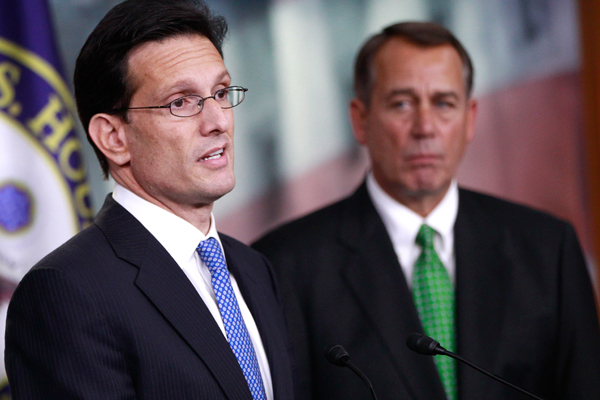
Eric Cantor and John Boehner (Credit: AP/Charles Dharapak) Have House Republicans lost their mojo? That’s the first conclusion that jumps to mind when attempting to read the tea leaves of the current negotiations over extending the payroll tax cut. On Tuesday, the most popular word used to describe the House GOP’s purported decision to abandon requiring spending cuts to offset the cost of another extension of the payroll tax cut was “cave.”
Ouch. A full two weeks before the ultimate deadline, Republicans are already willing to cut a deal that will add another $100 billion to the deficit. It wasn’t so long ago that these same Republicans were playing last-second brinksmanship while threatening to shut down the federal government in fervent protest of Big Government. Since when did the Tea Party become so meek?
If the consensus reporting from Capitol Hill is correct, sometime in the next two days, Republicans and Democrats will agree on a deal that keeps the payroll tax cut in place, extends unemployment benefits (albeit with a gradual reduction in the length of benefits put into place) and, once again, protects doctors from a cut in their Medicare reimbursement rate. The unemployment benefits and the so-called doc fix will purportedly be paid for by a combination of wireless spectrum sales, tweaks to how much the federal government contributes to federal worker pensions, and cash carved out of the health reform deal.
The politics of this are a lot easier to figure out than the economics. Simply put: It’s a win for Obama. The White House avoids putting the brakes on economic growth by preventing an imminent tax hike and keeping the safety net more or less intact for unemployed workers. In the run-up to an election that may be largely decided by the performance of the economy over the summer, that’s huge. If Republicans, as some have suggested, wanted to tank the economy to ensure new occupants in the White House, this is not the way to go about it.
And as a bonus, at least for the moment, the White House has also managed to avoid another game of budget showdown chicken. That said, the House has yet to vote, and over the past two years we’ve witnessed several occasions in which recalcitrant conservative representatives have torpedoed deals that were supposedly set in place. On the other hand, it’s possible that the negative political consequences of the 10 percent approval rating currently “enjoyed” by House Republicans is beginning to sink in.
Economically, the deal doesn’t do anything to additionally stimulate the economy, it merely keeps in place measures that have already been enacted. The maximum length of eligibility for unemployment benefits will gradually contract, a process that will cause hardship for workers who drop through the safety net. But macroeconomically speaking, the effect isn’t going to be that huge. Nor will the offsets that pay for the unemployment extensions and the doc fix add up to much in the way of contractionary austerity, though it certainly won’t be pleasant for federal workers who may end having to contribute more to their own pensions.
All in all, it’s kind of a wash. The White House avoids sabotaging the economy, the Republicans avoid making themselves any more unpopular than they already are. It’s a sign of just how dysfunctional Washington has been over the last couple of years that the absence of drama seems like a masterful political stroke by Obama. Maybe, as James Fallows suggests, he really is learning how to be president.
Andrew Leonard is a staff writer at Salon. On Twitter, @koxinga21. More Andrew Leonard.
Obama’s unwinnable payroll tax cut fight
The president's political position is strong, but Democrats still have to cut a deal that won't be pretty
President Obama (Credit: AP/Carolyn Kaster) With barely more than two weeks left to go in 2012, it is only fitting that Congressional Republicans and Democrats are once again engaged in doing what they do best: playing politics with the economy. The current fight over extending a payroll tax cut and unemployment benefits is just one more installment in the nation’s least favorite reality TV show: Partisan Gridlock.
Both sides more or less agree that it would be a bad idea to raise taxes and cut benefits during a weak economy — the question is what kind of pound of flesh will be extracted in exchange for a deal. Democrats want to pay for the extensions by taxing millionaires. Republicans want to pay for the measures by scooping money out of Obama’s priorities, such as health care reform, while pursuing their own agenda — gutting EPA regulations, getting the Keystone XL pipeline built, making it harder for poor women in Washington D.C. to get an abortion.
Continue Reading Close
Andrew Leonard is a staff writer at Salon. On Twitter, @koxinga21. More Andrew Leonard.
The economic price of the supercommittee fail
The interests of the wealthy are protected again, at the expense of economic growth
Mervin Sealy from Hickory, North Carolina, takes part in a protest rally outside the Capitol Building in Washington, October 5, 2011. (Credit: Jason Reed / Reuters) On Monday, the Dow Jones industrial average fell 300 points, a plunge immediately blamed on the supercommittee’s failure to agree on a debt reduction deal. If this is true, investors were displaying a remarkable lack of attention to current events. Is there anyone on Wall Street or in Washington, D.C., or anywhere else who expected the supercommittee to succeed? Failure should already have been “priced in” by the markets. As anticlimaxes go, the only surprising thing about the supercommittee’s impotence is that anyone was surprised by it.
Continue Reading Close
Andrew Leonard is a staff writer at Salon. On Twitter, @koxinga21. More Andrew Leonard.
Senate blocks House disaster aid bill
Relief legislation voted down after House Republicans passed offset-heavy version yesterday
Senate Majority Leader Harry Reid of Nev. gestures during a news conference on Capitol Hill in Washington on Thursday, Sept. 22, 2011, to discuss FEMA funding and the Continuing Resolution to fund the government. (AP Photo/Harry Hamburg)(Credit: AP/Harry Hamburg) The Democratic-led Senate blocked a House-passed bill on Friday that would provide disaster aid and keep government agencies open, escalating the parties’ latest showdown over spending and highlighting the raw partisan rift that has festered all year.
In a tit-for-tat battle, the Senate first used a near party-line vote of 59-36 to derail the measure from the Republican-run House. The House bill would fund federal agencies and provide $3.7 billion in disaster assistance, partly paying for that aid with cuts in two loan programs that finance technological development.
Continue Reading CloseHouse passes disaster aid, but Senate Dems object
Bill adds more offsets to secure Republican passage, all but guaranteeing death in Senate
Senate Majority Leader Harry Reid of Nev. gestures during a news conference on Capitol Hill in Washington on Thursday, Sept. 22, 2011, to discuss FEMA funding and the Continuing Resolution to fund the government. (AP Photo/Harry Hamburg)(Credit: AP) With the economy sputtering, the warring factions of Congress have lurched toward gridlock over the usually noncontroversial process of approving disaster aid and keeping the government from shutting down.
The GOP-dominated House early Friday muscled through a $3.7 billion disaster aid measure along with a stopgap spending bill to keep the government running past next Friday. The narrow 219-203 tally reversed an embarrassing loss for House GOP leaders that came Wednesday at the hands of rebellious tea party Republicans.
Continue Reading CloseDeficit-cutting Democrats depend on Pentagon contractors, data shows
Members face choice between hurting their donors or cutting your entitlements
Arizona’s Republican Sen. Jon Kyl wasted little time. A member of the bipartisan congressional “supercommittee” charged with finding $1.5 trillion in deficit reductions, he did his best to forestall even discussion of cuts to the Pentagon’s budget. “When we had our first meeting the chairman asked, ‘Well, what do we think about defense spending?’ and I said, ‘I’m off of the committee if we’re gonna talk about further defense spending [cuts],’” he told the audience at a recent forum sponsored by several conservative think tanks.
Continue Reading CloseNick Turse is the associate editor of TomDispatch.com and the winner of a 2009 Ridenhour Prize for Reportorial Distinction as well as a James Aronson Award for Social Justice Journalism. His work has appeared in the Los Angeles Times, the Nation, In These Times, and regularly at TomDispatch. This story is a joint investigative project of Salon, AlterNet, and Brave New Foundation. More Nick Turse.
Page 1 of 58 in Budget Showdown