
Birth Control

Catholic hypocrisy at its worst

Bishops condone much more direct contradictions of church dogma. The birth control uproar is a cynical power play

  • more
    • All Share Services

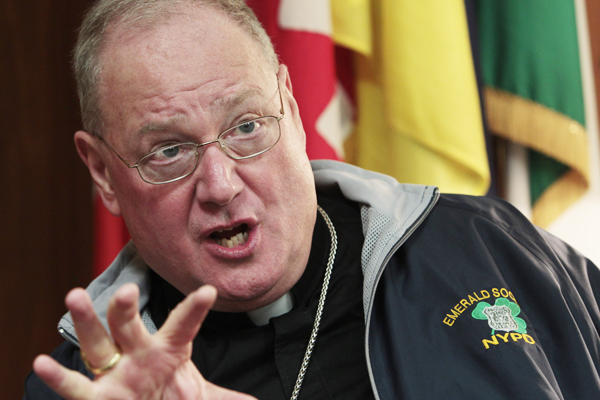
Catholic hypocrisy at its worstArchbishop of New York Timothy Dolan is interviewed at the North American College in Rome, Feb. 14, 2012.

For the record, the priest who married my wife and me in 1967 advised us that we could in good faith practice birth control. He reasoned that as Pope Paul VI was then preparing an encyclical regarding faith and sexuality, young Catholics could reasonably assume that church dogma regarding contraception would soon change to reflect contemporary realities: specifically that a couple intending to bring children into their marriage might legitimately seek to do so in their own time.

A university chaplain, he no doubt understood how the combination of Rome’s authoritarianism and theological nit-picking tended to drive educated young people from the church. Anyway, everybody knows how that worked out. Next came Humanae Vitae, Pope Paul VI’s 1968 doubling down on the church’s blanket condemnation of artificial means of birth control — a blast from the medieval past as most American Catholics now see it.

“Vatican Roulette,” we called it, and like the vast majority, declined to play. Surveys have shown that approximately 13 percent of the faithful agree with the Roman Catholic Church’s categorical ban on birth control; a mere 2 percent actually practice what the bishops preach. For most, it isn’t a serious personal issue. Sure, Your Grace, whatever.

For that matter, birthrates are declining in Catholic countries around the world. And a blessing it is, if poverty and human dignity concern you.

Until the U.S. Conference of Bishops recently got crosswise with the Obama administration, even the church rarely emphasized the contraceptive issue. So at first, I was mainly struck by the sheer quaintness of it all. (As, evidently, were many Catholic universities and hospitals quietly complying with state laws mandating contraceptive coverage.) The bishops’ indignant fulminations about their wounded consciences put me in mind of the hilarious production number in Monty Python’s “The Meaning of Life,” with its chorus of impoverished Catholic urchins singing

“Every sperm is sacred. Every sperm is great.
If a sperm is wasted, God gets quite irate.”

Coarse jokes about priests, altar boys and contraception virtually wrote themselves. I’ll spare you. But while we’re at it, let’s light a candle for Sinead O’Connor, an eccentric woman in combat boots with a shaven head, who tore up the pope’s photo on “Saturday Night Live” in 1992 to protest clerical sexual abuse of children in her native Ireland: wrecking her U.S. career to make a point entirely lost upon most viewers at the time.

In a bankruptcy proceeding last week, the diocese of Milwaukee listed 8,000 claims of sexual abuse among its liabilities. I’m with Esquire’s Charles P. Pierce, who writes that the great contraceptive kerfuffle with the Obama administration represents a fairly obvious power play by “the institutional American church to regain the power and influence in the secular government that it lost when it was exposed to be a multigenerational conspiracy to obstruct justice.”

If the reader detects bitterness, that’s an error of tone. The best priest I know is prone to remind his parishioners that the church is not God; rather, it’s a human institution, prone to sin and error. Recently watching him bless four little girls who carried alms to the altar, I was moved to think how humble, hardworking priests like him are also victims of the church hierarchy’s grave moral failure.

So you’d think they’d be a bit more modest in their rhetoric, the bishops. Particularly in anything touching upon human sexuality. This may be the place to say that I speak for nobody but myself. Not for Irish Catholics, Catholics in the South, Catholics Who Raise Fleckvieh Simmental Cows, nor even for my wife.

Her issue is how easily rich people are granted marriage annulments. The late Sen. Ted Kennedy’s marriage was declared null and void after 24 years and three children because — get this — he’d entered it with reservations. Specifically, he never intended to quit “dating.” (Evidently a family tradition.) Never mind that Kennedy’s ex-wife Joan agreed. Mine found it sickening, a patent end-run around the church’s unwillingness to countenance divorce.

For that matter, a couple of bishops attended Newt Gingrich’s third wedding. So don’t tell me they couldn’t find a way to accommodate President Obama’s downright Jesuitical compromise to the effect that Catholic hospitals don’t have to offer employees contraceptive care, but their insurance companies do. Canon lawyers make distinctions like that one every day.

Instead, they’ve settled upon a partisan power play to subvert the First Amendment rights they claim. Look, nobody’s forced to use contraceptives; it’s an individual’s choice, nobody else’s. Religious organizations have the right to believe anything they like, but not to impose those beliefs upon others. By essentially demanding a Catholic veto, the bishops and their GOP allies would impose their theological views upon millions of American women as a condition of employment.

That’s not “liberty,” it’s liberty’s opposite; and precisely what the First Amendment was written to prevent.

Arkansas Times columnist Gene Lyons is a National Magazine Award winner and co-author of "The Hunting of the President" (St. Martin's Press, 2000). You can e-mail Lyons at eugenelyons2@yahoo.com.

Catholic Church: Time for a new war on birth control

Notre Dame and other Catholic institutions have revived their fight against contraception with a new lawsuit

  • more
    • All Share Services

Catholic Church: Time for a new war on birth controlAbortion protesters in South Bend, Ind., in 2009. (Credit: AP/Joe Raymond)

Until Rush Limbaugh called Sandra Fluke a slut, the United States Conference of Catholic Bishops had almost convinced the public that fighting the contraceptive coverage mandate in the Affordable Care Act was about religious freedom. Now, 43 plaintiffs, including 13 dioceses and, most prominently, the University of Notre Dame, would like to bring back the argument that the Obama administration is encroaching on their religious rights.

“This lawsuit is about one of America’s most cherished freedoms: the freedom to practice one’s religion without government interference,” opens the Notre Dame suit, which was filed Monday. “It is not about whether people have a right to abortion-inducing drugs, sterilization and contraception.”

Because the words “abortifacient” or “abortion inducing” sound so scary, the Notre Dame lawsuit makes sure to claim over and over again that, despite a political compromise and executive order specifically exempting abortion coverage from Affordable Care Act provisions, they are being forced to pay for abortion. It claims that “many contraceptives approved by the FDA that qualify under these guidelines cause abortions,” which is false on multiple levels: Even if you believe, as Catholic doctrine does but medical professionals do not, that fertilization, not implantation, constitutes pregnancy, the latest scientific research shows that there’s no evidence that emergency contraception prevents implantation.

Not that they’ve entirely gotten their message straight: Whereas Harvard Law professor Mary Glendon argues in the Wall Street Journal today in defense of the bishops’ position that “if religious providers of education, health care and social services are closed down or forced to become tools of administration policy, the government consolidates a monopoly over those essential services,” the Notre Dame lawsuit suggests that instead of forcing them to cover birth control, the government could just expand Title X clinics that provide birth control to low-income women. The same clinics, by the way, that social conservatives and acquiescent Republicans are trying to either cut funding to or defund altogether.

The lawsuits make a First Amendment free exercise claim, but are aware that they face a standard set by Justice Antonin Scalia in his 1990 majority opinion in Employment Division v. Smith: That the free exercise of religion is not limited by a “neutral law of general applicability” – that is, it applies to everyone. In the Notre Dame suit, the plaintiffs argue that the “U.S. Government Mandate is not a neutral law of general applicability. It offers multiple exemptions … for example, all ‘grandfathered’ plans are exempted from its requirements.” Of course, that grandfathering is merely a temporal distinction, just like the one-year period that HHS gave religiously affiliated institutions to comply.

Earlier this year, the White House announced a compromise that would allow religiously affiliated institutions that objected to instead have insurance companies directly provide coverage. Notre Dame, as the lawsuit points out, is self-insured, but the administration has said it is seeking to work out an arrangement for such institutions.

The Notre Dame lawsuit also claims that the mandate was “implemented at the behest of individuals and organizations who disagree with certain religious beliefs regarding abortifacients and contraception, and thus it targets religious organizations for disfavored treatment.” Secretary of Health and Human Services Kathleen Sebelius is called out for speaking at a NARAL Pro-Choice America fundraiser. She’s quoted, disparagingly, for saying, “Wouldn’t you think that people who want to reduce the number of abortions would champion the cause of widely available, widely affordable contraceptive services?  Not so much.”

Not every Catholic organization has come out fighting; several dioceses and universities are sitting this one out, and the administration won the initial support of the Catholic Health Association’s Sister Carol Keehan with its compromise. (The most recent comment on its website says the CHA is awaiting specifics.) But as Angela Bonavoglia reports in the Nation, this struggle is part of a larger crackdown by the conservative hierarchy against liberal elements within it — chiefly, women, including nuns.

Continue Reading Close
Irin Carmon

Irin Carmon is a staff writer for Salon. Follow her on Twitter at @irincarmon or email her at icarmon@salon.com.

“Birth control doesn’t matter”

A new survey reveals just how ignorant young people are about contraception and pregnancy

  • more
    • All Share Services

(Credit: restyler via Shutterstock)

When it comes to sex and reproduction, even the most mind-numbingly intuitive conclusions can be politicized or disbelieved. So they bear repeating and resubstantiation. Take this recent Guttmacher study on contraceptive knowledge. Surveying 1,800 men and women ages 18–29, the authors “found that the lower the level of contraceptive knowledge among young women, the greater the likelihood that they expected to have unprotected sex in the next three months, behavior that puts them at risk for an unplanned pregnancy.” In other words, access to factual information helps prevent risky behavior.

I’m holding myself back from saying “duh” here, but this still has to be reiterated at a time when abstinence-only education that doesn’t provide detailed information about contraceptive use, except occasionally to emphasize its limits, not only persists but recently got a federal stamp of approval. As an Advocates for Youth report on the impact of abstinence-only education noted, “Proponents of abstinence-only programs believe that providing information about the health benefits of condoms or contraception contradicts their message of abstinence-only and undermines its impact. As such, abstinence-only programs provide no information about contraception beyond failure rates.” That’s how you get terrifying statistics like this one from the Guttmacher report: In the survey, “60 percent underestimated the effectiveness of oral contraceptives and 40 percent held the fatalistic view that using birth control does not matter.” Overall, “more than half of young men and a quarter of young women received low scores on contraceptive knowledge.” It’s also how you get figures like the one from the CDC that found that 31.4 percent of pregnant teens didn’t use contraception because they “thought they could not get pregnant at the time.”

There are two reasons to be optimistic that some dent can be made in these depressing figures, and they both have to do with provisions of the Affordable Care Act. Much has been made of the mandate that insurance policies cover all FDA-approved contraceptive methods, but there’s another aspect that’s been relatively overlooked: the fact that the same provision includes free education and counseling about sex and contraception, at least for the insured. The second reason for optimism is that the mandate will make it far easier for women to get longer-acting and more effective forms of contraception like the IUD — which are also more expensive and which studies have shown women would be interested in if they could afford them. Incidentally, the recent Guttmacher study found that women who were using long-acting or regular hormonal contraception tended to score higher on overall knowledge.

It will be awhile before we know if these changes will move the needle on the nation’s unparalleled rate of unintended pregnancy. The women’s health provisions only go into effect for new plans in August 2012, and older plans will be initially grandfathered and eventually phased out. And of course, there’s another big fat if – whether the Supreme Court overturns all or part of the Affordable Care Act. The Obama campaign and its allies are keen to point out how such a move — or, perhaps, a legislative repeal down the line — will hurt women above all. The Center for American Progress recently released a report on “Women and Obamacare” (the campaign having officially embraced the derisively intended term). It declares Obamacare “the greatest legislative advancement for women’s health in a generation,” which may be true for reasons more depressing than inspiring: There have been very few advancements partly because there has been so much political defense played.

In addition to the reproductive health benefits, the report points to preventive care recommendations for which cost-sharing has already been cut: mammograms, pap smears, prenatal care and so on. According to the report, “close to 9 million women will gain coverage for maternity care in the individual market starting in 2014,” currently not covered in 78 percent of plans sold on the individual market. It notes that women are more frequent users of healthcare services than men, that they’re likelier to make the household decisions on healthcare and that they’re more vulnerable to losing coverage because they’re likelier to be listed as dependents on a partner’s plan. The Affordable Care Act also makes it illegal to engage in “gender rating” – charging women $1 billion more than men on the individual market – and bans states from discriminating on the basis of gender identity in their insurance exchanges.

The report does acknowledge two ways in which Obamacare falls short for women who were “left out of the law — undocumented and recent immigrant women and women who need abortion services.” It claims that “political compromises on abortion coverage were necessary to ensure passage of the Affordable Care Act” – still a bitter loss to reproductive rights groups, who memorably described women as having been “thrown under the bus” by Democrats – “but the work to obtain abortion coverage for all women continues.” The last part is particularly debatable, at least when it comes to any momentum on the funding issue from national Democrats, while Republicans in the states and federally have spent considerable energy trying to limit abortion coverage on even private insurance plans.

Still, if the Affordable Care Act is allowed to stand, the magnitude of having an actual, proactive reproductive health access policy shouldn’t be underplayed. Maybe we’ll get closer to a saner republic where hearing “birth control doesn’t matter” from people who don’t want to get pregnant is a quaint memory.

Continue Reading Close
Irin Carmon

Irin Carmon is a staff writer for Salon. Follow her on Twitter at @irincarmon or email her at icarmon@salon.com.

Abortions made public

States want more data on abortion patients. Zealots want their hands on it. Shame is the new anti-choice strategy

  • more
    • All Share Services

Abortions made public (Credit: Cannaregio via Shutterstock/Salon/Benjamin Wheelock)

It was an “anonymous informant,” Operation Rescue claimed last week, after someone slipped them the April records of 86 women who were treated at Central Family Medical. The clinic’s lawyer was blunter. “It certainly appears to me that a crime was committed,” Cheryl Pilate told the Kansas City Star. Though the clinic (which performs abortions) had already reported a break-in to a locked dumpster, Pilate said it wouldn’t have contained patient records, which are shredded. The “informant” must have gotten the documents – containing names, addresses and details of procedures – another way.

“Our concern is for the privacy of these women and for their health and safety, for which Central Family Planning has shown very little regard,” said Operation Rescue’s Troy Newman – while posting photographs of the documents, partially redacted in black marker, online.

Antiabortion activists want to create the impression that one way or another, a woman’s decision to have an abortion will be discovered and exposed. The Central Family Medical incident is only the latest skirmish in a decades-long effort to undermine the privacy of abortion patients and harass doctors. In the early ’90s, for example, at least one group of clinic protesters printed on their signs the names of women seeking abortions that day, alongside “don’t kill your baby.” Such actions, while failing to make abortion illegal, have nevertheless managed to cloak it in a stigma that belies the fact that one in three women will have an abortion before the age of 45. Now, activists are seeking new ways to shame women who seek abortions, from requiring them to hand over personal information to actually hacking into their medical records.

Kansas has been ground zero for this: Last year, the Kansas Board for Discipline of Attorneys recommended that former Attorney General Phill Kline, a hero to Operation Rescue, have his legal license suspended indefinitely for mishandling the records from murdered abortion provider George Tiller’s clinic. (The Kansas Supreme Court will make the final call.) But the zeal to keep, and sometimes steal, abortion records casts a wide net.

In Texas, the state Department of Health is trying to implement a failed legislative measure that would require abortion clinics to report far more information about their patients to the state. In Florida, voters will weigh in on a ballot measure that would exempt abortion from the privacy clause in the state constitution, with the short-term aim being to strip minors of a right to privacy that would preclude parental consent. The U.K. recently jailed a hacker who stole and intended to publish the records of 10,000 women who visited the country’s largest abortion provider.

“It promotes the idea that abortion – or your privacy, if you have any – is not safe,” says Katie Stack, a graduate student and activist who spoke out about her abortion on an MTV special, “No Easy Decision.” That put her in close contact with the “online ministry” – the name antiabortion activists have given their efforts to reach women considering abortions through the Internet.

This has been the unstated goal of many activists in the antiabortion movement — and, sometimes, the stated one. “This might sound a little strange,” said antiabortion activist Lila Rose at the Value Voters Summit in 2009, but “if I could insist, as long as they are legal in our nation, abortions would be done in the public square, until we were so sick and tired of seeing them that we would do away with the injustice altogether … maybe then we might hear angels singing when we ponder the glory of conception.”

Rose won’t get her wish any time soon, but antiabortion activists are trying to use the Internet to have a similar effect. Rose was recently on a panel at the International Pro-Life Youth Conference about social media and pro-life activism, where topics included targeting women who are seeking information about abortion online, whether through Yahoo Answers or YouTube commenters – including figuring out where they live and recommending a crisis pregnancy center nearby.

“Privacy is very important to women who have abortions,” says Kate Cockrill, program director of the Social and Emotional Aspects of Abortion project, at the University of California, San Francisco. She points out that abortion is traditionally underreported even in confidential surveys, “which is a good indication that women don’t want to be associated with abortion experience in the eyes of someone who’s gathering data, even if it’s anonymous.”

Cockrill recently conducted a survey, as yet unpublished, that seeks to measure the impact of social stigma on women who’ve had abortions. It asked 641 women who had had abortions about 61 items, including questions about the fear people would gossip about you, judge you or hurt you, or the fear that you would lose an important relationship.

So far, she’s found that the women who experienced the most stigma were worried about being judged more than they were about being hurt or harmed, that they feared loss of social status and the ruining of their public identity, that they felt isolated and guilty, and that they feared community condemnation.

But as with other abortion restrictions, which create extra burdens in the supposed service of changing women’s minds, it’s not clear that anyone’s mind is being changed.

“Lots of women who feel a lot of stigma about abortions have abortion anyway,” Cockrill says. “If it’s not doing what antiabortion people want it to do, which is reducing the number of abortions, is it doing something on the other end, [after the fact]?”

Cockrill and her team are going to be using their scale in a study next year to look at the relationship between stigma and poor coping after abortion. Given that antiabortion activists have added to their obsessions the alleged harm abortion causes to women, there’s reason to believe that this is a self-fulfilling prophecy.

Women who have abortions, Cockrill says, “have a huge range of political views.” In fact, in her survey, only 62 percent of the women identified as pro-choice. (Seven percent identified as prolife, and 18 percent described their position as “mixed or neither.”)

“A lot of women don’t experience their abortions as a political act,” Cockrill says, partly an extension of the fact that they don’t see it as constitutive of their identity.

Whether it’s political rhetoric or individual ambivalence, these women are highly sensitive about whom they tell they had abortions. Sixty-four percent of the women in the study said they’d “withheld information about my abortion to someone I’m close to,” and 45 percent said they’d “lied to someone I’m close to about my abortion.”

They may not see it as political, but that silence functions as a vicious circle that antiabortion activists happily seize upon and promote. Cockrill says, “Some people say, ‘We need to have more people come out about their abortions.’ But it’s impossible to get more women to talk about their abortions if they don’t feel supported. And it needs to be on women’s own terms.”

Continue Reading Close
Irin Carmon

Irin Carmon is a staff writer for Salon. Follow her on Twitter at @irincarmon or email her at icarmon@salon.com.

The myth of the “morning-after abortion pill”

There's a reason why people mistake emergency contraception and abortion: The right intentionally confuses the two

  • more
    • All Share Services

The myth of the (Credit: Shutterstock/Salon/Benjamin Wheelock)

It started around February, when Republicans were still eager to talk about contraception. The Obama administration, or so Mitt Romney charged in Colorado, was forcing religious institutions to provide “morning-after pills –in other words abortive pills — and the like, at no cost.”

It was, of course, a lie. Romney was conflating two different pills: emergency contraception, known as the morning-after pill, which prevents a pregnancy; and chemical abortion, or mifepristone, which ends a pregnancy of up to seven weeks’ gestation and isn’t covered under the new guidelines. Since both pills were marketed in the U.S. around the same time, even some pro-choicers have gotten confused. But Colorado happens to be the epicenter of people confusing them on purpose. It’s the birthplace of the Personhood movement and home to Focus on the Family, both of which have strategically called emergency contraception “abortion” on the scientifically unproven basis that they could block a fertilized egg from implanting.

There are a host of ironies here. Obama has earned the renewed support of reproductive-rights advocates by requiring health insurers to cover contraception, but the Center for Reproductive Rights is still taking him to court – with oral hearings being held this week before a New York federal court -– for overruling the FDA’s recommendation to lift the prescription requirement on emergency contraception for women under 17. That litigation has been winding its way through the system for over a decade, throughout the Bush-era politicization of the FDA, eventually resulting in a federal judge concluding that “the FDA repeatedly and unreasonably delayed issuing a decision on [the emergency contraception pill] Plan B for suspect reasons.” The FDA was ordered to explain why Plan B shouldn’t be available over the counter for girls 13 and up. When the Obama administration overruled the FDA’s recommendation to make it over the counter, U.S. District Judge Edward Korman suggested the Center for Reproductive Rights reopen its case.

“It seems to me that what we’re going through is a rerun of what happened before,” Korman remarked, referring to politics trumping the recommendations of medical professionals.

The Obama administration’s unspoken but unmistakable fear was of an election-cycle attack line that Michele Bachmann would use anyway: That teenage girls would be able to get Plan B from “the grocery store aisles next to bubble gum and next to M&Ms.” That was, in fact, an echo of the language President Obama himself used to invoke a highly unsupported bogeyman: that “a 10-year-old or 11-year-old going to a drugstore would be able to, alongside bubble gum or batteries, … buy a medication that potentially if not used properly can have an adverse effect.”

But there is another twist, so far mostly overlooked: Emergency contraception won’t be covered by insurance for everyone, since it’s available over-the-counter for those who can show I.D. proving that they’re 17 or older. They’ll still have to fork over around $50 a pop. But as long as girls 16 and younger need a prescription for the morning-after pill and they have insurance, it will be fully covered — effectively free. The same goes for women older than 17 who decide to jump through the hoops of getting a prescription, either for over-the-counter Plan B or the prescription-only generic and Ella versions.

As much as pro-choice advocates want to lift the barriers that make emergency contraception hard to get — because it’s more effective the faster you use it — one of those barriers, the prescription requirement, also mitigates another, the high cost. Said Adam Sonfield, a senior public policy associate at the Guttmacher Institute, of this catch-22, “It presents a tradeoff between cost and access.”

– – — – — – — – — – — – — – — – — – — – — – — – –

Part of the reason people get confused about emergency contraception and abortion is because lots of people are confused about the basic biology of pregnancy: specifically, that it doesn’t necessarily happen instantaneously and that sperm can live in the body for several days, during which time a woman can ovulate and an egg can potentially be fertilized and implant. Regular use of hormonal contraception prevents ovulation and the chance for fertilization; emergency contraception essentially works the same way except that it’s taken after sex, by which point ovulation may have already happened. But according to recent studies, there is no evidence that taking emergency contraception after ovulation and fertilization will stop the egg from implanting.

But the misinformation and misunderstanding have created a contradictory public health picture when it comes to emergency contraception. In some ways, it’s become more accessible. In 2010, the U.S. approved a longer-acting French variant of Plan B, known as Ella, and there are scattered experiments in convenient delivery, from a birth-control vending machine at Shippensburg University in Pennsylvania to a new bike messenger service in London, both of which caused minor news sensations. The annual “Back Up Your Birth Control” campaign has been promoting the line “EC=BC,” emphasizing that emergency contraception is birth control, not abortion — just in case that is a barrier for women who are considering taking it. And the Center for Reproductive Rights’ petition did manage to lower the age restriction from 18 to 17.

But there are more disturbing suggestions that misinformation is triumphing. A recent Boston Medical Center study found that many pharmacists were still often misinformed about the age requirement and were even more likely to wrongly refuse emergency contraception to 17-year-olds in low-income neighborhoods, where the rate of unintended pregnancy is higher. In Honduras, the Supreme Court upheld the criminalization of emergency contraception, which means women who use it could be jailed. Personhood initiatives, which oppose the morning-after pill, have so far failed in Colorado, Mississippi and Oklahoma, but they’ve introduced false doubts by providing even more opportunities for pundits and candidates to say “the morning-after abortion pill.”

It’s a problem that dates back decades: When, throughout the ’90s, the U.S. considered approving a French chemical abortion pill known as RU-486, it was widely called the “morning-after abortion pill,” including, often, in the New York Times. The distinction wasn’t pressed by the pro-choice community itself.  “At the time, the prevailing medical wisdom was that there is a continuum rather than a bright line between EC and mifepristone,” said Gloria Feldt, who was president of Planned Parenthood at the time, with the benefit providing more options for women who did not wish to be pregnant. “It was also assumed that a formulation of mifepristone would eventually be made for use as a true ‘morning-after’ pill.” The widespread belief, she recalled, was that a chemical abortion pill would “solve all the abortion debate problems and guarantee privacy.”

Another problem was that although doctors and non-professionals had been giving women high dosages of regular birth control pills for decades as a form of emergency contraception, the science of exactly how emergency contraception worked remained unclear. The medical definition of pregnancy remains “implantation of a fertilized egg,” but let’s say you believe, as the Catholic Church does, that fertilization itself creates a human life. Anti-choice advocates obsess over what would happen if a woman who took emergency contraception did happen to ovulate anyway and an egg potentially was fertilized, which is enough reason for some of them to call postcoital contraception “abortion.” They have claimed that hormonal contraception makes the lining of the endometrium inhospitable to a fertilized egg, constituting “murder.” Even the official packaging for Plan B, the single-step version of emergency contraception, suggests that “in addition” to blocking ovulation and fertilization, “it may inhibit implantation (by altering the endometrium).”

Except that we now know it doesn’t, even if you walk down the path of remote maybes, which requires you to believe that a zygote, which may not implant for unknowable reasons, has the same rights as a living woman who doesn’t want to be pregnant. As Princeton’s Kelly Cleland pointed out recently, “The science has evolved considerably in the last 13 years. Newer evidence, published since the Plan B label was approved, provides compelling evidence that levonorgestrel EC (LNG EC) works before ovulation, but not after.” The International Consortium for Emergency Contraception and the International Federation of Gynecology & Obstetrics also note that two new studies have shown conclusively that if a woman has ovulated and an egg has been fertilized, it’s too late for emergency contraception to work. They recommended that the language on the product labeling be changed.

Of course, scientific evidence has rarely had much place in this debate. In the meantime, even the most non-ideological news sources keep making the mistake alongside the ideologues. Last week, a furor erupted after the Associated Press reported that “Women seeking to take emergency contraception like the so-called ‘morning after’ pill would have to do so in the presence of a doctor under a bill before the Alabama legislature.” That is, until Erin Gloria Ryan from Jezebel read the actual bill and saw that it was, in fact, a law meant to limit chemical abortion, not emergency contraception. (A spokesperson for the AP said a correction was being prepared). “The confusion over this issue is probably one of the reasons emergency contraception hasn’t had as positive an impact as hoped when it comes to lowering the abortion rate,” wrote Amanda Marcotte at RH Reality Check. “If women think it is some kind of abortion-ish thing, they probably think taking it is a big deal, instead of thinking of it more like taking the pill, since it’s basically the same thing.”

But talk about moved goalposts. If ’90s-era advocates had hoped that the ability to end a pregnancy in the safety of your home with RU-486 — the actual abortion pill, not the morning-after one — would defuse the abortion debate, their more recent counterparts hoped to take it to the next technological level by providing “tele-med” abortions. They would involve doctors seeing a woman over webcam with a nurse practitioner physically present, helping women in remote areas with ever-dwindling options for safe abortions to access them. But four states have already passed requirements meant to undercut these options by forcing a doctor’s presence, and the bill the Associated Press misreported was aiming to add Alabama to the list. All in all, there have been fewer gamechangers, and more cases of one step forward, two steps back.

Continue Reading Close
Irin Carmon

Irin Carmon is a staff writer for Salon. Follow her on Twitter at @irincarmon or email her at icarmon@salon.com.

Mockery: Women’s new weapon

From a sex strike to satirical anti-Viagra bills, the war on reproductive rights has some responding with laughs

  • more
    • All Share Services

Mockery: Women's new weapon

From a proposed sex strike to mock legislation restricting access to Viagra, women are coming up with increasingly creative ways to respond to attacks on reproductive rights. Many of them are relying on something ladies are often said to be without: a sense of humor.

In case you didn’t catch on, the sex strike is tongue-in-cheek. Annette Maxberry-Carrara, founder of Liberal Ladies Who Lunch — the group that proposed the “Access Denied” protest — tells me with a laugh, “We’re not looking at it as a literal strike.” But they are making a serious political statement. The event’s tagline reads, “If our reproductive choices are denied, so are yours.”

You would have to be profoundly tone deaf to not recognize the satire in recent bills proposed by female lawmakers that proclaim “every sperm is sacred” and restrict access to the blue pill. Last month, Oklahoma state Sen. Constance Johnson offered a bill in response to Senate Bill 1433 — which seriously and nonsatirically holds that a fetus at “every stage of development” has “all the rights, privileges and immunities available to other persons, citizens and residents of this state.” Her proposal states, “[A]ny action in which a man ejaculates or otherwise deposits semen anywhere but in a woman’s vagina shall be interpreted and construed as an action against an unborn child.”

A handful of similar bills call for men to jump through hoops to obtain Viagra — a mandated cardiac stress test, a rectal exam, even being forced to watch a “horrific” video on the drug’s side effects. Some have managed to make a big statement without a bill: During a protest of Oklahoma’s Personhood measure, state Sen. Judy Eason McIntyre stood in front of the state Capitol with a grin on her face and holding a sign reading, “If I wanted the government in my womb I’d fuck a senator.”

It isn’t just these daring female lawmakers who are turning to humor to combat the anti-choice onslaught. Consider the scores of everyday women who have hijacked the Facebook page of Virginia state Sen. Ryan McDougle — a supporter of the state’s transvaginal ultra-sound mandate — with exquisitely detailed descriptions of their vaginas. For example: “Hey senator! just a quick hello to let you know that I’m currently ovulating! my vaginal discharge is thick and sticky and smells acidic (probably all the garlic i’ve been eating!).” In February, my Facebook news feed was filled up with repostings of a screenshot from “Morning Joe” showing an all-male panel criticizing an all-male Congressional panel on birth control. (The show certainly didn’t intend it as satire, but it read like a piece from the Onion, and women circulated it as such.) That’s not to mention recent biting commentary on the topic from comedians like Amy Poehler.

This isn’t entirely new, of course. Women have long used satire to make political points. Just look at suffragette Alice Duer Miller’s bulletpoint list of reasons why men should not be given the right to vote (a highlight: “Because men are too emotional to vote. Their conduct at baseball games and political conventions shows this, while their innate tendency to appeal to force renders them unfit for government”).

“There were a lot of women humorists in the 19th century who were going at the political system in a very similar way, and it had a very big effect on women getting the vote and being able to be admitted to colleges,” says humorist and feminist theory professor Gina Barreca. “Every generation of women sadly thinks they’re the first ones ever to do this because the tradition isn’t usually encoded.”

That said, it’s reached a fever pitch as of late. The recent comedy-infused pushback against the assault on reproductive rights builds on what Amber Day, author of “Satire and Dissent: Interventions in Contemporary Political Debate,” calls a “satirical renaissance” of the last decade. It’s a result, in part of the fact that “political debate has become so heavily stage managed that there is rarely any discussion of substance happening,” she says, and talking points are “repeated ad infinitum on the debate programs, with scarcely anyone bothering to fact check or to push through to the real substance of the matter.” Contemporary satire — from “The Daily Show” to “Saturday Night Live’s” Weekend Update — offer “us a way to satisfyingly break through the existing script.”

Women are turning to satire now “for many of the same reasons others have in the past,” Day says — it’s just that the current war on reproductive rights is more motivating for vagina-havers. “What much of the recent satire has demonstrated is that there is still a lot of sanctimonious language that gets used in discussions of women’s health and sexuality,” she says. “That language is revealed as ridiculous when applied to men’s sexuality.”

That was the aim of Missouri state Rep. Stacey Newman, a Democrat, who proposed a measure earlier this month that read in part, “A vasectomy shall only be performed to avert the death of the man or avert serious risk of substantial and irreversible physical impairment of a major bodily function of the man.” She tells me that attempts to restrict women’s reproductive rights are constant. “We deal with this all the time,” she says. “You feel like all you can do is sit there and bury your head and go, ‘Is anybody paying attention?’”

Maxberry-Carrara, of the faux sex strikers, was similarly aiming to get people’s attention, and her tongue-in-cheek protest did the trick — and the strike hasn’t even officially started yet. “What we wanted was to bring attention to the assault on women’s rights,” she says. Her hope is that by poking fun at these legislators, “the less seriously we can take them as candidates.”

Barreca, author of “It’s Not That I’m Bitter … : Or How I Learned to Stop Worrying About Visible Panty Lines and Conquered the World,” says women are turning to humor right now “because it’s so much more effective than weeping or banging your shoe on that table!” She says, “The point of satire is not only to illustrate the absurdity of things but to show what the world looks like when it’s turned upside down.”

Amanda Marcotte, a feminist commentator and author, says, “Things have just gotten to the point of absurdity that you can’t react without being absurd yourself.” Thanks to recent attacks on even contraception, “ordinary women who often don’t pay attention to politics are finally beginning to pay attention,” she says. “And I think that means more opportunities to communicate through humor instead of the typical outrage thing. Humor can be very clarifying.”

Meg Wolitzer, author of “The Uncoupling,” a fictionalized account of a sex strike, points out, there’s a long tradition, “starting with Aristophanes and continuing up through a strange episode of “Gilligan’s Island” that I remember from my childhood,” of sex strikes being used for comedy. “Desperate times do call for creative and vigorous responses, and the assault on reproductive rights today certainly qualifies as desperate times. I think women need to find lots of ways to speak out and act, and this is just one,” she says.

You might ask how effective it is in bringing about actual change. Day says, “Historically, satire has often been dismissed as never actually accomplishing anything, because it is extremely rare to be able to draw a straight line from a piece of satire to a substantive political response, like a bill being passed.” (Although she gives the example of Jon Stewart and the Zadroga Act; Stewart helped shame Republicans who filibustered against extending benefits to Sept. 11 responders who died of cancer or respiratory diseases.) But this is “an overly narrow way to think about political efficacy,” she says. “When satire is successful, it functions to shift the terms of the wider public discussion. And that, in itself, is a big deal.”

Continue Reading Close
Tracy Clark-Flory

Tracy Clark-Flory is a staff writer at Salon. Follow @tracyclarkflory on Twitter.

Page 1 of 23 in Birth Control