

When the state of Arizona enacted a draconian anti-immigrant law — which gave the police wide powers to detain individuals they believed to be undocumented immigrants — nearly two years ago, the national media took notice. Activists campaigned against the law and tried to shame the state into submission, with Rage Against the Machine’s Zack de la Rocha even getting dozens of musicians to sign on to a boycott of performances in the state.
Yet soon after Arizona’s law passed, similar anti-immigrant legislation began appearing in legislatures across the nation. Partially coordinated by the American Legislative Exchange Council, a conservative advocacy group funded in part by private prisons, states from coast to coast initiated their own crackdowns.
In Georgia, Republican Gov. Nathan Deal signed a copycat bill into law in 2011, making his state the third to give police such wide powers to investigate the immigration status of suspected undocumented immigrants. “This legislation I believe is a responsible step forward in the absence of federal action,” said Deal.
The Arizona-like law had a decidedly detrimental effect on the state’s economy. One survey conducted during the summer of 2011 found that there was a shortage of at least 11,000 farmworkers in Georgia. The Georgia Agribusiness Council said that the state’s farms were left “with 30 percent fewer workers on average.” “We don’t need to stall the largest economic engine in this state and we don’t need to scare off our workforce,” warned Zippy Duvall of the Georgia Farm Bureau.
Yet Georgia went much further than many other red states in making the lives of undocumented immigrants uncomfortable. In 2010, the state’s major public universities were ordered to do an audit of all their students to identify undocumented immigrants. Then in October, the state’s board of regents voted 14-2 to effectively ban undocumented immigrants from attending Georgia’s five major public universities, citing concerns about space not being available for documented students. This policy was enacted on top of the fact that Georgia already barred undocumented students from getting in-state tuition.
The policy ended up harming one of the state’s treasured institutions — college football — in a way that the board of regents likely did not expect. Last month, high school football star Chester Brown of Hinesville, Ga., had a rude awakening. For months, he was courted by the University of Georgia football team to join its legendary football program. He even got a UGA tattoo on his left forearm. But the October 2010 vote made it so that the Samoan-born athlete would automatically be denied admission to UGA. Now Brown is likely to be recruited by big-name schools out of state.
A group of five professors at the University of Georgia decided that they weren’t going to take part in the state’s process of immiserating the lives of undocumented students. Shortly after the closed-door policy began, they started what they called “Freedom University,” where they secretly offered these students courses. “This is not a substitute for letting these students into UGA, Georgia State or the other schools,” said Pam Voekel, a history professor. “It is designed for people who, right now, don’t have another option.”
Some of Georgia’s far-right lawmaker want to go even further. Senate Majority Leader Chip Rogers is sponsoring a bill, S.B. 458, that would ban undocumented immigrants from attending all public Georgia colleges and universities.
In one sense, the bill is itself targeting a supposed problem — undocumented immigrants taking up space in classrooms that legal residents can’t have — that really doesn’t exist. According to an audit conducted by the University System of Georgia, which oversees the state’s public universities, there are only 300 undocumented students out of the system’s 318,000 total population. And there is little evidence that allowing undocumented immigrants to go to college would be a drain on taxpayers. After all, college graduates earn more money than non-graduates, and thus are much more likely to contribute more in taxes and be a boon, not a burden, to the public treasury.
That’s why looking at S.B. 458 as a flawed policy solution would be a mistake. The state Legislature has already proved that it has little concern with guaranteeing equity in education to Georgia’s residents. In early 2011 it enacted a series of major cuts to the state’s widely praised tuition subsidy program. The result has been a dramatic reduction in public aid to students across the state, with African-American students facing some of the worst cutbacks.
S.B. 458 does not seek to improve higher education in Georgia but rather to deflect attention from those who seek to harm it. By attacking undocumented immigrants and falsely portraying them as a drain on the system and taking the slots that legal residents deserve, the state Legislature is trying to distract the public from looking at the real culprits of Georgia’s educational and social welfare woes: politicians who have been gutting education spending.
On Wednesday, the Senate Judiciary Committee passed S.B. 458, and it will now move on to the full Senate. It is still unclear as to whether the radical legislation will make it into law. Deal is signaling that he is undecided about the bill.
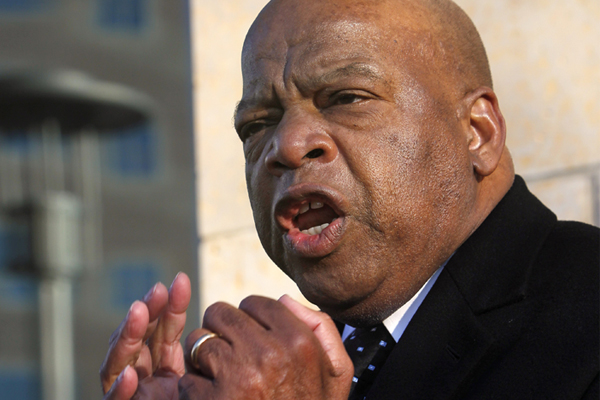
The day after the bill was passed out of committee, the Georgia Latino Elected Officials organization sought out civil rights legend Rep. John Lewis, D-Ga., to comment about the bill GALEO is calling the “Anti-DREAM” Act. Lewis, of course, is no stranger to the politics of hate and political distraction that are underlying the push for the bill.
“I would say to the students and to all of the young people, not to give up,” replied Lewis. “Another generation of young people, another generation of young people stood up. We created a mass movement … I think it’s a shame and a disgrace for the state of Georgia to move down that road.”
If Georgians don’t want to continue to see their state’s undocumented population turned into political punching bags, with even students simply seeking a decent education being stripped of their rights and liberties, it may be time for them to take Lewis’ advice, and, as he put it, “make some trouble. Good trouble.”
