
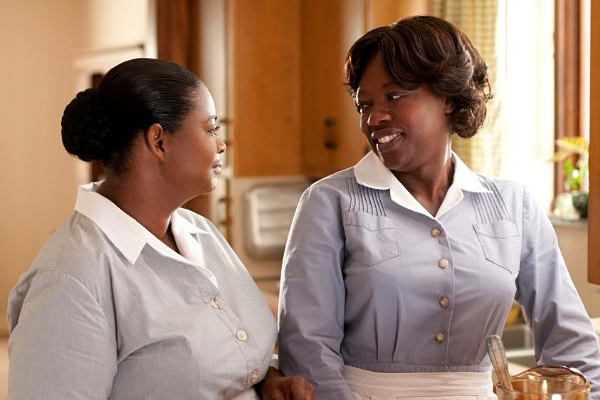

Months after its release, and perhaps in spite of the Academy Award nominations and Golden Globe awards garnered by two of its actresses, “The Help” continues to court controversy. Such was the case recently when Viola Davis and Octavia Spencer visited the set of “The Tavis Smiley Show,” and the host raised long-standing questions about why the actresses accepted roles that he felt diminished their humanity and that of other African-Americans. Smiley admitted disappointment that Davis and Spencer were being feted for playing the same role — as domestics — that earned Hattie McDaniel the first Oscar for an African-American for her role as “Mammy” in the film “Gone With the Wind” 73 years ago. Underlying Smiley’s gentle admonishment of Davis and Spencer is the simple question: Has so little changed that African-Americans are still tethered to the same stereotypical roles that defined their presence in mainstream American media nearly a century ago?
It is nearly impossible not to recall McDaniel in light of the success of “The Help.” Indeed, the pairing of Davis and Spencer evokes the similar pairing of McDaniel and Butterfly McQueen, whose comic turn as Prissy in “Gone With the Wind” was equally deserving of a nomination in 1939. And indeed, McDaniel and McQueen faced those same criticisms about the roles they took, as did their industry contemporary Lincoln Perry (aka Stepin Fetchit) and Bert Williams, whose success came in the early part of the 20th century. Though Perry and Williams are now celebrated for their comic genius, such latitude has rarely been given to black actresses like McDaniel, Spencer or recent nominees such as Gabourey Sidibe and Mo’Nique (who won for best supporting actress in 2010), who are criticized in some black circles as much for the roles they portray as they are for their body types, which seem to conjure, in the minds of many, the worst stereotypes of black domestics and so-called welfare queens.
Given the realities of racist imagery that continues to circulate in American society, whether as thoughtless tweets about professional basketball player Jeremy Lin or cartoons that compare the first black president to apes, it is not surprising that there is a desire among some blacks to police representations. This is old and dirty business, which led McDaniels in her day to make her oft-cited claim that she would rather play a maid in the movies than be one in real life; the kind of business that led the Hollywood Branch of the NAACP to establish the Image Awards in the late 1960s to more directly regulate the production and reproduction of blackness. Of course, the organization never fails to find itself in the quandary of having to mute its own proclivity to criticize black images that don’t adhere to some sanitized and respectable notion of how “Colored People” are supposed to look and act, especially when those images are produced by blacks themselves (see Tyler Perry) or if some of those “Colored People” are up for Academy Awards, as was the case 27 years ago when they shifted their criticism of “The Color Purple.” “The Help,” by the way, won several awards at the recent NAACP Image Awards.
For far too many people invested in the gatekeeping of all things black, Barack Obama’s “Dreams From My Father” is really a “Dream of Sidney,” the dashing, cinematically daring, Afro-Caribbean man, who in the late 1950s not only exemplified the best of his profession (regardless of race), but became the template for the right way to act and be black on-screen. Poitier, of course, continually wrestled with his characters, trying not to be some cardboard cutout of the naturally integrated and un-offensive black man (an image that our current president often chooses not to wrestle with), as witnessed by the roles he took on that we don’t so much celebrate: “The Lost Man” (1969), where he portrays an Army veteran turned radical; “The Organization” (1971), the third in his trilogy of Virgil Tibbs films that began with “In the Heat of the Night” (1967); or as post-civil rights gangster Manny Durrell in “A Piece of the Action” (1978), opposite Bill Cosby.
Ultimately for many black artists the “politics of respectability” is simply tiring and defeating; Poiter’s retreat from acting in the late 1970s was as much about the lack of quality scripts as it was a rejection of having to always represent the race. It was the same trap faced by Poiter’s once and future heir-apparent Denzel Washington. With seminal black heroic figures such as Steven Biko, Malcolm X, Rubin Carter and high school football coach Herman Boone in his rearview, Washington has sought to play less than respectable characters in his movies. When pressed about those choices and his responsibilities after the release of “American Gangster,” in which he portrayed legendary Harlem drug lord Frank Lucas, he told Men’s Vogue, “It’s not about the black experience. It’s more specific and selfish than that. It’s what I feel like doing, not what I feel like people need.” Though some have griped about Washington’s late career choices — including Smiley — he is allowed to be seen simply as a black artist, who brings depth to whatever role he plays.
Such courtesies are rarely extended to black actresses, who as an extension of the roles that black women often play in black communities, are expected to carry the “blood-stained banner” for the uplift of the race, even at the expense of their artistry. This was the point that Davis made as she responded to Smiley’s concerns with the assertion that such critiques are “absolutely destroying the black artist. The black artist cannot live in a place – in a revisionist place – the black artist can only tell the truth about humanity and humanity is messy, people are messy.”
Yet, I can’t help thinking what Hattie McDaniel, who died in 1952, would say about all of this. I imagine that McDaniel might be surprised at the number of black women who have been honored since 1939, and perhaps would take great pride in the ability of Davis and Spencer to elevate the humanity of those women who actually work as domestics — as McDaniel did many years ago. I imagine she’d be surprised by all the attention surrounding the portrayal of black women domestics of the 1960s, sensing a freedom to speak back — a spirit of resistance, that she couldn’t experience on- or off-screen in 1939. Finally, I imagine she’d just be happy that Davis and Spencer are allowed to celebrate their accomplishments among their White peers, unlike McDaniel and her escort, who were forced to sit alone because of segregated seating arrangements.
It’s all relative and it’s about time we trust black artists to make choices for the sake of their art and not tired ideals about how “negro-folk” are supposed to act.
