

In the world of advertising, nothing is more quintessentially American than the corporate endorser. From Michael Jordan’s storied history at Nike to Sam Waterston’s ubiquitous television presence as the face of TD Ameritrade, Big Business regularly relies on the reflected credibility of a famous spokesman to sell products.
So, in our age of money-dominated politics, it was only a matter of time before a sitting elected officeholder opted to moonlight as a spokesperson for a set of corporations that do business with the government. And not just a de facto mouthpiece who happens to politically align with said companies — but an official spokesperson who appears in paid ads on behalf of those private interests.
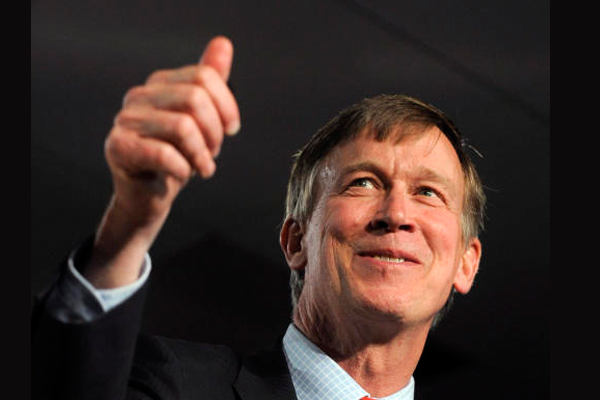
Thanks to Colorado’s Democratic Gov. John Hickenlooper, we’ve now reached that moment.
In a new statewide radio ad financed by the Colorado Oil and Gas Association, Hickenlooper promotes oil and gas drilling as it moves closer to major population centers in his state. Not to be confused with the Colorado Oil and Gas Conservation Commission, which is a governmental agency, the ad sponsor COGA is the official trade association and lobbying arm of the state’s oil and gas companies — an organization that is dedicated to preventing Colorado from better regulating oil and gas drilling.
Hickenlooper has helped achieve that goal. First he appointed a campaign donor from the oil and gas industry to a key regulatory position. Then he used a speech to oil and gas executives to insist that hydrofracking, a controversial drilling process, is perfectly safe, despite Environmental Protection Agency, Duke University and even industry-acknowledged evidence to the contrary. Then he used his State of the State address to deride local regulation of oil and gas drilling, which had the practical effect of killing the legislative initiative to allow municipalities some control over drilling in their communities. Then, after another EPA report found evidence of fracking-related groundwater pollution in neighboring Wyoming, Hickenlooper publicly heralded news of a planned fracking operation just a few miles from downtown Denver.
Now come the ads, featuring Hickenlooper’s stunning statement about drilling safety. In the spots, he insists that after the state Legislature passed some minimal drilling disclosure laws in 2008, Colorado has “not had one instance of groundwater contamination associated with drilling and hydraulic fracturing.”
Notice how Hickenlooper broadens his assertion beyond just fracking — he’s talking about all drilling, which, of course, makes his statements even more patently false.
In a letter to Hickenlooper, a group of environmental organizations protesting the ads notes that his own COGCC’s reports issued in October and last month “make clear that contamination of groundwater remains an ongoing issue with oil and gas development.” Additionally, as the Denver Post reports, under Hickenlooper’s watch, Colorado has experienced a wave of spills associated with drilling, some of which have contaminated groundwater — and Hickenlooper’s administration has responded to those spills by waiving penalties against oil and gas companies (emphasis added):
Colorado’s wave of gas and oil drilling is resulting in spills at the rate of seven every five days — releasing more than 2 million gallons this year of diesel, oil, drilling wastewater and chemicals that contaminated land and water…But a Denver Post analysis finds state regulators rarely penalize companies responsible for spills…
Among the latest: Anadarko Petroleum subsidiary Kerr-McGee on Aug. 12, Aug. 22 and Aug. 24 spilled cancer-causing benzene at concentrations exceeding state standards by as much as 320 times, and other chemicals from corroded equipment near wetlands in Weld County. The spills contaminated groundwater and, in one case, the Boulder White Rock irrigation canal and South Boulder Creek.
Put Hickenlooper’s past statements, appointments, enforcement record and now new ads together, throw in his recent statements questioning whether climate change is even happening, and you see a politician who is loyally paying back a fossil-fuel industry that was one of his biggest financiers. As the Institute for Money in State Politics reports, Hickenlooper received a whopping $73,666 from the oil and gas industry in his 2010 campaign for governor. That industry is now getting a handsome return on its investment — and not just short term in Colorado, but potentially within the national Democratic Party.
With Hickenlooper considered one of his party’s rising stars, speculation is already simmering about his possible run for the White House in 2016. Should he get there, the oil and gas industry would get there with him, meaning one day yet another barrier might be broken: We might not have a mere governor serving as the official public spokesperson for the oil and gas industry in its ads — we may see our president assume that role.
