

New Republic literary editor and guy who also for some reason regularly writes political columns Leon Wieseltier did not enjoy Rachel Maddow’s latest book, everyone. He thinks it is “an anthropologically useful document of the new American disaffection with American force,” by which he means it is annoyingly anti-war.
Written in the same perky self-adoring voice that makes her show so excruciating, it offers some correct observations about certain lamentable trends in the American military— its reliance on contractors, its exploitation of reservists, its surfeit of nuclear weapons; but its righteous aim is to make the use of force itself seem absurd.
You have to appreciate a literary critic who objects to the notion that war is absurd. (As for Leon Wieseltier calling out another author’s “self-adoring” tone, well … no one would ever accuse Wieseltier of being “perky,” I suppose.)
But his critique of Maddow’s book is only the preface to yet another column on the urgent necessity of military intervention somewhere. God bless the New Republic. Let’s hope new owner (and self-proclaimed publisher and editor in chief) Chris Hughes respects its grand tradition of never turning down an opportunity to demand that bombs rain down somewhere far away in the name of freedom and democracy.
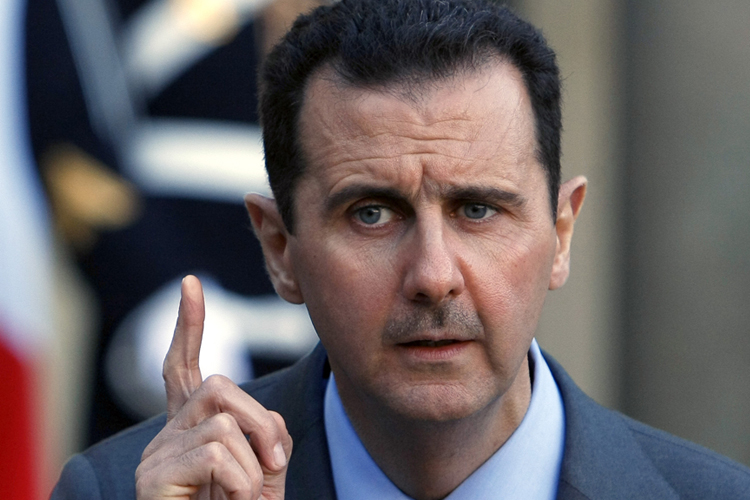
Today, the U.S. must intercede in Syria and oust Bashar al-Assad. How? I dunno. He’s sort of unspecific on the “how.” But America must act, because Assad is bad.
No argument here! Assad is a monster. But what, precisely, should the United States do? I mean besides the sanctions we’ve already imposed?
In Washington the usual excuses, familiar from Bosnia to Libya, were offered: the global isolation of the perpetrators (which is incorrect, since they always have Russia); the terrifying might of the Syrian army; the obscurity, or the disunity, of the opposition; the hidden hand of Islamists and terrorists; and so on. Meanwhile the chairman of the Joint Chiefs of Staff blurted out to Congress that “we can do anything,” thereby vitiating the plaintive appeal to the limitations of American competence. There are Arab states agitating for action to stop the slaughter, and arming the Free Syrian Army, whose ranks are growing. But Obama refuses to consider any direct or indirect application of force.
There is … no reason to believe that Obama is straight-up refusing to consider any direct or indirect application of force, and the only evidence Wieseltier provides of his claim is understandably diplomatic language from the president. His presidential mind-reading effort aside, Wieseltier’s summary of the arguments against armed intervention are very silly. He seems to think that people oppose introducing American armed forces to another overseas civil conflict because doing so “would contradict their conception of American power” — they don’t want to bomb Syria because they prefer to believe in American decline! — and not because the use of military force always involves unintended consequences. (Like, the death of even more people, including Syrian civilians and possibly members of the American armed forces? And the delegitimization in the eyes of the populace of the pro-democratic forces in the country? And the possibility of anti-Alawite ethnic cleansing post-Assad? I’m just spitballing, here.)
No, to Wieseltier, the idea that force — or, to be precise, the application of American force in a foreign uprising — might produce “a medicine that’s worse than the disease” is inherently ridiculous. In 2012, people like Leon Wieseltier are still pretending that American firepower is a literal magic bullet able to produce whatever outcome we desire in any nation so long as we believe strongly enough in our own “power.”
Wieseltier regularly writes of being distraught that modern liberals have turned away from interventionism because of the lies and failures of the Bush era, and he bemoans the commonplace idea that the promotion of democracy and human rights need necessarily come “at the barrel of a gun,” but he provides absolutely no other suggestion as to how the United States would promote democracy in Syria and Iran besides with bombs or arms. The modern history of liberal interventionism is in fact pretty sorry, in part because it’s rarely as “liberal” as it’s sold as being, and the long-term consequences of intervention are rarely predicted with anything approaching accuracy. Yet those who invariably support “doing something” — with deniable vagueness as to what “something” should be — for some reason always paint their opponents as the naive ones. (Or both naive and far too cynical.)
