
Movies
“Engagement’s” shocking anti-Asian trailer
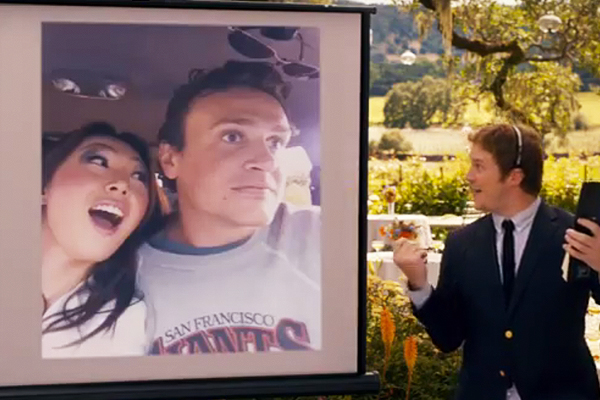
White women have names in a scene from "The Five Year Engagement." The Asians are "this Korean" and "that Korean"
Hollywood’s long-standing and embarrassing tradition of cruel Asian stereotypes probably hit its lowest point with Mickey Rooney, in terrible makeup and an exaggerated accent, playing Audrey Hepburn’s neighbor in “Breakfast at Tiffany’s.” Any progress has been a sign of how far the movies had to come, but clearly growth has stalled; there’s not much difference between Long Duk Dong in 1984′s “Sixteen Candles” or Mr. Chow in “The Hangover” films.
The trailer for director Nicholas Stoller’s “The Five Year Engagement,” an April film starring Jason Segel and Emily Blunt, is just the latest example that Hollywood still thinks it is OK to make racist jokes when Asians are the target.
In a scene set at Segel and Blunt’s engagement party, a friend (“Parks and Recreation’s” Chris Pratt) sings along to a slide show of Segel’s former girlfriends, set to the tune of Billy Joel’s “We Didn’t Start the Fire.” The song’s syncopation leads Pratt in a rapid-fire roll call of the exes’ names. The white former girlfriends all have actual first names like Ana and Lizzy. Two Asian past loves are merely referred to as “This Korean” and “That Korean.” To end the scene, the camera scans the partygoers, where an Asian woman (credited as “George’s Girl”) sits front and center completely unfazed, laughing even.
This Korean, that Korean? It would be easier to accept this as a colorblind joke if Hollywood wasn’t so consistently blind to the way it portrays Asians. There’s still a tacit rule that it is OK to mock people of Asian descent on film. Just imagine the political consequences of swapping “This Korean” for “This Mexican” or “This African.” It wouldn’t — and shouldn’t — be done. Why, then, do we laugh when Jason Segel’s Asian conquests are referred to by race?
In previous films, the team of Stoller, Segel and producer Judd Apatow has been able to tease out nuance in coming-of-age, sex and romantic-comedy genres. So why inculde these trite stereotypes and resort to a joke that fecklessly recycles a racialized trope about 1) indistinguishable Asian faces and identities, 2) the abundant sexual availability of Asian women and 3) the anonymity of Asians within a white context, sexual or otherwise. If the filmmakers are going to racially and ethnically identify these women in the slideshow for the purpose of eliciting laughs, then they technically threw out that first mythical “race card.”
Race plays a very important role in comedy, and comedy has been a space where racism has been dissected and explored in very revolutionary ways by a wide spectrum of comics (Dave Chappelle, Louis C.K., Margaret Cho), particularly in light of historical degradation of people of color as a source of humor in entertainment. Being comedic in nature doesn’t absolve a lack of critical thinking, social consciousness or originality, even when it comes to a complex, “heavy” issue like race.
And race likely isn’t a thematic element in this film. Which makes it so disappointing that the trailer’s use of this joke and its omission of the film’s Asian-American cast members — “The Office’s” Mindy Kaling and Randall Park (who I pray has a less stereotypical role than his character’s name, Ming, suggests) — raised these red flags for a comedy that might otherwise be sharp. We’ve seen what kind of light a racially offensive trailer can cast on a film overall, such as the case of 2009′s “The Goods: Live Hard, Sell Hard,” a tepidly received comedy that became best known for a preview that included the racial profiling and beating of an Asian-American man.
Here’s the irony: The writers of “The Five Year Engagement” can clearly handle cultural humor, as displayed later in the trailer when Segel jokes about his laxness with his Jewish faith. Within the span of a few seconds, there’s a fully developed joke that doesn’t use the culture — or a physical representative of the culture — as the punch line. It can be done. Just evidently not when Asians are the joke’s target.
Sylvie Kim is a contributing editor at Hyphen magazine and blogger for SF Weekly's The Exhibitionist blog. More Sylvie Kim.
Pick of the week: Haunting, gorgeous “Oslo, August 31st”
Pick of the week: "Oslo, August 31st" is a wrenching voyage of discovery in Norway's suddenly trendy capital
“Oslo, August 31st” is, as the title suggests, an evocation of one day in the Norwegian capital, as experienced by a troubled young man who’s facing the end of summer and the end of his youth. It’s a marvelously constructed personal journey, both wrenching and bittersweet, whose emotional ripple effects stay with you for days and weeks afterward. While much of international art cinema can seem overly talky or conceptually alien to American viewers, this second feature film from Norwegian director Joachim Trier is a dynamic, even breathtaking visual experience without much dialogue or any philosophical heavy lifting, following the bony, handsome, exceedingly vulnerable Anders (Anders Danielsen Lie) through coffee shops, nightclubs and bodies of water, en route to an ambiguous final destination.
Continue Reading Close“Moonrise Kingdom”: Wes Anderson’s mid-’60s love story
Bruce Willis and Ed Norton are at their best in the rapturous summer fantasy "Moonrise Kingdom"
Tilda Swinton, Bruce Willis and Edward Norton in "Moonrise Kingdom" All the details of Wes Anderson’s rapturous and hilarious mid-1960s New England summer romance “Moonrise Kingdom,” taken one at a time, are plausible. Indeed they are more than plausible; they’re perfect, from the fitted uniforms and yellow canvas tents of the troop of “Khaki Scouts” headed by cigarette-smoking Edward Norton to the achingly picturesque island home where the brood of children belonging to Bill Murray and Frances McDormand sit around listening to the Leonard Bernstein recording of “A Young Person’s Guide to the Orchestra.” (I’m not going to bother questioning whether that record existed in 1965; some production intern probably spent half a day tracking down its history.)
Continue Reading CloseMovie assailant punches a kid, becomes a folk hero
A 10-year-old gets punched in the face for being too noisy at "Titanic" -- and the Internet applauds the beating
(Credit: iStockphoto/IBushuev) It’s a general rule of thumb that a grown man doesn’t get a lot of support for knocking out a 10-year-old child’s teeth. But Yong Hyun Kim has won himself a few fans lately for doing just that.
Back on April 11, the 21-year-old Washington state man settled in with his girlfriend to enjoy “Titanic” in 3D — right in front of a boy known only in police documents as KJJ. What ensued led to a night in jail and a charge of second-degree assault.
Continue Reading Close
Mary Elizabeth Williams is a staff writer for Salon and the author of "Gimme Shelter: My Three Years Searching for the American Dream." Follow her on Twitter: @embeedub. More Mary Elizabeth Williams.
“The Intouchables”: Racial comedy, French style
"The Intouchables" is the biggest foreign-language film of all time. Some critics say it's also racist
A still from "The Intouchables" Here’s a startling news item: “The Intouchables,” a lively if largely predictable Parisian comedy about a wealthy quadriplegic and his ne’er-do-well immigrant caretaker, has become the biggest international success in the history of French cinema. Indeed, according to some sources — and these things are notoriously difficult to measure on a global and historical scale — “The Intouchables” is now the biggest non-Anglophone film of all time, with a worldwide gross approaching $300 million.
Continue Reading CloseMale grooming: The movie
From beard contests to ball cream, Morgan Spurlock's "Mansome" goofs through modern-day male narcissism
Jack Passion in "Mansome" American men are bewildered about their place in the cosmos, or so we have been told repeatedly over the last 20 years. They don’t know whether to thread their eyebrows or wield a welding torch, and end up trying to do both at once (which is inadvisable). As comedian Adam Carolla laments in a scene from Morgan Spurlock’s documentary “Mansome,” the old-time certainties of gender identity have melted away: Women are flying fighter jets and men work at the hair salon; there are no longer “chick jobs and guy jobs.”
Continue Reading ClosePage 1 of 708 in Movies