
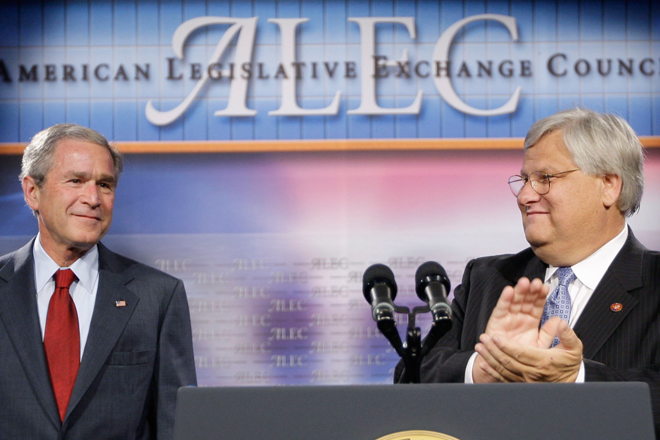

Should shareholders have a say in how much money corporations give to candidates, super PACs and dark money groups? The American Legislative Exchange Council, or ALEC, doesn’t think so.
ALEC is best known for giving moneyed special interests a hand in crafting “model legislation,” including the NRA-backed “stand your ground” laws that have touched off a furor in the wake of the Trayvon Martin shooting. But a trove of internal documents obtained by the advocacy group Common Cause shows that the group’s activities are far more varied than was previously known; it does everything from issuing boilerplate press releases to flagging how lawmakers should vote on given pieces of legislation.
It also lobbies actively to scuttle shareholders’ rights — specifically to limit their ability to weigh in on political giving. Last year, for instance, New York state lawmakers introduced a pair of bills requiring corporations to get shareholder approval before making donations to politicians or outside groups, such as super PACs. Backers argue the measure would provide crucial safeguards for investors. “Giving shareholders a voice ensures that their money isn’t used for political purposes they don’t agree with or that are detrimental to the corporation,” explains Adam Skaggs, a senior counsel with the Brennan Center for Justice at New York University law school.
Nevertheless, ALEC’s Public Safety and Elections Task Force — which has since been disbanded amid the outcry over stand your ground — sent out an “issue alert” to its New York members urging them to vote the measure down. Among other things, the document, which was dated Feb. 15, 2011, argued the bill imposed “oppressive and impractical requirements on corporations,” which restricted corporate free speech and thus could “deter and delay these entities from participating in political debate.”
“Not only do these burdensome requirements impede upon First Amendment rights, they are also unnecessary,” the memo continued. “Shareholders always have the option of voting out board members and removing management who engage in independent expenditures contrary to the interests of the company and its owners … Legislation punishing speech stifles uninhibited public debate and undermines the very purpose of the First Amendment.” The effort was apparently successful: The New York legislation is currently stalled.
ALEC’s advocacy on the issue apparently began shortly after the Supreme Court’s landmark Citizen’s United decision. In September 2010, the group issued a resolution in support of the ruling, which focused largely on limiting shareholders’ ability to weigh in on companies’ newly unencumbered political contributions. Among other things, it advocated barring shareholders from suing corporations based on their political activities on the ground that civil suits were merely “designed to silence corporate speech.” Some of ALEC’s critics find this argument puzzling. “The idea that the owners of a corporations — and, make no mistake, shareholders are the owners — shouldn’t have any influence over their political activities is absurd on its face,” says Lisa Graves, executive director for the Center for Media and Democracy.
But lawmakers have apparently taken ALEC’s recommendations to heart. Under pressure from the organization, last year at least nine states legislatures — including those in Massachusetts, Michigan, Minnesota, New Hampshire, North Carolina, Ohio, South Dakota, West Virginia and Wisconsin — jettisoned bills requiring companies to seek shareholder approval for their political giving, according to research by Common Cause. The group also found that ALEC’s top-spending corporate members have devoted nearly $16.5 million to shaping legislation in these states over the last decade. (ALEC did not respond to requests for comment.)
In the absence of legislation, many shareholders are taking matters into their own hands and launching campaigns to force corporations to be more transparent. Nearly a third of all shareholder resolution in 2012 call for more disclosure on political giving, according to a report by the investor advocacy group As You Sow, which also notes that “unruly” investors, outraged that their money is secretly being used to fund dark-money movers like the U.S. Chamber of Commerce, plan to turn out en masse and “occupy” annual shareholders meeting. The implications of this trend are far reaching. “Besides giving shareholders what they need to hold corporate managers accountable about how assets are being used, shareholder disclosure would provide the general public with information about who is trying to influence how they vote in the general elections,” explains Skaggs of the Brennan Center. This kind of transparency could be a game changer, since the power of dark-money groups hinges at least partly on their ability to mask the agenda and funding behind their work.
CORRECTION: This piece originally identified the American Legislative Exchange Council as the “American Legislative Exchange Committee.” We regret the error.
