
Who gets to be an FBI threat?

A recent Rolling Stone article raises troubling questions about FBI entrapment schemes and their targets

Topics: FBI, Occupy, Anarchism,

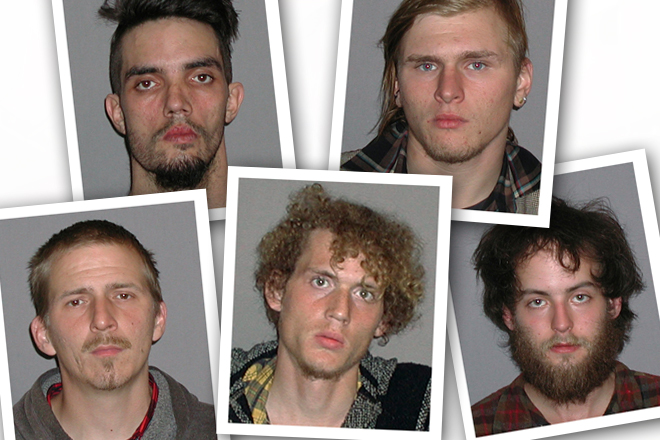
Who gets to be an FBI threat?The five men arrested on April 30 for plotting to blow up a bridge near Cleveland, Ohio. (Credit: AP/FBI)

Writing in Rolling Stone this week, Rick Perlstein looks at how the FBI regularly entraps and creates “terrorists” out of anarchists and activists, while comparatively ignoring violent white supremacist groups.

Using some recent examples, Perlstein paints a startling picture. He notes the arrest this month of a small group of self-identified anarchists, participating in Occupy Cleveland, who — strung along in an FBI sting — planned to blow up a large Ohio bridge. The target was suggested and (fake) C-4 explosives were provided by an FBI infiltrator. As Perlstein put it, the episode was one among numerous law enforcement schemes since 2001 in which “the alleged terrorist masterminds end up seeming, when the full story comes out, unable to terrorize their way out of a paper bag without law enforcement tutelage.”

Perlstein contrasts the Ohio arrestees with another recently arrested group: The American Front, a “known terrorist group” of Florida-based white supremacists who — without FBI encouragement — “took a break from training with machine guns for a race war in order to fashion weapons out of fake ‘Occupy’ signs which they planned to use to assault May Day protesters in Melbourne, Florida.” While anarchists, animal rights activists and Muslims pass muster as federal targets, organized hate groups do not.

The distinction between entrapment (which is illegal) and a sting (which is legal) now appears to be a much eroded line in the sand. As Perlstein’s piece points out, it is up to a jury once arrests have been made whether law enforcement set up a trap or a sting. In previous decades, defendants have been acquitted in cases of entrapment; but not in recent years:

Not a single “terrorism” indictment has been thrown out for entrapment since 9/11 – not the Liberty City goofballs supposedly planning to blow up the Sears Tower who had no weapons and refused them when offered; not the Newburgh, New York outfit whose numbers included a schizophrenic who saved his own urine in bottles. (Even the judge who sentenced them said “the government made them terrorists.”)


One of the most famous recent cases of FBI infiltration — which is not mentioned in the Rolling Stone article — hangs over anarchist networks worldwide. Brandon Darby, the once trusted activist and organizer-turned-FBI-informant and now writer for Andrew Breitbart’s Big Government, is the dirtiest name to utter in anarchist circles. Darby infiltrated groups organizing protests around the 2008 Republican National Convention in St. Paul, Minn. Darby fed the FBI information, which helped them seize riot shields made by a group from Texas. Enraged by the seizure (but still viewing Darby as a comrade) two young men from Austin, David McKay and Bradley Crowder, bought the materials for and constructed Molotov cocktails with the thought of using them against state vehicles. The two, however, decided overnight that this was a bad idea — and left the devices at home, with no intention of using them.

Darby passed information about the Molotov cocktail plans on to the FBI, and McKay and Crowder were arrested and charged with domestic terrorism. While Crowder accepted a plea deal without trial for a two-year prison sentence for making the devices, McKay went to trial, arguing Darby entrapped him. The trial ended with a hung jury. Before the retrial, however, McKay retracted claims of entrapment and agreed to accept a plea deal (and serve a four-year prison sentence, for making the Molotovs and perjury).

Perlstein notes that “the State is singling out ideological enemies” – and if federal sting targets are much to go by, the State’s position is clear: anti-capitalists, environmentalists and Muslims are threats; racists are not. We can respond by decrying FBI activity, and by arguing that their targets are not real threats. Or, we can take patterns of FBI activity more seriously and ask why anti-capitalists are more threatening than white supremacists. This line of questioning can likely be reduced to two questions, chanted again and again up and down the country when protest front lines are faced with lines of police: “Who do you protect? Who do you serve?”

Natasha Lennard

Natasha Lennard is an assistant news editor at Salon, covering non-electoral politics, general news and rabble-rousing. Follow her on Twitter @natashalennard, email nlennard@salon.com.

Featured Slide Shows

7 motorist-friendly camping sites

close X
  • Share on Twitter
  • Share on Facebook
  • Thumbnails
  • Fullscreen
  • 1 of 9

Sponsored Post

  • White River National Forest via Lower Crystal Lake, Colorado
    For those OK with the mainstream, White River Forest welcomes more than 10 million visitors a year, making it the most-visited recreation forest in the nation. But don’t hate it for being beautiful; it’s got substance, too. The forest boasts 8 wilderness areas, 2,500 miles of trail, 1,900 miles of winding service system roads, and 12 ski resorts (should your snow shredders fit the trunk space). If ice isn’t your thing: take the tire-friendly Flat Tops Trail Scenic Byway — 82 miles connecting the towns of Meeker and Yampa, half of which is unpaved for you road rebels.
    fs.usda.gov/whiteriveryou


    Image credit: Getty

  • Chattahoochee-Oconee National Forest via Noontootla Creek, Georgia
    Boasting 10 wildernesses, 430 miles of trail and 1,367 miles of trout-filled stream, this Georgia forest is hailed as a camper’s paradise. Try driving the Ridge and Valley Scenic Byway, which saw Civil War battles fought. If the tall peaks make your engine tremble, opt for the relatively flat Oconee National Forest, which offers smaller hills and an easy trail to the ghost town of Scull Shoals. Scaredy-cats can opt for John’s Mountain Overlook, which leads to twin waterfalls for the sensitive sightseer in you.
    fs.usda.gov/conf


    Image credit: flickr/chattoconeenf

  • Nordhouse Dunes Wilderness Area via Green Road, Michigan
    The only national forest in Lower Michigan, the Huron-Mainstee spans nearly 1 million acres of public land. Outside the requisite lush habitat for fish and wildlife on display, the Nordhouse Dunes Wilderness Area is among the biggest hooks for visitors: offering beach camping with shores pounded by big, cerulean surf. Splash in some rum and you just might think you were in the Caribbean.
    fs.usda.gov/hmnf


    Image credit: umich.edu

  • Canaan Mountain via Backcountry Canaan Loop Road, West Virginia
    A favorite hailed by outdoorsman and author Johnny Molloy as some of the best high-country car camping sites anywhere in the country, you don’t have to go far to get away. Travel 20 miles west of Dolly Sods (among the busiest in the East) to find the Canaan Backcountry (for more quiet and peace). Those willing to leave the car for a bit and foot it would be remiss to neglect day-hiking the White Rim Rocks, Table Rock Overlook, or the rim at Blackwater River Gorge.
    fs.usda.gov/mnf


    Image credit: Getty

  • Mt. Rogers NRA via Hurricane Creek Road, North Carolina
    Most know it as the highest country they’ll see from North Carolina to New Hampshire. What they may not know? Car campers can get the same grand experience for less hassle. Drop the 50-pound backpacks and take the highway to the high country by stopping anywhere on the twisting (hence the name) Hurricane Road for access to a 15-mile loop that boasts the best of the grassy balds. It’s the road less travelled, and the high one, at that.
    fs.usda.gov/gwj


    Image credit: wikipedia.org

  • Long Key State Park via the Overseas Highway, Florida
    Hiking can get old; sometimes you’d rather paddle. For a weekend getaway of the coastal variety and quieter version of the Florida Keys that’s no less luxe, stick your head in the sand (and ocean, if snorkeling’s your thing) at any of Long Key’s 60 sites. Canoes and kayaks are aplenty, as are the hot showers and electric power source amenities. Think of it as the getaway from the typical getaway.
    floridastateparks.org/longkey/default.cfm


    Image credit: floridastateparks.org

  • Grand Canyon National Park via Crazy Jug Point, Arizona
    You didn’t think we’d neglect one of the world’s most famous national parks, did you? Nor would we dare lead you astray with one of the busiest parts of the park. With the Colorado River still within view of this cliff-edge site, Crazy Jug is a carside camper’s refuge from the troops of tourists. Find easy access to the Bill Hall Trail less than a mile from camp, and descend to get a peek at the volcanic Mt. Trumbull. (Fear not: It’s about as active as your typical lazy Sunday in front of the tube, if not more peaceful.)
    fs.usda.gov/kaibab


    Image credit: flickr/Irish Typepad

  • As the go-to (weekend) getaway car for fiscally conscious field trips with friends, the 2013 MINI Convertible is your campground racer of choice, allowing you and up to three of your co-pilots to take in all the beauty of nature high and low. And with a fuel efficiency that won’t leave you in the latter, you won’t have to worry about being left stranded (or awkwardly asking to go halfsies on gas expenses).


    Image credit: miniusa.com

  • Recent Slide Shows

  • Share on Twitter
  • Share on Facebook
  • Thumbnails
  • Fullscreen
  • 1 of 9

Comments

34 Comments

Comment Preview

Your name will appear as username ( settings | log out )

You may use these HTML tags and attributes: <a href=""> <b> <em> <strong> <i> <blockquote>