
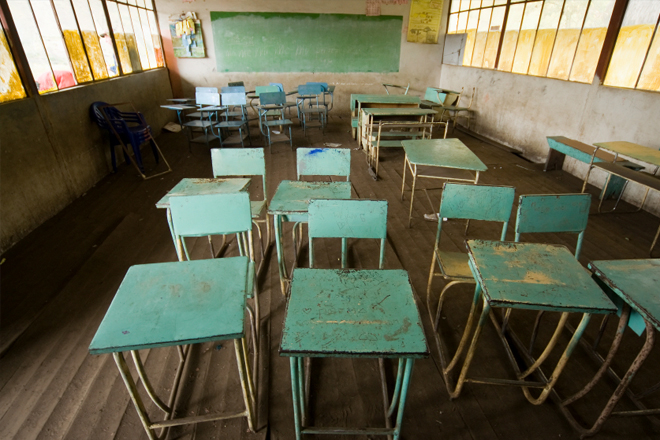

Here in the industrialized world’s most economically unequal nation, public education is still held up as the great equalizer — if not of outcome, then of opportunity. Schools are expected to be machines that overcome poverty, low wages, urban decay and budget cuts while somehow singlehandedly leveling the playing field for the next generation. And if they don’t fully level the playing field, they are at least supposed to act as a counter-force against both racial and economic inequality.
That vision, however, is now under assault by both political parties in America. On the Republican side, the Washington Post reports Mitt Romney just unveiled “a pro-choice, pro-voucher, pro-states-rights education program that seems certain to hasten the privatization of the public education system” completely. On the other side, Wall Street titans in the Democratic Party with zero experience in education policy are marshaling tens of millions of dollars to do much of what Romney aims to do as president – and they often have a willing partner in President Barack “Race to the Top” Obama and various Democratic governors.
Funded by corporate interests who naturally despise organized labor, both sides have demonized teachers’ unions as the primary problem in education — somehow ignoring the fact that most of the best-performing public school systems in America and in the rest of the world are, in fact, unionized. (Are we never supposed to ask how, if unions are the primary problem, so many unionized schools in America and abroad do so well?) Not surprisingly, these politicians and activists insist they are driven solely by their regard for the nation’s children — and they expect us to ignore the massive amount of money their benefactors (and even the activists personally) stand to make by transforming public education into yet another private profit center. Worse, they ask us also to forget that in the last few years of aggressive “reform” (read: evisceration) of public education, the education gap has actually gotten far worse, with the most highly touted policies put in place now turning the schoolhouse into yet another catalyst of crushing inequality.
Here are the five most prominent of those policies — and how they threaten to make this country even more economically unequal and racially segregated than ever before.
1. Unequal Funding Formulas
A half-century of social science research confirms that factors outside the school — and specifically, poverty — are far more determinative in student achievement than anything that happens inside the school. This is why, as both New York University’s Diane Ravitch and Dissent magazine’s Joanne Barkan note, public schools in America’s wealthiest enclaves consistently rank among the highest achieving in the world.
Knowing that, it stands to reason that schools in the lowest-income areas should receive disproportionately more education funding than schools in high-income areas so that they can combat the systemic out-of-classroom factors that schools in wealthy neighborhoods don’t face. With this extra money, they might be able to fund the so-called “wraparound” services that even reformers like Geoffrey Canada admit are crucial to the success of public schools in high-poverty locales.
Yet, it’s the other way around. As a 2011 U.S. Department of Education report documented, “many high-poverty schools receive less than their fair share of state and local funding” leaving “students in high-poverty schools with fewer resources than schools attended by their wealthier peers.” This inequity is further exacerbated by local property-tax-based education funding formulas that often generate far more resources for wealthy high-property-value school districts than for destitute low-property-value enclaves. Inequality also is intensified by devious new taxpayer-subsidized scholarship programs that, according to the New York Times, “have been twisted to benefit private schools at the expense of the neediest children” in traditional public schools.
Policy-wise, changing such funding formulas to make sure schools in poor areas get more funding than schools in wealthy neighborhoods is fairly straightforward. But, then, the commonsense idea threatens the gated-community ethos of the wealthy and powerful who control our politics. It also fundamentally challenges the core principles of a nation that still likens spreading the wealth to confiscatory socialism. Thus, the idea remains off the table — and consequently the increasingly unequal funding of education now effectively subsidizes a system that is cementing inequality for the long haul.
In practice, that means schools in low-income areas continue to receive comparatively less funding to recruit teachers, upgrade classrooms, reduce class sizes and sustain all the other basics of a good education.
2. Vouchers and Charter Schools
In national politics, private education profiteers and anti-government ideologues have successfully manufactured a debate over privately administered charter schools and private-school vouchers, insisting that, if created all over the nation, they will improve educational achievement. “Manufactured,” though, is the key word — because when it comes to results, there is no debate over what the data show.
Stanford University’s landmark study of charters found that while “17 percent of charter schools reported academic gains that were significantly better than traditional public schools, 37 percent of charter schools showed gains that were worse than their traditional public school counterparts” — meaning that, in total, charters actually harm overall student achievement. (Those results were corroborated by the Education Department’s National Center on Education Statistics.) Likewise, data from the nation’s largest voucher system prove that voucher-subsidized students do not systemically outperform students in traditional public school systems.
These facts, unfortunately, have little — if any — impact on the political rhetoric about education. But, then, at least there’s an ongoing discussion about the academic effectiveness of charters and vouchers. The same cannot be said for how those charter and voucher programs threaten to severely exacerbate racial and socioeconomic inequality.
When it comes to charter schools, Businessweek’s headline says it best: “Segregated Charter Schools Evoke Separate But Equal Era in U.S.” Here’s what we know, as I recounted in a recent newspaper column:
According to a new report from the National Education Policy Center, however, charters “tend to be more racially segregated than traditional public schools” – and in lots of places, they seem to be openly hostile to children who are poor, who are from minority communities or who have special education needs.
A smattering of headlines from across the country tells that story. “Nashville Charter Schools Blasted Over Racial Imbalance,” blared a recent headline in the Tennessean. “Charter Schools Face Discrimination Complaints,” read The Chronicle of Philanthropy. “Colorado Charter Schools Enroll Fewer With Needs,” screamed the Denver Post. “Charter Schools Enrolling Low Number of Poor Students,” reported the Miami Herald. The list goes on and on.
When it comes to vouchers, we can expect much the same if current pro-voucher efforts and a new Romney Administration successfully expand the idea nationwide. We know we can expect this because that’s exactly what happened in the nation that most recently went to a voucher system.
As University of Texas researchers documented in their study of Chile’s national voucher program:
Private-voucher schools have not only not reduced educational inequality, but also … have increased segmentation of the educational system according to (socioeconomic status) of students. Thus, the low and medium-low classes attend public schools, medium and medium-high classes study in private-vouchers, and the elite are educated in private-paid schools.
Why do vouchers increase inequality? Because they typically do not fund the entire private-school tuition bill, nor do they typically force private schools to accept the voucher as the sum total tuition. Not surprisingly, then, the wealthy are able to fill in the tuition gap with their own disposable income, while lower-income families can’t. Consequently, the voucher becomes a taxpayer handout to already middle- and upper-class parents to subsidize their children’s private school education, leaving economically disadvantaged kids in a newly defunded public school. Indeed, as the Texas researchers say, “Chilean parents from medium and medium-high classes were able to pay the additional money required, whereas the poorest parents did not have this choice.”
This very dynamic is already prevalent in the crypto-voucher programs being pioneered in states throughout the country. As the New York Times recently documented, conservative lawmakers have set up scholarship programs that pretend to be charitable endeavors but instead are designed as a tax subsidy for wealthy parents to finance their kids’ private school education. Because poorer families can’t afford those tuitions, even with the tax subsidy, low-income kids often remain in public education systems. Thanks to the way the scholarships divert public money into private schools, those public education systems are further depleted of resources, thus creating yet more educational inequality.
3. The Fee-Based Public School
For public education to be the great social equalizer it is supposed to be, it must limit economic barriers to entry. It must, in other words, be as close to free as possible. That’s why the new move to fee-based public schools is so troubling — it further turns public education into yet another instrument of economic stratification.
As the Wall Street Journal reports, schools across the country are “imposing or boosting fees for everything from enrolling in honors English to riding the bus.”
The fees run the gamut. In Kansas, for instance, one school district has created a $90 across-the-board “participation fee” for all students in order to fund extracurricular activities. In Maryland, it’s special fees for Advanced Placement biology courses. And perhaps worst of all, in Colorado’s largest school district, administrators are throwing kids off school buses until their parents pay a stiff transportation fee.
The move to such regressive fees has been prompted by the conservative movement’s success in draining government revenues, anti-tax politicians’ unwillingness to embrace new levies, and communities’ refusal to embrace measures to make up for budget shortfalls. Left without resources, local school administrators have thus resorted to fees. As one Maryland school official put it: “The reality is that the money has to come from somewhere.”
In the process, the new system is creating a whole new meaning for educational inequality. No longer is the inequity only between poor and rich school districts, it’s now between poor and rich kids within individual schools, themselves. Indeed, if high-income parents can pay the fees, their kids can have access to basic educational services — but when low-income parents can’t pay those fees, their kids are denied those same services.
4. Higher-Education Tuition Increases
For much the same reason, K-12 school administrators are moving their schools to fee-based models, and public universities have been jacking up tuition rates at a pace that far outstrips inflation. In just the last year, for example, tuition at these institutions rose a whopping 8.3 percent as universities sought to make up for legislatures’ huge reductions in higher-education funding.
At the same time, the New York Times reports that both private and public college scholarships have been cut. Additionally, as both Mitt Romney’s Wall Street-centric student loan initiative and Rep. Paul Ryan’s budget prove, federal loans and grants would only become more anemic in a Republican-dominated Washington.
The aggregate result of all this is to make access to higher education even more driven by economic privilege than it has been in the past. If your parents are wealthy and can pay ever higher tuition, you will have access to higher education, which gives you a better chance of higher wages. But if your parents aren’t wealthy and therefore can’t follow Mitt Romney’s request to lend you money, you either can’t go to college and will miss out on those opportunities for career advancement, or you are forced to assume crushing student debt. (No doubt, free college in other industrialized nations is a big part of why those other nations have higher rates of social mobility and lower rates of economic inequality than the United States.)
While it’s certainly true that economic status has always played a role in higher education in America, the key difference today is that economic status now increasingly affects access to public universities, not just private ones. That’s a major shift because those public universities were set up specifically to expand access — and mitigate economic obstacles — to higher education. Now, with financial barriers so high, they are becoming just another instrument of inequality.
5. Differential Tuition Rates Based on Majors
In 21st century America, math, science and business majors often make more money in the job market than their peers in other majors. In that sense, majoring in such subjects can be a means of moving up the economic ladder.
Unfortunately, more and more public universities are instituting regressive fees on those students who want to pursue those majors. As USA Today recently reported:
A growing number of public universities are charging higher tuition for math, science and business programs …
More than 140 public universities now use “differential tuition” plans, up 19% since 2006, according to research from Cornell’s Higher Education Research Institute. That number is increasing as states cut higher-education spending and schools try to pay for expensive technical programs …
Some worry that higher tuition will put off low-income students.
“The fear in all of this is will it lead to people being rationed out of classes?” said Ronald Ehrenberg, the Cornell researcher behind the tuition study.
That fear is legitimate. Already facing high tuition and massive debt, lower-income students are naturally more sensitive to add-on fees than wealthy students. The fees, then, serve to create a powerful deterrent to low-income students to major in precisely the fields that typically generate higher post-college incomes.
Ultimately, just like K-12 fees transform economic inequality into a factor inside individual schools, so to do “differential tuition” rates. In this case, low-income students face not just barriers to a given set of more expensive private schools, they now face new economic barriers to particular studies within the schools they somehow manage to afford. And because of that, low-income students will have an even harder time than rich kids in getting a post-college job that pays a good wage.
