
Tea Party shields tax dodgers

Rand Paul and Jim DeMint are complaining that new rules on tax dodging will make Wall Street suffer

Topics: Taxes, Rand Paul, Jim DeMint, Tea Party, ,

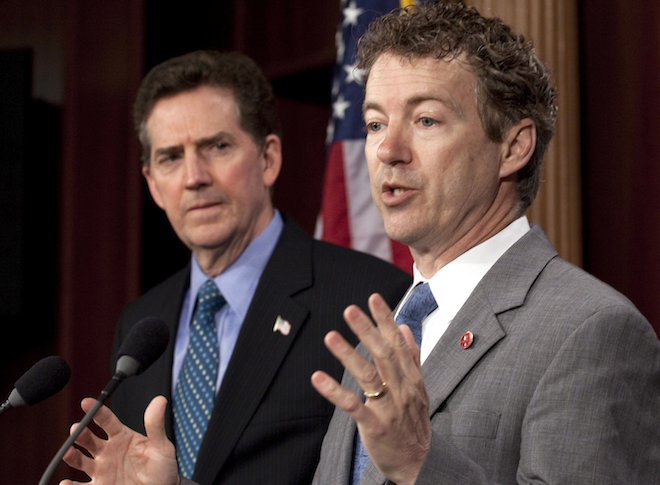
Tea Party shields tax dodgersIn a March 17, 2011 file photo, Sen. Rand Paul, R-Ky. speak at a news conference on the budget on Capitol Hill in Washington, as Sen. Jim DeMint, R-S.C., left, listens. (Credit: AP/Harry Hamburg)

The U.S. Treasury believes that it can generate $8.7 billion in revenue over the next 10 years by cracking down on Americans who dodge taxes by parking cash overseas. Some Republican senators, including a couple of Tea Party renowned — Rand Paul and Jim DeMint — are criticizing the plan, complaining that the new rules will raise operating costs for banks.

In Paul and DeMint’s perfect world, there would be no taxes at all. And we know that the standard conservative argument to deflect regulation is to argue that “burdensome” rules raise costs. So it’s not hugely surprising to see the two conservative icons rally against the Treasury on an issue that combines both taxation and regulation.

But let’s break this down a little bit more. Bank misbehavior and irresponsibility wiped out trillions of dollars of American wealth, forcing millions of Americans out of their homes and jobs. Fixing the damage is costing the U.S. government a lot of money. If one way to find the cash necessary to do things like pay for unemployment benefits requires banks to do a little extra paperwork, is that really so bad? As far as I can tell, populist Tea Partyers hate Wall Street just as much as any Occupy activist. It just doesn’t ring true: Give me liberty, or give me death, and, oh, by the way, keep the regulatory burden on multinational banks low so that they can help the richest Americans avoid paying taxes.

The legislation authorizing the Treasury to go after American tax dodgers is the Foreign Account Tax Compliance Act, or FATCA, passed in 2010 as part of the HIRE Act (more familiarly known as the “jobs” bill). On Thursday, the Wall Street Journal reported that the Treasury had released new details on intergovernmental cooperation with respect to combating cross-border tax evasion. But earlier in the week, reported the Journal, four Republican senators, including Paul and DeMint, sent a letter to the Treasury warning that FATCA could “impose major new regulatory costs on domestic banks.”

Tea Party outlets have been screaming for years that the new regs will make life miserable for American expatriates. Some poor souls, they warn, might even be forced to renounce their U.S. citizenship just to get a bank account abroad! But a close look at the proposed regulations reveals that your average expatriate will have nothing to worry about.

Notably, individuals who have less than $50,000 in their foreign bank accounts are excluded from the reporting requirements. For “entities” the threshold is $250,000. How many foreign expatriates really need to have more than 50 grand in their foreign bank account?

FATCA isn’t about making life hard for expatriates. It is targeted at big players who are moving huge amounts of cash overseas for the specific purpose of avoiding their U.S. tax obligations. And Rand Paul and Jim DeMint are defending these upstanding members of the 1 percent by carrying water for banks who want to avoid the paperwork costs involved in ferreting out the tax dodgers.

Is that how the Tea Party wants this country to be run — in the best interests of the richest Americans and the banks?

Continue Reading Close
Andrew Leonard

Andrew Leonard is a staff writer at Salon. On Twitter, @koxinga21.

Next Article

Featured Slide Shows

What To Read Awards: Top 10 Books of 2012 slide show

close X
  • Share on Twitter
  • Share on Facebook
  • Thumbnails
  • Fullscreen
  • 1 of 10
  • 10. "The Guardians" by Sarah Manguso: "Though Sarah Manguso’s 'The Guardians' is specifically about losing a dear friend to suicide, she pries open her intelligent heart to describe our strange, sad modern lives. I think about the small resonating moments of Manguso’s narrative every day." -- M. Rebekah Otto, The Rumpus

  • 9. "Beautiful Ruins" by Jess Walter: "'Beautiful Ruins' leads my list because it's set on the coast of Italy in 1962 and Richard Burton makes an entirely convincing cameo appearance. What more could you want?" -- Maureen Corrigan, NPR's "Fresh Air"

  • 8. "Arcadia" by Lauren Groff: "'Arcadia' captures our painful nostalgia for an idyllic past we never really had." -- Ron Charles, Washington Post

  • 7. "Gone Girl" by Gillian Flynn: "When a young wife disappears on the morning of her fifth wedding anniversary, her husband becomes the automatic suspect in this compulsively readable thriller, which is as rich with sardonic humor and social satire as it is unexpected plot twists." -- Marjorie Kehe, Christian Science Monitor

  • 6. "How Should a Person Be" by Sheila Heti: "There was a reason this book was so talked about, and it’s because Heti has tapped into something great." -- Jason Diamond, Vol. 1 Brooklyn

  • 4. TIE "NW" by Zadie Smith and "Far From the Tree" by Andrew Solomon: "Zadie Smith’s 'NW' is going to enter the canon for the sheer audacity of the book’s project." -- Roxane Gay, New York Times "'Far From the Tree' by Andrew Solomon is, to my mind, a life-changing book, one that's capable of overturning long-standing ideas of identity, family and love." -- Laura Miller, Salon

  • 3. "Billy Lynn's Long Halftime Walk" by Ben Fountain: "'Billy Lynn's Long Halftime Walk' says a lot about where we are today," says Marjorie Kehe of the Christian Science Monitor. "Pretty much the whole point of that novel," adds Time's Lev Grossman.

  • 2. "Bring Up the Bodies" by Hilary Mantel: "Even more accomplished than the preceding novel in this sequence, 'Wolf Hall,' Mantel's new installment in the fictionalized life of Thomas Cromwell -- master secretary and chief fixer to Henry VIII -- is a high-wire act, a feat of novelistic derring-do." -- Laura Miller, Salon

  • 1. "Behind the Beautiful Forevers" by Katherine Boo: "Like the most remarkable literary nonfiction, it reads with the bite of a novel and opens up a corner of the world that most of us know absolutely nothing about. It stuck with me all year." -- Eric Banks, president of the National Book Critics Circle

  • Recent Slide Shows

  • Share on Twitter
  • Share on Facebook
  • Thumbnails
  • Fullscreen
  • 1 of 10

More Related Stories

Comments

81 Comments

Comment Preview

Your name will appear as username ( profile | log out )

You may use these HTML tags and attributes: <a href=""> <b> <em> <strong> <i> <blockquote>