
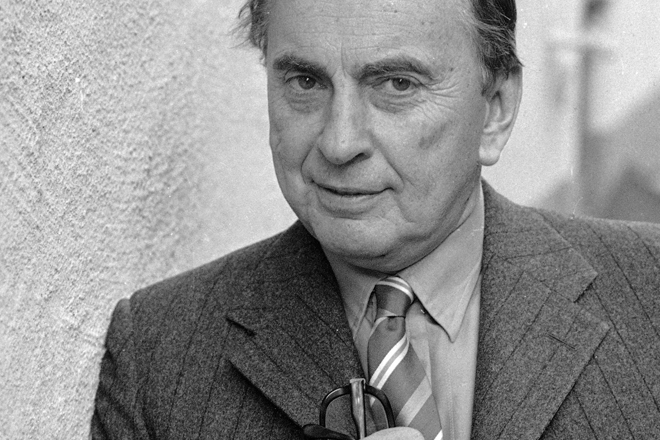

I remember exactly where I was when I understood Gore Vidal. The late writer was giving a speech at the Woodrow Wilson Center in Washington, D.C., during the impeachment proceedings against then-President Bill Clinton. Earlier that evening I had met Vidal in person for the first time. We had corresponded since the early 1990s, even when I had still been a member in good standing of the neoconservative movement as executive editor of the National Interest, published by Irving Kristol, and an occasional contributor to Norman Podhoretz’s Commentary. We exchanged letters about the “culture war,” neoconservatism, sex, religion, Thomas Mann and God knows what else (I don’t have copies of our correspondence, which is in the Vidal papers at Harvard). When I broke publicly with my conservative friends and colleagues and published “Up From Conservatism: Why the Right Is Wrong for America” in 1996, Vidal supplied me with a slyly equivocal blurb: “Part Candide, part de Tocqueville, Lind is a brilliant guide to the radicals who call themselves conservative, to the ossified who call themselves liberal.” To the dinner that preceded the speech that evening I had brought, as a gift, a facsimile reproduction of a Civil War-era guide to brothels in Washington,D.C., which I thought would amuse the controversial author of “Lincoln.”
Soon I found myself as uncomfortable as the other members of the auditorium audience, when, during his speech, Vidal launched into what sounded like a defense of Timothy McVeigh, the far-right would-be revolutionary whose bombing of the Murrah Federal Building in Oklahoma City in 1995 was the most devastating terrorist attack on American soil before the al-Qaida attacks on Sept. 11, 2001. While not exactly condoning McVeigh, Vidal told us that a violent reaction was inevitable, given the way that the federal government was oppressing American farmers.
I could sense that others in the audience shared my disquiet. The farmers? What the hell is he talking about? As his speech degenerated into a tirade, his accent changed from mid-Atlantic to a distinctive upcountry Southern twang. Before our eyes the polished, patrician public intellectual metamorphosed into a ranting backwoods populist politician.
It was at that moment that I understood. Oh, my God, I thought. Gore Vidal has turned into his grandfather.
Vidal had always insisted that to understand him it was helpful to understand his grandfather, Thomas Gore (1870-1949). Blind from an early age, Thomas Gore served as Democratic senator from Oklahoma twice, from 1907-1921 and again from 1931-1937. A populist in the tradition of Jefferson and Jackson, Sen. Gore was a maverick who did not hesitate to take on his own party. He voted against President Woodrow Wilson’s call for U.S. entry into World War I and he voted against President Franklin Roosevelt’s Works Progress Administration. In the light of Jeffersonian ideology, each of these votes made sense as efforts to preserve the American republic from the evils of empire and the welfare state.
The conventional wisdom about Vidal holds that he was a mainstream liberal Democrat until the mid-’60s, when he broke with the Kennedys (he was related by marriage to Jackie Kennedy) and moved to the political left. But as I see it, Gore Vidal didn’t move to the left. He moved to the South and West and back in time.
His best novel, in my opinion, was not “Burr” or “Lincoln,” but “Washington, D.C.,” published in 1967. In the novel the most sympathetic figure is a neo-Confederate, anti-New Deal conservative Democratic senator, James Burden Day, clearly modeled on Vidal’s grandfather. The villain, Clay Overbury, is a calculating, opportunistic young politician just as clearly modeled on Jack Kennedy. Although it was set in the ’50s, the book was published in 1967, at a time when reactionary Southern senators were the stage villains in conventional political fiction and drama and the late president had undergone an apotheosis. Whatever he was, Gore Vidal was not a conventional liberal or leftist.
It is interesting that, like Vidal in “Washington, D.C.,” William F. Buckley Jr. chose JFK as a symbol of decadent modernity in his never-published first book, a meditation on the “mass man” inspired by the Spanish philosopher Ortega y Gasset, which I read two decades ago as a guest in Buckley’s Connecticut home. Vidal had a number of contretemps on live TV with other intellectuals and writers, including Norman Mailer and Truman Capote. But none surpassed the moment during televised coverage of the turbulent 1968 Democratic National Convention in Chicago when Buckley called Vidal a “goddam queer” after Vidal had repeatedly called him a “crypto-Nazi.” Bill Buckley had a generous side. When I asked him in the 1980s what he thought about Vidal, he said that he regretted the incident and told me that Vidal had recently published a brilliant piece of writing (alas, I don’t remember which).
Vidal would have been appalled by the suggestion, but he and Buckley had more in common than being celebrity intellectuals with snarky styles, cult followings and failed campaigns for public office that were successful as publicity stunts (Bill for Mayor of New York, Vidal for a New York congressional seat and the Democratic nomination for the U.S. Senate seat from California). Both Vidal and Buckley came from rich arriviste families with deep roots in the American South. Both inherited their political worldviews — Vidal from his grandfather the Oklahoma senator, and Buckley from his father, the South Texas oil man Will Buckley. Both had audiences on the fringes of the political consensus — Vidal among the leftist readers of the Nation, Buckley among the right-wing readers of the magazine he founded and edited, National Review.
Most important of all, both Vidal and Buckley represented strains of the Jeffersonian reaction against mid-century liberalism that was gathering force in the U.S. in the middle and late 20th century. In my recent book “Land of Promise: An Economic History of the United States,” I argue that periods of Hamiltonian nation-building in American history are followed by periods of Jeffersonian backlash against big government, big business or both. The right-wing admirers of Bill Buckley and the left-wing admirers of Gore Vidal found a common enemy in what Arthur Schlesinger called “the vital center” to which Eisenhower and Nixon as well as FDR, Truman, Kennedy and Johnson belonged.
Victorious revolutions tend to decay into nepotistic oligarchies or corrupt political patronage machines. That is what happened to the Lincoln Republicans after the Civil War and it is what happened to the New Deal revolution by the 1970s. The vital center had become the dead center. Many of the young reformers of the 1930s and 1940s had aged into scandal-plagued machine politicians like Dan Rostenkowski and Jim Wright. (As Woodrow Wilson observed, “Some men grow in office, and others merely swell.”) For many of those of us who came of age in the 1970s, the long-dominant Democratic Party seemed comatose and brain-dead. For the combat of ideas and the energy of argument, you had to read the magazines of the right, like National Review, the Public Interest and Commentary, or of the left, like the Nation and Dissent. I was not the only American of that time who enjoyed watching both Bill Buckley and Gore Vidal as they provoked the establishment from different points of the compass.
By the end of their lives (Bill died in 2008), it was not clear which of the two was on the right and which on the left. In his later years Buckley defended environmentalism, the decriminalization of drugs and, having earlier written nasty things about homosexuals and AIDS, joined his friend Barry Goldwater in supporting gay rights. He opposed the Iraq war and shortly before his death told an interviewer that if he were young again he might be a communist. For his part, by the end of his life, Vidal had warned that the white nations like America and Russia needed to unite against the supposed threat of Asia, befriended and defended the right-wing terrorist Timothy McVeigh and was subscribing to conspiracy theories about 9/11.
Arguably Vidal, like his grandfather, had been a populist reactionary all along. His loathing of American “empire” and bankers endeared him to the left and his Hollywood friends, but those attitudes are shared by many “paleoconservatives.” The people who agree with Vidal that Washington, Hamilton, Lincoln and the Roosevelts were power-mongering empire builders who destroyed the American republic are found for the most part on the extreme right, among libertarians and neo-Confederates.
Even Vidal’s anti-clericalism and atheism, found in his novel “Julian” about the anti-Christian Roman emperor and elsewhere, had precursors in the Southern tradition. The South was not always the center of evangelical Protestantism in the U.S. In the 19th century, the equivalent of today’s “Bible Belt” consisted of New England and the parts of the Midwest settled by Yankees in the Puritan tradition. As late as the 20th century, “banned in Boston” was a byword for religious censorship.
The Southern gentry from which Gore Vidal emerged, like the British aristocracy, have often attended church out of social duty, not sincere belief. Thomas Jefferson, a self-described Epicurean naturalist, thought that Jesus was a wholly human sage misunderstood by his followers. He sought to correct their error by doing his own cut-and-paste version of the Gospels, the so-called “Jefferson Bible,” which eliminated everything supernatural. Mark Twain, another intellectual Southerner, devoted much of his life to writing satires on religion for posthumous publication. Anticlericalism, like admiration of yeoman farmers and suspicion of big-city bankers and foreign military involvements, is part of the Southern populist tradition that provides the key to unlocking the life’s work of Gore Vidal.
In his essay “The Southern Quality” in the Summer 1945 issue of the Sewanee Review, Marshall McLuhan might have been describing Gore Vidal:
The Ciceronian ideal reaches its flower in the scholar-statesman of encyclopedic knowledge, profound practical experience, and voluble social and public eloquence. That this ideal was perfectly adapted to agrarian estate-life with its multiple legal problems and its need for direct (republican) political representation is obvious to anybody who has considered the South. Moreover, within such a society, literary ability is quite naturally drained off into legal and political channels, to say nothing of highly developed social conversation.
I rest my case — but not before noting that in a BBC interview in 1993 Vidal complained about being called a patrician: “I’m a populist, from a long line of tribunes to the people. And I believe the government, to be of any value, must rest upon the people at large, and not be the preserve of any elite group or class, or anything of a hereditary nature.”
In a 1999 interview in Gadfly, the poet Dana Gioia asked Vidal: “Do you feel that your formidable public persona is significantly different from the private Gore Vidal?” Vidal replied: “You are what you are. [Andre] Gide at the end of his life said that the one thing that he most detested were those who affected to be other than what they were in truth. I have an over-developed sense of justice. This means a lot of wrath which comedy alone can siphon off. I was asked by a French reviewer of what I was most proud. I said, considering my nature, that I have never killed anyone. It is, of course, never too late.”
Now it is.
Will any of Gore Vidal’s work outlive him? His fans among the intelligentsia preferred Vidal’s bitchy, name-dropping essays to his historical novels. But gossip about celebrities has a brief shelf life, a fact that has already doomed the work of his one-time admirer Christopher Hitchens to posthumous oblivion. In 1995, when Vidal’s memoir “Palimpsest” was published, an elderly fan of Vidal told me, “He should have published this memoir a generation ago, when more readers would have recognized the names he is dropping.”
The most sustained project of Vidal’s career was the series of novels that make up the “Narratives of Empire,” retelling the story of American history from the founding as one of decline from republic to empire. In order of the periods of American history they cover, the novels are “Burr” (1973), “Lincoln” (1984), “1876” (1978), “Empire” (1987), “Hollywood” (1990), “Washington, D.C.” (1967) and “The Golden Age” (2000).
Not only the message, but also the mode — fiction — has precedents in earlier American populism. William Hope “Coin” Harvey (1851-1936), born in West Virginia, spread the Bryanite gospel of free silver with several bestsellers, beginning with “Coin’s Financial School” (1893) in which a smart little boy (imagine a prepubescent Ron Paul) explains the mysteries of finance to the so-called experts. Another populist writer of didactic fiction was Ignatius Donnelly, who penned a dystopian novel about the downfall of the American republic, “Caesar’s Column: A Story of the Twentieth Century” (1890) and also drafted the celebrated opening of the 1892 Populist Party Platform: “A vast conspiracy against mankind has been organized on two continents, and it is rapidly taking possession of the world. If not met and overthrown at once it forebodes terrible social convulsions, the destruction of civilization or the establishment of an absolute despotism.”
As the title “Caesar’s Column” suggests, American populists have feared that the United States will recapitulate Rome’s degeneration from a republic of virtuous yeomen into a corrupt empire run for the benefit of monied elites by mercenaries. That Vidal should have worked on the screenplays of “Ben-Hur” and Penthouse publisher Bob Guccione’s pornographic “Caligula” is no surprise. Vidal’s long residence in Italy made it easy for him to pose for the cameras in front of the Arch of Titus and other ruins in Rome and play the role of an American Tacitus or Juvenal, whenever European or American journalists asked him to hold forth about the decline of the American empire. Ignatius Donnelly would have been jealous.
The closest modern equivalent to Vidal’s American historical cycle that I can think of is Aleksandr Solzhenitsyn’s cycle of historical novels about the death of Tsarist Russia and the rise of the Soviet Union, “The Red Wheel.” Notwithstanding the differences between Orthodox Mother Russia and anti-clerical Jeffersonian republican America, both Vidal and Solzhenitsyn can be understood as old-fashioned national populists who thought that their nations had been injured by tyranny and foreign adventurism.
The academic literati do not hold either Vidal or Solzhenitsyn in high esteem — but neither wrote to be read by what Vidal described as “the scholar-squirrels.” If you think that the political and journalistic establishments are corrupt and that fiction provides you with a way to bring your message directly to the public, you are going to write your didactic fiction in a traditional, accessible style that ordinary citizens can understand, not in an avant-garde style that only graduate students in literature can decipher. Other Nation columnists wrote about the masses. Gore Vidal wrote for them.
And they loved him for it. Growing up in Texas, I marveled at the way that suburban conservatives who would not read any other fiction would buy the latest Gore Vidal novel. But if you think of Vidal as a populist, it makes sense. He was giving them the inside scoop about American history, the scandalous true story, not the patriotic pablum they were taught in school. The fact that he had grown up as a member of the Washington establishment (as he never ceased reminding his readers and viewers) gave him credibility as he carried out his revisionist project of exposing the secret history of the United States. What Ayn Rand’s “The Fountainhead” and “Atlas Shrugged” are to libertarians, Vidal’s historical novels have been to middlebrow Middle America.
Is tendentious, politically inspired fiction “literary”? Why not? One literary genre cannot be judged by the standards of another. It is unfair to condemn a historical novel because it is not an intimate character study or a bildungsroman or a self-referential poioumenon. If Sir Walter Scott’s historical novels have a place in the British canon, Vidal’s may find a place in the American.
I venture the possibility even though I have spent much of the last two decades, in books of history and political journalism, trying to rehabilitate the very Federalist-Whig-Lincoln Republican-Rooseveltian Progressive tradition that Vidal, along with paleoconservatives, libertarians and leftists in the tradition of William Appleman Williams, viewed as the source of all that is rotten in today’s “imperial” America. From my perspective, my two early role models, Bill Buckley and Gore Vidal, both represent the Jeffersonian denomination of the American Creed that I have come to reject.
But you do not have to share a political philosophy to admire a brilliant exposition of it. As much a politician manque as a literary figure, Vidal had far more influence as a writer than he ever could have had as a mere congressman or senator. Forget the Hollywood gossip, the TV talk show appearances, the ephemeral essays. Vidal’s achievement — and it is at once a literary achievement and a political achievement — was to conceive and execute and complete, over half a century, a cycle of historical novels, read by millions of his fellow citizens, that sets forth a coherent view of American and world history.
The American populist tradition at last found its epic in the Narratives of Empire and its Virgil in Gore Vidal. The senator from Oklahoma would have been proud.
