
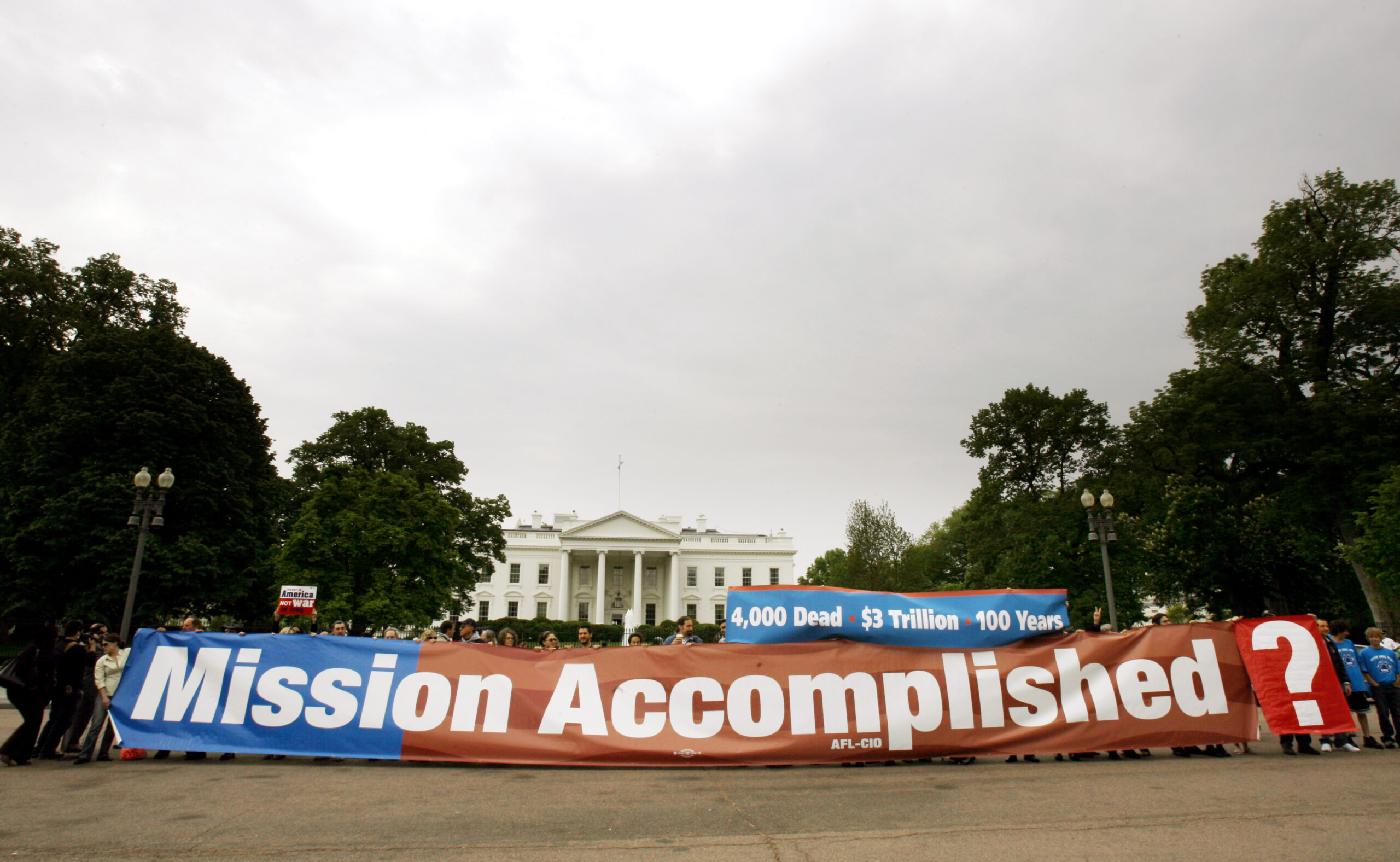

Some images remain like scars on my memory. One of the last things I saw in Iraq, where I spent a year with the Department of State helping squander some of the $44 billion American taxpayers put up to “reconstruct” that country, were horses living semi-wild among the muck and garbage of Baghdad. Those horses had once raced for Iraqi autocrat Saddam Hussein and seven years after their “liberation” by the American invasion of 2003, they were still wandering that unraveling, unreconstructed urban landscape looking, like many other Iraqis, for food.
I flew home that same day, a too-rapid change of worlds, to a country in which the schools of my hometown in Ohio could not afford to pay teachers a decent wage. Once great cities were rotting away as certainly as if they were in Iraq, where those horses were scrabbling to get by. To this day I’m left pondering these questions: Why has the United States spent so much money and time so disastrously trying to rebuild occupied nations abroad, while allowing its own infrastructure to crumble untended? Why do we even think of that as “policy”?
The Good War(s)
With the success of the post-World War II Marshall Plan in Europe and the economic miracle in Japan, rebuilding other countries gained a certain imperial patina. Both took relatively little money and time. The reconstruction of Germany and Japan cost only $32 billion and $17 billion, respectively (in 2010 dollars), in large part because both had been highly educated, industrialized powerhouses before their wartime destruction.
In 2003, still tumescent with post-9/11 rage and dreams of global glory, anything seemed possible to the men and women of the Bush administration, who would cite the German and Japanese examples of just what the U.S. could do as they entered Iraq. Following what seemed like a swift military defeat of the Taliban in Afghanistan, the plan had gotten big and gone long. It was nothing less than this: remake the entire Middle East in the American image.
The country’s mighty military was to sweep through Iraq, then Syria — Marines I knew told me personally that they were issued maps of Syria in March 2003 — then Iran, quickly set up military bases and garrisons (“enduring camps”), create Washington-friendly governments, pour in American technology and culture, bring in the crony corporations under the rubric of “reconstruction,” privatize everything, stand up new proxy militaries under the rubric of regime change, and forever transform the region.
Once upon a time, the defeated Japanese and Germans had become allies and, better yet, consumers. Now, almost six decades later, no one in the Bush administration had a doubt the same would happen in Iraq — and the Middle East would follow suit at minimal cost, creating the greatest leap forward for a Pax Americana since the Spanish-American War. Added bonus: a “sea of oil.”
By 2010, when I wrote “We Meant Well: How I Helped Lose the Battle for the Hearts and Minds of the Iraqi People“, the possibility that some level of success might be close by still occupied some official minds. American boots remained on the ground in Mesopotamia and looked likely to stay on for years in at least a few of the massive permanent bases we had built there. A sort-of elected government was more or less in place, and in the press interviews I did in response to my book I was regularly required to defend its thesis that reconstruction in Iraq had failed almost totally, and that the same process was going down in Afghanistan as well. It was sometimes a tough sell. After all, how could we truly fail, being plucky Americans, historically equipped like no one else with plenty of bootstraps and know-how and gumption.
Failure Every Which Way
Now, it’s definitive. Reconstruction in Iraq has failed. Dismally. The U.S. couldn’t even restore the country’s electric system or give a majority of its people potable water. The accounts of that failure still pour out. Choose your favorites; here are just two recent ones of mine: a report that a $200 million year-long State Department police training program had shown no results (none, nada), in part because the Iraqis had been completely uninterested in it; and a long official list of major reconstruction projects uncompleted, with billions of taxpayer dollars wasted, all carefully catalogued by the now-defunct Special Inspector for Iraq Reconstruction.
Failure, in fact, was the name of the game when it came to the American mission. Just tote up the score: the Iraqi government is moving ever closer to Iran; the U.S. occupation, which built 505 bases in the country with the thought that U.S. troops might remain garrisoned there for generations, ended without a single base in U.S. hands (none, nada); no gushers of cheap oil leapt USA-wards nor did profits from the above leap into the coffers of American oil companies; and there was a net loss of U.S. prestige and influence across the region. And that would just be the beginning of the list from hell.
Even former National Security Advisor and Secretary of State Condoleezza Rice, George W. Bush’s accomplice in the invasion of Iraq and the woman after whom Chevron Oil once named a double-hulled oil tanker, now admits that “we didn’t understand how broken Iraq was as a society and we tried to rebuild Iraq from Baghdad out. And we really should have rebuilt Iraq outside Baghdad in. We should have worked with the tribes. We should have worked with the provinces. We should have had smaller projects than the large ones that we had.”
Strange that when I do media interviews now, only two years later, nobody even thinks to ask “Did we succeed in Iraq?” or “Will reconstruction pay off?” The question du jour has finally shifted to: “Why did we fail?”
Corruption and Vanity Projects
Why exactly did we fail to reconstruct Iraq, and why are we failing in Afghanistan? (Rajiv Chandrasekaran’s new book, “Little America: The War Within the War for Afghanistan,” is the Afghan version of We Meant Well in detailing the catastrophic outcomes of reconstruction in that never-ending war.) No doubt more books, and not a few theses, will be written, noting the massive corruption, the overkill of pouring billions of dollars into poor, occupied countries, the disorganization behind the effort, the pointlessly self-serving vanity projects — Internet classes in towns without electricity — and the abysmal quality of the greedy contractors, on-the-make corporations, and lame bureaucrats sent in to do the job. Serious lessons will be extracted, inevitable comparisons will be made to post-World War II Germany and Japan and think tanks will sprout like mushrooms on rotted wood to try to map out how to do it better next time.
For the near term a reluctant acknowledgment of our failing economy may keep the U.S. out of major reconstruction efforts abroad. Robert Gates, who succeeded Donald Rumsfeld at the Pentagon, told a group of West Point cadets that “any future defense secretary who advises the president to again send a big American land army into Asia or into the Middle East or Africa should ‘have his head examined,’ as General MacArthur so delicately put it.” Still, the desire to remake other countries — could Syria be next? — hovers in the background of American foreign policy, just waiting for the chance to rise again.
The standard theme of counterinsurgency theory (COIN in the trade) is “terrorists take advantage of hunger and poverty.” Foreigners building stuff is, of course, the answer, if only we could get it right. Such is part of the justification for the onrushing militarization of Africa, which carries with it a reconstruction component (even if on a desperately reduced scale, thanks to the tightening finances of the moment). There are few historical examples of COIN ever really working and many in which failed, but the idea is too attractive and its support industry too well established for it to simply go away.
Why Reconstruction at All?
Then there’s that other why question: Why, in our zeal to rebuild Iraq and Afghanistan, we never considered spending a fraction as much to rebuild Detroit, New Orleans, or Cleveland (projects that, unlike Afghanistan and Iraq in their heyday, have never enjoyed widespread support)?
I use the term “reconstruction” for convenience, but it is important to understand what the U.S. means by it. Once corruption and pure greed are strained out (most projects in Iraq and Afghanistan were simply vehicles for contractors to suck money out of the government) and the vanity projects crossed off (building things and naming them after the sitting ambassador was a popular suck-up technique), what’s left is our desire for them to be like us.
While, dollar-for-dollar, corruption and contractor greed account for almost all the money wasted, the idea that, deep down, we want the people we conquer to become mini-versions of us accounts for the rest of the drive and motivation. We want them to consume things as a lifestyle, use nice sewer systems, and send everyone to schools where, thanks to the new textbooks we’ve sponsored, they’ll learn more about…us. This explains why we funded pastry-making classes to try to turn Iraqi women into small business owners, why an obsession with holding mediagenic elections in Iraq smothered nascent grassroots democracy (remember all those images of purple fingers?), why displacing family farms by introducing large-scale agribusiness seemed so important, and so forth.
By becoming versions of us, the people we conquer would, in our eyes, redeem themselves from being our enemies. Like a perverse view of rape, reconstruction, if it ever worked, would almost make it appear that they wanted to be violated by the American military so as to benefit from being rebuilt in the American fashion. From Washington’s point of view, there’s really no question here, no why at all. Who, after all, wouldn’t want to be us? And that, in turn, justifies everything. Think of it as an up-to-date take on that classic line from Vietnam, “It became necessary to destroy the town to save it.”
Americans have always worn their imperialism uncomfortably, even when pursuing it robustly. The British were happy to carve out little green enclaves of home, and to tame — brutally, if necessary — the people they conquered. The United States is different, maybe because of the lip service politicians need to pay to our founding ideals of democracy and free choice.
We’re not content merely to tame people; we want to change them, too, and make them want it as well. Fundamentalist Muslims will send their girls to school, a society dominated by religion will embrace consumerism, and age-old tribal leaders will give way to (U.S.-friendly, media-savvy) politicians, even while we grow our archipelago of military bases and our corporations make out like bandits. It’s our way of reconciling Freedom and Empire, the American Way. Only problem: it doesn’t work. Not for a second. Not at all. Nothing. Nada.
From this point of view, of course, not spending “reconstruction” money at home makes perfect sense. Detroit, et al., already are us. Free choice is in play, as citizens of those cities “choose” not to get an education and choose to allow their infrastructure to fade. From an imperial point of view it makes perfectly good sense. Erecting a coed schoolhouse in Kandahar or a new sewer system in Fallujah offers so many more possibilities to enhance empire. The home front is old news, with growth limited only to reviving a status quo at huge cost.
Once it becomes clear that reconstruction is for us, not them, its purpose to enrich our contractors, fuel our bureaucrats’ vanity, and most importantly, justify our imperial actions, why it fails becomes a no-brainer. It has to fail (not that we really care). They don’t want to be us. They have been them for hundreds, maybe thousands of years. They may welcome medicines that will save their children’s lives, but hate the culture that the U.S. slipstreams in like an inoculation with them.

Failure in the strict sense of the word is not necessarily a problem for Washington. Our purpose is served by the appearance of reconstructing. We need to tell ourselves we tried, and those (dark, dirty, uneducated, Muslim, terrorist, heathen) people we just ran over with a tank actually screwed this up. And OK, sure, if a few well-connected contractors profit along the way, more power to them.
Here’s the bottom line: a nation spends its resources on what’s important to it. Failed reconstruction elsewhere turns out to be more important to us than successful reconstruction here at home. Such is the American way of empire.
To stay on top of important articles like these, sign up to receive the latest updates from TomDispatch.com here.
