
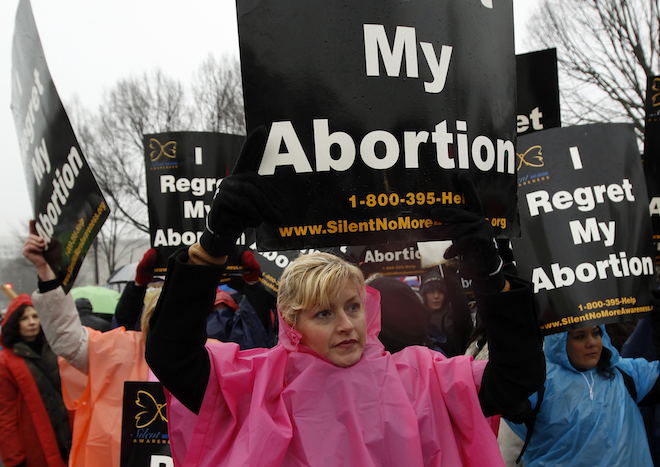

With Democrats making a relatively robust case for reproductive rights this week, it hasn’t taken long for someone in the mushy middle to wish they would apologize for it some more.
Writing in Bloomberg View, Margaret Carlson demands to know why the Democrats have “removed the sentence ‘Abortion should be safe, legal, and rare’ from its platform? It was in the 2004 document but not in 2008’s or this year’s. Can’t Democrats just throw a crumb to the many millions who are pro-choice but not pro-abortion?” She doesn’t define what “pro-abortion” is, but presumably it means that you think women should be able to terminate pregnancies without first submitting to a regime that wants to determine whether they deserve it enough and then makes them jump through hoops intended to make abortion really, really uncomfortable.
Give Carlson points for this much: She concedes that “Republicans are in favor of forced motherhood — regardless of its effects on an unwanted child.” But the inadequacy of terms like “pro-life” and “pro-choice” is underscored when Carlson cites Gallup poll data indicating that a slight majority of Americans identify as pro-life without pointing out that a vast majority, 77 percent, don’t support the Republican platform position, which is an abortion ban without exceptions.
Here is why activists agitated to have “rare” taken out: Because we still live in a country with an unintended pregnancy rate substantially higher than that of comparable countries, with an ever-diminishing system of supports for the poor, and because even with planned pregnancies, women will seek abortions for their own reasons. “Rare” does not necessarily denote that women don’t want abortions and aren’t getting them; in states where clinics have been driven out or where restrictions like the ones Carlson appears to favor are all too effective, abortions may be rare but very much desired.
In search for an untenable middle, Carlson conjures up a character that is both the most “sympathetic” possible portrait of someone seeking an abortion (the kind mainstream pro-choice rhetoric favors) and the most unsympathetic in terms of gestational age (the kind antiabortion activists love to focus on).
“It’s a terrible thing to force a 12-year-old who lives in chaos and hopelessness, with a boyfriend who has disappeared or an abusive uncle who hasn’t, to have a baby. But it’s worse to let her abort it after she waits so long for help that the only difference between the baby being born alive or dead is a gruesome procedure that Democratic Senator Daniel Patrick Moynihan said approximated ‘infanticide.'”
Both of these circumstances are rare, although when it comes to the child abuse, not nearly rare enough. (As for an abortion necessitating a “gruesome procedure,” according to the CDC, only about 1.3 percent of abortions take place after 21 weeks, and it’s banned outright in several states.) But let’s say they aren’t; Carlson seems entirely uninterested in the structural reasons behind such a situation. Some of these are much bigger than abortion law: “Chaos and hopelessness,” for example, or rape or incest. But the sorts of compromises she favors also generate dire circumstances: Parental consent laws, which remain broadly popular, that would force that 12-year-old into court if she didn’t want to talk to a guardian and might encourage her to delay dealing with the situation as long as possible, for one. Public funding bans that were a “compromise” but often mean in practice that abortions happen later, and are riskier and cost more. Waiting periods that are likely to do the same.
Carlson’s right when she says that “Roe’s legal framework has been eroded by loopholes,” but they aren’t ones that make it fantastically easy to get an abortion at eight and a half months on a lark. They are the erosions in abortion access — practical, legal, cultural, political — that have been put in place by people who, like Carlson, believe that abortion is OK only if you’ve suffered enough on the road to it, especially if you’re poor. And what, exactly, have they achieved besides stigmatizing women?
There is, of course, a careful “both sides are doing it” concession here, the driving intent behind the entire column: “Pro-choice women would be more apt to acknowledge that Republicans have a point on some aspects of abortion policy if they didn’t fear that Republican legislators want to send their doctor and Todd Akin at them for an ultrasound probe. Abortion won’t be a defining issue for Democrats this election, but the party’s more militant posture guarantees that bipartisanship is still a long way off.” In other words, Democrats should negotiate — or preemptively give ground — with people who officially not only want to ban all abortion, but with people who oppose increased access to birth control. (Even Democrats for Life, which is trying to change the party’s stance from within, doesn’t take a position on contraception as abortion prevention and came out against the Obamacare birth control mandate.)
To that I say, good luck splitting the difference and thinking you’ll be left with anything.
