
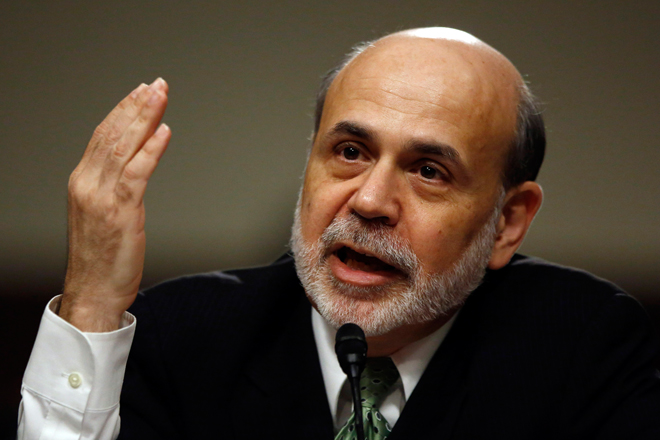
In the arcane world of Fed-watching, last week’s uninspiring labor report appears to have achieved the near-impossible: the likelihood of real action on the economy. In response to sluggish economic growth and persistently high unemployment, there is a widely shared expectation that Ben Bernanke is about to unleash a third round of economy-juicing asset purchases — aka “QE3.” And as is the case with any kind of government action designed to directly boost the U.S. economy, the Romney-Ryan campaign disapproves.
QE stands for “quantitative easing,” two words that cause the minds of 99 percent of Americans to immediately shut down. But the basic concept at work is simple. It’s a way to inject money into the economy without running (much) risk of inflation. At its two-day meeting later this week, the Federal Reserve’s Open Market Committee will likely commit to buying around $50 billion worth of bonds a month — probably a mix of U.S. Treasuries and mortgage securities backed by Fannie Mae and Freddie Mac. In theory, this action will push interest rates lower across the economy.
Two previous rounds of quantitative easing don’t appear to have done a whole lot except push stock prices up, but there is at least one intriguing reason to believe that times might be different. One of the main ways quantitative easing affects ordinary Americans is by pushing mortgage interest rates down, which should make refinancing and home buying more attractive. But up until recently, with home prices falling, and lenders only willing to lend money to people with excellent credit, it’s been difficult for QE to get any traction on the housing market. But now home prices are rising and more and more people seem to be willing to get into the market. So this time around, suggests the always percipient Bill McBride at Calculated Risk, “this channel will start to become more effective.”
Of course, judging by their public comments, Romney and Ryan believe the Fed should be standing pat, and making no efforts to lower unemployment through advanced interest-rate management techniques. On Friday, Ryan declared that “our monetary policy has been trying to serve as a substitute for really bad fiscal policy,” and that the “cost” of QE “outweighs the benefits.” Two weeks ago, Romney also pooh-poohed the idea.
“I think a QE3 and another Fed stimulus is not going to help this economy. I think that is the wrong way to go. I think it also seeds the kind of potential for inflation down the road that would be harmful to the value of the dollar and I think harmful to the stability that our nation needs. “
At the same time, Romney also reiterated his promise not to reappoint Ben Bernanke to a third term.
There’s no question that a reasonable debate over the merits of quantitative easing can be had. But let’s recall that Bernanke was originally appointed by a Republican president and served under Bush with many of the same economists who currently act as Romney’s advisers — and who mostly seem to think that Bernanke has been doing a fine job as Fed chairman. If Romney were president right now, and Bernanke were his Fed chairman, it seems virtually certain that he would be hoping the Fed was doing everything in its power to attack unemployment and stimulate economic growth.
It is almost certainly too late for a new round of quantitative easing to make a difference in the U.S. economy that would take effect before Election Day, but it’s still worth pondering the box Romney and Ryan have put themselves in. The linchpin of their attack on Obama is the bad economy. But they are on record as opposing either fiscal or monetary action to address what ails the economy. Their only substantive policy proposals require spending cuts on a level that would surely boost unemployment by cutting government jobs and subtracting government demand from the economy.
It’s kind of crazy, when you think about it. This week, the only branch of the U.S. government that is capable and willing to engage in a concrete effort to deal with the stagnant U.S. economy is the Federal Reserve. But even that is too much for the Republicans who want to run the country.
