
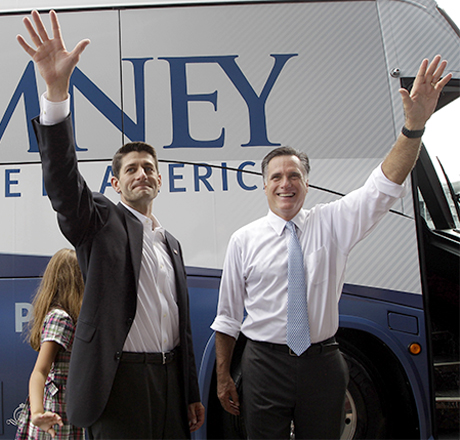

Well, it took a while, and an awfully circuitous route, but we’re finally getting back to the national debate we need to have, the one about the role of government.
Unfortunately, it’s taken a terribly misguided, albeit revealing turn towards “makers versus takers.”
What’s misguided about it? It misses the dynamics of real lives in America and instead, creates a false and divisive framework. Were we to accept this framework and try to embed it in our economic policy, our nation would be the worse for it.
The implication is that one group—the makers—is supporting the well-being of another—the takers. Moreover, since the takers don’t pay taxes—they just take government benefits—they are endlessly incentivized to support politicians who keep their Ponzi scheme going. When conservatives say “we’re reaching a tipping point” they mean that the takers will soon be a larger electoral block than the makers, at which point the former only have to get up from their well-worn sofas once a year to vote for their facilitator-in-chief who pledges to keep the transfer checks coming.
But, in reality, for the vast majority, both here and in every other democratic economy, it doesn’t work that way. The distinction is meaningless. We almost all “take” at some point and “make” at others. Medicare and Social Security programs are social insurance programs to which we contribute during our working lives and receive benefits from in retirement. Are the beneficiaries of these programs makers or takers? About 60% of those who don’t pay federal income tax pay payroll taxes, meaning they’re working. Slightly over a fifth are low-income elderly families. Are they takers who should leave retirement and get the hell back to work?
Mark Schmitt makes the point using unemployment insurance (UI):
Everyone who receives benefits from UI, without exception, has worked – usually full-time and steadily for at least a year – and paid into the system through their employers. And they will (they desperately hope) work again and pay even more. Some people might end up receiving more, over their long working lives, while others might pay in while having the good fortune never to be unemployed. But that’s the nature of insurance. Most of us, other than the permanently disabled, are givers and takers to government, because that’s what it is to be part of a community or a nation.
Are low-income workers benefitting from the wage subsidy that Ronald Reagan called the best anti-poverty program—the Earned Income Tax Credit—takers? What about kids who lost a parent and benefit from Social Security survivors benefits, as did Paul Ryan (and yours truly)? What about those who take advantage of government-backed student loans (again, yours truly)? The mortgage interest deduction, the favorable tax rate on capital gains, the deductibility of interest costs from debt financed private equity deals?
Is there someone somewhere who’s not disabled, is of working age, lives off of government assistance but neither works nor pays any taxes? In a nation of over 300 million there must be, but they’d actually be hard to find—according to my CBPP colleague Arloc Sherman, 94% of entitlement and UI benefits go to people who are elderly, disabled, on UI, or work at least 1,000 hours per year. And if they ever put gas in their car, they paid a federal excise tax, not to mention state sales tax, local property taxes, and so on.
A few weeks ago, Bill Clinton warned of a “you’re-on-your-own” approach to government versus a “we’re-in-this-together” mode. The makers/takers distinction feeds directly in that YOYO mindset, and you can see it embodied in the privatization or voucher schemes for social insurance, the Paul Ryan/House budget which cuts from the poor to give to the rich, the attack on the safety net, the proposed cuts to mobility enhancers like college aid, the repeal of health reform designed to reduce the number of uninsured, all fed by false claims as to the shares of Americans who don’t pay taxes or who needlessly depend on government largesse.
All of us need some help at some point. Sometimes that help comes from family, sometimes from government, typically from some combination of both, but no one goes it alone. If you’re lucky, have people who care for you, or have the wherewithal to seek it out yourself, there will be a ladder in front of you at some point. That doesn’t make you a taker—you’ll have to climb it yourself.
Right now, I’m hearing a lot from people who were born on third yet think they hit a triple. They’re telling me that the role of government is to kick out those ladders. But they are wrong. The role of government is to make sure those ladders are there, along with insurance against ill-health and penury in old age, a safety net when the economic bottom falls out, investments in the public goods the market won’t provide, protections against negative externalities like pollution and market bubbles that private markets fail to price in, and so on.
And the more we think in terms of YOYOs and makers and takers, the less likely we are to recognize how important this role is and how dangerously close we are coming to rejecting it.
