
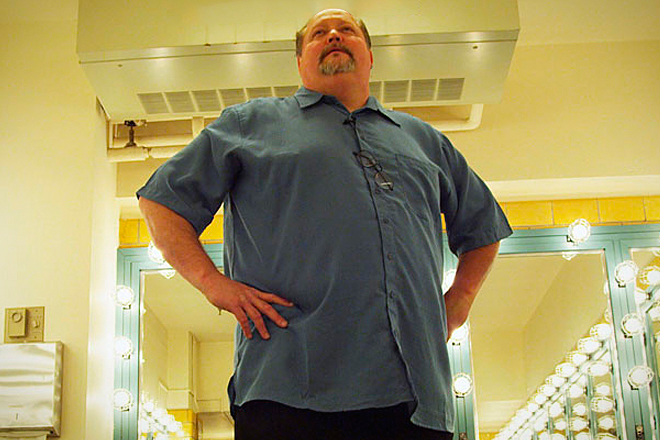

As the pastor of the much-reviled Westboro Baptist Church, Fred Phelps has become synonymous with hatred. The pastor and his family make it a point to carry signs at the funerals saying, “Thank God for Dead Soldiers.” They show up to media-friendly events with signs that read, “God Hates Fags.”
Nate Phelps is the sixth of Fred’s 13 children, and he has the scars to show for it. He describes his father as verbally and physically abusive. When he was 18, Nate ran away from home and from the fundamentalist Calvinist religion in which he was raised.
Now in his 50s, Nate finds himself publicly squaring off with his father and siblings to reverse their legacy of intolerance. He lives in Calgary, where he has become a public speaker who champions LGBT rights and raises awareness about the connection between extreme religion and child abuse. He is currently writing a book about his life and is the subject of an upcoming documentary.
What was your childhood like?
It was a very strict environment. We were isolated from the community, not so much physically, as ideologically. We heard from the time we were very young that we were to be separated from the world, and we were unique. We were God’s chosen ones. On one hand we had this sense that we were better than everybody else, and on the other hand we had this clear awareness that we were different from everyone else. That cut both ways. And then all of that ideology was supported and promoted with violence and psychological — I don’t know if you want to call it abuse, but you know those lessons we learned in that religious environment were such that we were constantly anxious and frightened for whether or not we were going to upset God.
How did your father explain that to you? That you were one of God’s chosen ones and yet he could mistreat you?
He was able to justify using verses out of the Bible. That was a major criteria for him. If he could find an excuse for it, then it was OK to do it, because God gave him permission. As far as how he justified the idea that we were different from the rest of the world, he made much of the ideas that he found in the Bible about the nature of what God expected of us, that extreme Calvinist ideology that is at the cornerstone of their campaign. The fact that other groups had it wrong or got this or that doctrine wrong was proof that God didn’t find favor with them.
As far as the physical violence, that’s a fairly common idea that exists in fundamentalist Christianity, that the husband is the head of the house and has absolute authority — and has the right to bring his wife and children into submission if they aren’t.
And when you talk about the physical violence was it something that was spontaneous or routine? How do you remember?
It was both. I mean there were some things that you just knew if he found out about it there was gonna be trouble. There was also this tendency to explode without any warning and that actually was far more destructive in the long run because you just never knew, and that’s more terrifying than cause-and-effect.
Did he use his belt or a cane, what was his …?
When we were younger it was a barber strap. That thing got so shredded at the ends that it would wrap around the sides of our legs and tear the skin. It was kind of like a cat o’ nine tails. When I was about 8 or 9 he introduced us to a Mattock handle, which is a farming instrument or tool that you use to pull up roots, and it’s got an axe head on one end and a hoe head on the other end. It’s big. You know, take a baseball bat, add maybe 30 percent to that.
What, he’d have you bend over a chair or what did he do?
Yeah, and then he would beat us anywhere from the lower part of our back down to behind our knees and he swung it hard, he swung it like a baseball bat. And oftentimes what would happen is there would be eight or 10 strokes and then he would go into a 10- or 15-minute screaming session with what we were doing wrong and how it was defying God and that we were evil. You know all of these religious-based threats and insults to the children and then he’d go back to the beating and by then the skin has stretched tight from the damage. So the next blows would just split the skin and so you’d get blood.
Would your father choose to do this in front of your other brothers and sisters?
No, it was very public. It couldn’t help but be public because there was so much noise and ranting, everybody in the house knew that he was on a tear. And sometimes when it got really bad my mom would try to intervene and then he would go after her and beat her for that. He used all of these strategies that appeared to be very deliberate. He required the older boys to start administering the beatings themselves, and if they didn’t do it properly then they would get beat from him because they weren’t hitting hard enough or doing it as he would do it. And that was kind of a pattern he used even with the passing on of the message that he taught. He didn’t just settle for making sure we knew it. He required us to present it the way he did.
Did you have any opportunity to run away?
The thought never really occurred to me. You grow up in that environment, you just kind of accept that’s the way the world is and that you’re there and you’re stuck there. And then my older brother Mark left when I was about 16, and that put the idea in my head. But then my older sister Kathy left, and she was only 17, so he went after her, found her, forced her back home because he still legally owned her, and abused her terrible for the remaining four to five months before she turned 18. So I learned from that that if I was going to be successful I had to wait till my 18th birthday. So that’s what I did. Literally the night of my 18th birthday, at midnight, I had made my arrangements and I walked out the back door.
Were you obliged to be a part of the public protests he would do, whether it was picketing funerals or homosexuals?
He didn’t start the “God hates fags” campaign until after I left. But throughout our childhood there was that inclination toward conflict with neighbors and community members, and he absolutely required of us, whatever form it took, as well as this putting the word out there that everybody in the world was going to hell, that had to be presented with the same kind of vitriolic fury that he did it, or then we’d end up getting in trouble if we weren’t vicious enough. Without a doubt you don’t have an option in that environment, and I’m quite certain that’s still the case that those kids that are out there, the young ones and even the teenagers, they’re not necessarily there because they want to be, they have to be there.
And in that kind of fearsome environment, is there ever an opportunity, I’m trying to think of you as a sort of 15-, 16- maybe even 17-year-old, to just challenge your dad, to just stand up and like say, “You’re wrong”?
Just in your own mind. That was the safe way to do it, and I did plenty of that. But no, I was terrified of him. I didn’t dare defy him openly.
Let’s go back to that night of your 18th birthday. You were determined to leave then. How did you do it?
Well, the actual planning, I had saved up money. We were selling candy for years there, and I was able to save a few dollars here and there and hide it, and I bought an old used car from a security guard at my high school and I hid that down the street so no one knew that I owned it. I kept it far enough away from the house that no one realized it was mine. And then over the course of the last month or so I started packing my meager belongings; I think I had four, five, six boxes of stuff. I would pack a little bit at a time and hide it in the garage. And then on the night of my 18th birthday I waited until about 10.30 when everyone was asleep and I went and got the car and backed it into the driveway and loaded the boxes into the trunk. Then I went and parked the car about half a block up the road, just in case, because it was critical that no one know that’s what I was doing. One of the dynamics of the situation is that we were more than willing to throw each other under the bus to save ourselves.
Not one brother or one sister you could’ve confided in at that point or would have?
It was way too dangerous to do that. So I went back in the house and I remember sitting in my room for about 15 minutes just literally shaking. As it approached midnight I actually stood at the bottom of the stairs going up to my dad’s bedroom and watched the clock on the wall. As soon as it hit midnight I yelled as loud as I could at the top of my lungs and then ran out the back door and jumped in the car and took off.
What did you yell?
I just yelled. Just like a yell. And then of course I was terrified because I knew it would wake my father up. I spent the first three nights of freedom sleeping in the bathroom of a gas station.
Did anyone know you were there?
The people in the gas station did. There was someone that I knew that was near the high school that I went to and basically he locked me in every night. And I had to stay in the bathroom so no one would no I was there.
And what after that?
Well, then my older brother’s mother-in-law …
This is the brother who had left, Mark, right?
Yeah. She took me in and I lived at her place for a time, until I got a job and got on my feet.
And you never went home again?
Nope.
Did you ever find out if your dad was searching for you during that time?
I did hear from couple of my siblings that he was surprised, which was a big surprise to me because he and I had had such a violent relationship in those last three or four years. And he’d even asked me a couple times, as my 18th birthday approached, if I was going to leave him. And I dutifully said I wasn’t.
How long ago was that night now? How long has it been since you left?
That would be about 35 years now.
And in that time you’ve moved around, I know you’re in Canada now. Is that because you wanted to put distance between yourself and Topeka, Kan.?
No, but that is the reason I went to southern California in 1981. That was very deliberate. I wanted to put as much distance as I could between him and I.
As the Westboro Baptist Church became known for its protests, did you tell anyone you were the son of Pastor Fred Phelps?
My close friends, yeah. I didn’t advertise it. I did a couple of interviews with local TV stations there in the Topeka area. But by and large, I avoided talking about it.
And how much of what you went through as a kid did you carry with you then?
It’s a funny thing, because I would have told you when I left that I was fine. When people would talk about what it had been like there and say stuff like, it’s amazing you’re not crazy, I just shrugged that off. And then you get older and some of that stuff starts to come out. You start realizing you’ve got very serious issues and you just have to start dealing with that. And I don’t think you ever completely get rid of it, but you learn strategies for managing it.
Was there a time when you thought to yourself, uh-oh, I actually haven’t left my father or the church or what happened in my youth behind?
I can’t pinpoint a specific time, but I can recall behaviors that seemed normal at the time. I would literally go away for two to three hours at a time and refuse to communicate with anyone and get lost in this morass of hateful thinking, and anger, and raging to the point where I would get really bad headaches and would be so tense that I could hardly move. And that was fairly normal. I would do that probably once or twice a month. But I just thought that was something that was a part of me. I didn’t recognize it was something that I brought with me from my youth.
What about contact with brothers, or sisters, or your mother in all those years?
No, not allowed. Like I said, early on it was still a little bit unrefined; a lot of my siblings hadn’t yet really taken this really strong hold, like my father has, with their religion. He hadn’t fine-tuned the control he had over them as far as the ostracizing process, so there was the occasional phone call. And actually several of my other siblings left and then went back. So, I spent about nine months living in the Kansas City area with my older sister Margie, who is one of the most outspoken ones there now. Because she had left home as well. So I had that contact in the early years. But as the years went by and they got more steeped in that ideology and isolated, that ostracizing process was like, you know, there was like a stone wall, so there was no more communication.
When did you become aware that your family was this international news story for their whole “God hates fags,” picketing soldiers’ funerals all that stuff. When did that come into focus for you?
It was a long process for them. I think that they started doing it in 1991 and, like I said, I got some of that local attention – the TV and radio stations in the Topeka area wanted to get my perspective. So I was aware they were doing it back then, it seemed to kind of just lose its steam and then they went and picketed at Matthew Shepard’s funeral. And this whole idea of picketing funerals suddenly caught their imagination. That’s when things really started to pick up.
This was the young man who was tied to a fence post by people who accused him of being homosexual, right?
Yeah, in Laramie, Wyo. Left him exposed to the elements with all the injuries. He hung on for seven or eight days before he finally passed. And that caught the attention of the international community and became the touchstone on that whole subject. So they were right there in the middle of that funeral with their signs and it got them a lot of attention and the rest is history as they say, right?
I had moved up here to Canada. The gal I was with suggested I write about it, as part of trying to deal with my past. I was driving a cab and picked up this young man who was a journalism student at the University of British Columbia. He figured out who I was. That turned into a three-hour interview that turned into an article that got about a half-million hits on the BBC website. Then I was asked to give a public talk. And suddenly I had people emailing me in droves, people who were relating to that on one level or another, including a lot of people in the gay community. It occurred to me that I could have a positive impact on their lives and the lives of others who were suffering from this message and this behavior that my family was engaged in.
Tough choice, though, in a way. Because at one level it puts you right back to where you were, confronting on a routine basis this hatred that comes from your father’s church.
Yeah, that’s absolutely true. I actually ended up seeking counseling as a result of that because it’s with me constantly. Another part of it that was a real challenge for me was you don’t even necessarily realize it but you always live with this hope that something will change and somehow it will be restored to that family relationship. So I had to make the deliberate decision that I was willing to let go of that dream, in order to be this confrontational with them.
And how close have you come, in the last years, to a direct confrontation with your younger brothers and sisters, your mother, your father, at any of these protests where they make themselves so public?
My father won’t have anything to do with me. Actually, in 1995 he was on a radio program in Southern California, when I lived out there. I thought it was a pre-recorded program, so I called in to talk to the host. Turned out it was live, and he asked me if I would get on and ask my father a question. And that lasted about 45 seconds and he started calling me names, and so, it was fairly nonproductive. And that is the only time my father has every talked to me since I left.
And you’re an atheist now. Was that a conscious decision? A conscious way of stiff-arming the brutal religious upbringing you had? Or was there more to it than that?
There was a lot more to it. I spent years in a more mainstream church. My kids and wife and I attended an evangelical-free church for a big part of their childhood. And all the while I was asking questions and reading prolifically, and going to see a counselor for nine months who had a theology degree as well as a psychology degree. I read about two years’ worth of seminary school on textbooks on the subject. You know, I was looking for God. I was looking for answers.
And, all in the context of those passages that my father used so much in the Bible, and I eventually got to the point that I realized it all hinges on the validity of the Bible and I started looking for evidence for the validity of the Bible, and I couldn’t find it. That’s a fairly simplistic way to explain 20-plus years of searching. But that was the essence of the path. You know, my position today is, if there is a deity I’m satisfied that it’s not the deity described in any of the mainstream religions of the world. I’m not opposed to the idea of a deity. I just don’t see evidence for it.
How old is your father now?
He’ll be 83 in November.
Do you think that the hatred he espouses will die with him?
I used to. You know, when I first start talking about this I know there is a wellspring of righteous hatred and indignation in my father, and it seems never ending, and I know he has ultimate control over everyone in that environment. But I’ve seen enough evidence in the past few years from several of my siblings that it is very possible that they can maintain or continue on with some form or version of this same ideology that exists right now. But I think it will look profoundly different when my father dies.
Just because that center of that hatred will be gone at that point?
That’s right. And that absolute control that he has will … what will that do to a bunch of people who only knew how to follow?
Do you still think about one day being able to sit down and have a cup of coffee with your mother?
Yes. That’s one of my long-shot hopes, that he passes before her and depending on where she is in her ideology, there is a possibility that she and I can reconcile and talk again.
