
Activists go where US drones strike

A delegation from Code Pink plans to march with Pakistani groups to South Waziristan

Topics: Islamabad, Drone Attacks, Code Pink, Activism, drones, Taliban, Pakistan, Anti-war,

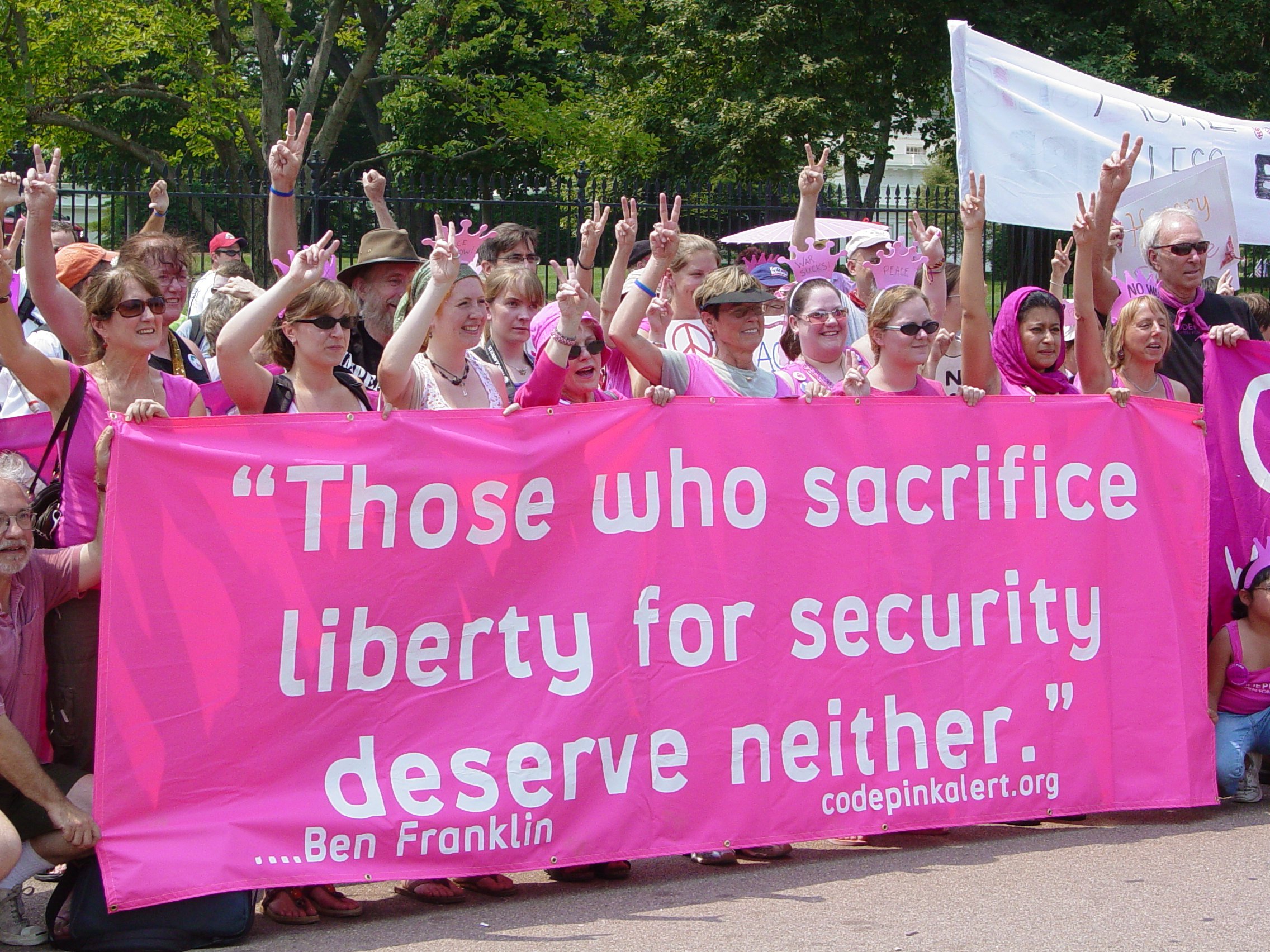
Activists go where US drones strike Code Pink activists outside the White House (Wikimedia)

For a decade, Code Pink activists have been a central fixture at anti-war protests around America. Not for the first time in its history, the group’s supporters are putting their bodies on the ground where U.S. bombs strike.

A delegation of 32 American women have traveled to Islamabad and will march alongside Pakistani organizers and political groups to South Waziristan — a nucleus of Taliban militancy regularly struck by U.S. drones. The aim of the trip is to draw greater attention to the harm wrought by drone attacks, while reaching out and building solidarity with Pakistanis on the ground.

“We want to make it known to Pakistanis that there are Americans with a conscience who do care about their lives,” Code Pink co-founder and delegation organizer, Medea Benjamin told Salon on the phone from Islamabad.

“We’ve encountered some overwhelming admiration over the fact that we’re here, willing to put ourselves at risk,” said Benjamin, who said she has been meeting with human rights groups, women’s groups, Pakistani generals, U.S. diplomats and even members of the military spy agency Inter-Services Intelligence (ISI) in Islamabad.

The Code Pink delegation, comprised of women aged 22 to 80, plans to march to South Waziristan on Oct. 7., unless prevented by local authorities. The area is safer than North Waziristan in terms of regularity of drone strikes and the intensity of militant activity. However, concerns remain over the safety of the march, which will be led by Imran Khan, former cricketer and leader of the Pakistan Tehreek-e-Insaf (PTI) party.

“The warnings run the gamut from the CIA to the Taliban,” said Benjamin, explaining that Taliban responses to the planned march have been split, with opposition aimed at Khan, “We’ve heard this week,  ‘We don’t need a liberal like Imran Kahn to protect us from drones’,” said Benjamin.

But with assurance from U.S. authorities that the march will be able to run “100 percent” drone attack-free, and with growing confidence in support from Pakistani groups on the ground, Benjamin is optimistic. She noted too that even if the march is disallowed, the delegation will have successfully highlighted the secrecy and impenetrability of the areas where U.S. military programs kill hundreds of civilians.

On Wednesday, the delegation will meet with two victims from the first drone strike conducted during Obama’s presidency (in January 2009) which killed nine civilians. One victim is Fahim Qureshi, who lost an eye, and had to have abdominal surgery because the drone missile pierced his stomach. He also lost four members of his family. The other victim is Mohammad Ejaz, who lost two family members.

“We feel the mission is already a success,” said the veteran activist. “We’ve had tremendous publicity in Pakistan… And it’s amazing to me, as someone who organized the delegation, that 32 people were willing to come out to an area where there is so much uncertainty. We feel it’s important to go where the fear is,” she said.

Continue Reading Close

Natasha Lennard is an assistant news editor at Salon, covering non-electoral politics, general news and rabble-rousing. Follow her on Twitter @natashalennard, email nlennard@salon.com.

Next Article

Featured Slide Shows

What To Read Awards: Top 10 Books of 2012 slide show

close X
  • Share on Twitter
  • Share on Facebook
  • Thumbnails
  • Fullscreen
  • 1 of 10
  • 10. "The Guardians" by Sarah Manguso: "Though Sarah Manguso’s 'The Guardians' is specifically about losing a dear friend to suicide, she pries open her intelligent heart to describe our strange, sad modern lives. I think about the small resonating moments of Manguso’s narrative every day." -- M. Rebekah Otto, The Rumpus

  • 9. "Beautiful Ruins" by Jess Walter: "'Beautiful Ruins' leads my list because it's set on the coast of Italy in 1962 and Richard Burton makes an entirely convincing cameo appearance. What more could you want?" -- Maureen Corrigan, NPR's "Fresh Air"

  • 8. "Arcadia" by Lauren Groff: "'Arcadia' captures our painful nostalgia for an idyllic past we never really had." -- Ron Charles, Washington Post

  • 7. "Gone Girl" by Gillian Flynn: "When a young wife disappears on the morning of her fifth wedding anniversary, her husband becomes the automatic suspect in this compulsively readable thriller, which is as rich with sardonic humor and social satire as it is unexpected plot twists." -- Marjorie Kehe, Christian Science Monitor

  • 6. "How Should a Person Be" by Sheila Heti: "There was a reason this book was so talked about, and it’s because Heti has tapped into something great." -- Jason Diamond, Vol. 1 Brooklyn

  • 4. TIE "NW" by Zadie Smith and "Far From the Tree" by Andrew Solomon: "Zadie Smith’s 'NW' is going to enter the canon for the sheer audacity of the book’s project." -- Roxane Gay, New York Times "'Far From the Tree' by Andrew Solomon is, to my mind, a life-changing book, one that's capable of overturning long-standing ideas of identity, family and love." -- Laura Miller, Salon

  • 3. "Billy Lynn's Long Halftime Walk" by Ben Fountain: "'Billy Lynn's Long Halftime Walk' says a lot about where we are today," says Marjorie Kehe of the Christian Science Monitor. "Pretty much the whole point of that novel," adds Time's Lev Grossman.

  • 2. "Bring Up the Bodies" by Hilary Mantel: "Even more accomplished than the preceding novel in this sequence, 'Wolf Hall,' Mantel's new installment in the fictionalized life of Thomas Cromwell -- master secretary and chief fixer to Henry VIII -- is a high-wire act, a feat of novelistic derring-do." -- Laura Miller, Salon

  • 1. "Behind the Beautiful Forevers" by Katherine Boo: "Like the most remarkable literary nonfiction, it reads with the bite of a novel and opens up a corner of the world that most of us know absolutely nothing about. It stuck with me all year." -- Eric Banks, president of the National Book Critics Circle

  • Recent Slide Shows

  • Share on Twitter
  • Share on Facebook
  • Thumbnails
  • Fullscreen
  • 1 of 10

More Related Stories

Comments

7 Comments

Comment Preview

Your name will appear as username ( profile | log out )

You may use these HTML tags and attributes: <a href=""> <b> <em> <strong> <i> <blockquote>