
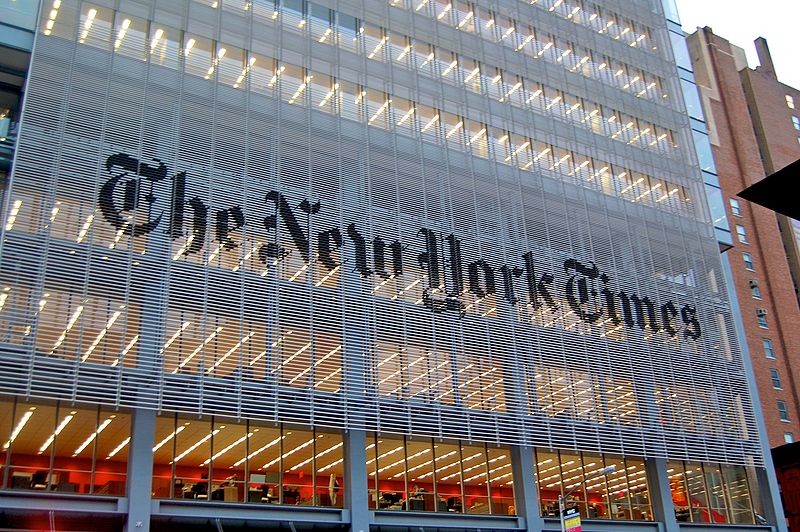

Unionized New York Times staffers plan a short walkout on Monday afternoon, reported Katherine Fung at the Huffington Post. The staffers, members of the Newspaper Guild of New York, will meet up and collectively walk outside of the new but iconic New York Times building in Manhattan to protest management’s position on contract negotiations.
Fung reports that “the walkout won’t be the first protest that Times’ staffers have staged over proposed contract terms. Earlier this year, employees held a silent protest outside a meeting of top editors, and demonstrated outside the company’s annual shareholders meeting. Angry staffers also made their demands heard in a series of videos.”
Below is an edited version of the email that the staffers received today from Grant Glickson, the unit chair for the Newspaper Guild at the Times, detailing the background for Monday’s protest:
Colleagues:
There is no longer any time to waste. At every bargaining session for the last year and a half, negotiators for The Times have offered us the same poisoned chalice: perpetually shrinking compensation.
Today we begin a series of actions to make sure that the company hears and understands our position. We have more than earned fair wages and benefits. We will accept nothing less.
That message has not yet gotten through, despite huge concessions by our representatives. It is time to raise our voices.
Having been told that The Times urgently needed to freeze pension obligations, the Guild brought to the table an alternative plan that absolves the company of all volatility, and shifts the risks entirely to us.
How did the company respond to this historic change? Its negotiators returned with radical demands to slash our wages and benefits. Their early proposals called for an overall $12,000 annual cut, in real dollars, to our compensation package.
Then it got worse.
In their latest proposal, The Times proposed to extend the term of the contract, piling onadditional years of reduced wages and benefits. That would make the new real cost to each one of us at least $15,000 annually. Other responsible estimates reckon that the losses to us are even higher. No matter how hard you squint at the numbers, they never get better.
As far as the eye can see, your wages and benefits would decline.
By itself, that is a formula for disaster, for us as individuals, and for the ability of The New York Times to attract and keep talented people. But there’s even more. Now they want – or so they say – separate contracts for digital and print journalists, even though there are no longer meaningful distinctions in the work we do. Our journalism is distributed across multiple platforms, print, digital, audio and video. That was and (we think) still is the vision of Arthur O. Sulzberger, Jr. for The New York Times of the 21st Century. It was a vision embraced without reservation throughout the newsroom. That took plenty of work. But we all saw it as necessity and opportunity.
Any proposal to dismantle the decade of work that has been done to unify the newsroom, securing its place as the world’s premier news organization, could be laughed off as far-fetched legal gimmickry. After all, that would be an act of self-immolation. But even if it’s not worth serious consideration, it has landed just we are heading at full speed toward a crisis over genuine issues like our pay and benefits.
They threaten to declare impasse; they burn up hours on low-farce; then they slap down another version of their repugnant demands to cut our compensation.
It is long past time for the company and its negotiators to pay attention to what matters most of all to us. Together, we can make sure that happens. Join in, as beginning today, we will repeat our message until they hear it:
Nothing less than fair wages and benefits.
Believe us.
…
And don’t stop until they get the message.
In solidarity,
The Mobilization Committee.
