
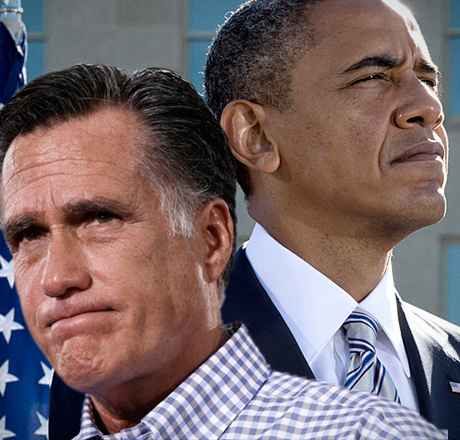

Americans like to turn elections into morality tales with sentimental elements and an underlying premise: that we are a vulnerable country threatened with some level of destruction if the other guy wins. Since our nation was first united, voters have always been treated to pointed contrasts between one candidate who represents privilege and insensitivity and another whose vision of national community is told in his personal biography.
On this basis, how does Mitt Romney, superficially attractive but awkward and remote, even begin to compete with a politician whose oratorical specialty has long been to make pragmatism sound empathetic and empathy sound pragmatic?
Born basking in the glow of Thomas Paine’s runaway bestseller of 1776, “Common Sense,” Americans have been convinced of the soundness of their reason, adding to it a special (one might say “exceptional”) disposition to hear the voice of the people – and that’s what requires empathy. One assumes that Romney, as a blue-state Republican businessman-turned-governor, understands pragmatism. But we still, to this day, have no idea whether or not he is genuinely empathetic. He can’t identify his empathy with the teachings of Mormonism because he wants to say “Mormon” as little as possible; it doesn’t poll well for him. He may indeed possess the requisite empathy voters want, but for years he has played mean and nasty in order to woo the Tea Party fanatics.
The pragmatism-empathy formula also helps to explain Barack Obama’s premature selection for the Nobel Peace Prize – an honor conferred strictly on anticipated promise. The unpredicted story of an African-American’s triumph would bring America redemption, the Prize committee was thinking, after the undignified George W. Bush had squandered the world’s goodwill in the wake of 9/11. In his acceptance speech, Obama cited Mahatma Gandhi’s and Martin Luther King’s antiwar sentiments, and he stated poignantly: “As someone who stands here as a direct consequence of Dr. King’s life’s work, I am living testimony to the moral force of non-violence. I know there is nothing weak – nothing passive, nothing naive – in the creed and lives of Gandhi and King.” Upon which, he added directly: “As a head of state sworn to protect and defend my nation, I cannot be guided by their examples alone. I face the world as it is and cannot stand idle in the face of threats to the American people. For make no mistake: Evil does exist in the world.” He feels for the human condition, a feeling mixed with pragmatism.
We all know how Obama wins people over: Behind the engaging smile, he is wholly a humanist, a man whose values are meant to be received as latter-day realizations of Jeffersonian principles – especially inclusiveness. The forty-fourth president tells us, as the third did, that we should commit ourselves to a harmonious moral community in which one role of government is to exhibit concern and promote compassionate legislation on behalf of those who are hurting or unwell or unequal.
This is the flip-side to another Jeffersonian dictate that oppressive government must be resisted. Recurring to an intense vocabulary to make his points, Jefferson criticized the unfeeling King George III in the immortal Declaration of Independence for having “sent hither swarms of officers to harass our people and eat out their substance.” The once-beloved British people had turned away from the patiently suffering colonies, abandoning ties of blood-brotherhood; they had become “deaf to the voice of justice and of consanguinity.” America’s 99 percent (well, probably closer to 80) were feeling powerless before a distant government that belittled them while ignoring their appeals for fairness.
On being inaugurated, President Obama adopted Jefferson’s style when he told a cheering crowd that he intended to represent all citizens, including those who had voted against him: “We come to proclaim an end to the petty grievances and false promises, the recriminations and worn-out dogmas that for far too long have strangled our politics.” If only that road could have opened up. But instead, the political lexicon has further devolved so that the right insists that the poor love Obama for the handouts they have come to expect, and the rich (except in Hollywood and Silicon Valley) enjoy sneering at the 99 percent. Clearly, dogmas keep barking at us.
The election of 1800 was marked by a comparable degree of recrimination. Jefferson was called out for being an atheist, which was even worse for a candidate in his time than being an Africa-descended Muslim is today. Yet, in his first Inaugural Address in March 1801, Jefferson spoke about healing: “Though the will of the majority is in all cases to prevail, that will to be rightful must be reasonable; that the minority possess their equal rights, which equal law must protect, and to violate would be oppression. Let us, then, fellow-citizens, unite with one heart and one mind. Let us restore to social intercourse that harmony and affection without which liberty and even life itself are but dreary things.” A beautiful sentiment, indeed.
For Obama, the empathetic pragmatist, it was, back in 2009, and it remains now as he seeks a second term, “not whether our government is too big or too small, but whether it works, whether it helps families find jobs at a decent wage, care they can afford, a retirement that is dignified. Where the answer is yes, we intend to move forward. Where the answer is no, programs will end … The success of our economy has always depended not just on the size of our gross domestic product, but on the reach of our prosperity; on the ability to extend opportunity to every willing heart – not out of charity, but because it is the surest route to our common good.” Pragmatic empathy, if ever you heard it. President Obama is sticking to what worked four years ago: the promise of his tireless commitment to fairness.
Until now, challenger Romney saw no advantage in leading the charge for government-generated fairness. That’s not what the Republican base wanted. Obviously, Mitt did not have to do anything to appeal to that constituency, which admires big money and acquiesces to (if it does not outwardly embrace) racial bigotry. As a pragmatist himself, his only chance to win votes – he can all but forget about capturing hearts – is to embrace Obama’s successful policies while loudly insisting that Obama’s policies have failed to help Americans, which is a disturbing thought.
To those of us who look for consistency, for genuineness, all one has to do is to speak the phrase “Etch-a-Sketch” to conclude that Romney is not easily definable. And yet, in his shockingly good debate performance, the uncomfortable tax-evader became facile and capable of a friendly banter that finally, after months or even years, seemed halfway real – even as an entirely new set of talking points. He may even have convinced a significant portion of the electorate that his pragmatic approach to the jobs picture and the deficit contain the right degree of empathy; yes, because he has been trying damned hard, since his 47 percent comments leaked and went viral, to convince voters that he cares about every American, not just the primary-days constituency of the rich, fearful and bigoted.
Here’s the rub for Romney. As he reaches for a few more percentage points, he faces a truly visceral problem. He cannot tap into America’s long-practiced allegiance to the eighteenth century culture of sensibility as it was converted into a permanent language of patriotism. The idea that a public man deserves high office on the basis of his compassion for ordinary people began with the literary model of a masculine capacity to feel for vulnerable womanhood: The strength of a man resided not in his ability to get his way by scheming and bullying, but in his readiness to feel – and the tendency to shed appropriately manly tears. Popular Scottish author Henry Mackenzie provided the prototype in a transatlantic bestseller of 1771 called “The Man of Feeling.” His “man of feeling” could not sit idly by while others suffered: He rescued a seduced and abandoned young woman and reunited broken families.
It was not just the wordsmith Jefferson who played into this narrative. The innate power to feel, as well as to judge, was demanded of George Washington in the romantic literature that followed his death. Andrew Jackson’s political enemies portrayed him as a heartless Indian killer who executed his own men on specious grounds – he was a bigamist, to boot. To his ardent supporters, however, Jackson was the naturally gifted common man, the frontier gallant who adopted an Indian orphan and protected every suffering citizen, every God-fearing farmer’s wife. His opponent, the bookish, cerebral John Quincy Adams, was out of touch with real Americans. The presidential election boiled down to whether Jackson was a “man of feeling” or an insensitive bully. We know which narrative stuck.
Today’s Republicans and Democrats are divided, as much as anything, on their positions toward helping those in need. The accepted narrative says that do-it-yourself Republicans contest bleeding-heart Democrats. In foreign policy terms, Republicans are associated with tough-talking, teach-them-a-lesson military aggressiveness. But that model, the pushy protector, is irreconcilable with the Democratic “man of feeling” who communicates with reason and whose primary weapon is diplomacy. In Mackenzie’s novel, the “man of feeling” is always clever enough to avoid a physical confrontation with the brutes of society. Republicans’ fantasy Democrat, meanwhile, is the Obama who is too meek to go to bat for our ally Israel. (Arguably, this particular tactic has been unsuccessfully deployed against the proactive, drone-reliant pragmatist president.)
If the authentic American leader is he who saves the country from moral/economic/reputation decline, who can claim authenticity today? It is this question that besets our morally charged campaign of 2012, generations after the revolutionary man of feeling bequeathed the proper balance between warm sympathy and cool, calm reason – the rhetorical ideal Barack Obama exudes, which, ever since Jefferson’s day, is meant to attach to our elected leaders. Mitt’s wife Anne tells us that her husband is really caring, but he is unquestionably inept at the “shared pain” trope that works so well for Democrats. But let’s see what happens. There’s still time to dredge up the story of Romney pulling out the stops to rescue a colleague’s kidnapped daughter – it’s not quite as good as adopting a Latino orphan, but it could be rewritten into something comparable. Or maybe Republican focus groups do not warm up to that tale. What will be the Romney-has-feeling narrative? His campaign knows he needs one.
Even those who do not identify with the nasty campaign to deny Barack Obama the fundamental privilege of U.S. citizenship cannot but go after him with moral outrage. He “apologizes for America,” Romney declares. “He wants Americans to be ashamed of success.” Ironically, the most well-known author of the phrase, “Shame on you Barack Obama,” is Hillary Clinton, spoken amid their nomination fight in 2008 – which only goes to demonstrate the universal application of this line of attack.
Who is that authentic, morally remarkable, strong-minded American we want as our president? The point is, in the hands of their handlers, candidates are ultimately fictions. They cannot be themselves except when doing so brings them closer to us – as when candidate Hillary Clinton’s voice cracked that one time. But she can’t be too weepy too often. Edmund Muskie’s momentary breakdown sank his presidential prospects. Howard Dean sounded a little crazy in one microphone, and a new narrative was invented. An illusion of reality persists – consensus moves along until the next new rewrite. That said, the point of this piece is to suggest that Obama has been more “himself” (in the combination of empathy and pragmatism he exhibits) than Romney.
As psychologists and experimental scientists are looking these days for neurochemical distinctions between liberal and conservative brains, no harmonizing politician would dare propose, “We are all Democrats; we are all Republicans,” the way Jefferson pronounced, “We are all Republicans; we are all Federalists.” Political “harmony and affection” was a fiction then as it is now. The difference for Jeffersonian Americans was that the power of sympathy retained its symbolic association with the Spirit of 1776, when disparate colonies felt each other’s pain and believed that Union had to be tried. It is hard to conceive that if the states were separate entities in 2012, any statesman would be able to get them all to surrender certain rights to a united whole.
So, back to where we began: empathetic pragmatism versus pragmatic empathy. The campaign of 2012 boils down to which word you emphasize. Romney is out there promising that he is not just the dollars-and-cents guy – that he really has a capacity for empathy, too. The question is: Who’s buying?
