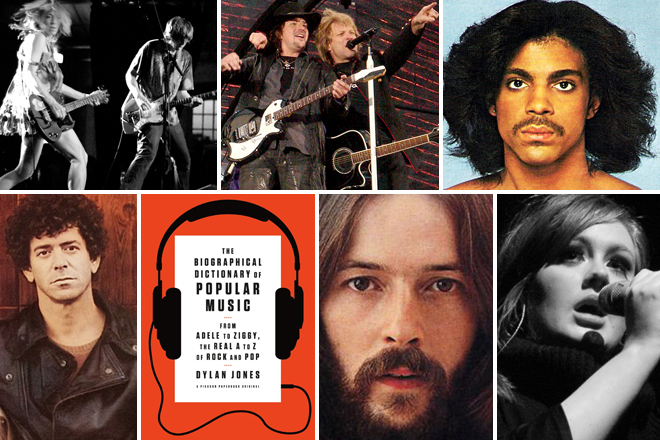

Lou Reed’s been terrible for years!

Kill your idols: A new pop encyclopedia has sharp barbs and surprising praise for Adele, the Eagles, Bowie and more SLIDE SHOW

Topics: Music, Adele, Eric Clapton, The Eagles, Bon Jovi, ,

Lou Reed's been terrible for years!

close X
  • Share on Twitter
  • Share on Facebook
  • Thumbnails
  • Fullscreen
  • 1 of 13
  • ADELE: The only way to properly bridge the generation gap is by having cultural ubiquity, by having the sort of demographic spread and cross-generational traction that wins elections and appeals to critics, aficionados and those who simply need something to stick in the CD player when they’re driving to and from work. Oh, and children. Look at the history of any truly mass pop act and they will more than likely have been hugely popular with the under 10s. Take that Justin Bieber.

  • BON JOVI: When I was in my formative years – 14-15 – the record that made me want to be a man was “Behind Blue Eyes” by the Who. Later, when I was 17, the record that I thought summed up being a man was “Complete Control” by the Clash. But since I’ve actually been a man, dozens of records have made me feel like putting on my boots, picking up my gun and walking through the valley of death. Often, that record is “It’s My Life” by Bon Jovi. Written by Jon Bon Jovi, Richie Sambora and Max Martin, it is just about the most generic Jovi record of them all. A line in the second verse, “For Tommy and Gina, who never backed down,” refers to Tommy and Gina, the fictional working class couple that Bon Jovi and Sambora first wrote about in the 1986 classic “Livin’ on a Prayer.” When JBJ sings, “Like Frankie said, I did it my way,” the hairs on the back of my neck start facing Hoboken.

  • ERIC CLAPTON: Whenever I find myself listening to Eric Clapton, I always feel as though I ought to be in a car commercial. Not an ad for one of those little city runabouts, not a Skoda Fabia, not a Chevrolet Matiz, or a Renault Laguna or one of those miniature Citroens that look as though they were designed – like Glamour magazine – to fit into your handbag as well as your life. No, I mean the sort of ads for proper German behemoths, the gas-guzzling, road-hogging monsters like a Mercedes S-Class, a serious BMW, or any of the new Audis.

  • CROWDED HOUSE: I remember putting on a Crowded House CD (possibly their greatest hits) during a dinner party at my house in the mid-'90s, and two people at the table actually started laughing. Apparently I had committed a terrible cliché, and although I was actually in the mood to hear “Weather With You,” “Four Seasons In One Day,” “Don’t Dream It’s Over,” “Fall At Your Feet,” “Into Temptation” and all the rest, the mood of the room (v. male, three hours in and, I thought, oblivious to what music might be playing in the background) told me otherwise. Their derision was instant and total (I may as well have referred to them by their Australian nickname, the “Crowdies”). This was a sin tantamount to playing Dire Straits’ "Brothers In Arms" in the mid-'80s (not guilty), or indeed anything by Billy Joel (guilty, though not in company) or Fleetwood Mac (ditto). I was intimidated, cowed and never did it again. Not in company, anyway.

  • THE EAGLES: I’m sure there are still some of you who would rather have lighted matches slipped slowly under your fingernails than admit to buying their "Greatest Hits," yet how many of you can honestly say you turn the dial down when “New Kid In Town” comes on the car radio? And while the band’s singing drummer, Don Henley, still has the ability to come out with the most asinine nonsense, as though he were still trying to get into the head of a 13-year-old (“A man with a briefcase can steal millions more than any man with a gun,” is one of my favorites), they still have their grip on the hair-trigger of collective consciousness.

  • GENESIS: “The Carpet Crawlers” and “Los Endos” are officially the two Genesis songs you’re allowed to like.

  • INTERPOL: The ugly Franz Ferdinand. Oh, and with absolutely no hits. Or tunes. Or indeed anything. Great apart from that.

  • PINK FLOYD: Sometimes the public really knows what they’re talking about. And in 1973 they knew that space was the place. "Dark Side Of The Moon" is the sound of pop music getting long. Not stretching wildly in the studio, turning licks into jams into interminable solos, not the inexpert extrapolation of progressive rock. No, this is a journey on a rocket ship, shooting way out into the farthest reaches of the galaxy, to a place where sound doesn’t sound like it does at home, where it bounces around between the planets, pinballing about in one big echo box.

  • PRINCE: Until he started throwing his toys out of the purple pram, rowing with his record company, and embarking on a ludicrous strategy of flooding the market with too much product (most of which could be filed under Too Much Information), Prince was The Man, and for much of the '80s he was The One To Watch. Sexual chameleon, James Brown clone, enigmatic imp, and near-genius songwriter, Prince (once called “the Joe Strummer of orgasms”) treated his acclaim seriously, continually using his own success as a benchmark, forcing himself to top himself with each subsequent album. And for a while it worked.

  • PUBLIC ENEMY: This was not crossover music, not the sort of black music intended to appeal to anyone other than its core constituency. Which is why it was so influential. "Yo! Bum Rush The Show" was the 1987 sound of black consciousness, a torrent of unambiguous anger. With this, and 1988’s "It Takes A Nation Of Millions To Hold Us Back," and 1990’s "Fear Of A Black Planet," Public Enemy became the most politically charged group in hip-hop’s short history. They turned confrontation into an art form – not in a post-modern Sex Pistols way, but in a genuine call-to-arms way. Made a generation of suburban white boys rather too desperate to be black.

  • LOU REED: Am I alone in believing that Lou Reed hasn’t made a good record since 1972?

  • SONIC YOUTH: No, sorry, it’s just too much, way too late. Oh my Lord, when will it end? Maybe with a one-way ticket to Dignitas.

  • Recent Slide Shows

  • Share on Twitter
  • Share on Facebook
  • Thumbnails
  • Fullscreen
  • 1 of 13

Dylan Jones has strong opinions, even when they’re a little dodgy. For my money, he gives Spandau Ballet and Travis too much credit, and R.E.M. and Lloyd Cole nowhere near enough. His favorites hew a little close to the artists he’s interviewed over his long career as an editor and writer at British magazines. (He’s now the editor of British GQ.)

But that’s the thing about critics: Sometimes you love the ones who are so smug and sure and confident that they’re perfectly fine defending something unfashionable, or going on for pages about someone you’d never otherwise have taken seriously. Often, that’s the best way to break past your own biases and prejudices.

And then there’s Jones’ devastating way with a quip. In his new “Biographical Dictionary of Popular Music,” Jones has a way to make you smile even when he’s taking apart one of your favorite acts, to make you think whether he’s celebrating a band or dismissing one. It’s the kind of book you can squander a lot of time flipping through — and it might just send you deep into your own collection or onto iTunes.

This slideshow samples some of his best lines and sharpest opinions. Disagree and defend Lou Reed and his terrific “New York” album in the comments.

Excerpted from “The Biographical Dictionary of Popular Music” by Dylan Jones. © 2012 by Dylan Jones. All rights reserved. Reprinted by permission of Picador.

Continue Reading Close

Next Article

Featured Slide Shows

What To Read Awards: Top 10 Books of 2012 slide show

close X
  • Share on Twitter
  • Share on Facebook
  • Thumbnails
  • Fullscreen
  • 1 of 10
  • 10. "The Guardians" by Sarah Manguso: "Though Sarah Manguso’s 'The Guardians' is specifically about losing a dear friend to suicide, she pries open her intelligent heart to describe our strange, sad modern lives. I think about the small resonating moments of Manguso’s narrative every day." -- M. Rebekah Otto, The Rumpus

  • 9. "Beautiful Ruins" by Jess Walter: "'Beautiful Ruins' leads my list because it's set on the coast of Italy in 1962 and Richard Burton makes an entirely convincing cameo appearance. What more could you want?" -- Maureen Corrigan, NPR's "Fresh Air"

  • 8. "Arcadia" by Lauren Groff: "'Arcadia' captures our painful nostalgia for an idyllic past we never really had." -- Ron Charles, Washington Post

  • 7. "Gone Girl" by Gillian Flynn: "When a young wife disappears on the morning of her fifth wedding anniversary, her husband becomes the automatic suspect in this compulsively readable thriller, which is as rich with sardonic humor and social satire as it is unexpected plot twists." -- Marjorie Kehe, Christian Science Monitor

  • 6. "How Should a Person Be" by Sheila Heti: "There was a reason this book was so talked about, and it’s because Heti has tapped into something great." -- Jason Diamond, Vol. 1 Brooklyn

  • 4. TIE "NW" by Zadie Smith and "Far From the Tree" by Andrew Solomon: "Zadie Smith’s 'NW' is going to enter the canon for the sheer audacity of the book’s project." -- Roxane Gay, New York Times "'Far From the Tree' by Andrew Solomon is, to my mind, a life-changing book, one that's capable of overturning long-standing ideas of identity, family and love." -- Laura Miller, Salon

  • 3. "Billy Lynn's Long Halftime Walk" by Ben Fountain: "'Billy Lynn's Long Halftime Walk' says a lot about where we are today," says Marjorie Kehe of the Christian Science Monitor. "Pretty much the whole point of that novel," adds Time's Lev Grossman.

  • 2. "Bring Up the Bodies" by Hilary Mantel: "Even more accomplished than the preceding novel in this sequence, 'Wolf Hall,' Mantel's new installment in the fictionalized life of Thomas Cromwell -- master secretary and chief fixer to Henry VIII -- is a high-wire act, a feat of novelistic derring-do." -- Laura Miller, Salon

  • 1. "Behind the Beautiful Forevers" by Katherine Boo: "Like the most remarkable literary nonfiction, it reads with the bite of a novel and opens up a corner of the world that most of us know absolutely nothing about. It stuck with me all year." -- Eric Banks, president of the National Book Critics Circle

  • Recent Slide Shows

  • Share on Twitter
  • Share on Facebook
  • Thumbnails
  • Fullscreen
  • 1 of 10

More Related Stories

Comments

36 Comments

Comment Preview

Your name will appear as username ( profile | log out )

You may use these HTML tags and attributes: <a href=""> <b> <em> <strong> <i> <blockquote>