Cinema’s 11 most memorable LGBT villains

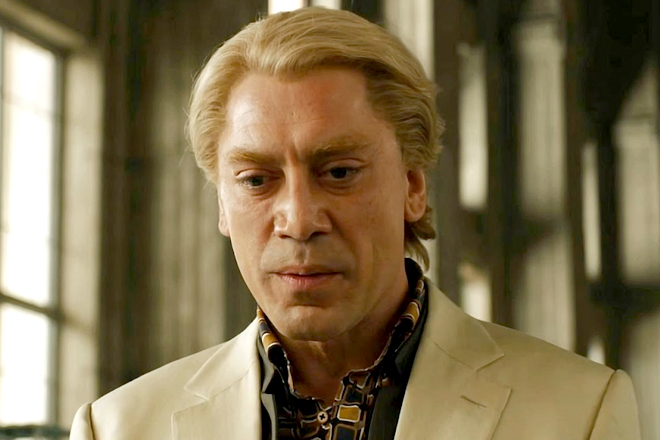
"Skyfall" debuts Bond's first openly gay evildoer, Raoul Silva. Is this progress? Let's look at his predecessors SLIDE SHOW

Topics: cinema, Javier Bardem, james bond, Homophobia, Film, LGBT, Movies, stereotypes,

Cinema's 11 most memorable LGBT villains

close X
  • Share on Twitter
  • Share on Facebook
  • Thumbnails
  • Fullscreen
  • 1 of 12
  • As the title of Alfred Hitchcock’s noir thriller suggests, tennis player Guy Haines (Farley Granger) is on a train when he meets the psychopathic Bruno Anthony (Robert Walker), who quickly insinuates himself into the straitlaced athlete's life and cons him into swapping murders: Bruno’s father, and Guy's wife. The film is rife with homoeroticism (unlike Patricia Highsmith's novel, on which it's based; the lesbian writer expresses it more subtly): When Bruno tries to ease Guy’s visible discomfort at his prying, he says, “There I go again, too friendly. I meet someone I like, and I open my yap too wide.”

    Bruno Anthony from "Strangers on a Train"

  • "Silence of the Lambs" was hugely controversial when it came out in 1991 for its depiction of a transsexual serial killer. Many felt Buffalo Bill (Ted Levine), who would kidnap and murder size-14 women for their flesh, with the intent of constructing a human body suit, was nothing more than a wannabe with gay mannerisms. But it was no less terrifying, especially as the film was released when real-life serial killer Jeffrey Dahmer was at large, killing young men in Illinois and Wisconsin.

    Buffalo Bill from "Silence of the Lambs"

  • "Dune’s" boil-covered, sadistic ogre, played by Kenneth McMillan, would growl, "Bring me that young fellow we bought …with the lovely eyes. Drug him well. I don't feel like wrestling." In David Lynch’s 1984 film adaption of Frank Herbert's novel, Baron is known for raping his beautiful male slaves, smothering them with his fat — and then eating them.

    Baron Vladimir Harkonnen from "Dune"

  • Author Catherine Tramell falls under the conniving, sociopath category: Is she crazy like a fox, though? After all, who'd kill someone in the exact same manner as she'd described in her book? Only psycho-killer author Catherine Tramell (played by a panty-less, leg-crossing Sharon Stone), whose talent for wielding an ice pick is only matched by her ability to juggle bedtime with her lesbian lover Roxy (Leilani Sarelle) and her seduction of the detective (Michael Douglas) who’s hot on her trail.

    Catherine Tramell from "Basic Instinct"

  • In his adaptation of Patricia Highsmith's psychological thriller, Anthony MInghella adds a layer of romance to the story of "The Talented Mr. Ripley" by having Tom Ripley (Matt Damon) yearn for Dickie Greenleaf, not just his wealth. This serves to dial up the tension and raise the stakes for a secretive Tom, suggesting that he was motivated by his spurned homosexual advance.

    Tom Ripley from "The Talented Mr. Ripley"

  • Hitchcock’s bright-eyed newlywed (Joan Fontaine) and her widower husband settle into his estate, Manderley. But the shadowy memory of his first wife, Rebecca, lingers. As does Mrs. Danvers (Judith Miller), Rebecca’s devoted servant, who exhibits a fanatical longing for her dead mistress, especially as she caresses Rebecca's transparent black negligee. “Look, you can see my hand through it,” she says suggestively to Fontaine. Eventually Mrs. D's grief-stricken yearning drives her to burn down Manderley.

    Mrs. Danvers from "Rebecca"

  • Catherine Deneuve plays Miriam, a beautifully dangerous vampire who seduces Sarah (Susan Sarandon) by performing "Flower Duet" on the piano, which causes her unsuspecting victim to spill her blood-red sherry wine all over her white shirt. It's a prelude to, arguably, one of the best lesbian/villain-hero sex scenes. But of course it comes with strings attached: All of Miriam's former vampire lovers have been doomed to suffer an eternal living death, helplessly decrepit and trapped alive in their coffins. Fortunately, Sarah finds a way out.

    Miriam Blaylock from "The Hunger "

  • In Henri-Georges Clouzot's 1955 thriller, Nicole, a stylish laissez-faire teacher (Simone Signoret) conspires to murder her headmaster lover (Paul Meurisse) with the help of his mousy wife (Vera Clouzo), who becomes the new object of Nicole’s “affection” … or is it “animosity”?

    Nicole from "Diabolique"

  • In Pedro Almodóvar's early film, Antonio Banderas stars as Antonio, a young man who becomes fixated on gay film director Pablo (Eusebio Poncela) after having anal sex for the first time. For Antonio, it is an act of love; for Pablo, who is still in love with longtime partner Juan, it’s a one-night stand. The experience sends lovelorn Antonio into a tailspin of infatuation and jealousy that leads him to kill Juan and seduce Pablo’s transsexual brother (Carmen Maura) to get to Pablo.

    Antonio from "Law of Desire"

  • Dame Judi Dench takes a creepy turn as Barbara Covett, a repressed spinster history teacher who falls in unrequited love with free-spirited new faculty member Sheba Hart (Cate Blanchett), who is sleeping with one of her underage male students. When Sheba’s affair is exposed, she runs to Barbara for consolation, only to discover that the older woman is the one who betrayed her secret and has been pining for Sheba the whole time. “You put me in prison, I could get TWO years!" says Sheba. “They'll fly by!" Barbara promises. "I'll visit you every week! We've so much life to live together!”

    Barbara Covett from "Notes on a Scandal"

  • In Sam Mendes’ dark take on suburbia, closeted ex-Marine Frank Fitts (Chris Cooper) is convinced his son is involved with his next-door neighbor Lester (Kevin Spacey) after watching a video of them lifting weights together. Determined to confront Lester, the repressed Frank finds himself making a pass at him, instead. When Lester rejects him, Frank shoots him, revealing just how much his secret has eaten away his sanity.

    Frank Fitts from "American Beauty"

  • Recent Slide Shows

  • Share on Twitter
  • Share on Facebook
  • Thumbnails
  • Fullscreen
  • 1 of 12

James Bond movies have always been charged with sexual innuendo and cast with the occasional homicidal bad guy with a swish, his flamboyance winking at us, alerting us to his homosexuality. But in “Skyfall,” the latest installment of the James Bond franchise, there is no winking, no subtext whatsoever. The gay villain — Javier Bardem’s platinum-blond-tressed, plastic-surgically tweaked Raoul Silva — is out of the closet. And with this introduction, Silva enters the pantheon of cinematic LGBT evildoers who offer something extraordinary to the commonplace villain: a motive that doubles as a kind of apologia. Because in the movies, LGBT villains appear as either brooding and fiercely guarded or sinister and effete, signifying that these aren’t your run-of the-mill bad people. These are villains who are victims of society, their crimes born out of depraved sexuality, unrequited love, self-hatred, gender dysphoria or a desperate need to feel normal. Until the mid- to late ’90s, most of the LGBT portrayals on the big and small screens were of killers or sad sacks — or sad-sack killers. So, is it progress that Raoul Silva is aboveboard about his sexuality? Or have we regressed to the same-old offensive depictions? Let’s review some of the most memorable big-screen evildoers on the higher end of the Kinsey scale.

Lisa Quintela is an attorney, entertainment writer, and film buff who has written for the Washington Post, Entertainment Weekly, Premiere, TimeOut NY, Latina and Paper magazine, among others. Raised in Miami, by way of Cuba, she lives in New York.

Next Article

Featured Slide Shows

What To Read Awards: Top 10 Books of 2012 slide show

close X
  • Share on Twitter
  • Share on Facebook
  • Thumbnails
  • Fullscreen
  • 1 of 10
  • 10. "The Guardians" by Sarah Manguso: "Though Sarah Manguso’s 'The Guardians' is specifically about losing a dear friend to suicide, she pries open her intelligent heart to describe our strange, sad modern lives. I think about the small resonating moments of Manguso’s narrative every day." -- M. Rebekah Otto, The Rumpus

  • 9. "Beautiful Ruins" by Jess Walter: "'Beautiful Ruins' leads my list because it's set on the coast of Italy in 1962 and Richard Burton makes an entirely convincing cameo appearance. What more could you want?" -- Maureen Corrigan, NPR's "Fresh Air"

  • 8. "Arcadia" by Lauren Groff: "'Arcadia' captures our painful nostalgia for an idyllic past we never really had." -- Ron Charles, Washington Post

  • 7. "Gone Girl" by Gillian Flynn: "When a young wife disappears on the morning of her fifth wedding anniversary, her husband becomes the automatic suspect in this compulsively readable thriller, which is as rich with sardonic humor and social satire as it is unexpected plot twists." -- Marjorie Kehe, Christian Science Monitor

  • 6. "How Should a Person Be" by Sheila Heti: "There was a reason this book was so talked about, and it’s because Heti has tapped into something great." -- Jason Diamond, Vol. 1 Brooklyn

  • 4. TIE "NW" by Zadie Smith and "Far From the Tree" by Andrew Solomon: "Zadie Smith’s 'NW' is going to enter the canon for the sheer audacity of the book’s project." -- Roxane Gay, New York Times "'Far From the Tree' by Andrew Solomon is, to my mind, a life-changing book, one that's capable of overturning long-standing ideas of identity, family and love." -- Laura Miller, Salon

  • 3. "Billy Lynn's Long Halftime Walk" by Ben Fountain: "'Billy Lynn's Long Halftime Walk' says a lot about where we are today," says Marjorie Kehe of the Christian Science Monitor. "Pretty much the whole point of that novel," adds Time's Lev Grossman.

  • 2. "Bring Up the Bodies" by Hilary Mantel: "Even more accomplished than the preceding novel in this sequence, 'Wolf Hall,' Mantel's new installment in the fictionalized life of Thomas Cromwell -- master secretary and chief fixer to Henry VIII -- is a high-wire act, a feat of novelistic derring-do." -- Laura Miller, Salon

  • 1. "Behind the Beautiful Forevers" by Katherine Boo: "Like the most remarkable literary nonfiction, it reads with the bite of a novel and opens up a corner of the world that most of us know absolutely nothing about. It stuck with me all year." -- Eric Banks, president of the National Book Critics Circle

  • Recent Slide Shows

  • Share on Twitter
  • Share on Facebook
  • Thumbnails
  • Fullscreen
  • 1 of 10

More Related Stories

Comments

16 Comments

Comment Preview

Your name will appear as username ( profile | log out )

You may use these HTML tags and attributes: <a href=""> <b> <em> <strong> <i> <blockquote>