
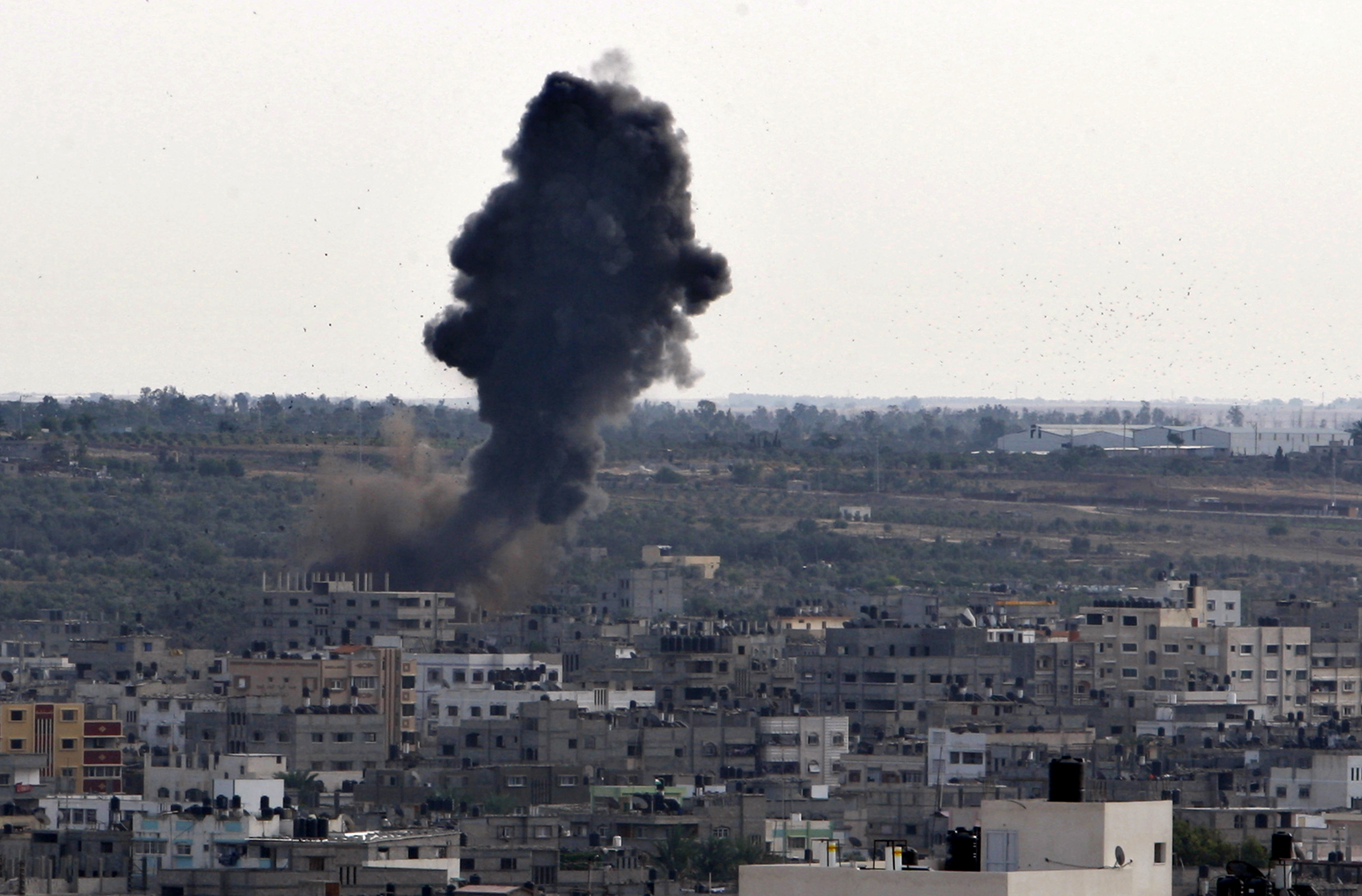

 As I write, and pray for a ceasefire, rockets continue to swarm out of Gaza; Israeli planes continue flock to strike the Hamas-ruled enclave.
This has been an unequal battle in at least two ways. The rockets are indeed a form of terrorism, tired as that word is: The men firing them want to kill random people for a political purpose. Only the technological wizardry of the Iron Dome anti-missile system has kept Israeli casualties low. Israeli pilots, in contrast, aim smart bombs at military targets. But if a bomb is misaimed or the target is inside a crowded neighborhood, the blast is stupid; it kills children as easily as Hamas fighters. Thus the toll rises among people whose only offense is living in Gaza.
So for Israel, there has been a rising moral and a strategic cost, even if the government would prefer to ignore it. Israel’s barrage hasn’t turned Gazans against Hamas. It has made them rally around their government, just as the rockets have boosted support in Israel for Prime Minister Netanyahu. Rather than provide any lasting relief, Israel’s offensive has shown that the Gaza problem can’t be solved militarily. Instead, it has underlined the failure of controlling Gaza through deterrence—the strategy on which Israel’s unilateral withdrawal from Gaza was based. Diplomacy, spurned then, has become more difficult and more necessary, and still requires an American role.
In Israel, it’s fairly easy to remember the hope that the pullout from Gaza in 2005 might bring calm. Israeli hawks constantly cite that broken hope to show the danger of withdrawal from the West Bank. It’s much harder to remember that the withdrawal created a brief but promising opening for negotiating a two-state solution, since few Israelis noticed at the time.
As the Israeli army was completing its pullout and soon after, two Palestinian polling institutes measured the response of the public in Gaza and the West Bank. Most Palestinians credited “armed struggle” with pushing Israel to leave Gaza, and Hamas received much of that credit, the Palestinian Center for Policy and Survey Research (PSR) found. This was predictable. Israeli Prime Minister Ariel Sharon had carried out a withdrawal without a peace agreement. He had called it “disengagement,” as when an army disengages from the enemy—a euphemism for retreat.
The surprise was that public backing for Hamas and continued armed resistance actually dropped. With Palestinian legislative elections a few months off, voters were tilting toward Fatah, a party seen as corrupt but capable of negotiating. Close to 70 percent of Palestinians favored holding final-status talks with Israel. Another poll, by a second institute, pointed to the same trend. The unexpected impact of withdrawal was that the Palestinian public was particularly ready for talks leading to a two-state agreement.
Of course, those talks never happened. Sharon chose a unilateral pullout precisely to avoid peace negotiations, since they could only succeed if Israel agreed to leave nearly all of the West Bank as well. As he planned, disengagement squelched interest in Israel in the Geneva Accord, the model for a peace agreement unofficially hammered out by Palestinians and Israelis. As one of Sharon’s top advisers predicted (Hebrew), the disengagement put President George W. Bush’s roadmap for peace “in formaldehyde.” It allowed Sharon to evade the challenge posed by Mahmud Abbas’s accession to the Palestinian presidency: Abbas very publicly wanted (and wants) to negotiate Palestinian independence in the West Bank and Gaza.
Sharon believed that Israel could safely leave Gaza without peace, and without the security arrangements of a peace agreement. Israeli military power and its control of Gaza’s borders would deter Palestinian attacks.
He was mistaken. What failed was not withdrawal from occupied territory. The failure was doing so unilaterally. Abbas’s unfulfilled promise of diplomatic progress contributed to Hamas’s victory over Fatah in the 2006 legislative election. That was the first step in the chain reaction leading to the violent split in the Palestinian Authority, the Hamas takeover of Gaza, and all that has followed.
Israel’s harshest effort to deter Hamas and more radical groups from firing rockets was Operation Cast Lead, culminating with the invasion of Gaza in January 2009. That effort only seems to have spurred Hamas and its rivals to seek their own form of deterrence by building a large stockpile of missiles, some able to reach Tel Aviv. The last week has shown that deterrence has not worked very well for Hamas either, at least on the level of dissuading Israel from attacking. The fighting has, however, increased support for Hamas not just in Gaza but also in the West Bank, and further weakened Abbas.
Because of Sharon’s bankrupt legacy, the conditions for reaching diplomatic arrangements are much worse today than they were in 2005. But the need is even greater. With the Hamas-Fatah divide, the Israeli-Palestinian conflict now has three sides. If the Obama administration is satisfied with another fragile Israel-Hamas ceasefire, the risks include more strain on the Israeli-Egyptian relation and the potential collapse of Abbas’s government in the West Bank. The advantages that President Obama does have include Egypt’s desire to control Hamas, and Israel’s debt both for political support over the last week and for funding the Iron Dome.
One side of American policy should be announcing, or demanding, resumed negotiations between Israel and Abbas as soon as the next Israeli government is formed. (The precedent is American insistence on the Madrid conference following the first Gulf War.) That move would put a two-state solution back on the Israeli electoral agenda. Among Palestinians, it could improve Abbas’s position.
Dealing with Gaza, one American option is to promote rather than block creation of a Palestinian unity government. Another is to push to extend the indirect Israel-Hamas negotiation of recent days in Cairo, and aim at turning Gaza into a Taiwan-style non-state: able to claim all of Palestine as long as it does nothing about it, able to develop free of the Israeli blockade.
Very recently, it was easy to argue glibly that Obama was too busy with other problems to spend time on Israelis and Palestinians. Once again, though, the Middle East has shown that it is too busy for an American president to ignore.
