

 A gang of brazen CEOs has joined forces to promote economically disastrous and socially irresponsible austerity policies. Many of those same CEOs were bailed out by the American taxpayer after a Wall Street-driven financial crash. Instead of a thank-you, they are showing their appreciation in the form of a coordinated effort to rob Americans of hard-earned retirements, decent medical care and relief for the poorest.
Using the excuse of a phony, manufactured crisis known as the “fiscal cliff” – which isn’t a crisis at all, as economist James K. Galbraith has succinctly explained — they are gearing up to pull the wool over the public’s eyes by cutting Social Security, Medicare and Medicaid. The CEOs are part of the Fix the Debt campaign run by the Peter Peterson-backed Center for a Responsible Federal Budget, which plans to unleash tens of millions pushing for a deficit reduction deal that favors the rich in the lame-duck session and beyond.
You can be sure that many more CEOs in addition to the names on the list below sympathize with plans to shred the social safety net and enjoy windfall tax breaks. But these Scrooges are so bold as to publicly announce their desire to pick the pockets of fellow Americans while simultaneously pigging out at the corporate welfare trough. Multitasking!
A generation ago, an American CEO would think twice about announcing utter disregard not only for his neighbors and employees, but also for the economy, which can’t prosper when income is consistently redistributed upward (see Nobel laureate Joseph Stiglitz’s The Price of Inequality for more on that theme). But in the present culture — even after the Occupy Wall Street movement – these business barons feel perfectly comfortable trumpeting their desire to get richer at your expense.
Here’s a sample of the Fix the Debt CEO Council Hall of Shame. (Download the complete list at the organization’s Web site.)
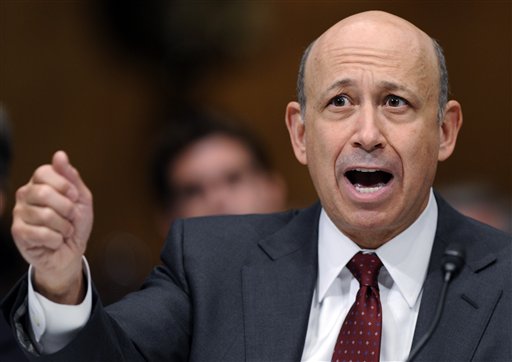
1. Lloyd Blankfein, chairman and CEO, Goldman, Sachs & Co. Blankfein, infamous for describing his financial activities as “God’s work,” shared his attitude toward society with CBS news recently. He explained his keen desire to see Americans lowering their sights for the future. You really have to watch the interview to get the full flavor of Blankfein’s smug assurance that predation can be sold as concern for the nation’s well-being. In addition to trotting out several myths about Social Security’s design and functions, including the bogus notion that retirement age must be raised, he gives a pithy summary of what life is going to be like for the 99 percent:
“You’re going to have to do something, undoubtedly, to lower people’s expectations of what they’re going to get, the entitlements, and what people think they’re going to get, because you’re not going to get it.”
Not if Lloyd Blankfein has anything to do with it. He calls it managing expectations. Here’s another word: theft.
Since the financial crash, Blankfein’s company, Goldman Sachs, has received tens of billions of dollars in what the Economic Policy Journal describes as “direct and indirect succor from the Fed.” In sharp contrast to average Americans, when Goldman needed help in the 2008 crisis, a friendly Federal Reserve let Goldman turn into a commercial bank almost overnight, so it could go to the Fed for help 24/7.
2. Jeffrey Immelt, chairman and CEO, General Electric Company. In 2011, President Obama welcomed outsourcing pioneer Jeffrey Immelt to his White House inner circle as chair of a newly created jobs council – a move that was a sharp slap in the face to American workers. Immelt returned the favor by dumping Obama in favor of Mitt Romney in the recent election.
Obviously, supporting disastrous financial deregulation, dodging taxes and helping to destroy American manufacturing has not satisfied Immelt. He’d like to add insult to injury by making sure that people who have been screwed by the reckless activities of short-sighted corporate titans like himself are left to starve in their golden years and go without medical care. And as for the poor, well, couldn’t they be just a little bit poorer? Immelt thinks that would be swell.
After the 2008 crash, the government gave a giant boost to hard-pressed GE Capital, the company’s financing arm, through the Temporary Liquidity Guarantee Program. GE has also helped itself to enormous taxpayer-funded subsidies, especially in green energy. And guess how much GE paid in taxes in 2010? Nothing. In fact, using what the New York Times describes as its “innovative accounting practices,” it claimed a tax benefit of $3.2 billion!
3. Jamie Dimon, chairman and CEO, JPMorgan Chase & Co. At a recent gathering of the Council on Foreign Relations, Jamie Dimon vented his feelingsabout a number of things that peeve him, from a federal lawsuit brought against JPMorgan Chase to Obama’s failure to adopt the harmful and misguided Simpson-Bowles deficit reduction plan, which, among other things, recommended reducing the tax rate for top earners. Dimon has claimed that his bank did not need the TARP funds bestowed on it by the federal government, but there is no question that today his bank borrows funds more cheaply than smaller banks because of the federal government’s implicit too-big-too-fail guarantee.
Dimon is deploying a familiar scare tactic on the topic of the so-called fiscal cliff. He’s claiming that his company will be forced to cut down on hiring and so on if a budget plan is not tailored to enrich the wealthy. During a recent visit to India, he issued warnings to CNBC-TV18:
“I’ve spoken to CEOs who say, you know, absolutely, we are making decisions to protect ourselves from the ‘fiscal cliff’ and those are like investment decisions and hiring decisions.”
Maybe Dimon’s company would be better served figuring out what happened to the $6 billion that recently went up in smoke in the “London Whale” derivatives fiasco.
4. W. James McNerney, Jr., chairman, president and CEO, the Boeing Company. McNerney launched at Procter & Gamble, reached high altitude at GE and shot to the stratosphere by becoming head honcho at Boeing in 2005.
Boeing has been a long-time beneficiary of the government’s Export-Import Bank, which has financed sales of many of its planes. McNerney chairs President Obama’s Export Council, where he works hard to arrange policies that benefit his company. He spent much of 2011 slugging it out with the National Labor Relations Board over moving assembly plants from Washington to South Carolina, a right-to-work state. That got settled, but now the profitable company is in a fight with engineers who don’t want their pensions chopped nearly in half. Boeing’s excuse? It wants to keep the engineers “competitive.” Union members have reported intimidation from the company’s management as the dispute has intensified.
The Boeing boss is now crying “deficit” and asks for your retirement money. Pretty brassy, considering that the company paid not a single penny in taxes between 2008 and 2011. In fact, Citizens for Tax Justice calculates that Boeingactually got money back from the U.S. government over the past decade, “paying a negative 6.5 percent tax rate, even though it was profitable every year from 2002 through 2011.”
5. David Cote, chairman and CEO, Honeywell International Inc. David Cote is a veteran of GE and also sits on the board of JPMorgan Chase, where he is one of three members of the risk committee that failed to prevent the disastrous $6 billion trading loss mentioned above. Cote has led Honeywell, one of the world’s largest industrial conglomerates, since 2002. Along with GE and Boeing, Honeywell shares the distinction of being a top corporate polluter.
Obama invited Cote to join the Simpson-Bowles deficit commission in 2010, where he worked hard to create a flawed plan meant to reward the rich and cut vital services for the 99 percent. Meantime, sales of mostly aerospace-related Honeywell products sold to the government make up about 12 percent of Honeywell’s total revenues.
Here’s the 2009 figure for what Cote raked in as Honeywell’s CEO: $12,839,038. In response to the recession, Cote forced Honeywell’s employees to take unpaid furloughs of between two and five weeks during 2008 and 2009.
6. Glenn Britt, chairman and CEO, Time Warner Cable Inc. Maybe the head of one of the world’s largest media conglomerates is ticked off because hiscompensation dropped from $17.4 million in 2010 to $16.4 million in 2011. Whatever it is, he is channeling his frustration by setting his sights on your wallet.
As a telecom giant, TWC is part of one of the most despised industries in America, and it’s no wonder. Whether it’s offering terrible customer service (Britt is devising a special “white glove” package for the affluent), leaving customers disconnected during Hurricane Sandy, or lobbying for laws that squash competition and lead to telecom oligopolies, Britt seems out to prove that his company can only succeed if the rest of the country suffers.
And with his Fix the Debt campaign, he’d like to make that suffering just a little more intense.
7. Reid Hoffman, cofounder and executive chairman, LinkedIn Corporation. Reid Hoffman brought us LinkedIn, possibly the most annoying social media network on Planet Earth. Why is it necessary to send scores of nagging emails to accept invitations to “link” to people you don’t even know? No one can say. But it sure is irritating. LinkedIn, along with his investments in companies like Facebook, has made Hoffman a billionaire. He’s ready to start giving – to the rich.
Hoffman hails himself as the champion of entrepreneurship. What he fails to mention is that entrepreneurship gets stifled when people don’t have a decent social safety net. You can’t take risks starting a new business if there’s nothing to fall back on. That’s why Norway is considered an entrepreneur’s heaven: the social safety net is strong and there’s far less shoveling income toward the rich.
Fix the Debt proposals would shred the social safety net, increase income inequality and make entrepreneurship less attractive for Americans. Hoffman’s presence on this list means only one thing: he wants to make it harder for you to be an entrepreneur like him. He’s made his money. And now he’s bent on kicking the ladder out from under the rest of us.
8. Richard Anderson, CEO, Delta Air Lines, Inc. Historically, airlines have been recipients of enormous subsidies from the federal government; after 9/11,many of those subsidies increased.
Delta CEO Richard Anderson enjoyed a 10 percent raise in 2011, bringing his compensation to $8.9 million. Not bad for a year when the company’s stock pricefell by more than a third. Delta employees didn’t fare so well as the boss. In 2010, Delta flight attendants lost their battle to protect their pay and benefits. According to Labor Notes, Anderson was quite creative in his effort to crush the American dream of those hard-working folks:
“[Anderson] played up a culture clash between Northwest’s Northern base and Delta’s Southern workforce, attacking AFA [Association of Flight Attendants] in one company-called meeting for being ‘un-Christian’ and ‘immoral.’ A DVD of the meeting was sent to every flight attendant.”
As the head of an airline, Anderson knows that his business would not have been possible but for the taxpayer-funded research and development that led to the creation of passenger jets, along with enormous air mail subsidies. He returns the favor by screwing workers and attempting to pass austerity measures designed to stick it to working people whose tax dollars make his job possible.
9. Dave Barger, president and CEO of JetBlue Airways Corp. Sky’s the limit to Dave Barger’s fondness for right-wing politicians. And he’s quite proud of being the only major U.S.-based airline that’s “100% union free.” Several grassroots attempts at unionization have failed in recent years, much to his delight.
JetBlue has been running Fox shows on its in-flight entertainment network since 2004. Recently, the company pulled its sponsorship of Yearly Kos, a convention held by liberal Web site DailyKos, in response to pressure from Fox’s Bill O’Reilly.
Like Delta CEO Richard Anderson, Dave Barger understands very well that the airline industry has enjoyed enormous benefits thanks to the U.S. taxpayer, from the massive airports built at government expense to air traffic control infrastructure, which is heavily subsidized. And, like Anderson, he’d like to deliver a sharp kick in the teeth to the customers who support his business and would like to have a decent retirement and, oh, maybe some quality care when they’re sick.
