

 “Fix the Debt,” as you’ve probably noticed from the Internet ads that are now as ubiquitous as the old Netflix pop-ups, is the newest high-profile effort by Peter G. Peterson and allies to build a public movement for long-term deficit reduction. Fix the Debt appears to be an ambitious public relations and grassroots lobbying effort layered on top of the other major Peterson-funded anti-deficit groups, all of them pushing for a “grand bargain” on taxes and spending, ideally before the “fiscal cliff” (or what I prefer to call the “fiscal reset,” because it’s a chance to start over and reconsider bad choices from the 2000s). These include the Committee for a Responsible Federal Budget, the Concord Coalition, the Comeback America Initiative (former Peterson Foundation president David Walker’s new project), as well as groups such as the Business-Industry Political Action Committee.
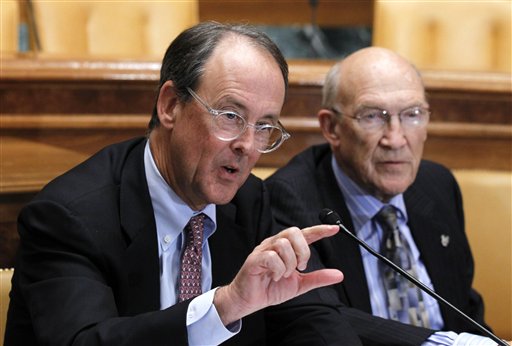
Although Fix the Debt’s co-chairs are Alan Simpson and Erskine Bowles, of the failed Simpson-Bowles commission, the organization has no specific deficit reduction plan. Its basic principles are that debt reduction is urgent and that it should be “comprehensive.” “Everything should be on the table” is the closest thing to a motto. That compares favorably to the Republican attitude, circa 2011, that everything should be on the table except taxes. Fix the Debt has enlisted several prominent Democrats in addition to Bowles, notably former Pennsylvania governor Ed Rendell.
So far, so good. No doubt the long-term budget gap needs to be narrowed and the ratio of debt to GDP stabilized, and it’s better to chart that path sooner rather than make disruptive changes later. The evidence I see indicates that long-term fiscal stability is primarily a problem of system-wide health cost inflation and historically insufficient revenues – but that just affects my idea of a solution, not the long-term goal.
But there’s one exception: When it comes to taxes, Fix the Debt has a less open-minded position than it seems: Their “core principle” is “comprehensive and pro-growth tax reform, which broadens the base, lowers rates, raises revenues, and reduces the deficit.” That could be okay, too – but everything depends on the baseline. If the Bush tax cuts are allowed to expire on January 2, in accordance with the law, then the next step would surely be to lower some of the rates that would come back into effect, principally for the middle class, and also to “broaden the base,” such as by bringing taxes on capital gains in line with other rates and thus eliminating the “carried interest loophole,” the “hedge fund loophole,” and all the others that play on that unwarranted tax preference. But that doesn’t seem to be what Fix the Debt is thinking about. They seem to hold an unspoken core principle that the grand bargain must be achieved before the fiscal reset on January 2. That, in turn, implies that any deal would “lower rates” from the already very low tax rates of the Bush tax cuts. That’s the essence, for example, of Fix The Debt leader Maya MacGuineas’s Washington Post op-ed last week, which declared as a certainty that “Going over the cliff would be the worst possible outcome.”
It’s also the argument of a paper posted prominently on the website of MacGuineas’s Commitee for a Responsible Federal Budget, which challenges a study by the congressional Joint Committee on Taxation showing just how difficult it would be to achieve all the goals of lowering tax rates, raising revenues, and reducing the deficit. CRFB claims that the Joint Tax Committee study erred by starting the exercise using the “current law baseline” – that is, assuming that all the Bush tax cuts would expire. From there, letting rates go back up will have already raised a lot of revenue, some loopholes will have already been narrowed (including the preference for investment income), and there will be some limits on deductions for high earners. CRFB insists that comprehensive tax reform is possible if and only if you begin with the “current policy baseline” – that is, assume the Bush tax cuts continue and work from there, or do the deal before the cuts expire. It’s a very complicated argument, but what it comes down to is this: Letting the tax cuts expire by law would actually achieve many of the goals of tax reform, as I wrote in October. But if the tax reform is already half-completed, there’s less room for classic tax reform in a grand bargain.
And thus, Fix the Debt and its partners find themselves twisted in a knot. Because “comprehensive tax reform” is such a central component of their vision, they have to root for the Bush tax cuts, because there’s not much room for reform otherwise. But supporting the Bush tax cuts, as a baseline, is not “fixing the debt.” It’s the opposite, since the Bush tax cuts make up almost all of the long-term projected deficit, as this chart from the Center on Budget and Policy Priorities shows:
It’s also worth noting that Fix The Debt’s approach to taxes is not the same as the Simpson-Bowles commission. Simpson-Bowles started from the assumption that the Bush tax cuts would expire. Insisting that the Bush tax cuts form the starting point for negotiations was the position, instead, of Mitt Romney, Paul Ryan (it was one reason he opposed Simpson-Bowles), and the current House Republicans.
I’m not sure why Fix the Debt put itself in a position where it now seems more concerned with protecting the Bush tax cuts than actually reducing the long-term deficit. Maybe it’s that the devotion to the fantasy of a grand bargain that includes something called “tax reform” drove them there. Maybe it’s that it’s necessary to maintain the nominal support from Republicans and business leaders that they boast. But whatever the cause, it’s where they seem to be. And a group devoted to fiscal responsibility has no business protecting one of the two most irresponsible fiscal choices in recent history.
