
Does anyone want Medicare cuts?

A new poll reveals that 68 percent of conservatives oppose slicing the health care program for seniors

Topics: The American Prospect, Medicare, Washington Post, ABC, Mitt Romney, Affordable Care Act,

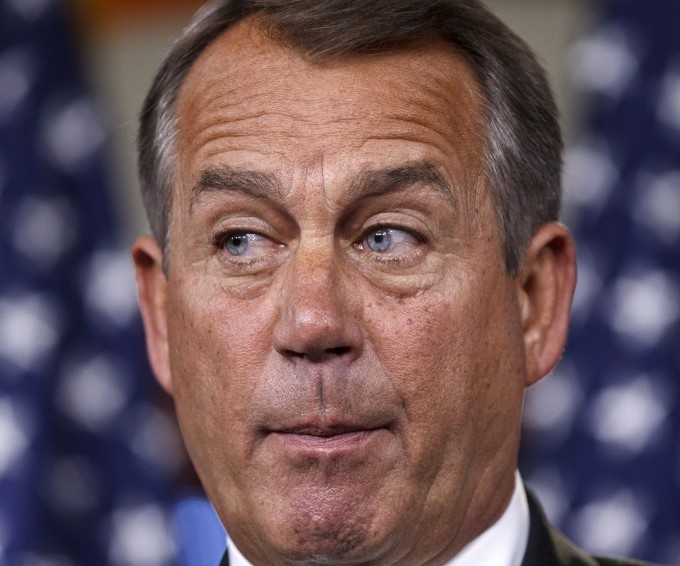
Does anyone want Medicare cuts?John Boehner (Credit: AP/J. Scott Applewhite)
This article originally appeared on The American Prospect.

The American Prospect One of the more interesting results in yesterday’s Washington Post/ABC News poll, as the Post‘s Greg Sargent alluded to this morning, is the overwhelming opposition to Medicare cuts from Republican voters. Sixty-eight percent of self-identified Republicans—and 68 percent of self-identified conservatives—oppose cuts to the health-care program for seniors.

There’s no question that this is the result of the GOP’s demographics. Sixteen percent of all voters this year were 65 or older, and they broke for Mitt Romney, 56 percent to 44 percent. If you disaggregate by race—and count only white seniors—that margin widens by 5 points in Romney’s direction. And if you include the age group just below seniors—a large portion of whom are several years away from claiming Medicare benefits—you have Romney winning 61 percent of white voters who are 45 or older.

In other words, it’s no wonder GOP voters are opposed to Medicare cuts—it’s money out of their livelihoods in a way that’s concrete and (I imagine) frightening.

But, with that said, it’s also worth considering the role Republican leaders have played in encouraging opposition to Medicare cuts. In 2010, GOP congressional candidates—to great success—ran against the Medicare savings in the Affordable Care Act. Although the following year, House Republicans relentlessly pushed the Ryan plan, which called for massive cuts to Medicare for everyone under the age of 55, they reversed course during the 2012 election. Mitt Romney’s and Paul Ryan’s sole word on Medicare was an attack on the administration for “stealing” from Medicare in order to fund Obamacare, and a promise to restore the $716 billion in cuts.

Is it any surprise that—after two solid years of running against them—Republicans find themselves with an electorate that’s overwhelmingly opposed to the prospect of Medicare cuts? Congressional Republicans can certainly try to include cuts in a deal over the fiscal cliff, but given their unpopularity with GOP voters, it’s not a wise move.

It should be said that this problem will only become worse. The GOP electorate is aging, with more and more people entering the ranks of Medicare recipients. As time goes on, older Republican voters are likely to become even more opposed to Medicare cuts, putting GOP politicians in the same, tough position: committed to smaller government but reliant on voters who rely on one of our largest programs.

Continue Reading Close

Next Article

Featured Slide Shows

What To Read Awards: Top 10 Books of 2012 slide show

close X
  • Share on Twitter
  • Share on Facebook
  • Thumbnails
  • Fullscreen
  • 1 of 10
  • 10. "The Guardians" by Sarah Manguso: "Though Sarah Manguso’s 'The Guardians' is specifically about losing a dear friend to suicide, she pries open her intelligent heart to describe our strange, sad modern lives. I think about the small resonating moments of Manguso’s narrative every day." -- M. Rebekah Otto, The Rumpus

  • 9. "Beautiful Ruins" by Jess Walter: "'Beautiful Ruins' leads my list because it's set on the coast of Italy in 1962 and Richard Burton makes an entirely convincing cameo appearance. What more could you want?" -- Maureen Corrigan, NPR's "Fresh Air"

  • 8. "Arcadia" by Lauren Groff: "'Arcadia' captures our painful nostalgia for an idyllic past we never really had." -- Ron Charles, Washington Post

  • 7. "Gone Girl" by Gillian Flynn: "When a young wife disappears on the morning of her fifth wedding anniversary, her husband becomes the automatic suspect in this compulsively readable thriller, which is as rich with sardonic humor and social satire as it is unexpected plot twists." -- Marjorie Kehe, Christian Science Monitor

  • 6. "How Should a Person Be" by Sheila Heti: "There was a reason this book was so talked about, and it’s because Heti has tapped into something great." -- Jason Diamond, Vol. 1 Brooklyn

  • 4. TIE "NW" by Zadie Smith and "Far From the Tree" by Andrew Solomon: "Zadie Smith’s 'NW' is going to enter the canon for the sheer audacity of the book’s project." -- Roxane Gay, New York Times "'Far From the Tree' by Andrew Solomon is, to my mind, a life-changing book, one that's capable of overturning long-standing ideas of identity, family and love." -- Laura Miller, Salon

  • 3. "Billy Lynn's Long Halftime Walk" by Ben Fountain: "'Billy Lynn's Long Halftime Walk' says a lot about where we are today," says Marjorie Kehe of the Christian Science Monitor. "Pretty much the whole point of that novel," adds Time's Lev Grossman.

  • 2. "Bring Up the Bodies" by Hilary Mantel: "Even more accomplished than the preceding novel in this sequence, 'Wolf Hall,' Mantel's new installment in the fictionalized life of Thomas Cromwell -- master secretary and chief fixer to Henry VIII -- is a high-wire act, a feat of novelistic derring-do." -- Laura Miller, Salon

  • 1. "Behind the Beautiful Forevers" by Katherine Boo: "Like the most remarkable literary nonfiction, it reads with the bite of a novel and opens up a corner of the world that most of us know absolutely nothing about. It stuck with me all year." -- Eric Banks, president of the National Book Critics Circle

  • Recent Slide Shows

  • Share on Twitter
  • Share on Facebook
  • Thumbnails
  • Fullscreen
  • 1 of 10

More Related Stories

Comments

9 Comments

Comment Preview

Your name will appear as username ( profile | log out )

You may use these HTML tags and attributes: <a href=""> <b> <em> <strong> <i> <blockquote>