
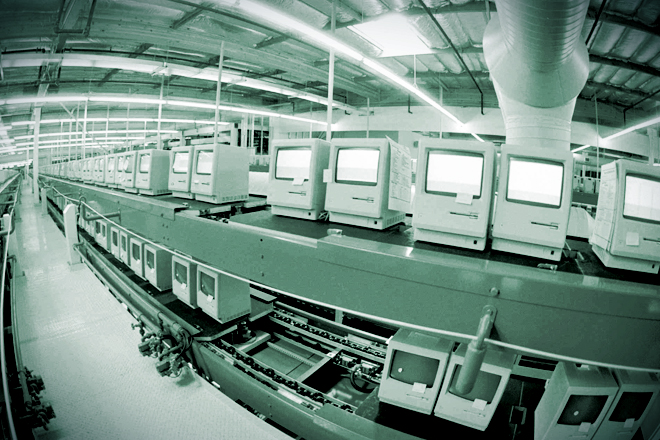

Tim Cook may not be Steve Jobs, but the new Apple CEO proved this week that he is just as good as the old Apple CEO at getting the media to snap to attention. One carefully calibrated bomb dropped toward the end of a humongous Bloomberg BusinessWeek interview — that Apple plans to spend $100 million to bring some Mac manufacturing back to the United States in 2013 — rocketed around the world, from Twitter to the New York Times, in less time than it takes to run down the battery on your iPhone. Who needs Steve Jobs? Real jobs are coming back to America!
The timing was perfect for a growing cohort of economy-watchers eager to make the argument that globalization’s malign impact on the American worker has hit high tide and is finally beginning to ebb. Just a week ago, the Atlantic presciently published “The Insourcing Boom,” a fascinating in-depth story by Charles Fishman investigating General Electric’s decision to start up new appliance assembly lines in the U.S. And “GE is not alone,” writes Fishman, arguing that an increasing number of American corporations are discovering it makes economic sense to bring the factories back home. Apple’s news was the exclamation point at the end of the Atlantic’s sentence.
Except it wasn’t, really. Big changes are certainly afoot in the global economy, and there are very good reasons why transnational capital may now be willing to lavish some long-lost love on the U.S. But Tim Cook’s announcement, on its face, is hardly proof of this trend, or cause for celebration. $100 million isn’t even a rounding error on the balance sheet of global tech manufacturing. The cost of building a new, state-of-the-art microchip fabrication plant, for example, is around $5 billion and rising. Foxconn, Apple’s chief manufacturing partner, spends upward of $4 billion a year to produce its zillions of iPhones and iPads. Apple itself currently has around $123 billion in cash sitting around, waiting for someone to figure out what to do with it. $100 million, in the context of Apple making a significant dent in bringing the manufacturing of its products back to the United States, is a joke. Cook’s overture is better seen as a marketing exercise than as a gut-check on changing patterns of global supply and production chains.
But what about the larger thesis? Why has General Electric suddenly decided to make water heaters and refrigerators in its long dormant factory town, “Appliance Park,” again? Is there any reason for the Rust Belt to hope for a real manufacturing revival?
The answer to that question is complicated, and requires us to consider one of the most depressing facts about modern capitalism: namely, what’s smart for the American corporation isn’t necessarily that great for the American worker, even if the new jobs created by “insourcing” are in the United States instead of China. Because even as one can make a good argument that there is an economic justification for making things in the U.S., and on that basis predict that we’re going to see a lot more manufacturing jobs return to the United States, that still doesn’t mean happy days are here again for the American worker.
Charles Fishman makes a compelling argument why a lot of the initial rush to outsource manufacturing, which was clearly motivated by the desire to take advantage of cheap overseas labor, was profoundly unwise, and ignored some real costs. When you move production away from your domestic market, you also break the positive feedback loop that occurs when you have engineers, designers, workers and consumers all in the same location. What the economists like to call “clustering” is also very real. If you move chip manufacturing overseas, that’s where the new innovations in chap manufacturing are going to happen. There are plenty of positive “spillovers” that accrue to a thriving manufacturing base. There’s more to long-term success in manufacturing than just the relative price of labor.
The people at GE that Fishman interviews make this case explicitly, and one can only wonder at how long it took them to realize it. Certainly, no one in Taiwan or Korea or Japan or China had any problem understanding the fantastic benefits that come in the wake of a strong manufacturing sector. But as Fishman himself acknowledges, another huge factor propelling the tentative reversal of these decades-long trends is that labor costs overseas are rising, while labor costs in the United States are falling.
American unions are changing their priorities. Appliance Park’s union was so fractious in the ’70s and ’80s that the place was known as “Strike City.” That same union agreed to a two-tier wage scale in 2005 — and today, 70 percent of the jobs there are on the lower tier, which starts at just over $13.50 an hour, almost $8 less than what the starting wage used to be.
Whether you are fervently pro-union or believe organized labor is a parasitical force leeching the lifeblood out of the economy, it’s awfully strange to use the formulation “American unions are changing their priorities” to describe what’s happened to the relationship between labor and capital in the U.S. in the last quarter-century. Friends and foes of unions can all agree: Organized labor got its ass handed to it on a platter by capital. “Priorities” changed because there was no other choice, like your priorities change when you see a locomotive headed directly toward you. Globalization was the locomotive, and the American worker was tied to the tracks.
So, another more cynical way to look at why insourcing is suddenly all the rage starts from the understanding that American corporations embraced offshoring as one tactic (of many) to weaken the negotiating power of unions. And it worked! Mission accomplished! Now that the power of organized labor has been broken, they can safely return home.
This might be an oversimplification of a complex, multi-factored process, but one does have to wonder how great insourcing will end up for American workers, when the average wage of these new jobs is significantly lower than it was for comparable jobs 20 or 30 years ago.
Slate’s Matthew Yglesias has long argued that Democrats make much too much fuss about manufacturing, for precisely this reason. Manufacturing jobs are no longer the middle-class bulwark that they were in the decades immediately following WWII. Now, they’re low-level jobs, always on the verge of being wiped out by the next advance in robot technology, and under constant wage pressure from workers all over the world.
If we want to judge whether reverse globalization is good for America, counting the number of new manufacturing jobs is probably the wrong metric to be using. The much more important standard of measurement is inequality. If the decision by companies like GE to restart assembly lines in the U.S. is the harbinger of an era in which workers start to get a larger piece of the pie, or the stagnating (and falling) incomes of middle-class families start moving in a positive direction, then we can cheer. But there’s no sign of that happening yet, and it’s not at all clear that a job putting together water heaters is the right pathway toward that future.
I asked Charles Fishman whether he was underplaying the relative importance of the changing fortunes of organized labor in his positive appraisal of insourcing. His answer, as usual, was forthright:
“You don’t have to be cynical to say that outsourcing broke the US manufacturing unions. It’s simply true. The cynical interpretation might be that companies did it to break the unions, but I don’t think it was anything that deliberate. Union wages and union benefits were hurting US companies in competitive terms — and unions did an abysmal job seeing the future and finding ways of adapting. Why didn’t the GE unions, for instance, propose this kind of teamwork 15 years ago? Unions didn’t help US companies try to compete. They just stood their ground — while the ground dissolved.
“The manufacturing went overseas because in 1990 you could hire 30 Chinese workers for every American worker. That math seemed obvious. These other costs — which turned out to be big and very damaging — weren’t so easy to see. And no one is rewarded for saying, let’s keep the factory here and do some [lean manufacturing] and some other things and save on transportation costs. You’re rewarded in your bonus for being able to say, Wow! I cut labor costs 40 percent!
“I agree with you, I think the wages are a bit discouraging. But. I agree with the union that it’s better to have 1,500 new jobs, at $13.50 an hour, where wages rise steadily every six months, than no jobs at $21 an hour. Benefits are the same as for long-term workers. The union is still in place.”
That’s the reality of reverse globalization and insourcing. And it’s easy enough to bring it all back to Apple. Because another thing that Tim Cook said in his BusinessWeek interview was that the commitment to bring at least one Mac manufacturing line back to the U.S. “doesn’t mean that Apple will do it ourselves, but we’ll be working with people, and we’ll be investing our money.”
Who will those people be? Well, the most likely prospect is of course Foxconn, the manufacturing giant that currently possesses the most “know-how” necessary to produce Apple products. U.S. laws won’t allow Foxconn to import the same model of factory organization that the company employs in China, but that doesn’t mean that these new jobs will remotely resemble the U.S. manufacturing jobs of yesteryear either.
For one thing, they’ll probably be performed by robots. Who never, ever go on strike.
