

Over the week of Thanksgiving, I was on a cruise. The idea of my going on a week-long cruise provoked a seemingly endless series of smirks and scoffs from everyone I told beforehand. I am not exactly the cruise ship type. Cruises, as we all know, are environmentally disastrous post-industrial American extravagances, bloated and vulgar parodies of the classy transatlantic voyages of yesteryear, with more than a touch of colonialism in the way they deposit their hordes of rich passengers on poor islands, making small economies dependent on their tourism dollars but keeping the vast majority of them for the fantastically profitable companies that own the boats. Cruises are gross and weird and I was sure I would hate going on one.
When I agreed to write about my time At Sea, I did so knowing that it is unwise to invite comparison to the beloved author of That One Essay everyone mentions when you tell them you are going on a cruise. I’ve read it, of course, though not in 10 years, at least. I’m not half the writer that the author of that particular beloved piece was, though I think I’m perhaps better able to enjoy myself than he was. (Though not without assistance, as my bar bill showed by the end of the week.)
Here is what I’m trying to avoid: smug condescension at those ugly, fat Americans who are totally unable to appreciate foreign travel unless it’s wrapped in as comfortably American a package as possible. And also: bleeding-heart liberal hand-wringing over the poor lot of the ship’s crew, the overwhelming majority of whom are from very poor nations. Both of those themes are well-worn and boring. I will, though, complain about the food.
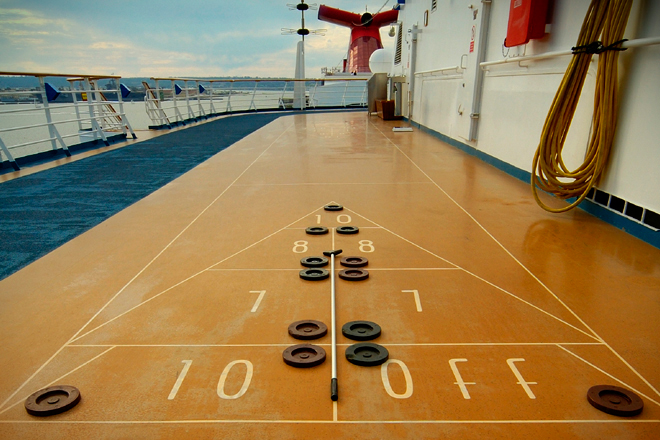
I was on board the Oasis of the Seas, billed as the largest cruise ship ever built — nearly five times the size of the Titanic, by gross tonnage — though it was whispered once we were aboard that her sister ship, the Allure of the Seas, was in fact wider by nearly a foot. Second place or no, the thing towered over every other ship, and most buildings, at every port. Seen from land, it was vaguely ominous, or at least vulgar.
The Oasis has room for 6,000 passengers and another couple thousand crew, making it a small floating city. Or, more accurately, two small floating cities, one mostly below the other, and largely out of sight, except for when its residents are pouring drinks for the residents of the upper decks, or cleaning their rooms. (OK, maybe three floating cities, if you count the nicer, fancier one the richest, most frequent cruisers inhabited, just above us petite bourgeoisie.) The ship was massive enough that it never quite seemed crowded, though its main “promenade” was about as difficult to walk through as midtown Manhattan, and whenever the sun made an appearance the top two decks teemed with sunbathers.
Having grown up in a landlocked state, I still have a slightly childish fascination with the ocean, and I enjoy boats and being on the water, but a super-mega cruise ship is not built to please people who enjoy being reminded that they are at sea. The top deck was mostly a narrow ring around the pool area, and the majority of the boat’s restaurants, bars, dining rooms and amenities were indoors. On Deck 8 was a bit of green space, sort of absurdly called “Central Park,” that was roofless but totally enclosed on all sides. It looked more like a Galleria mall than the park it was named for. I envied the passengers with stateroom balconies overlooking the ocean, but not so much the ones with interior balconies overlooking the ship’s “Boardwalk” area in the back, with a noisy carousel (with hand-carved horses!), restaurants and the ship’s “aquatic theater,” with “the deepest pool at sea.”
The bar on the top deck closed at 11 most nights, and if you wanted a late-night drink, you had to go to the casino, which, like all casinos, was windowless and depressing. Our stateroom had no porthole or balcony, which served to amplify motion sickness. When the ship traveled at top speed, it felt like being in a windowless Atlantic City hotel room that slowly rocked back and forth.
I was with a large contingent of family — aunts, uncles, cousins, mother and stepfather, brother, grandmother — and while I love them all, I was a bit grateful that cruises make it blessedly easy to limit the amount of time you spend with your party (the fact that no one’s phones work helps, too). I was also with my girlfriend, who had gone on a cruise once before, though for a much shorter voyage on a much smaller boat.
Here is what I noticed about cruises: A lot of it seems to revolve around trying to convince people to buy diamonds. Either people — seemingly regular, Middle American family people, rich enough to cruise but not rich enough to do what real rich people do on vacations — spend thousands of dollars buying diamonds, on board the ship and at port, after already having spent thousands of dollars on cruise tickets, or else the people in charge of cruises intend cruisers to think that is what everyone else is doing. (No one in my party bought any diamonds, though my uncle bought cigars he was told were Cubans and we each purchased a few shockingly cheap cartons of duty-free cigarettes.)
The food is awful. I’m sure there was fine food to be had at the “specialty restaurants” (well, not the Johnny Rockets, obviously, but one of the other ones), but everyone had already paid quite a bit for an endless supply of the crappy food and it seemed extravagant to pay for nicer meals. For the most part it was designed for the depressing Middle American palate, starchy and bland, with salt the most dominant and frequently sole seasoning. The appearance, on the last day, of a soup tasting distinctly of cilantro seemed a small miracle. In the buffet, you quickly learned to seek out whatever everyone else seemed scared to go near, which generally tended to be surprisingly good Indian fare.
You have to pay for soda, which seems like a scam designed to make sure kids didn’t get away with drinking for free, though the coffee was free, unless you wanted it from the Starbucks kiosk on the promenade. (I am reasonably sure the “Starbucks coffee” was exactly the same as the free coffee.)
Water was slightly hard to come by. They put huge spring water bottles in your room, and charge you six bucks for drinking one of them, and the water in the stateroom bathroom sinks tasted of chlorine. I spent much of Day 2 terrified that I’d poisoned myself by drinking it, though I was likely only hung over and a bit seasick.
I was slightly surprised to learn that the drinks were no more expensive than they are at a neighborhood bar in New York, though they are perhaps more expensive than they would be at a neighborhood bar in much of the rest of the country. The tips — a decent 15 percent — are included on all the bills, for each and every drink, which is a very civilized way of doing things altogether, and almost as good as simply paying your employees what they deserve. I am sure that cruise ship employees are grateful to be working in a totally cashless economy, as people tend to be more generous than usual when paying for everything with key cards tied to bills they needn’t look at until the last night on board.
I felt worst for the teens. The ship had a large contingent of teens, all traveling with family and uniquely miserable. American drinking age was in effect, too, making the 18- to 20-year-olds the saddest cruise-goers of all. There was a garishly decorated “teens only” lounge on an upper deck, which usually contained a small contingent of teens taking turns sitting on one another’s laps, but otherwise they wandered the ship listlessly, drinking Cokes and waiting for the stray beers that’d be surreptitiously slipped them when their cooler relations had already had a few. For some reason “Gangnam Style” played at one bar or another almost hourly, and whenever I heard it a seemingly different contingent of teens would appear from nowhere and do the dance.
There were also kids, scores of them, riding up and down the glass elevators and running on the pool deck and eating only dessert for dinner at the buffet. They were all enjoying themselves much more than the teens, though by the end of the trip the ship ran out of surprises and dangerous boredom set in. (One girl, probably 9, studied a much smaller Carnival ship docked near ours as we prepared to set off from St. Martin back to Florida, and had a shocking realization. “They have a pool on the front of their ship,” she said, her back to our ship’s zip line, kids’ pool, basketball court and table tennis tables. “It’s not fair.”)
The ship was also full of parents having a blast. This is how I realized why people do these ridiculous, pricey things. It’s quite difficult to enjoy yourself on vacation with children. I know because I was once the child ensuring that my family did not enjoy themselves too much. Maybe if you want to go camping or hiking or something, you can drag kids along, but if you want to go drinking and dancing and gambling and nightclubbing, you need to find somewhere to put your wretched kids, and simply leaving them to fend for themselves in Vegas hotel rooms is probably inadvisable. So you cruise. Your kids have an endless supply of their own amusements and no real opportunities to get into serious trouble, and you can relax and enjoy yourself like a childless person, or a person wealthy enough to hire help. It’s brilliant. (The only downside being the cost: Each child’s ticket is just as expensive as each adult’s.)
Nearly everyone who serves you is non-white and nearly all your fellow cruise-goers are white. (Though not all of them. There were a fair number of African-American cruise-goers on board, though it appeared that nearly all of them were near retirement age, or older, while the white Americans were young and old in equal numbers.) The captain was a slightly accented Scandinavian man who looked so incredibly competent and assured that we all decided he was an actor hired by the cruise director to ensure us that we were in capable hands.
We sailed from Fort Lauderdale, Fla., to Nassau, then St. Thomas, and then St. Martin, and then back to Florida. It was a lot of islands to hit in only six days. The ship sailed at top speed to each one, lingered for the better part of a day, and then left each soon after sundown.
Each day we spent docked, at these beautiful tropical islands, the daily “Cruise Compass” schedule of events delivered to our staterooms the evening before contained no information on the islands at all beyond lists of and maps to a few jewelry stores located in the fake “downtown” strips located near the massive ports required to dock our monstrous boat. The company offered a wide variety of excursions at each island, but undirected exploration was not encouraged. (And most didn’t seem to mind: If you are the sort of person who wants undirected exploration of an island, you fly there directly instead of taking the Oasis of the Seas.)
We were at Nassau on a Sunday, and much of it was closed, temporarily for the Sabbath or permanently for the recession. As most of the ship’s passengers wandered the small strip of luxury and duty-free shops, or hurried to the one small beach within walking distance of the cruise dock, my companion and I wandered up a hill, where we quickly found ourselves totally alone but for the walled and quiet offshore headquarters of British financial institutions. Heading back downtown, we walked past the closed House of Assembly and spent some time at a public exhibit celebrating the heroes of the Bahamian Women’s Suffrage Movement, who had won their right to vote a mere 50 years ago. None of the other boat people seemed interested in the display. We took photos next to a statue of Queen Victoria, and hurriedly ate some fried seafood at the closest approximation to a local restaurant we could find before going through the metal detectors and reboarding the Oasis.
St. Thomas and St. Martin are both gorgeous, and I wished at each that I’d had more than just a few hours to see them. At St. Thomas we took a catamaran out to a nature preserve and saw sea turtles and a coral reef. At St. Martin we hiked through an old sugar plantation at the top of a hill that was not quite a mountain, and we learned what was probably dodgy history from a tour guide who kept insisting that a local plant had the ability to cure all cancers.
From the top of the hill we could see St. Barts, where the world’s truly rich stay in massive compounds well away from cruise ships and the people who take them. Nearer the boat, we wasted an hour looking for a restaurant offering even phony Caribbean food. I finally got some curry goat that was about as good as the curry goat I get at the Caribbean place around the corner from my Brooklyn apartment.
People on cruises, like people everywhere, frequently have very sad stories, and they often share them when they are a little drunk, as many people were, especially on the long days spent at sea. A wedding planner from Wisconsin was taking his first cruise with his widowed mother. One woman, having a white wine and a smoke at the top deck bar on a sunny afternoon, told me she’d lost her husband two years ago. She was traveling with her young sons and her late husband’s parents. This trip was the first time she’d seen any of them smile since their loss. (And she was getting a chance to drink wine and smoke cigarettes in the afternoon with impunity, an opportunity too few parents get.)
On Thanksgiving, my family, unwilling to attend the cruise’s second formal night, dined in the casual buffet rather than the main dining room. It was quiet enough that a waiter sat down with us for a while, to chat. Let’s call him Daniel. Daniel was quite funny and seemed genuinely to love his work (waiters are near the top of the cruise ship employee hierarchy, in terms of status and compensation), but his story was sad, too.
Most of the ship’s workers, from South and Central America, the Philippines and the West Indies, make a great deal more money than the majority of their countrymen, and they are grateful for it. By and large they’re not mistreated, though there are some horror stories of delayed medical attention and the threat of ICE being called if you miss your flight from Florida back home. But they spend the better part of a year on the boat, sleeping in windowless rooms, usually on bunk beds with roommates. The workers who have it worst clean the kitchens and the decks late at night, and hope to someday be waiters or bartenders, earning tips. Daniel told us he’d had six different roommates in as many months (he might talk a bit too much, it seems), and he also told us that when he goes home, his young son calls him by his name, rather than “dad.” After our cruise, he was off to Europe, which sounded lovely to us, but which he was not looking forward to, because the euro and the exchange rate ate into the money he sent home each payday, to his family and the child that does not really know him.
St. Thomas was our last stop. We were patted down as we reboarded, to ensure that we were not trying to sneak liquor onto the Oasis of the Seas, in order to amuse ourselves more frugally during our two remaining days. We dreaded two full days of sailing with no more islands ahead of us.
Oddly, by Friday, my companion and I simultaneously announced to each other that now we liked the boat. The Oasis now felt like home. We’d figured out where to find the “secret” outdoor decks, unmarked on the many diagrams of the ship. We knew where the best places to drink and people-watch were, we had come to enjoy sitting in the jacuzzi watching the sun go down with strangely large groups of Russian men, and I thought of the hippie in the Bonnaroo T-shirt I always saw during my morning top-deck stroll and smoke as an old friend. I’d grown to love my total disconnection from Twitter and email and the awful Internet. I was reading so much! I sat in a deck chair reading Orwell essays for hours, in beautiful weather, finally completely comfortable being waited on and attended to at all hours of the day by a small army of men and women from a dozen countries poorer than the one I was lucky enough to be born in.
“All left-wing parties in the highly industrialized countries are at bottom a sham, because they make it their business to fight against something which they do not really wish to destroy,” Orwell says in his critique of Kipling. “We all live by robbing Asiatic coolies, and those of us who are ‘enlightened’ all maintain that those coolies ought to be set free; but our standard of living, and hence our ‘enlightenment,’ demands that the robbery shall continue.
“A humanitarian is always a hypocrite,” said old George, and I smiled smugly for agreeing with him and recognizing the irony.
