

 DENVER – The rapid rise of Muslim Brotherhood to power in Egypt after the deposing of Hosni Mubarak last year prompted many observers to see an Islamist Egypt as inevitable. After all, the Muslim Brotherhood was the best organized and most popular political party in Egypt, the opposition was divided, there was little Western support for the secular opposition and the United States welcomed Muslim Brotherhood delegations to the White House and worked openly with President Mohammed Morsi to achieve a ceasefire in the Israel-Hamas War.
All this seemed to many to be a rough replay of the 1979 Iranian Revolution.
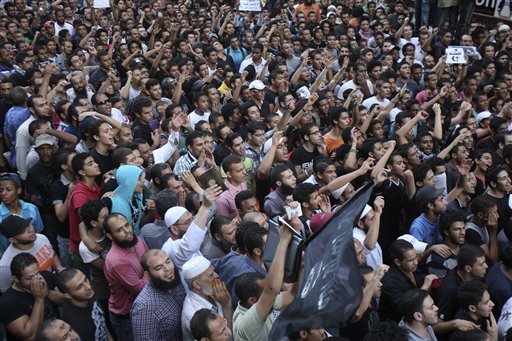
Yet, as the mass demonstrations against the Muslim Brotherhood recently in Tahrir Square and across Egypt have shown, an Islamic Egypt, while still likely, is far from inevitable.
Charismatic leaders with strong political intuition, like Mao, Lenin, Tito, Castro and Ayatollah Khomeini, usually lead successful revolutions. They personified their revolutions and inspired the masses to coalesce around their leadership.
Morsi is no Ayatollah Khomeini, a religious leader who embodied revolutionary mysticism in his a triumphant return to Tehran in 1979 after 14 years in exile. Morsi lacks charisma and spent his life pursuing a Ph.D. at USC and chairing an Egyptian engineering school until 2010. His abrupt and radical moves do not reflect an adroit understanding of what to do when faced with a crisis.
The Ayatollah returned to an Iran rich in oil and gas revenue and quickly expropriated the great wealth the Shah had accumulated. He used this financial leverage effectively. Morsi and the Brotherhood are stewards of a very poor country. Egypt’s GNP is $80 billion and its stock market is valued at $40 billion, two measures of national wealth that, by comparison, are less than 1 percent of the United States.
Equally important is the lack of powerful enemies against which to rouse the masses. Khomeini cast the US as the “Great Satan” and Israel as the “Little Satan.” By contrast, Morsi, through his negotiations with the United States and willingness to accept its money, looks more like an ally of the “Great Satan.” He has pledged to maintain the Camp David Peace Accord with Israel. He also lacks a war with another country, such as the Iran had with Iraq from 1980-1988, as a strategy around which he could rally the population.
The Shiites in Iran, after a lengthy period of perceived persecution, came together around the idea that a revolutionary Iran would restore them to their “proper” role in a Sunni-dominated region. This appeal was reinforced by the frequent and powerful interference in their internal affairs by England, the United States and Russia. Egypt lacks such a history. What’s more, it has 8 million Christian Copts, a major ethnoreligious group, many of whose members oppose the Brotherhood.
The Muslim Brotherhood also faces a significantly stronger military than post-Shah Iran; a million-man security force, multi-million man bureaucracy, independent courts and media. Unlike Iran, Egypt lacks the resources to provide serious help to the impoverished masses. Female illiteracy is more than 40 percent and 88 percent of the population have no books at homes, save for schoolbooks for their children.
Finally, having seen what happened in Islamic revolutions in Iran (1979), Afghanistan (1996) and Gaza (2006), the Brotherhood’s secular opponents are far more likely to come out and fight for their interests.
The recent flight of Mohammed Morsi from his presidential palace and the massive number of demonstrators in front of the palace and elsewhere does not augur well for Morsi. The Muslim Brotherhood faces either a protracted battle for consolidation of its power or a possibility of ultimately being ousted from power. Either way, an Islamic Egypt may not seem so inevitable anymore.
