
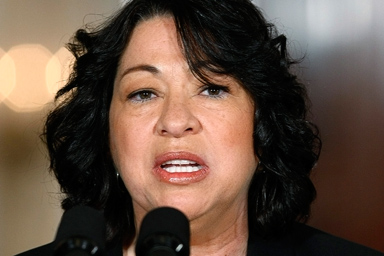

Supreme Court Justice Sonia Sotomayor says in her upcoming memoir that her lifelong battle against diabetes and the fear that she might die early played a big part in her decision not to have children.
The 58-year-old Sotomayor says in an unusually personal book for a Supreme Court justice that she feels an occasional tug of regret at not having borne or adopted children. The memoir, “My Beloved World,” is being published by Alfred A. Knopf in January. An early copy was sent by the publisher to the Associated Press.
Sotomayor also defends affirmative action – under which she was admitted to Princeton University and Yale Law School – as needed to get disadvantaged students to the starting line of a race to success. She grew up so poor in the South Bronx that her family never even had a bank account.
She acknowledges she entered through a special door reserved for minority students but writes that her accomplishments at Princeton, including receiving the highest prize given to seniors, earning a place in the Phi Beta Kappa honor society and graduating with highest honors, speak for themselves.
Sotomayor received an advance of nearly $1.2 million for the book, which Knopf will publish simultaneously in English and Spanish. The book does not deal with the more than three years Sotomayor has served as a justice or the previous 17 years she spent as a U.S. district and appeals court judge.
Instead, it tells the story of her rise from a tenement in which English was rarely spoken to her entry into service as a federal judge in 1992.
She includes an especially painful encounter with illegal drugs in her description of her beloved first cousin Nelson, who eventually died of AIDS that she said he contracted through a contaminated needle. Sotomayor says she was working as a prosecutor when she gave Nelson a lift to what he told her only after the fact was a drug den in the Hunts Point section of the Bronx and waited for him in her car while he shot up heroin inside.
The up-from-poverty story is in many respects similar to the one told by her Supreme Court seatmate, Justice Clarence Thomas, in “My Grandfather’s Son.” Both grew up with few creature comforts and ran into prejudice on a regular basis.
But where Thomas has become a strong opponent of affirmative action and says he felt stigmatized by the racial preference that also helped him get into Yale, Sotomayor says she took the opportunity to join the elite and ran with it.
She acknowledges that her Hispanic heritage played a role in her rise to the Supreme Court, where she is the first Latina and third woman to be a justice. She says she has never let slurs about her roots or put-downs based on her gender get the best of her.
Her parents, both natives of Puerto Rico, met in New York at the end of World War II and had Sotomayor in 1954.
Her childhood was filled with tension, both because of the diabetes that was diagnosed before she turned eight and her father’s losing struggle with alcoholism. He died when Sotomayor was 9.
Sotomayor has spoken publicly and movingly about her diabetes before. She told children with diabetes that she suspected something was wrong when she started wetting her bed.
In her book, Sotomayor relates several instances where she blacked out and was found unconscious, including by a roommate at Princeton, a client in Venice, Italy, and a friend’s barking dog. She said such episodes were never frequent and have been rare in the last decade.
The disease may have been a big part of her decision not to have children, but Sotomayor says that partly as a result, she is godmother to more children than anyone she knows.
She married her high school sweetheart, Kevin Noonan, soon after they graduated from college. They divorced during Sotomayor’s time as a prosecutor in Manhattan, but parted amicably.
One detail Sotomayor notes is that on their wedding night, Noonan produced a bag of Quaaludes that was a gift from his friends. She insisted he flush the pills down the toilet.
She says she used to smoke three-and-a-half packs of cigarettes a day, until she saw her young niece holding a pencil between her fingers and blowing imaginary rings of smoke. She spent five days in a residential program to quit smoking and says she hasn’t had a cigarette since. But she could imagine lighting up one more time on her deathbed, as her grandmother did.
Sotomayor declined an interview with AP on Monday. Michelle Somers, her publicist at Knopf, said the justice has agreed to sit down with People magazine and CBS’ 60 Minutes as her first print and broadcast interviews. They will run next month, Somers said.
