

Congratulations, Mitt Romney! You lost the presidential race, but you won another big contest: You’re Politifact’s Liar of the Year, for your brazen claim that thanks to the Obama auto restructuring, Chrysler was “going to build Jeeps in China,” costing Americans jobs.
In fact, of the top 10 worst political lies Politifact nominated, four came straight from Romney. In addition to the Jeep lie, he was dinged for claiming Obama began his presidency “with an apology tour,” that the president gutted the work requirement for welfare, and that he told business owners “you didn’t build that” when in context he said they didn’t build businesses alone. Only two of the top lies came directly from Obama (exaggerating George Bush’s responsibility for the deficit and claiming Romney called Arizona’s draconian immigration laws a model for the nation). The rest came from campaign surrogates or television ads. In what feels like standard Politifact false equivalence, Democrats and Republicans were responsible for five lies apiece.
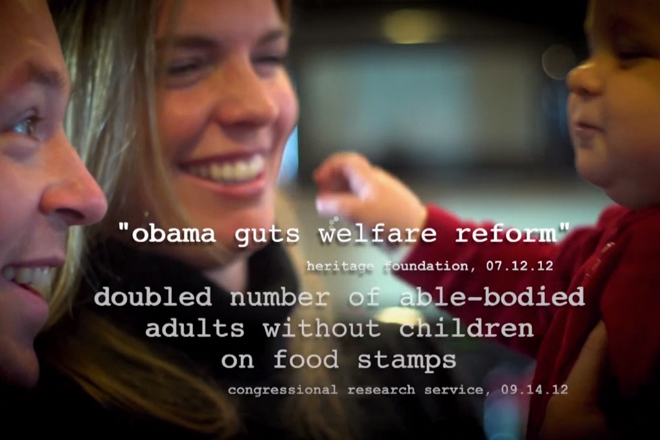
Romney’s Jeep claims and ads were pretty horrific, even leading some Chrysler workers to panic and ask supervisors if they were losing their jobs. They made a desperate effort to avert defeat in Ohio, and they failed. But I think Politifact missed the top lie of the year, which had to be Romney and Paul Ryan’s claim that Obama had “gutted” the work requirements in current welfare law. “Under Obama’s plan (for welfare), you wouldn’t have to work and wouldn’t have to train for a job. They just send you your welfare check,” intoned an ad from Romney’s campaign, against a backdrop of mostly white families.
It was such a lie that not only Bill Clinton but Newt Gingrich and Ron Haskins, the GOP staffer who’d developed the original bill, came out and said it wasn’t true. (Obama had granted some program waivers to governors, including Republicans, who wanted to try some local innovations to increase the number of people working — and only under the condition that work rates go up.) “There’s no plausible scenario under which it really constitutes a serious attack on welfare reform,” Haskins told NPR after the ad began airing.
The welfare ads came at a time when the campaign was realizing that Romney couldn’t close the deal with the GOP’s white working-class base. That necessitated taking a few favorites from the party’s old racial dog-whistle hymn-book. As the New York Times reported in August, “Convinced [Romney] needs a more combative footing against President Obama in order to appeal to white, working-class voters,” the campaign “has added a harder edge … injecting volatile cultural themes into the race.” The welfare ads, the Times reported, reflected that new edge. An anonymous Romney advisor made the same point to BuzzFeed: “This is going to be a base election, and we need them to come out to vote.”
Romney and Ryan’s welfare claims made it seem as though Obama was letting slackers and moochers leech taxpayer dollars again. So even though the program in question makes up .07 percent of the federal budget, and even though its caseload has declined 58 percent since 1998, it became a major theme of the summer campaign.
Finally, it’s kind of funny that Politifact didn’t include things like Todd Akin’s claim that women can’t get pregnant during a “legitimate rape,” but maybe that would require creating a whole category for crazy claims, vs. cold, calculated lies. “Politi-Crazy?”
