
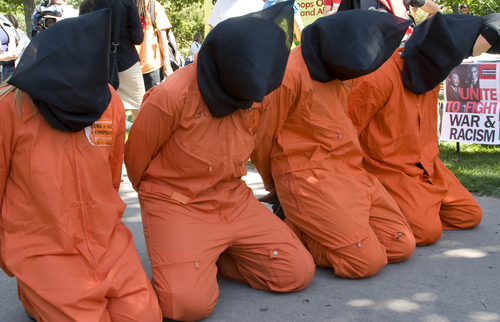

While new movie “Zero Dark Thirty” has renewed debates over the CIA’s use of torture in the hunt for Osama bin Laden, a Thursday ruling in the European Court of Human Rights has brought the issue of U.S. extraordinary rendition practices to the fore. The court ruled that the CIA illegally subjected a German-Lebanese man to extraordinary rendition in a secret Afghan prison sinisterly dubbed “the salt pit.” It was the first case relating to the U.S.’s practice of transferring terror suspects across borders for interrogation to come before the Strasbourg-based court.
Khaled El-Masri was kidnapped in Macedonia by the authorities there and handed over to U.S. custody. He was flown to Afghanistan in December 2003 and interrogated there until his release in May 2004, when he was dumped on a mountain road in Albania. Thursday’s European court decision focused on Macedonia’s role, ruling that the government must pay El-Masri 60,000 euros in damages, but carries important implications for U.S. accountability over the use of torture in its war on terror.
“It will make it harder for the United States to continue burying its head in the sand,” said Jamil Dakwar, head of the human rights program at the American Civil Liberties Union, of the ruling.
El-Masri had taken his case all the way to the U.S. Supreme Court with the help of the ACLU after it was consistently thrown out by U.S. courts under the now-infamous “state secrets” doctrine, which allowed the government to have the case dismissed without ever getting to the merits. “When [the SCOTUS bid] failed, the [ACLU] filed an international petition against the U.S. with the Inter-American Commission on Human Rights, making El-Masri the first person to have brought cases before both the European and the American human rights systems,” the Guardian reported earlier this year.
Commentators on Thursday suggested that the European Court of Human Rights’ ruling against Macedonia provides an opportunity for the U.S. to step forward and be accountable. “It might be too much to ask for the prosecution of those responsible, but proper compensation and an apology must be a bare-minimum in the case of Mr Masri,” wrote British newspaper the Telegraph’s U.S. editor Peter Fraser, who noted, “There is a precedent. Canada issued an apology and substantial paid compensation to Maher Arar, a Canadian citizen who was picked up in JFK airport in 2002, interrogated for two weeks and then deported to his native Syria where he was held and tortured for a year … However when Mr Arar tried to sue members of the Bush administration in 2010 but was stopped – you guessed it – on grounds of national security.”
The legal blockade that saw Masri’s case thrown out of U.S. courts remains firmly in place under President Obama.
Meanwhile, also on Thursday, the British government agreed to pay more than 2 million pounds to the family of a Libyan dissident abducted with the help of MI6 and secretly flown to Tripoli where he was tortured by the security police of the former dictator Moammar Gadhafi — it’s believed to be the only cased where an entire family was subjected to extraordinary rendition.
The European ruling also coincides with a vote Thursday in the U.S. Senate intelligence committee on whether to approve a 6,000-page report on the use of torture by the CIA and whether so-called enhanced interrogation techniques produced valuable information in the fight against al-Qaida. Meanwhile, human rights advocates remain horrified by the U.S. entertaining the question — returned to headlines thanks to “Zero Dark Thirty” — of whether torture can be justified.
